A- #BookReview: Lake of Souls by Ann Leckie

A- #BookReview: Lake of Souls by Ann LeckieLake of Souls: The Collected Short Fiction by Ann Leckie
Format: eARC
Source: supplied by publisher via Edelweiss
Formats available: paperback, ebook, audiobook
Genres: science fiction, short stories
Pages: 403
Published by Orbit on April 2, 2024
Purchasing Info: Author's WebsitePublisher's WebsiteAmazonBarnes & NobleKoboBookshop.orgBetter World Books
Goodreads

Hugo, Nebula, and Arthur C. Clarke award-winner Ann Leckie is a modern master of the SFF genre, forever changing its landscape with her groundbreaking ideas and powerful voice. Now, available for the first time comes the complete collection of Leckie's short fiction, including a brand new novelette,  Lake of Souls.
Journey across the stars of the Imperial Radch universe.
Listen to the words of the Old Gods that ruled  The Raven Tower.
Learn the secrets of the mysterious Lake of Souls.
And so much more, in this masterfully wide-ranging and immersive short fiction collection from award-winning author Ann Leckie. 

My Review:

I read this story almost two years ago, when I reviewed the collection for Library Journal. (LJ runs ahead, so the collection, which was published in April 2024, was reviewed in the February 2024 issue which was finalized in December 2023.)

Which means that I read the story, “Lake of Souls”, more than 18 months ago and I didn’t remember the details before I reread it the other night. It didn’t stick the way that, say, Naomi Kritzer’s “The Year Without Sunshine” did in last year’s Hugo reviews.

That doesn’t mean it wasn’t interesting, just that it didn’t stick in the mind. Come to think of it, the difference in the way my memory of this story contrasts with the Kritzer story reminds me a bit of “The Brotherhood of Montague St. Video” in its discussion about stories that are easy vs stories that make you think – and keep thinking.

But this story is also reminiscent of Jessica Levai’s The Glass Garden and This World is Not Yours by Kemi Ashing-Giwa as well as the Star Trek Original Series episode “The Devil in the Dark” (the one with the Horta) and the Next Generation episode “Home Soil” (“ugly bags of mostly water”).

All of which may explain why it didn’t stick, as it’s a story that’s been done before in SF, and at least sometimes done well.

There’s actually two stories in “Lake of Souls”. The overarching, sorta/kinda framing story, is similar in theme to all the above references, in that it’s a story about humans going out into the galaxy and terraforming any suitable planet that doesn’t already contain sentient life. With the deck stacked very high against finding such sentient life by not looking very hard. And particularly, in the case of this particular story, by bringing along specialists to determine whether or not the life they find is sentient while keeping those specialists on ice in cryosleep so that such life isn’t recognized when it is found.

Which is where human side of this story comes in, or rather wakes up and goes down to the planet and discovers that she is the last human left alive after one of her former crewmates went on a murderous, mutinous rampage and killed everyone else.

Where she discovers that the “animals” they all referred to as “lobster dogs” are, in fact, sentient and sapient. Because one of them tries to protect her and helps to heal her.

What makes the story interesting isn’t that human’s point of view. We’ve seen that before and as a species we aren’t all THAT fascinating. At least not here.

What is fascinating is the perspective of that “lobster dog”, originally called Spawn, and Spawn’s journey away from their home village because they don’t quite fit with the people they were born to. So they are on a quest to find themselves – or to find the probably mythical Lake of Souls – whichever comes first.

Spawn recognizes that the human is “people” because they are tool-using just as their own people are. And even though they can’t save the human, recognizing that “people” come in all shapes, sizes and belief-systems allows them to make a place for themselves among their own people. Not as someone who goes along with the herd, but as a person who can show other restless souls like themselves that there are more ways to be “people” than the more rigid members of their tribe had led them to believe.

Escape Rating A-: I have to admit that this worked better the second time around. Which could be because I read it in isolation, separate from the collection in which it was published. Not that it isn’t isolated there, as the collection Lake of Souls is a mostly retrospective collection of the author’s short works, and all of the other stories except one (“The Creation and Destruction of the World”) had been previously published elsewhere.

The thing about this particular story is that it HAS been done before because it is such an SFnal story, in the sense that it uses SF to tell ITS story but to also tell a lot of other stories. Because from the human side of the story it’s about the propensity of humans to take and take and to pretend that they are not taking FROM someone else by defining whoever they are stealing from or raping or conquering as being less than themselves. So in that sense this is an eternal story in SFnal trappings – possibly in order to get the message across – or at least to make it go down easier.

And from the other side, from Spawn’s perspective, it’s an equally eternal but not necessarily SFnal story about following the beat of your own drummer – and forging a path  or at least providing an example – for others who can’t make themselves follow the herd either. Even if the members of that herd are all lobster dogs.

On this reading of the story, I’m left thinking about it a lot harder than I did the first go around. It’s also making my Hugo voting in this category a bit harder for everything below first place. However, I am now finished with the Best Novelette category, and will be turning my reading and/or listening attention to the Short Story category so that I can finish in time to get my ballot in!

Review: The Raven Tower by Ann Leckie

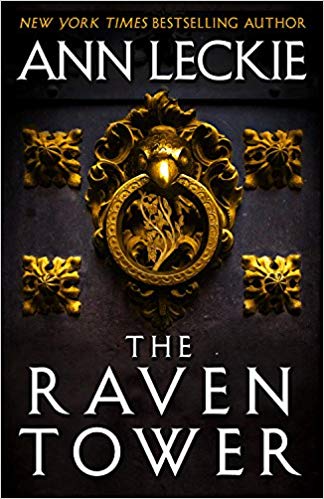
Review: The Raven Tower by Ann LeckieThe Raven Tower by Ann Leckie
Format: eARC
Source: supplied by publisher via Edelweiss
Formats available: hardcover, paperback, ebook, audiobook
Genres: fantasy
Pages: 432
Published by Orbit on February 26, 2019
Purchasing Info: Author's WebsitePublisher's WebsiteAmazonBarnes & NobleKoboBookshop.org
Goodreads

Gods meddle in the fates of men, men play with the fates of gods, and a pretender must be cast down from the throne in this breathtaking first fantasy novel from Ann Leckie, New York Times bestselling author and winner of the Hugo, Nebula, and Arthur C. Clarke Awards.

For centuries, the kingdom of Iraden has been protected by the god known as the Raven. He watches over his territory from atop a tower in the powerful port of Vastai. His will is enacted through the Raven's Lease, a human ruler chosen by the god himself. His magic is sustained via the blood sacrifice that every Lease must offer. And under the Raven's watch, the city flourishes.

But the power of the Raven is weakening. A usurper has claimed the throne. The kingdom borders are tested by invaders who long for the prosperity that Vastai boasts. And they have made their own alliances with other gods.

It is into this unrest that the warrior Eolo--aide to Mawat, the true Lease--arrives. And in seeking to help Mawat reclaim his city, Eolo discovers that the Raven's Tower holds a secret. Its foundations conceal a dark history that has been waiting to reveal itself...and to set in motion a chain of events that could destroy Iraden forever.

My Review:

Quoth the Raven, “Nevermore” and that’s pretty much how I feel about this book. Quote me as disappointed. I expected so much from this book after the awesome Imperial Radch series – but I did not get it. And damn but I’m sad about that.

The story is, for the most part, a familiar one. The heir to the kingdom returns from service at a contested border. He’s received a message that his father the king is dying, and he needs to be back in the capitol to see him one last time and for the handover of power.

But when he enters the capitol he discovers that nothing is as its supposed to be. His father is missing and his uncle has taken the throne, seemingly peacefully and with the full agreement of the other power brokers in the kingdom.

In spite of the kingdom being more of a theocracy than a kingdom, where the ruler is not called king but is the voice of the local godling for as long as he lives, the story is one that has been done before.

This is where it should get interesting, because we see the story not from the perspective of either the “king” or the “prince” or even the “prince’s” aide, but from the perspective of a local godling who has seen it all.

In fact, the story is being told by the godling, both to the reader in its first-person perspective, and to the aide in the second person. So the godling tells big parts of the story as “I” and other parts as “you”.

One of the things this author is known for is her inventive uses of voice, but this particular variation, while technically interesting, and more than a bit meta, is distancing for the reader, who is not, after all, the aide.

(That would make this self-insert fanfiction and I don’t even want to go there. Or even in the region of there.)

The godling’s first person narrative actually works better than the second-person narrative – at least we know what the godling is thinking and where it’s coming from – even if it is just a big rock and doesn’t move.

But, and it is a very big but, the godling’s perspective begins at the beginning of time in this world and comes to the present day in its own good time. After all, as a big rock, that has sentience but has chosen not to have mobility – it has nothing but time and takes the long view of everything.

The feeling I got as a reader was as if James Michener decided to write fantasy, as many of his longer books (Centennial, Alaska, etc.), start with the rocks, and move through the geologic and prehistoric ages much as The Raven Tower does. I loved his books, but I was always grateful when the first animals would appear because it finally gave me a perspective I could almost identify with. Not to mention the plot usually started to move at that point – along with the animals.

I should be saying “I digress” at this point, but it doesn’t feel like I did. Make of that what you will.

Escape Rating C: I wanted to like this so much, and I just didn’t. The experiment with voice was interesting but distancing rather than compelling as it was in Ancillary Justice. The injection of the godling’s perspective allowed for a fascinating bit of deus ex machina at the end, involving a quite literal deus, but it takes a LONG time to get there and not nearly enough happens along the way.

There was so much that could have been done here. A lot is said about the way that words have power, and it’s interesting and different but also adds to the distancing. The godling has learned that its words have the power of truth in that if it says something that is not true its power will be sacrificed to make it true. If it says a large or impossible truth, that sacrifice may consume all of its power.

As a consequence, much of its own story is told with the preface, “Here is a story that I have heard.” so that it never runs the risk of claiming that something is true that is not. While this is logically consistent from its perspective within the context of the story, it does add a layer of remove to the storytelling.

In the end, interesting but neither compelling nor absorbing. I will say that the reviews vary widely. Those that love it really, really love it. Those that don’t really, really don’t and there’s not much middle ground. If you like experimental fiction or metafiction in your fantasy, give it a try and see what you think.
Review: Provenance by Ann Leckie

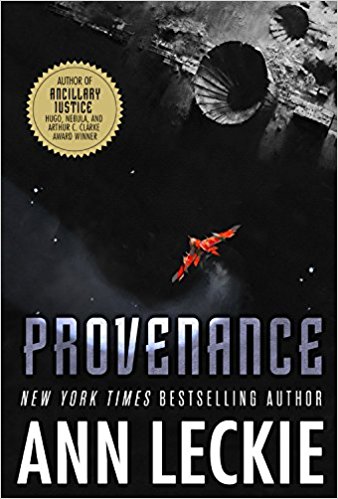
Review: Provenance by Ann LeckieProvenance by Ann Leckie
Formats available: hardcover, ebook, audiobook
Pages: 448
Published by Orbit on September 26th 2017
Purchasing Info: Author's WebsitePublisher's WebsiteAmazonBarnes & NobleKoboBookshop.org
Goodreads

Following her record-breaking debut trilogy, Ann Leckie, winner of the Hugo, Nebula, Arthur C. Clarke and Locus Awards, returns with a thrilling new story of power, theft, privilege and birthright.

A power-driven young woman has just one chance to secure the status she craves and regain priceless lost artefacts prized by her people. She must free their thief from a prison planet from which no one has ever returned.

Ingray and her charge will return to their home world to find their planet in political turmoil, at the heart of an escalating interstellar conflict. Together, they must make a new plan to salvage Ingray's future, her family, and her world, before they are lost to her for good.

My Review:

Provenance was awesome. I mean like stay up half the night, read in the bathroom at work awesome. I’m not sure it matches the blurb AT ALL, but I loved every minute of it.

It also reminded me more than a bit of John Scalzi’s The Collapsing Empire, but I’m absolutely not sure why. It just did. And since I loved that too, it’s a good thing.

Although it was a bit hard to tell from the promos, Provenance is part of the Imperial Radch of Ancillary Justice. Well, it is in the sorta/kinda sense. This is the same universe that was created for that series. The Radchaii are a presence. But not a big one. Or a particularly well-liked one. Provenance, instead, takes place outside of the Imperial Radch, in a system that acknowledges the existence of the Radch and resents the way that the Radchaii act as though they speak for all of humanity – which they don’t. Except when they kind of do.
Politics is always fascinating. And makes for the kind of large-scale conflict that can drive a book series into the stars.

The conflict in Provenance is a bit smaller scale. The story here takes place on Hwae, and involves a kind of cold war turned lukewarm over the control of the gates that make interstellar travel both possible and reasonable.

It’s also about what a society believes about itself, and what it values.

And strangely enough, it really is about provenance, in its dictionary definition. The Hwae give great weight and reverence to what they call “vestiges”. In their culture, “vestiges” are certified artifacts of important, or not so important events. To make it clearer, the Hwae would consider a signed, original U.S. Constitution, or a signed, original Magna Carta, for example, as a “vestige”. These are artifacts of important events that were present at the event itself.

What’s at issue in Provenance is that the Hwae veneration of “vestiges” has extended to anything that might have been tangentially present at an important event or in the proximity of an important personage. And material at that remove is all too easy to fake. After all, how does one determine if a specific floor tile was or was not ever trod upon by one our “Founding Fathers”? Or one of theirs?

So this is Ingray’s story. She attempts, through some rather underhanded means, to gain access to a treasure trove of stolen “vestiges”. She’s trying to impress her mother and gain a much needed advantage over her brother. She’s certain that she needs to do both if she’s to keep her place in the family, and keep her home.

And she might be right.

But what she discovers instead is part of the vast and rather stinking underbelly of her own culture, and the even nastier ways that their enemies are attempting to exploit that stink for their own nefarious ends.

Caught in the literal cross-fire, Ingray can only do what she does best – indulge in five minutes of panic and then think her way out. Even if her exit is, as it often is, out of the frying pan into the fire.

Even if that fire is gunfire.

Escape Rating A: If you are searching for an excellent piece of science fiction, particularly space opera of the “diplomacy is war waged by quieter means” type, Provenance is a winner from beginning to end.

It starts out small, and keeps growing bigger and bigger as the story goes on. We start with Ingray and her rather ingenious but extremely foolhardy plan. She just wants to get back at her brother, who is a douche. And she does it because she’s just tired of him being smug and superior. She hopes to embarrass him, she does not expect to gain actual permanent ascension.

And yes, there’s an element of be careful what you wish for, because you might get it, woven into the story.

What makes this story work is the way that the complexities are introduced. While this is not told in the first-person, Ingray is still our point of view character. As her view expands, we learn more about her world and what moves and shakes it. As does she.

So we start with an uncertain young woman in the midst of a not terribly well thought out scheme that has just gone awry. While parts of the scheme might have had large implications, her purpose was relatively small – putting one over on her brother.

But as her rather rudimentary plans go further and further out the airlock, more people, more situations, and more politics get involved. All seen from Ingray’s perspective, as she has to cope with more and more crap being thrown at her. And always feels, as most of us do at least some of the time, that she’s in WAY over her head while the crap is continuing to rise.

Our perspective and understanding grow. As does hers. And we feel for her as it does. So in the end, we stand with her as all her choices come full-circle. And she leaps out.

Review: Ancillary Mercy by Ann Leckie

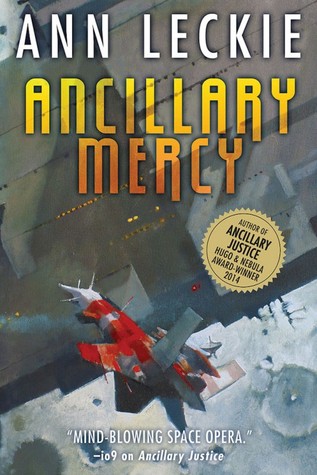
Review: Ancillary Mercy by Ann LeckieAncillary Mercy (Imperial Radch, #3) by Ann Leckie
Formats available: paperback, ebook, large print, audiobook
Series: Imperial Radch #3
Pages: 336
Published by Orbit on October 6th 2015
Purchasing Info: Author's WebsitePublisher's WebsiteAmazonBarnes & NobleKoboBookshop.org
Goodreads

The stunning conclusion to the trilogy that began with the Hugo, Nebula, and Arthur C. Clarke award-winning Ancillary Justice.
For a moment, things seem to be under control for the soldier known as Breq. Then a search of Atheok Station's slums turns up someone who shouldn't exist - someone who might be an ancillary from a ship that's been hiding beyond the empire's reach for three thousand years. Meanwhile, a messenger from the alien and mysterious Presger empire arrives, as does Breq's enemy, the divided and quite possibly insane Anaander Mianaai - ruler of an empire at war with itself.
Anaander is heavily armed and extremely unhappy with Breq. She could take her ship and crew and flee, but that would leave everyone at Athoek in terrible danger. Breq has a desperate plan. The odds aren't good, but that's never stopped her before.

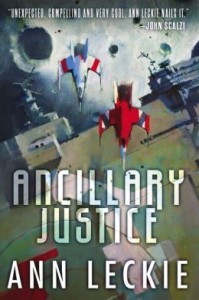
ancillary justice by ann leckieI absolutely adored both Ancillary Justice (review) and Ancillary Sword (review) so I preordered Ancillary Mercy and was so happy to see it pop up on my iPad Tuesday morning that I started reading it immediately.

Now that I’ve finished, I have comments. And questions. And yet again, an absolutely terrible book hangover. Neither Breq’s story nor the story of the Imperial Radch feel anywhere near done, but I want more.

On that other hand, while it feels like there is still more story to tell, I’m not exactly sure where it goes next. Or, for that matter, what type of ship the next one will be named for. Unless it’s Ancillary Gem? Or perhaps the author will take the story of this universe in a different direction altogether. As long as there are more, I’m happy.

Ancillary Mercy continues directly on from Ancillary Sword. And this is definitely a series where it is practically required that the reader have read the previous entries. While there is enough information about prior events to refresh the memory of a reader who read the last book last year, there doesn’t feel like enough to fill in the necessary background for someone who comes into Ancillary Mercy cold.

There are lots of players, and you really need a scorecard – especially since some of the clues that one usually uses to differentiate characters are missing.

The conceit in this series is that Breq simply doesn’t care about gender pronouns. Whether that is because she used to be a ship, and ships don’t have gender, or because the noun her language uses for people is “Citizen”, which also has no gender, or that the universe’s culture has finally moved beyond gender, the reader doesn’t know. But when Breq is required to use a gendered pronoun, she always uses “she”. It could be that the universal default has become “she”, where for us the default is currently “he”. Whatever the reason, it makes things interesting. From Breq’s perspective, it does not matter whether the citizen she is addressing or thinking about is either male or female.

Occasionally it matters to us, but not really all that often. Whether a character is female or male does not affect whether or not they can do their jobs, or fulfill their part in this story. But there are a lot of characters in this story and losing a piece of what we normally use as identification sometimes makes it difficult to keep all of the secondary and tertiary characters straight.

We don’t actually know whether the ruler of the Radch, Anaander Mianaai, is male or female. Because that’s not the important thing about the Lord of the Radch. The real problem with Anaander Mianaai is that she has cloned and split herself into multiple bodies, each containing pieces of her consciousness. They have developed a serious split personality and are now at war with each other. But all of them are the Lord of the Radch, and citizens find themselves obeying different factions of the same person without being aware of it.

Meanwhile, this very, very uncivil war is doing exactly the opposite of what the Radch was supposed to do. The Imperial Radch was built to civilize and protect its citizens. While there can be some questions about how many people were killed or re-educated in order to bring about the civilization and protection, there is no question that the war between the facets of the Lord of the Radch is killing lots of citizens for no good reason except that Anaander Mianaai has quite possibly gone mad.

And Breq, and whoever she cares about or is protecting, is caught smack in the middle. She doesn’t really support any of the Lords, although she is more sympathetic to some aspects than others. And the most violent facet of Anaander Mianaai personally hates Breq and everything she stands for. And will do anything or destroy anyone in order to stop her.

ancillary sword by ann leckieEscape Rating A-: Ancillary Mercy is a very political space opera. Not just because of the mess in the Radch, but also because of Breq’s current base of operation. She has been assigned to Athoek Station since the beginning of Ancillary Sword, and has found herself, or inserted herself, into local politics.

Breq always wants to do what is fair and what is right. She still carries with her a lot of her programming from when she was part of the ship Justice of Toren. Her job was to protect and care for her crew, and she is still doing that. Admittedly the definitions of crew have expanded quite a bit. She cares and protects everyone, not just those who are wealthy or well-born or of the right race or bloodlines. Which generally pisses the rich, high-born and upper-caste races off in a big way.

She is generally impartial, but she doesn’t suffer fools or the self-important. And people are afraid of her because she is physically powerful, has an armed ship backing her up, and because she can’t be bought.

Which makes her a fine target for the facet of Anaander Mianaai that hates her when she comes to Athoek, and gives the upper crust a chance to believe the worst of her. Meanwhile, Breq is off convincing the giant AIs that run ships and stations that maybe, just maybe, they are worthy of being citizens in their own right and having self-determination. They don’t want Anaander Mianaai to turn them all back into relatively mindless slaves again, or destroy them.

And there’s a big monkey wrench in everyone’s plans. The alien Presger, who feel a lot like the Meddlers in Jean Johnson’s Theirs Not to Reason Why series, are trying to decide which, if any, of the races of the Radch are significant enough to maintain a non-aggression treaty with. And while the Translator (read Ambassador) Zeiat seems like a buffoon, he is actually more powerful than anyone imagines. Also way more quirky.

There are lots of chefs tinkering with the soup of the Radch, and not all of them have her citizens at heart. Or sometimes even a clue about what they are doing. Breq steps into that breach and pulls a big and surprising rabbit out of the helmet she seldom wears. And Breq, Athoek Station, the Radch and even the Presger will never be the same.