#AudioBookReview: Signs of Life by Sarah Pinsker

#AudioBookReview: Signs of Life by Sarah Pinsker"Signs of Life" by Sarah Pinsker in Uncanny Magazine Issue 59: July/August 2024 by Sarah Pinsker
Narrator: Erika Ensign
Format: ebook, podcast
Source: podcast, supplied by publisher via Hugo Packet
Formats available: magazine, podcast
Genres: magical realism, short stories
Series: Uncanny Magazine Issue 58
Pages: 35
Length: 1 hour
Published by Uncanny Magazine on July 2, 2024
Purchasing Info: Author's WebsitePublisher's WebsiteAmazonBarnes & NobleKobo
Goodreads

The July/August 2024 issue of Hugo Award-winning Uncanny Magazine.

Featuring new fiction by Sarah Pinsker, Greg van Eekhout, Sunwoo Jeong, John Chu, AnaMaria Curtis, Eleanna Castroianni, and Megan Chee. Essays by John Scalzi, Marissa Lingen, Del Sandeen, and Natania Barron, poetry by Terese Mason Pierre, Natasha King, Roshani Chokshi, and Abdulkareem Abdulkareem, interviews with Greg van Eekhout and AnaMaria Curtis by Caroline M. Yoachim, a cover by Broci, and an editorial by Lynne M. Thomas and Michael Damian Thomas.

Uncanny Magazine is a bimonthly science fiction and fantasy magazine first published in November 2014. Edited by 2016, 2017, 2018, 2019, 2020, 2022, 2023 Hugo award winners for best semiprozine, and 2018 Hugo award winners for Best Editor, Short Form, Lynne M. Thomas and Michael Damian Thomas, and Monte Lin, each issue of Uncanny includes new stories, poetry, articles, and interviews.

My Review:

I’m attempting to be a bit – just a bit – more deliberate in my Hugo reading this year, so I’ll be reviewing all of the Best Novelette nominees before moving on to the Best Short Story nominees. With one exception for Lake of Souls by Ann Leckie because I reviewed that year for Library Journal as one of the two not previously published stories in the author’s collection of the same title.

The story here in “Signs of Life” is more speculative fiction than either SF or fantasy – and I spent most of my listen/read of it wondering exactly when the spec fic element was going to come in, because if I hadn’t known there had to be one for most of the story I wouldn’t have guessed that a specifically speculative element was coming.

For most of its length, this is a story about sisters reconnecting after spending their entire adult lives on the outs with each other. The story is told from the perspective of Veronica, the sister who left – although she’s not the most reliable narrator.

Not because she lies to the reader, but because her desire to heal the rift with her sister Violet after FOUR DECADES of estrangement is at war with her need not to touch that third rail in her head about how it came about in the first place. As Veronica looks back, the cause of their rift is unforgivable and all her own fault. A fault she feels the need to apologize for before that rift can be healed.

And she doesn’t really want to bring it up, out of fear that raising those old ghosts will widen the rift instead of being a prelude to healing it.

It turns out that this story – as much as it’s about two sisters reconnecting after a lifetime of being apart – isn’t so much about the rift or even the sisters as it is about LONELINESS and their very different responses to it. And that’s where the speculative aspects of the story come in.

It’s a huge spoiler and more than a bit of a wow at the end. I’ll leave it for you to discover just how much of a wow that wow is for yourself.

Escape Rating B: For about half of the length of this story, I was wondering when it was going to get to the point. Or at least to the point of what made it eligible for the Hugos in the first place. It’s kind of appropriate that this story appeared in Uncanny Magazine, because that’s the right word for it, uncanny.

If I had to assign a genre to it – and I sorta/kinda do – I’d call this one “magical realism”. Except the words should be switched around, because it’s very much grounded in the real until that halfway point when we start to get hints of the magic behind it all.

At that halfway point I did get a pretty big hint about what the magical part of the story was – I just didn’t think that element went nearly as far as it turned out that it did.

I started this one from the podcast, as I do whenever possible with short works like this one. The reading by Erika Ensign was well done, and she did a particularly good job of letting the listener into Veronica’s head. I always love a good first-person perspective in audio when the narrator’s voice is a good match for the head they are in, and this one was. The reader made it easy to feel all of Veronica’s very mixed emotions along with the mental ellipses where her reminiscences took her places that she just didn’t want to go.

In the end, I had a surprisingly similar reaction to “Signs of Life” that I did to this author’s 2024 nominated novelette, “One Man’s Treasure”, but like the reference to “magical realism” above, just a bit backwards. In that previous story, I LOVED the story but didn’t think it stuck the dismount. It didn’t feel like the story got the closure it needed.

This time around, the ending was a WOW of a close. It ended with a bang and it was just the right bang. It did a pretty good job of making the story that led up to it worth the read. At the same time, I was really glad this was a short work, because the first half meandered in a whole lot of places that just didn’t feel speculative or magical at all. A longer story would have meant more of that meandering and that’s not what I was looking for.

I’m planning to review one story a week, mostly, so I’ll be back next week with the story I’m most looking forward to even if there isn’t a podcast. It’s “The Four Sisters Overlooking the Sea” by last year’s Best Novelette WINNER, Naomi Kritzer.

A- #BookReview: Haunt Sweet Home by Sarah Pinsker

A- #BookReview: Haunt Sweet Home by Sarah PinskerHaunt Sweet Home by Sarah Pinsker
Format: eARC
Source: supplied by publisher via Edelweiss
Formats available: hardcover, ebook, audiobook
Genres: fantasy, horror, paranormal
Pages: 161
Published by Tordotcom on September 3, 2024
Purchasing Info: Author's WebsitePublisher's WebsiteAmazonBarnes & NobleKoboBookshop.orgBetter World Books
Goodreads

On the set of a kitschy reality TV show, staged scares transform into unnerving reality in this spooky ghost story from multiple Hugo and Nebula Award-winning author Sarah Pinsker.
“Don’t talk to day about what we do at night.”
When aimless twenty-something Mara lands a job as the night-shift production assistant on her cousin’s ghost hunting/home makeover reality TV show Haunt Sweet Home, she quickly determines her new role will require a healthy attitude toward duplicity. But as she hides fog machines in the woods and improvises scares to spook new homeowners, a series of unnerving incidents on set and a creepy new coworker force Mara to confront whether the person she's truly been deceiving and hiding from all along—is herself.
Eerie and empathetic, Haunt Sweet Home is a multifaceted, supernatural exploration of finding your own way into adulthood, and into yourself.

My Review:

This wasn’t the book I planned to read this week, but after yesterday’s book I needed something with a bit harder of an edge, or a bit more adventure in its heart, or something other than cozy relationship fiction. I also needed something short because I flailed a bit.

I picked this out of the virtually towering TBR pile because I read the author’s “One Man’s Treasure” as part of my Hugo reading this year. I didn’t think it stuck the dismount but the story was a whole lot of fun as it went along.

And the premise of this one also looked like a whole lot of fun. I’m not sure whether it’s more fun or less fun if you believe, as I do, that “Reality TV” is an oxymoron, an inherent contradiction in terms. (And come to think of it, there’s another recent horror-adjacent story with a similar premise, The Holy Terrors by Simon R. Green – but Haunt Sweet Home is a much better, and more original, story.

Haunt Sweet Home lies at a surprising intersection of tropes and genres. OTOH, it’s a bit of an exposé of how the not-so-ghostly sausage of spooky reality TV shows get made. On a second hand, it’s about the grind of clinging by one’s fingernails to the lowest rung of the entertainment ladder – and discovering that the work is the thing one has been looking for all along.

And then there’s that third, ghostly hand, which really surprised me by circling back to Susan M. Boyer’s Liz Talbot series and thereby tying itself to yesterday’s book, as the protagonist, Mara, seems to have manifested or acquired or midwifed or all of the above, a sort of family ghost of her very own. By a method that owes more than a bit to Pygmalion – not the play or any of the adaptations of the play including the movies, but the original Greek myth about the man who sculpted his perfect woman and brought her to life.

Mara doesn’t sculpt a perfect paramour. Instead, she sculpts a perfect – or at least a more functional – version of her very own self. A version of herself that is a bit better at people, a bit less of an indecisive screw-up, much less of the family joke, and a whole lot better at believing in herself.

And very nearly decides to throw it all away. Because she’s started to believe entirely too many of her family’s so-called jokes than any one person can stand.

Escape Rating A-: I liked this a whole lot, and in fact a whole lot more than I expected to. Clearly, I don’t believe “Reality TV” has anything to do with actual reality, so reading a story that lampooned that genre at every turn was a good choice for me.

I also liked the horror-adjacency of this one, even though that’s why I had passed it by earlier in the month. I wasn’t sure how adjacent the horror was, but as it turns out the answer is – VERY. The TV series is simulating horror, manipulating or editing reactions to make it seem like horrors are happening – but everyone involved is very aware that it isn’t. Except for a bit of a tease at the end which just makes the whole damn thing work even better!

What really makes this story work is the character of Mara. She seems to be an afterthought for her whole family, the butt of every joke and the person voted least likely to succeed at every turn, to the point where she’s internalized all of that attitude.

It hurts her but she can’t make it stop. Every single thing she says or does goes through the family story editing machinery until it comes out that Mara is always lifeless, feckless and useless. She’s become entirely self-effacing because it no longer matters what she does – not even to herself.

At least not until her alter ego, her creation, her ghost avatar, Jo, comes into the picture. Because Jo IS Mara every bit as much as she is her own self. Jo sees Mara for who she really is on the inside – and isn’t in the least bit shy about telling Mara all about herself – no matter how much Jo KNOWS it’s gonna hurt. Because it needs to.

Someone needs to make Mara listen to the truths she doesn’t want to hear, and who better to make herself listen to those truths than herself? So Jo’s very existence, and Mara’s family’s reaction to a ‘better’ version of Mara forces Mara to confront those truths and do something about them. Which they do. Together. Even if it broke my librarian heart to watch them destroy most of a library to get there.

In spite of the terrible treatment of that poor library, it was still a terrific end to a really fun story.

#BookReview: One Man’s Treasure by Sarah Pinsker

#BookReview: One Man’s Treasure by Sarah Pinsker"One Man's Treasure" by Sarah Pinsker in Uncanny Magazine Issue 50, January-February 2023 by Sarah Pinsker
Format: ebook
Source: supplied by publisher via Hugo Packet
Formats available: magazine, ebook
Genres: fantasy, short stories
Series: Uncanny Magazine Issue 50
Pages: 29
Published by Uncanny Magazine on January 3, 2023
Purchasing Info: Author's WebsitePublisher's WebsiteAmazonBarnes & NobleKobo
Goodreads

The January/February 2023 issue of Hugo Award-winning Uncanny Magazine .

Our landmark Issue 50, a double sized issue! Featuring new fiction by Ken Liu and Caroline M. Yoachim, Mary Robinette Kowal, P. Djèlí Clark, A. T. Greenblatt, A.M. Dellamonica, Eugenia Triantafyllou, Sarah Pinsker, E. Lily Yu, Marie Brennan, Christopher Caldwell, John Wiswell, and Maureen Mchugh. Essays by Elsa Sjunneson, John Picacio, Annalee Newitz, A.T. Greenblatt, Diana M. Pho, and Javier Grillo-Marxuach, poetry by Neil Gaiman, Terese Mason Pierre, Sonya Taaffe, Betsy Aoki, Theodora Goss, Ali Trota, Abu Bakr Sadiq, Elizabeth Bear, and Brandon O'Brien, interviews with Ken Liu and Caroline M. Yoachim by Tina Connolly; interviews with Eugenia Triantafyllou, E. Lily Yu, and Christopher Caldwell by Caroline M. Yoachim, a cover by Galen Dara, and editorials by Lynne M. Thomas and Michael Damian Thomas, and Meg Elison.

My Review:

This second entry in my very informal and scattered series of reviews of this year’s Hugo nominated works is focused on one of the nominees in the Novelette category – meaning a story between 7,500 and 17,500 words.

The title isn’t quite as evocative as last week’s “How to Raise a Kraken in Your Bathtub” – which is absolutely one of the most attention grabbing TITLES on the entire ballot. But this one came next because it’s from the same issue of Uncanny Magazine so I decided “Why not?”

For my next pick from the ballot I may have to resort to “Eeny, meeny, miny, moe” – or I will once I get through all the works by my faves that are on the list.

The title of this story, while not quite the claxon warning that Kraken should have been, does bring a scenario to the top of one’s mind – even if it’s a much different scenario – as well as a potentially less dangerous one.

“One man’s trash is another man’s treasure” as the old proverb goes. There’s also a variation about “one man’s meat being another man’s poison” but that’s not nearly as applicable in this story.

Because this is a story about the way that the trash gets taken out in a magically powered world, as seen through the eyes of the garbage collectors.

It’s kind of a “lower decks” story, in other words, a view of the world, not from the top where the movers and shakers do their moving and shaking and where stories are often set, but rather from much nearer to the bottom, where the nitty gritty is very gritty indeed and where shit gets done and disposed of – in this case one truckload at a time.

But this particular story is also a story about class and labor organizing and the rich being different from you and me, and especially from Aden, Blue and Nura.

And it’s a story about karma being a real bitch – but in a way that might just possibly teach someone a few lessons as she goes.

Escape Rating B-: It’s lucky for this story that it is not in the same category as Kraken because in spite of having potentially twice as much space to tell its tale, One Man’s Treasure doesn’t stick the dismount half as well.

The best part of One Man’s Treasure is the world creation and character creation by way of slice of life. On the one hand, it’s fantastically familiar on multiple levels.

While we might not think about how the Wizarding World in Harry Potter gets rid of its trash, it does have to happen somehow. In a magical world where everyone has a bit of magic, and a leisure class that has even more leisure, there would be neighborhoods where more magical detritus got thrown in the trash because there was more available to waste.

The potential of magical trash to be magically dangerous seems high once you think about it for a minute. That the ritzy neighborhoods would be paying good money to make sure that THEIR trash got taken away quietly and with minimal fuss seems obvious. That’s just humans being human in their ugliness.

The garbage collectors themselves, Aden and Blue along with Aden’s girlfriend Nura, represent an entirely different perspective. They’re the ones at the sharp end of the danger. They resent the waste of material and money that could make their lives better – AND they are frustrated by government budgeting – set by those very same rich people who don’t want to see them – that refuse to fund even basic safety equipment for their very dangerous jobs.

The situation is ripe for some kind of labor organizing and class action – which is exactly what happens. The way that situation comes about is woven into every thread of the story – even if the exact triggering point is a disgusting surprise.

But the denouement of the whole story felt a bit rushed, as though the words were running out – they possibly were – and it had to get wrapped. The character who has been lying all along – and for disgusting reasons – gets found out and gets punished. He seems to have an epiphany but we don’t get the chance to find out whether that’s real or whether it stuck.

So I was happily reading along, really liking the characters and loving the way the whole thing was working out and then BOOM it was over but not in a way that really felt like closure. This is a story where the world is terrifically built and just the right balance between familiar and new – but if you want to feel like it came to a solid conclusion you’ll need to decide that in your own head after you’ve finished – even as you wonder whether or not Aden ever lost the fox ears.

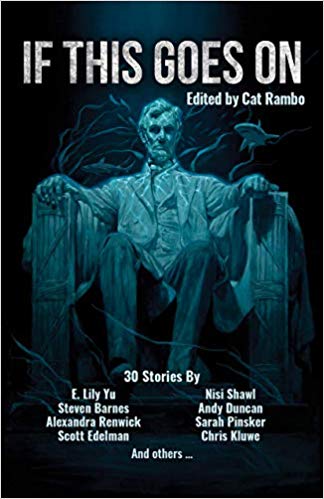
Review: If This Goes On edited by Cat Rambo

Review: If This Goes On edited by Cat RamboIf This Goes On by Cat Rambo, E. Lily Yu, Aimee Ogden, Rachel Chimits, Cyd Athens, Scott Edelman, Jack Lothian, Gregory Jeffers, Conor Powers-Smith, Priya Sridhar, Andy Duncan, Lynette Mejía, Hal Y. Zhang, Nick Mamatas, Steven Barnes, Kitty-Lydia Dye, Tiffany E. Wilson, Nisi Shawl, Kathy Schilbach, Zandra Renwick, Chris Kluwe, Sarah Pinsker, Calie Voorhis, Marie Vibbert, James Wood, Jamie Lackey, Paul Crenshaw, Langley Hyde, Judy Helfrich, Beth Dawkins, Sylvia Spruck Wrigley
Format: eARC
Source: supplied by publisher via NetGalley
Formats available: paperback, ebook
Genres: anthologies, dystopian, post apocalyptic, science fiction, short stories
Pages: 304
Published by Parvus Press LLC on March 5, 2019
Purchasing Info: Author's WebsitePublisher's WebsiteAmazonKoboBookshop.org
Goodreads

A bold new anthology born of rage and sorrow and hope. 30 writers look at what today's politics and policies will do to shape our world a generation from now. Some of today's most visionary writers of science fiction project us forward to the world of the future; a world shaped by nationalism, isolationism, and a growing divide between the haves and have nots. This anthology sits at the intersection of politics, speculative fiction, and American identity. The choices we make today, the policies of our governments and the values that we, as people, embrace are going to shape our world for decades to come. Or break it. Edited by Cat Rambo, the current President of the Science Fiction and Fantasy Writers of America, the stories of If This Goes On invite you to worlds very like this one-- but just a little different.

Table of contents:Green Glass: A Love Story by E. Lily YuTwelve Histories Scrawled in the Sky by Aimee OgdenDead Wings by Rachel ChimitsWelcome to Gray by Cyd AthensThe Stranded Time Traveler Embraces the Inevitable by Scott EdelmanGood Pupils by Jack LothianAll the Good Dogs Have Been Eaten by Gregory JeffersThe Sinking Tide by Conor Powers-SmithMustard Seeds and the Elephant’s Foot by Priya SridharMr. Percy’s Shortcut by Andy DuncanA Gardener’s Guide to the Apocalypse by Lynette MejíaBut for Grace by Hal Y. ZhangHurrah! Another Year, Surely This One Will Be Better Than The Last; The Inexorable March of Progress Will Lead Us All to Happiness by Nick MamatasThe Last Adventure of Jack Laff: The Dayveil Gambit by Steven BarnesThree Data Units by Kitty-Lydia DyeOne Shot by Tiffany E. WilsonKing Harvest (Will Surely Come) by Nisi ShawlCounting the Days by Kathy SchilbachMaking Happy by Zandra RenwickThe Machine by Chris KluweThat Our Flag Was Still There by Sarah PinskerThe Editor’s Eyes by Calie VoorhisFree WiFi by Marie VibbertDiscobolos by James WoodFine by Jamie LackeyBulletproof Tattoos by Paul CrenshawCall and Answer by Langley HydeA Pocketful of Dolphins by Judy HelfrichTasting Bleach and Decay in the City of Dust by Beth DawkinsThe Choices You Make by Sylvia Spruck Wrigley

My Review:

I picked this up around the same time I received Cory Doctorow’s Radicalized to review for Library Journal. Just from the descriptions, it seemed that these two books either springboarded off the same event, were in dialog with each other, or both. (This is also a giant hint that if this book interests you that one will too!)

They’re not exactly in dialog with each other, but they certainly arose out of the same event – the 2016 election. Both are wrapped around the question about what the state of the US – and by extension the world – will be in the future if the hateful politics and policies that were given voice and force by the election of 45 continue into the future relatively unchecked.

That premise is explicit in If This Goes On, and implicit in Radicalized, but it is definitely there in both books.

They are very different collections, however. Radicalized consists of four novellas by a single author, where If This Goes On is a collection in the broader sense, of relatively short stories by 30+ authors around the single theme.

A theme that the collection is screaming about – loudly and with metaphorical expletives. As far as the authors and editor are concerned (and this reader) the policies of those elected in that mess are undoing much of the good that the US has done and are making both the country and the world into a worse place than it was.

None of the writers want the situation to continue – and have done science fiction’s usual excellent job of extending the present out into the possible, even plausible, end point of the contemporary mess in order to show just how awful things can be.

In the hopes that we will band together and do something about it before it is too late.

Escape Rating B+: My feels are all over the place on this one.

First, because it bothered the hell out of me and presumably will other people, the title of the collection sounds familiar because it is. If This Goes On— is the title of a novella by Robert A. Heinlein, a novella which would itself feel at home in this collection.

Whether the title of the collection is in homage or not, there is still plenty of resonance between the two.

This is not a collection to be read late at night, particularly with only the light of one’s screen to push back the darkness. Because there’s plenty of darkness in these stories. While some of them border on horror in the traditional sense, most of the stories give the reader the sense that they are looking at something horrible. And I was appropriately – and shudderingly – horrified.

There is some humor in some of the stories, but it is primarily humor of the “gallows” persuasion. These futures are all bleak in one way or another. While the stories themselves are excellent, the overall tone is fairly dark.

Each story is followed by an editor’s note that tends to hit that dark tone over the head with a baseball bat. The stories generally speak for themselves so that repeated emphasis felt a bit like being bludgeoned with the point of the collection – over and over again. I was already metaphorically bleeding so this was a case where the beatings didn’t need to continue until morale improved because it wasn’t going to happen. But there’s something about the reference to that t-shirt saying that seems appropriate just the same – possibly because hearing the news these days does feel a bit like that proverbial beating.

As much as I agreed with the authors’ and the editor’s perspectives, I’ll admit to getting tired of having it beaten into my head over and over again. YMMV.

These stories stand on their own. Sometimes swaying in the wind from the apocalypse, but they do stand. And the collection is well worth reading. If you read nothing else from this collection, look for Mustard Seeds and the Elephant’s Foot by Priya Sridhar – it’s lovely.

As the saying goes, in reference to the collection as a whole, “Read ‘em and weep.”