
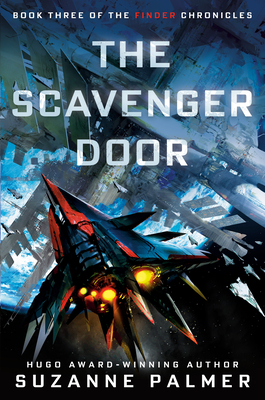
 The Scavenger Door by Suzanne Palmer
 Format: audiobook, eARC
Source: purchased from Audible, supplied by publisher via Edelweiss
Formats available: hardcover, ebook, audiobook
Genres: science fiction, space opera
Series: Finder Chronicles #3
Pages: 464
Published by DAW Books on August 17, 2021
Purchasing Info: Author's Website, Publisher's Website, Amazon, Barnes & Noble, Kobo, Bookshop.org
Goodreads
From a Hugo Award-winning author comes the third book in this action-packed sci-fi caper, starring Fergus Ferguson, interstellar repo man and professional finder.
Fergus is back on Earth at last, trying to figure out how to live a normal life. However, it seems the universe has other plans for him. When his cousin sends him off to help out a friend, Fergus accidently stumbles across a piece of an ancient alien artifact that some very powerful people seem to think means the entire solar system is in danger. And since he found it, they're certain it's also his problem to deal with.
With the help of his newfound sister, friends both old and new, and some enemies, too, Fergus needs to find the rest of the artifact and destroy the pieces before anyone can reassemble the original and open a multi-dimensional door between Earth and a vast, implacable, alien swarm of devourers. Problem is, the pieces could be anywhere on Earth, and he's not the only one out searching.
My Review:
 Surprisingly – honestly, extremely surprisingly – the basic premise of The Scavenger Door and the opening of last Friday’s book, Murder in the Dark, turned out to be much more similar than one might expect for all sorts of reasons.
They are both stories about mysterious doors in the space-time continuum that are causing havoc in this galaxy/solar system/planet and need to be closed and kept closed. The person tasked with shutting the damn weird door, in both stories, is someone who appears to be human but sorta/kinda isn’t completely, and in ways that turn out to be relevant to the story.
That is where the similarities end, but it was still strange that when I didn’t get to read the book I wanted to in the moment, which was this one, I ran across something more like it than it should have been.
The Scavenger Door is the third book in the Finder Chronicles, and it’s a story that brings the series full circle from its origins in Finder. Not that Fergus Ferguson goes back to Cernee, more that Cernee comes to him in the persons of Arelyn Harcourt and Mari Vahn. Actually, it seems like everyone Fergus has met, not just in the series but in his entire life, makes an appearance in this story.
Fergus is usually surprised to discover that he’s survived – or gotten by – his latest adventure with a little or a lot of help from the friends he doesn’t quite believe he has or deserves. This time he’s going to need every last one of them.
Because he needs to save not just Earth but the entire Solar System – and possibly further – from what’s on the other side of his particular uncanny door. Before someone else lets them out.
All in a day’s – or week’s, or month’s – work for Fergus Ferguson. Find the pieces, find the door, call in some favors, make some – LOTS – of enemies, save his friends, save the planet, save the solar system.
No pressure, right?
Escape Rating A: This series is great fun and totally awesome. Just don’t start here. It feels like everything has been building towards this point from the first moment we met Fergus in Finder, and the action here picks up right where the second book, Driving the Deep, left off. Fergus is back home in Scotland after running away as a teenager, connecting, and living with, the cousin he remembers as his only childhood friend and the baby sister he never knew he had.
 So don’t start here, because this book feels like the payoff for the whole thing. Start with Finder. Also, the audio for this entire series is wonderful. The narrator does a terrific job of conveying Fergus’ universe-weary voice, the entire story is told from Fergus’ first-person perspective. (That the narrator, when he is voicing Fergus’ internal dialog, sounds weirdly like Bill Kurtis from NPR’s Wait Wait…Don’t Tell Me! just feels like an extra bit of the chaos that Fergus seems to generate.)
The blurb says that this one, like the rest of the series, is a bit of a caper story. And it has plenty of those elements. But the series has been getting increasingly serious over its course, and this one is way more serious than the first two. Not that there wasn’t plenty of mayhem and gallows humor in both of those, but this one feels even deeper than the oceans of Enceladus in Driving the Deep.
From the very beginning of The Scavenger Door, this one feels like a farewell tour. Like the way that Shepherd touches base with seemingly every person and organization they’ve met or worked with during the course of Mass Effect 3. This book, from very early on in its story, reads like it’s heading towards an ending. Not necessarily Fergus’ own ending, but at least the ending of this particular phase in his life.
In Fergus’ case, it literally feels like he has to make sure this door stays shut in order for the next door in his life to open. Or something like that. Even more of an argument to start the series at the beginning and not here.
The thing that Fergus has found, the thing that kicks off this story, is a door. Or rather, while he’s searching for a flock of lost sheep in Scotland, he finds a tiny piece of a very big door that wants him to find all the other pieces and put its puzzle back together so that it can open and let in creatures that sound like space locusts.
In other words, a very bad idea. But the pieces of this door were scattered over the Earth a decade ago. That’s more than enough time for multiple groups and theories to chase after them in the hopes of uncovering their secret. And, humans being human, the theories that these human groups have are all about mastering this alien technology and conquering the planet. Or someone else’s planet. Or both.
Well, they’re half right. Or, as one of the aliens puts it, “like all such things, there are those who covet the fire and do not understand that it burns.” And isn’t that humanity in a nutshell?
But as high and desperate as the stakes are, what makes this series so much fun, and it is generally a lot of fun, are the characters. It’s not just Fergus and his universe-weary perspective, but also Isla, his previously unknown baby sister, who wants to learn about this brother she’s never met but already knows just how to take the mickey out of him at every turn. It’s all Fergus’ friends on Mars and Luna.
My favorite characters, and the ones who made me chuckle the most, were Ignatio and Whiro, an alien and a self-aware ship, because their running commentary on what Fergus is doing, how far off base he’s getting, how often he’s getting visited by Murphy’s Law, how much he’s flying by the seat of his pants and how desperate the stakes are, are always pointedly funny and provide a fascinating outside perspective on the best and worst of humanity – who happens to be Fergus Ferguson.
 So this is an out-of-the-frying-pan into the lava-filled volcano story that rides on the semi-controlled insanity of its protagonist and the circle of amazing people that have been drawn into his chaotic orbit.
This could be the end of Fergus’ adventures – if not the end of Fergus himself. I’ll be very sad if it is, because I’ll miss him and his merry band of crazed adventurers, including his cranky cat Mister Feefs, rather a lot. So I hope the author finds a way to bring him back.
Who knows what he’ll find the next time he hunts down a flock of missing sheep?
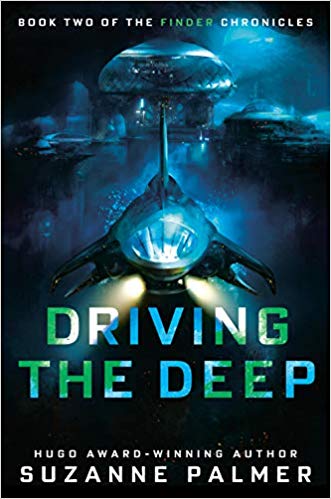 Driving the Deep (Finder Chronicles, #2) by
 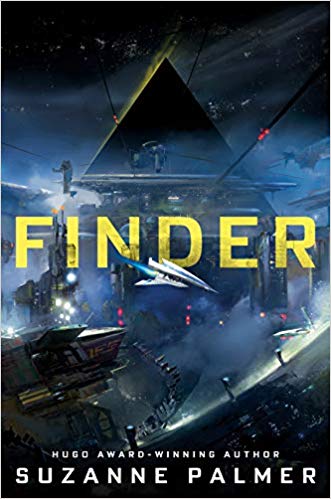 Finder by