#BookReview: We Will Rise Again edited by Karen Lord, Annalee Newitz and Malka Older

#BookReview: We Will Rise Again edited by Karen Lord, Annalee Newitz and Malka OlderWe Will Rise Again: Speculative Stories and Essays on Protest, Resistance, and Hope by Karen Lord, Annalee Newitz, Malka Ann Older
Format: eARC
Source: supplied by publisher via Edelweiss
Formats available: paperback, ebook, audiobook
Genres: activism, anthologies, essays, fantasy, hopepunk, politics, science fiction, short stories, social justice, speculative fiction
Pages: 384
Published by S&S/Saga Press on December 2, 2025
Purchasing Info: Author's WebsitePublisher's WebsiteAmazonBarnes & NobleKoboBookshop.orgBetter World Books
Goodreads

From genre luminaries, esteemed organizers, and exciting new voices in fiction, an anthology of stories, essays, and interviews that offer transformative visions of the future, fantastical alternate worlds, and inspiration for the social justice movements of tomorrow.

In this collection, editors Karen Lord, Annalee Newitz, and Malka Older champion realistic, progressive social change using the speculative stories of writers across the world. Exploring topics ranging from disability justice and environmental activism to community care and collective worldbuilding, these imaginative pieces from writers such as NK Jemisin, Charlie Jane Anders, Alejandro Heredia, Sam J. Miller, Nisi Shawl, and Sabrina Vourvoulias center solidarity, empathy, hope, joy, and creativity.

Each story is grounded within a broader sociopolitical framework using essays and interviews from movement leaders, including adrienne maree brown and Walidah Imarisha, charting the future history of protest, revolutions, and resistance with the same zeal for accuracy that speculative writers normally bring to science and technology. Using the vehicle of ambitious storytelling, We Will Rise Again offers effective tools for organizing, an unflinching interrogation of the status quo, and a blueprint for prefiguring a different world.

My Review:

This fascinating collection, edited by Karen Lord, Annalee Newitz and Malka Older, does something that isn’t done often – or perhaps just not often enough. Because it deals with real world issues explicitly through speculative fiction, it deliberately puts the included stories in dialogue with essays by and interviews with thinkers and especially doers who have experience with the problems raised and carried into the speculative realm.

This collection is also an homage and a continuation of the book Octavia’s Brood, edited by adrienne maree brown and Walidah Imarisha in 2015. It is both right and fitting that interviews with brown and Imarisha are part of the introduction to this current work.

My personal reading of this book focused on the included short stories which were written specifically for this collection, rather than the essays and interviews, many of which have been previously published elsewhere.

R.B. Lemberg – “Other Wars Elsewhere” c2025

This fantasy is a bit about the magic of places to pull at the heart, but is mostly about wars and refugee crises and people’s attention span for caring and giving to people and places that are not their own. It’s also a story about activism, both in the sense of doing it and in the sense of being caught up in the performance of it. And it’s also the story of a young woman learning that just because there’s a new crisis it doesn’t mean that an individual isn’t still emotionally attached to the old one and that sometimes you find your place to help and sometimes you come back to it. Mivka is a stand-in for Ukraine but that is far from all it is. Escape Rating A-

Rose Eveleth – “Originals Only” c2025
On the one hand this SF story has some fascinating things to say about athletes and how they’re viewed and lionized and cut down to size, how their lives are so wrapped up in their sport and prepping for it that they get tunnel vision, how little control they have over their lives and how they’re not prepared for their day in the sun to end – while also talking about how politics weaponizes people and talking points and whatever is top of mind to score off against marginalized groups and play identity politics. The problem with the story is that the protagonist is pretty much a cipher even at the ending. There’s no there there to wrap the story around – which may also be part of the point but leaves a void at the story’s center. Escape Rating B

Laia Asieo Odo – “Where Memory Meets the Sea” c2025

The story is about the erasure of memory and history, but makes it personal, poignant and downright heartbreaking by setting it in a world and specifically a country where individual memory erasure is possible and government sanctioned. The people have one day per year where they can remember and experience their losses, but even that is too much for a repressive government, leaving everyone with holes in their memories, injuries upon their bodies, and missing friends and family they’re not allowed to remember. Because if they did they’d overthrow them all. We know that history is written by the victors, and that counter-narratives to accepted truth get suppressed on the regular, but this puts the whole terrible thing and breaks the reader’s heart with grief and loss – even the ones that we don’t remember. Escape Rating A+

Samit Basu – “Disruption” c2025

This was interesting in that it’s not the first story I’ve read recently about weaponizing history erasure and using accepted truths to push a narrative. This one is a bit different because it also pulls in not just the evils of AI in general and the evils of AI in particular to do this work, but also the evils of letting AI control human behavior. It reminds me a bit of Where the Axe is Buried but is trying a bit too hard to be arch and the keystone doesn’t quite fit. Escape Rating B

Nisi Shawl – “The Gray and the Green” c2025

This one was weird – but that’s appropriate because the protagonist was totally weirded out. The story centers on a rather rapacious business owner who does an excellent job exploiting legal loopholes to make more money with fewer consequences. They start getting messages from their future self, attempting to set themselves on a better, more community-oriented but still highly profitable, path. It was a neat idea but didn’t quite work for me. Escape Rating B-

Sabrina Vourvoulias – “Perséfoni in the City” c2025

This story is about government corruption, community activism and the importance of food security, wrapped up in beautiful poetry and set in a world where food is a kind of magic in ways beyond the obvious. This was a story with a lot of irons in its fire, all of which were stories of their own. It would have worked better for me if it had picked a few of its storylines to follow through on – or if it had been long enough for all those crops to have had time to grow. And for a story intended for a speculative fiction collection, the speculative element was very slight. Escape Rating B

Jaymee Goh – “A Brief Letter on the Origins of the Harpy Aviary in the Kirani Citadel” c2025

This was fun, somewhat satirical and very pointed. Also feathered and clawed. It’s a story about sanctioned rebellions in a fantasy kingdom with a fascinating political structure where seemingly all marriages are polygamous in all directions, where children can inherit from anyone in the parental group – even the throne, and where outsiders coming in think that their quaint, backwards, “western” ways will hold sway over the Kirani’s very sensible arrangements for things. One pretender to the throne tries to bribe his way to the top, only to be overthrown by a mage who summons harpies to rout his illegal government. She’s in the right, but no good deed goes unpunished so she becomes the official heir AND is endlessly harangued by everyone who has to deal with the damage done by the harpies. The entire story is told in a letter to a friend, begging for at least a visit to help her get away from her onerous, necessary, but unwanted elevation to the crown. Escape Rating A-

Malka Older – “Aversion” c2025

At first, it seems like this story is about technology, kind of a reverse of subliminal advertising, where tech is used to show things people don’t want to see and generally turn their eyes away from. Things like horrific accidents, incidents of terrorism, war and peacetime atrocities. Then it pulls back a bit, and turns into a story about whether the ends of getting people to see the things that make them uncomfortable is worth the means of forcing them to do so. When that devolves into a debate about safety and security and protecting the children, it all sounds familiar but also necessary AND, more importantly, how easy it is to derail anything uncomfortable – if it pokes at the status quo. Then it pulls back again and it becomes a question about why people don’t see the truth of the world and how to get them to turn their attention back ON. This isn’t a fun story, but it is thought-provoking, particularly in that everyone is right but everyone is also very wrong. Escape Rating B+

Charlie Jane Anders – “Realer Than Real” c2025

This was fun, but it also made its point and hit it hard and well. At its heart, its a story that exposes the contradiction among conservatives that they want the US Constitution to be interpreted as the Founding Fathers would have seen it in the late 18th century. And at the same time they want it to enshrine the status quo as it is today – meaning that they want the law to enforce current ‘norms’ whatever those might be. The story takes that contradiction and pushes the envelope in both directions by poking directly at the way that some want to lock people down in their gender presentation based on how they look and how they dress and whether or not that conforms to ‘accepted’ interpretations of male and female. Because the clothing worn in the late 18th century – by the Founding Fathers and Mothers themselves – does not conform to 21st century standards AT ALL. And it doesn’t have to and neither should anyone today or any other day. Watching the drones all go spare and the Supreme Court judges get turned around was funny, but the point still got made and reinforced among the laughs. Escape Rating A+

Izzy Wasserstein – “The Rise and Fall of Storm Bluff, Kansas: An Oral History” c2025
This was an ultimately sad story about a failed anarchist revolution. The thing is that it should have worked, but the powers that be that preserve the status quo and stay in power by separating groups couldn’t tolerate the entirely legal and extremely cooperative purchase of all the land in a dying town in the middle of Kansas by a group of anarchists led by a transwoman, so they created a crisis so they could bring in troops and shut it all down. The story is told as a series of interviews with the survivors and its both fascinating and heartbreaking. A part of me wants to say that it wouldn’t happen like this because everything was done ‘right’ and legally, but reality says that it would. Dammit. Escape Rating A

Vida James – “Chupacabras” c2025

This is a story of frustration and rage – and it’s impossible not to feel both while reading. I think it hits even hard now than it did when it was written – or perhaps its that the theme feels realer and closer because it’s no longer just somewhere else but also here – albeit in a different way. The story is set in Puerto Rico, and it’s a story about hypergentrification, about the way the island is treated as a colony instead of a real part of the U.S., the way that the laws are written to favor the mainland instead of the citizens – or even just treating the citizens equally with other U.S. citizens. It’s about activism burnout, about how hard it is to keep fighting when the enemy owns all the battlefields for public awareness – and then it personalizes the whole fight into one woman, one monster and one very bloody possibility for extreme change. I can’t say I liked this story, exactly, but I absolutely did feel it. Escape Rating B

Alejandro Heredia – “If I Could Stay with You on Earth” c2025

This story was surprisingly sweet. It’s also a story where a non-violent protest is successful. And it’s a bit of a love story AND a love-letter to the Bronx at the same time. (And it made me want to go back and read The City We Became with its commentary on the personality of the five boroughs. It’s also a story about the power of an organized group to move the needle towards justice IF they have fair access to the lines of communication. It’s also, just a bit, about the impossibility of getting teenagers to hear the word “No”, but this time in a good way. It’s also a great story to shift the reader into a bit of a more hopeful space particularly after “Chupacabras”. Escape Rating A-

Annalee Newitz – “One of the Lesser-Known Revolutions” c2025

I’ve often said that I’m grateful to have grown up before digital footprints. Whatever mistakes I made – and they were as legion as anyone else’s – are not preserved and regurgitated over the internet. This story, in a way, reflects that era in that it’s about a group of students who want to go back to some of that, the idea that free speech isn’t an absolute right and that people who want to talk about murdering people and groups they hate have the right to say what they want but they don’t have the right to say it where they want. They can hate if they want, but they need to keep it private. Which is kind of the way it used to be before the megaphone of the internet existed. It’s a story about going back to enforcing the old stricture about not shouting fire in a crowded theater. While I loved the idea that it would keep haters from spamming and doxxing people they’ve decided to hate all over the internet, I can’t unsee the slippery slope this leads to. Escape Rating B

Kelly Robson – “Blockbuster” c2025

This managed to be both fun and sad at the same time, because it posits a world – or at least a tiny corner of it – where things are working as they could. And it’s wrapped around street burlesque in Toronto, which is inherently as fun as it is subversive. And it’s immersive, and the story is about one filmmaker who gets immersed and caught up in the possibilities of entertainment as a wedge to create social change even though the money backing his production pushes him towards cutting down the effort and preserving the status quo. The story is a lot bigger than all of this, and I liked what it was doing but didn’t care much for the protagonist or the cookie-cutter villain. Escape Rating B-

Abdulla Moaswes – “Kifaah and the Gospel” c2025

From one perspective, this is a story about AI as a tool of colonialism and the erasure of the cultures that colonialism wipes out in its rapaciousness. From another perspective, it resembles Nnedi Okorafor’s African futurism, even though this is not set in Africa, but rather the idea of the people who were once subjugated, returning to their land and making it their own, again. While, from a third perspective it reads as an attempt at cultural erasure that failed, as it centers around an artifact that, as much as it tells a terrible – and terribly slanted – story about cultural erasure in its historical past, becomes an object of error and derision when its programming forces it to assert that the present that is actually around it doesn’t exist. At the same time, the historical conflict that it references, the conflict that exists in our present between the Arabs and the Israelis in the Middle East is reduced to a simple binary that doesn’t sit right with this admittedly biased reader. I’m not sure I can rate this fairly because I can’t be remotely objective about it. But I’m still thinking about it, and that might be the most important part.

Overall Rating B+: Due to the collection’s mix of fiction and nonfiction, I can’t decide whether the rating should be “Escape” or “Reality”, particularly as even the fiction – or perhaps that’s especially the fiction, is real-world thought-provoking, as intended. However, speaking of the thoughts this collection evoked, I would highly recommend Cadwell Turnbull’s Convergence Saga, recently concluded with A Ruin, Great and Free, as a readalike for We Will Rise Again as his story brings so many of the concepts in this compelling collection to fantastic life.

#AudioBookReview: Every Day I Read by Hwang Bo-Reum, translated by Shanna Tan

#AudioBookReview: Every Day I Read by Hwang Bo-Reum, translated by Shanna TanEvery Day I Read: 53 Ways to Get Closer to Books by Hwang Bo-reum
Translator: Shanna Tan
Narrator: Rosa Escoda
Format: audiobook, eARC
Source: supplied by publisher via Edelweiss, supplied by publisher via Libro.fm
Formats available: hardcover, ebook, audiobook
Genres: books and reading, essays, memoir
Pages: 240
Length: 3 hours and 49 minutes
on December 2, 2025
Purchasing Info: Author's WebsitePublisher's WebsiteAmazonBarnes & NobleKoboBookshop.orgBetter World Books
Goodreads

From the internationally bestselling author of Welcome to the Hyunam-dong Bookshop comes a warm and reflective collection of essays inviting us to reflect on our relationship with reading.
Why do we read? What is it that we hope to take away from the intimate, personal experience of reading for pleasure?
Rarely do we ask these profound, expansive questions of ourselves and of our relationship to the joy of reading. In each of the essays in Every Day I Read, Hwang Bo-reum contemplates what living a life immersed in reading means. She goes beyond the usual questions of what to read and how often, exploring the relationship between reading and writing, when to turn to a bestseller vs. browse the corners of a bookstore, the value of reading outside of your favorite genre, falling in love with book characters, and more.
Every Day I Read provides many quiet moments for introspection and reflection, encouraging book-lovers to explore what reading means to each of us. While this is a book about books, at its heart is an attitude to life, one outside capitalism and climbing the corporate ladder. Lifelong and new readers will take away something from it, including a treasure trove of book recommendations blended seamlessly within.

My Review:

I was SO tempted to begin this review with snark – and just keep right on snarking all the way through. Obviously, I chose to begin with a bit of snark, because, well, I do too. Read every day, that is. Reading is life.

Not ALL of life, but a lot of life, and all of my life has been filled with books and reading. So I picked this up with a lot of empathy for the writer, because from an outside perspective we’re coming from a similar place. From the inside perspective provided by this book, clearly not – and not just the obvious differences of age, location and pretty much everything else except gender.

We may both read every day, but we don’t read the same, either the same things or the same way or for (most) of the same reasons.

But I agree wholeheartedly with something the author says in THIS book, that “Books are like a spider’s web: you’ll only get more attached.” We’re both clearly enmeshed, we’re both biblioholics, and neither of us ever plans on getting treatment for the condition.

I know I wouldn’t have it any other way. After reading Every Day I Read, I believe that the author feels the same.

Reality Rating B: This one doesn’t get an escape rating because I didn’t – which was kind of the point of it. (I often found myself talking back to the excellent audio while listening in the car.) I was looking to read a book by someone who reads A LOT and lives a chunk of their life in and through books. (I also found this book through a fellow reading addict’s article about the book intending to get even more people hooked on the joy of reading. This whole reading thing is addictive!)

One of the ways in which the author and I read differently is that the author loves to collect quotations from the books she reads. Collecting the quotes is part of her process of reading and jotting them down is part of her process of, well, processing and understanding the books she’s read. (Sometimes things stick with me, but it’s not what I’m there for.)

I’m going to use one of her examples as a way of furthering my response to the book. This quote is her quote from Lee Kwonwoo’s book, Learning to Write Begins with Reading a Book, “The focus isn’t on the book, but on the reader, and your experience reading it.” in regards to a reader’s response to a book as opposed to a professional book critic’s response or review.

And that’s what this “review” is intending to be, my response, as a reader, to this book about her thoughts about the reading life, the reading experience, and ways that others can themselves become habitual readers.

From this reader’s perspective, there’s a difference between getting pleasure out of reading vs. reading for pleasure – and I think the author and I are on opposite sides of that divide. She clearly does receive a great deal of pleasure from her reading – but her process is, well, definitely a PROCESS. Like the quotes. Or setting a timer so as to read a certain number of minutes each day. Or it could simply be that all the books she references and quotes from are all “improving” in some way – either they are classics, they are literary fiction, or they are nonfiction.

Telling humans to do ANYTHING because they “should” is not a way to get people to do something. Telling people they would love the classics if they just gave them another chance is not a message that’s going to resonate with as many people as “if you need an escape from the crisis of the day this will let you leave it behind for a bit.”

Reading itself is the pleasure and the escape, and some days a cozy mystery is just what the “book” doctor ordered. It doesn’t have to be “good” from a literary perspective or impart a particular lesson. “Fiction is (still) the lie through which we tell the truth,” to quote philosopher Albert Camus, and that’s just as true for a so-called trashy romance or a sweeping epic fantasy as it is the highest of highbrow literary fiction.

Your reading mileage may vary. The author of this book’s certainly seems to.

Here’s the point where I get up on my soapbox, because I need to let this out. There’s an essay in this book about ebooks, and it pretty much parrots all the negative stuff that gets repeated that reading an ebook isn’t “as good” as reading print. I have problems with this. In fact, I have LOTS of problems with this.

The study that was used as justification for this pronouncement compared readers’ behavior (by tracking eye movement) when reading “web pages” with readers’ behavior when reading a printed book. That is an apples to oranges comparison. Back in the days when print was all we had, readers didn’t read newspapers or magazine articles the same way they read books – because those things are not the same. So I wouldn’t expect readers’ behavior to be the same and whoever created the study shouldn’t have either unless they were looking for proof of a point they had already decided on.

Second, and more important from my personal perspective, is that the all the articles that “prove” that reading ebooks is somewhat less real or less true or simply a lesser experience than reading print books just cuts off vast swaths of readers from continuing to read once the inevitable vision changes of middle age – and older – set in. While large print books have existed for decades, the number and types of books that are published in large print have always been limited. (Specifically, I read fantasy and science fiction and the amount of either genre that is published in large print is vanishingly small. Without ebooks, I’d have had to give up the genres I have loved for my entire reading life.) This is not the way to keep people who love reading reading.

To put it another way, all that the articles and essays that denigrate ebook reading do is shame readers who read ebooks for whatever reason. As a librarian, shaming the reader for their reading preferences is anathema.

Stepping down off my soapbox now to conclude by answering a question the author poses in her essays about reading books that change one’s life. My own answer explains my passion when it comes to ebooks by reaching back into my early days as a lover of reading. When I was 8 years old someone loaned me a copy of J.R.R. Tolkien’s The Hobbit, with the promise that if I liked it and more importantly returned it, there were MORE. That one book was the right book at the right time to influence all of my reading for the sixty years and counting that have followed. It was the right book at the right time in that it swept me away into a vast, fully realized and utterly absorbing world filled with characters that touched me and made me think and feel, that it told a story that STILL resonates all these years later, and that grew with me as I grew up and reread it and got more and deeper into it each and every time.

It doesn’t matter whether the book that changes or influences your life is the most literate, or the most improving, or the most popular or the most highly thought of or most award winning. What matters is that it works for you. And that if you haven’t already found it, it’s still out there waiting for you to discover it.

Grade A #JointBookReview: How a Game Lives by Jacob Geller

Grade A #JointBookReview: How a Game Lives by Jacob GellerHow a Game Lives by Jacob Geller
Format: eARC, hardcover
Source: publisher, supplied by publisher via Edelweiss
Formats available: hardcover, ebook
Genres: essays, gaming, nonfiction, storytelling, video games
Pages: 208
Published by Harper Collins, HarperPop, Lost In Cult on November 18, 2025
Purchasing Info: Author's WebsitePublisher's WebsiteAmazonBarnes & NobleKoboBookshop.orgBetter World Books
Goodreads

Over his illustrious career, Jacob Geller has written and produced a sprawling collection of video essays. Deftly interweaving video game analysis with complex narratives about art, politics, and history, Geller’s work positions games as vital tools for understanding each other and ourselves. How a Game Lives re-examines ten of Geller’s most iconic essays accompanied by his brand-new commentary, afterwords on each piece by some of the industry’s best writers, and stunning original artwork by Kilian Eng and other exceptional artists.

With videos like “Who’s Afraid of Modern Art”, “Every Zelda is the Darkest Zelda”, and “The Legacy of the Haunted House”, Geller has taught audiences how to think about the art that’s affected them. How a Game Lives immortalises those works and more, and provides boundless insight into the construction, philosophy, and afterlife of each essay.

Marlene’s Review:

There’s power in stories, though. That’s all history is: the best tales. The ones that last. Might as well be mine. – Varric Tethras in Dragon Age: Inquisition

I’ve always loved this quote because it manages to combine how I feel about games, how I feel about their characters, what makes some games live in my imagination and even my heart for decades while and even after playing them – along with the reason I’m playing in the first place. It also kind of explains why I decided to dive into How a Game Lives AND, a whole lot about how I approach the world, whether real or imaginary.

Because I play games FOR the story, to be INSIDE the story, to experience the story as a character within it and not just a consumer of it. And some of those stories LAST, not just Dragon Age but also Mass Effect, Horizon Zero Dawn and Final Fantasy X. They feature stories that can still move me and characters that I still think about – often quite fondly. (I STILL miss the original Elder Scrolls game, Arena. The sequels have never quite lived up to the first. Your gaming mileage may vary.)

The stories in games, whether games I play myself or games that I watch Galen play (he loves a good platformer where I tend to throw the controller across the room and hit one of the cats) also inform my own writing about other stories in other formats. I review books, particularly science fiction and fantasy, and there’s plenty of cross pollination between them.

As there is with pretty much every other form of storytelling, which is what games and books and movies and any other form of media ARE. If, as one writer said, “Man is the only animal that blushes…or needs to,” then stories are how we deal with some of that blushing, whether we use it to excuse or explain or change the subject entirely. Stories are how we process the world, and the stories in games are part of that processing.

A part of me is tempted – HIGHLY – to just talk back to How a Game Lives. Not to argue, but to continue the conversation, because that’s part of the point, both for the original video essays and for the book I have in real, live, hand. (I seldom get print books for multiple reasons, but this is one of the rare cases where I requested an actual, physical, reading copy from the publisher and I’m glad I did. The format works MUCH BETTER in print, but if you have to read the ebook use a black background layout for readability. Still, get the real book if you can.)

A huge part of me wants to add more fuel to the various contextual fires. I’ve read two books recently that I would have had even more appreciation of if I’d seen Geller’s essay “Fear of Cold” first, as both Michael Nayak’s Symbiote AND Sarah Gailey’s Spread Me reference John Carpenter’s The Thing in very similar ways. Also The Blackfire Blade uses golems, but it uses them in the same way that Dragon Age Origins does, starting with an ancient artifact and an unwilling victim, and I kind of want to throw that on the discussion in “The Golem and the Jewish Superhero”, along with the more traditional, if decidedly female, golem in The Maiden and the Monster.

And I would love to do a really deep dive with someone about the issues raised in “Does Call of Duty Believe in Anything?” because the question at the heart of that essay is both profound and applicable to way more than just THAT series. It’s all about the structure of narratives that in effect reinforce the status quo while doing their damndest (and most likely ours) to pretend that the status quo is neutral when it never is. Which, in its turn, jumps straight off a cliff into discussions about how opening up gaming and other media to traditionally underrepresented viewpoints supposedly ‘ruins some people’s childhoods’ and goes against a canon that originally reinforced that status quo and whether or not viewpoints in the public sphere or in art in general should be restricted to the acceptable. That way lies tyranny and book banning and I could go on all day because these essays made me THINK and that’s always an excellent thing.

Before I get down off my soapbox here, I can’t leave without adding a quote from another long-running media property, because the more I think about it, the more apropos it is. It’s part of a dialog between the still somewhat idealistic Bashir and the ever mysterious and frequently duplicitous Garak in Star Trek Deep Space 9.

Bashir: Out of all the stories you told me, which ones that you told me were true and which ones weren’t? Garak: My doctor, they all were true. Bashir: Even the lies? Garak: Especially the lies.

So I’m not here to review How a Game Lives, because it isn’t a book that lends itself to that treatment. I’m here to talk about what the book made me think about. The trick for me, much as it seems like it can be for the author, is to wrestle those thoughts into a coherent mass less than the size of, oh, say, The Lord or the Rings or the movies it spawned.

I’ve been playing computer and video games for nearly 50 years. I built my first computer out of a Heathkit in 1979 and one of the first things I did was type game code onto cassette tapes from books, because 1979 predates just about everything including even floppy disk drives and color monitors. The first games I remember purchasing were the original Zork, followed by the other Infocom text adventure games because, well, that’s what there was. I also had an Atari but that came later.

In other words, I’ve always played games, and I still do. I play because it’s fun – even when it sometimes literally hurts. There are games I play, like Diablo, because there are just some nights when pixels need to die. But the games that live, the ones that stick with me, are the games with big stories and fascinating characters, and that’s true whether I’m the actual player or whether I’m watching Galen play. Some games, like most of the Assassin’s Creed series, Ghost of Tsushima, Horizon Zero Dawn and the Uncharted series, tell great stories and make fantastic television.

So the question of ‘How a Game Lives’ or ‘What makes a game live’ are questions that I’ve been wrestling with for a long time. From a personal standpoint, the games that stick with me are the ones that make me care for their worlds and their characters, which is why Final Fantasy X has stuck with me for more than 20 years, what made the Dragon Age series infinitely replayable – at least until the latest iteration, and why I can’t make myself replay the Mass Effect Trilogy in spite of how good it was.

When I was first offered a review copy of this book, part of what appealed to me as a reviewer was that it presented an opportunity for both Galen and I to get a say. My experience of playing computer and video games is longer, but his is broader, and in the context of this book, he’s played many if not most of the Zelda games which rightfully warranted a chapter of their own in How a Game Lives – because those games certainly do.

So here’s Galen’s essay in response to “Every Zelda is the Darkest Zelda”

Childhood memories can grow dim, but one of the NES-era Legend of Zelda games was quite likely the very first game I played on a home console during a trip visiting a family member. The most vivid part of that memory was how difficult it was to deal with the Tektites; I didn’t get very far before it was time to return home.

Ocarina of Time was the Zelda game that first truly sunk its claws into me; after that I played many but not all of the successor games. It combined a good story with interesting puzzle-dungeons and a successful illusion that there was always more to its world over the next hill. That sense of having a world to explore that felt lived reached a peak in Breath of the Wild and Tears of the Kingdom. To this day, a game that combines good writing, a world to explore that feels real, and environmental storytelling is like catnip to me. It doesn’t have to be a true open world—Final Fantasy X isn’t, for example—but as long as the world has verisimilitude and rewards poking around its corners, I’ll probably enjoy exploring it.

While double-checking some facts for this review, I was reminded that Ocarina of Time came out in 1998; i.e., the year I graduated college. That fact might inspire one of the common questions regarding a platform for telling stories that sometimes still stings: “Aren’t you a bit old to be playing that?” (Marlene’s comment: At this point in my life, when I get questions like that, I just laugh. I’ve got nothing else – or at least nothing else polite – left to say.)

In his essay “Every Zelda is the Darkest Zelda”, Geller provides an answer: video game stories—or at least the ones that are written well—can grow along with the player. The experience (and hopefully wisdom) one gains as one grows older can turn a cartoon tale that features thwacking energy balls back and forth with Ganon into an exploration of adult themes such as maturation and picking up the pieces from a disastrous war…that the heroes lost. It’s not for nothing that Archive of Our Own has 329 fanfics tagged “Link has PTSD”… for a game series that also features a lot of charm and humor. As Geller points out, however, the darkness of some of the themes is balanced by a fundamental sense of hope: not necessarily the adolescent hope that Good will beat Evil and All Will Live Happily Ever after, but the messy adult hope that amelioration from disaster is, while partial, also possible.

I really appreciated Geller giving me a fresh way of looking at one of my favorite game series. The essay (and the afterward to the essay by Matt Margini) by itself is worth the price of the book. I’m glad Marlene suggested that we do a joint review; I will be following Geller’s work henceforth.

Escape Rating, well, not this time. Neither of us precisely escaped while reading this book. Instead, separately and together, we engaged with this book in a very real way, leading instead to a rather personal Reality Rating of A. Anyone interested in a discussion of video games as art, as storytelling, as a reflection on the world that game players and game creators inhabit is going to be riveted even though their brain is likely to explode while reading – and or diving back into these essays original video format.

Meanwhile, I’ll be keeping my eye out for Geller’s just announced NEXT BOOK, which, based on the book I’ve just finished, may have THE most appropriate title EVER with You’re Not Overthinking It, no matter how much the author fears he – or for that matter his readers and viewers – might be.


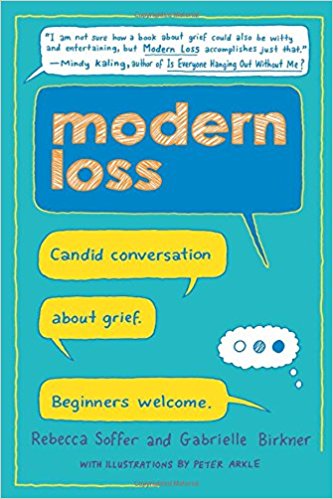
Review: Modern Loss by Rebecca Soffer and Gabrielle Birkner

Review: Modern Loss by Rebecca Soffer and Gabrielle BirknerModern Loss: Candid Conversation About Grief. Beginners Welcome. by Rebecca Soffer, Gabrielle Birkner
Formats available: hardcover, ebook, audioboook
Pages: 384
Published by Harper Wave on January 23rd 2018
Purchasing Info: Author's WebsitePublisher's WebsiteAmazonBarnes & NobleKoboBookshop.org
Goodreads

Inspired by the website that the New York Times hailed as "redefining mourning," this book is a fresh and irreverent examination into navigating grief and resilience in the age of social media, offering comfort and community for coping with the mess of loss through candid original essays from a variety of voices, accompanied by gorgeous two-color illustrations and wry infographics.

At a time when we mourn public figures and national tragedies with hashtags, where intimate posts about loss go viral and we receive automated birthday reminders for dead friends, it’s clear we are navigating new terrain without a road map.

Let’s face it: most of us have always had a difficult time talking about death and sharing our grief. We’re awkward and uncertain; we avoid, ignore, or even deny feelings of sadness; we offer platitudes; we send sympathy bouquets whittled out of fruit.

Enter Rebecca Soffer and Gabrielle Birkner, who can help us do better. Each having lost parents as young adults, they co-founded Modern Loss, responding to a need to change the dialogue around the messy experience of grief. Now, in this wise and often funny book, they offer the insights of the Modern Loss community to help us cry, laugh, grieve, identify, and—above all—empathize.

Soffer and Birkner, along with forty guest contributors including Lucy Kalanithi, singer Amanda Palmer, and CNN’s Brian Stelter, reveal their own stories on a wide range of topics including triggers, sex, secrets, and inheritance. Accompanied by beautiful hand-drawn illustrations and witty "how to" cartoons, each contribution provides a unique perspective on loss as well as a remarkable life-affirming message.

Brutally honest and inspiring, Modern Loss invites us to talk intimately and humorously about grief, helping us confront the humanity (and mortality) we all share. Beginners welcome.

My Review:

I picked this book for a very specific reason. My mother died on December 25, 2017 and this is a book about dealing with grief and loss. Since I’m not quite sure how well I’m dealing with everything, it felt like a good time to see how other people do. Or don’t, as the case may be.

The authors met each other, founded their website, and wrote this book after both of them lost one or both of their parents at a relatively young age. Not necessarily the parents’ age, although that too. But their own. They both were “orphaned” in their 20s, at a time when most people’s parents are not just still living, but still thriving and still working.

Their personal stories resonated with me, but not so much in the present tense. My dad passed away at 63, when I was 34.We were both too young for that particular trauma, and in some ways I never got over it. I still dream that he’s alive and we’re talking about something or doing something together. It’s always a shock to wake up and remember that he’s gone, and that he died long before I met my husband. I think they’d have liked each other. I’m certain that they would have had some epic chess games.

And every time I have one of those dreams I wake up with a migraine. My dad died suddenly and unexpectedly. I think we still have unfinished business, business that will never be finished. I keep trying to dream it better, and can’t.

The book is a collection of stories and essays by people who have experienced the death of someone close to them. Not just parents, but also spouses, children, parental figures, and anyone else whose loss brought them profound grief. Or anger. Or all the stages of grief at once.

For someone grieving a loss, or who has ever grieved a loss, reading the book is cathartic. I was looking for answers because my reaction to my mother’s death has been so very different from my reaction to my dad’s, and I was looking for a kind of validation. I wanted to see if my reaction was, if not normal, at least somewhere within the normal range.

And now I know I’m not alone. My mom was 89 when she died. We did not always get along, but we did keep in touch. Her passing was not unexpected, and there was time to, if not finish all the business, at least resolve in my own head and heart that all the business was finished that was ever going to get finished. We were who we were, and there were topics that were just never going to get discussed and arguments that were never going to be resolved.

It is what it is. Or as my mom so often said, “what will be will be”. And so it is.

Reality Rating B: I found this book helpful, but difficult to review. In the end, what I’ve written above is personal, and in a way is similar to some of the personal narratives told in the book.

The individual essays are a very mixed bag. Some spoke to me, whether their situation resembled my own or not. Others did not. This is definitely a case where one’s mileage varies. And I’ll also say that I can’t imagine reading this book unless one had experienced this type of loss and was looking for something, whether that be validation, shared experience or just catharsis. Or even just to feel all the feels.

Everyone’s experience of loss is different, and as my own issues show, every loss, even experienced by the same person, is different. We change, and so do our relationships.

If you or someone you know is grieving and is the type of person who looks for answers in books, reading this one may prove cathartic, or at least affirming. There is no one true answer. Just a true answer for each of us alone.

I still have dreams about my dad, but not, at least so far, my mom. And that is what it is, too.

TLC
This post is part of a TLC book tour. Click on the logo for more reviews and features.

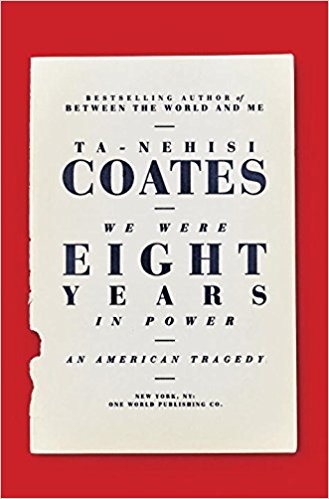
Review: We Were Eight Years in Power by Ta-Nehisi Coates

Review: We Were Eight Years in Power by Ta-Nehisi CoatesWe Were Eight Years in Power: An American Tragedy by Ta-Nehisi Coates
Formats available: hardcover, paperback, large print, ebook, audiobook
Pages: 367
Published by One World on October 3rd 2017
Purchasing Info: Author's WebsitePublisher's WebsiteAmazonBarnes & NobleKoboBookshop.org
Goodreads

A sweeping collection of new and selected essays on the Obama era by the National Book Award-winning author of Between the World and Me

"We were eight years in power" was the lament of Reconstruction-era black politicians as the American experiment in multiracial democracy ended with the return of white supremacist rule in the South. Now Ta-Nehisi Coates explores the tragic echoes of that history in our own time: the unprecedented election of a black president followed by a vicious backlash that fueled the election of the man Coates argues is America's "first white president."

But the story of these present-day eight years is not just about presidential politics. This book also examines the new voices, ideas, and movements for justice that emerged over this period--and the effects of the persistent, haunting shadow of our nation's old and unreconciled history. Coates powerfully examines the events of the Obama era from his intimate and revealing perspective--the point of view of a young writer who begins the journey in an unemployment office in Harlem and ends it in the Oval Office, interviewing a president.

We Were Eight Years in Power features Coates's iconic essays first published in The Atlantic, including "Fear of a Black President," "The Case for Reparations," and "The Black Family in the Age of Mass Incarceration," along with eight fresh essays that revisit each year of the Obama administration through Coates's own experiences, observations, and intellectual development, capped by a bracingly original assessment of the election that fully illuminated the tragedy of the Obama era. We Were Eight Years in Power is a vital account of modern America, from one of the definitive voices of this historic moment.

My Review:

I came to this book via multiple odd routes. I heard the author speak a couple of years ago, because my husband really likes his writing. While it doesn’t resonate with me quite the same way, when it does, it really, really does. Coates’ comment at the beginning of Between the World and Me regarding the social construction of whiteness in America, and how that social construct can be withheld, conferred and taken away as conditions change, spoke directly to me and my own experience as a Jew growing up in America. I was not white when I was a child. I have been through most of my adulthood. But if the neo-Nazis chanting at that Unite the Right rally last year in Charlottesville have anything to say about it, I will not be again in the future.
I was also interested in the historical resonance. I recently completed the extremely well-written (and incredibly massive) biography of Ulysses S. Grant by Ron Chernow. The historical “eight years in power” that Coates refers to in the title of the book largely overlap the years of Grant’s administration. Grant attempted to guarantee civil rights for the newly freed slaves in the South, and broke the 19th century incarnation of the Ku Klux Klan. But the resulting backlash of white supremacy swept away his achievements, and those rights that were held most dear and paid for in blood.

That the backlash in the 19th century looks all too much like the backlash after Barack Obama’s election and administration in the 21st is all too poignant. And frightening in the intensity of its fear and hate, and in the depths of its depravity and its denial that there is anything wrong that still needs to be addressed.

America was founded on and prospered because of two original sins. One was the theft of the land itself from the Native Americans who already lived here, and the generations upon generations of continuing theft, pillage, murder and suppression, all sanctioned by law.

The second original sin is chattel slavery, the kidnapping of people in Africa, their shipment to the U.S., and their continued bondage, exploitation, theft, pillage, murder and suppression, all sanctioned by law. The wealth and prosperity of this country was founded on slavery, and the suppression of the descendants of that crime continue to this day. And tomorrow.

If the arc of history does bend towards justice, it seems to operate on a geologic scale of time. What feels more real is that for every swing towards what seems like progress, there is an equal and opposing backlash that feels worse than the oppression that went before, because once there was hope, and then there isn’t.

Which sums up a lot of liberal feelings about the election of Trump, after eight years of a President who was intelligent, thoughtful, statesmanlike, progressive, an always informed if not always inspiring speaker, and scandal-free – but who just so happened to be black, which is an original sin that too many people cannot forgive. Not because he was a bad president, but because he was a good one. Not perfect, but then no human is. But good.

And in the eyes and hearts of white supremacists, his Presidency is something that must be erased or delegitimized at every turn. Because it is proof that truly anyone can hold the highest office in this land.

Unfortunately, the current occupant also proves the exact same thing. Anyone can be President. But Obama appealed to the better angels in our nature, where Trump continues to build his base among the worst elements of repression, racism, anti-semitism and suppression of any and all people who are not just like him, meaning white, male, Christian, heterosexual, and rich.

Reality Rating A: Some of the above is personal. And while it isn’t directly about the book, it also is. We Were Eight Years in Power combines essays that Coates published in The Atlantic during the course of Obama’s administration, one for each year, with a framing narrative that is his own personal story of who he was at the time, what he was trying to accomplish with his writing craft, and how he felt both about what he was writing and about the issues that he raised within it. He places himself, his research and his writing within the context of the black writers who came before him, and attempts to set himself in the context of those who will come after.

Some of the early essays are a bit dated, and occasionally it is obvious that the writer was still honing his craft. The later ones are searing in their intensity, as the author marshalls both his facts and his passion in service of stories that need to be told and things that must be said, but unfortunately seldom are.

The ending is hard to read, because we know what came after. And there is a bit of an element of what should be “preaching to the choir” but isn’t. Because I agree with the author that so much of what caused the rise of Trump is racism (along with its terrible brethren, xenophobia, misogyny, homophobia, anti-Semitism, Islamophobia and all the rest of the fearful hatreds of people who the perpetrators perceive as “not like them” and equate in their minds to “less human”).

But too few writers seem to be willing to call it by its name. Because until this terrible history, and the present that derives from it, is acknowledged as exactly what it is and called to account, it can never become the past, and we can never move forward.

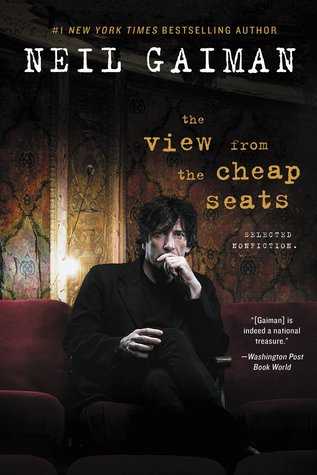
Review: The View from the Cheap Seats by Neil Gaiman

Review: The View from the Cheap Seats by Neil GaimanThe View from the Cheap Seats: Selected Nonfiction by Neil Gaiman
Formats available: hardcover, paperback, ebook, audiobook
Pages: 544
Published by William Morrow on May 31st 2016
Purchasing Info: Author's WebsitePublisher's WebsiteAmazonBarnes & NobleKoboBookshop.org
Goodreads

An enthralling collection of nonfiction essays on a myriad of topics—from art and artists to dreams, myths, and memories—observed in Neil Gaiman’s probing, amusing, and distinctive style.
An inquisitive observer, thoughtful commentator, and assiduous craftsman, Neil Gaiman has long been celebrated for the sharp intellect and startling imagination that informs his bestselling fiction. Now, The View from the Cheap Seats brings together for the first time ever more than sixty pieces of his outstanding nonfiction. Analytical yet playful, erudite yet accessible, this cornucopia explores a broad range of interests and topics, including (but not limited to): authors past and present; music; storytelling; comics; bookshops; travel; fairy tales; America; inspiration; libraries; ghosts; and the title piece, at turns touching and self-deprecating, which recounts the author’s experiences at the 2010 Academy Awards in Hollywood.
Insightful, incisive, witty, and wise, The View from the Cheap Seats explores the issues and subjects that matter most to Neil Gaiman—offering a glimpse into the head and heart of one of the most acclaimed, beloved, and influential artists of our time.

My Review:

“Fiction is the lie that tells the truth” – This is a quote that Neil Gaiman seems to have adapted from Albert Camus’ version: “Fiction is the lie through which we tell the truth.”

A good bit of this collection is about the creation of that fiction, not just his own, but also other people’s. So we get a look into how the writer does his craft, but even more of a peek at what the writer thinks about other writers’ books that he has known and loved. And sometimes that’s about the books, and sometimes that’s about the writer, and most often it’s about the love.

As a librarian, I have to say that the entire first section of this collection just warms the proverbial cockles of my book-loving and book-pushing heart. Because in it, Gaiman basically lays out his love of books and bookstores and libraries for the entire world to see. And his expression of that love is absolutely lyrical. It’s a paean to libraries and a clarion call to save them all wrapped into one beautiful ball.

He also talks a lot about the books that shaped him, both as a person and as a writer. If the “Golden Age of science fiction is twelve” or thirteen, as the age varies depending on what story he is telling, then Gaiman was exposed at just the right moment. But even if you are not a lover of science fiction, his story of escaping into books as a child will resonate for any adult who has spent their life escaping from it in books. We all started out young.

As a writer, Gaiman began as a journalist (not unlike his friend, the late, much lamented Terry Pratchett) and moved from writing for other people to writing the stories that, as he says, he couldn’t keep inside. And the stories that he wanted to read. Along the way, he passed through comic books, fantasy, science fiction and horror. As many of the languages of myth-making as he could manage. In various pieces of this collection, there are essays that speak to one or more of those interests, with digressions into movies and music.

But whatever he is, or was, writing about (or in some cases speaking about) the author’s voice shines through. And that love. Love for the genre, love for the medium, and especially love for the power of words and the worlds they create.

Escape Rating A: Because this is a collection of essays and whatnot, I don’t actually need to read the entire thing to write a credible review. But I had so much fun reading it that I could not make myself stop.

Also, I recently listened to the beginning of Neverwhere, read by the author. As I read The View From the Cheap Seats, I could hear the author’s voice in my head, especially reading the speeches. It’s a very distinct authorial voice, and a surprisingly excellent voice for reading.

(Some authors are notoriously bad at reading their own work. Gaiman is emphatically not one of them.)

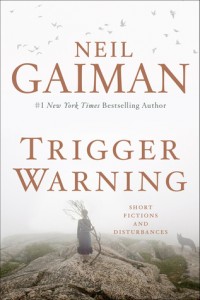
trigger warning by neil gaimanAs an essay collection, while I wouldn’t say that it is uneven the way that last year’s short story collection, Trigger Warning, was, I would say that the appeal of the collection will depend on how closely the reader’s interests match the author’s.

Anyone who loves books and reading AT ALL will enjoy the first section, Some Things I Believe. Because the author believes A LOT about the joy of reading to move us and the importance of bookstores and libraries and of simply READING.

But other parts of the collection reflect different tastes and interests. As someone who reads a lot of science fiction and fantasy, the essays in those sections, including the speeches, had plenty of resonance for this reader. The stories within the stories, the tropes that are referred to, the people being honored, are all ones that I am not just familiar with, but frequently also love. And occasionally have my own stories about.

And his writing about science fiction and fantasy and being both a reader and a writer echo my own experiences in the SF fan community.

His speech about Tulip Mania as it relates to the Comic Book Industry (Good Comics and Tulips: A Speech) should probably be read by anyone interested in the economics of fads and/or the bursting of false-demand economic bubbles.

At the same time, the sections where I’m not as invested, aren’t as interesting to me. My taste in music is different from the author’s. So while I find his essays on music interesting, they don’t move me in the same way that the ones on SF and fantasy do. They are excellently written, but don’t touch a place in my heart.

But so much of this collection does.

TLC
This post is part of a TLC book tour. Click on the logo for more reviews and features.