Grade A #JointBookReview: How a Game Lives by Jacob Geller

Grade A #JointBookReview: How a Game Lives by Jacob GellerHow a Game Lives by Jacob Geller
Format: eARC, hardcover
Source: publisher, supplied by publisher via Edelweiss
Formats available: hardcover, ebook
Genres: essays, gaming, nonfiction, storytelling, video games
Pages: 208
Published by Harper Collins, HarperPop, Lost In Cult on November 18, 2025
Purchasing Info: Author's WebsitePublisher's WebsiteAmazonBarnes & NobleKoboBookshop.orgBetter World Books
Goodreads

Over his illustrious career, Jacob Geller has written and produced a sprawling collection of video essays. Deftly interweaving video game analysis with complex narratives about art, politics, and history, Geller’s work positions games as vital tools for understanding each other and ourselves. How a Game Lives re-examines ten of Geller’s most iconic essays accompanied by his brand-new commentary, afterwords on each piece by some of the industry’s best writers, and stunning original artwork by Kilian Eng and other exceptional artists.

With videos like “Who’s Afraid of Modern Art”, “Every Zelda is the Darkest Zelda”, and “The Legacy of the Haunted House”, Geller has taught audiences how to think about the art that’s affected them. How a Game Lives immortalises those works and more, and provides boundless insight into the construction, philosophy, and afterlife of each essay.

Marlene’s Review:

There’s power in stories, though. That’s all history is: the best tales. The ones that last. Might as well be mine. – Varric Tethras in Dragon Age: Inquisition

I’ve always loved this quote because it manages to combine how I feel about games, how I feel about their characters, what makes some games live in my imagination and even my heart for decades while and even after playing them – along with the reason I’m playing in the first place. It also kind of explains why I decided to dive into How a Game Lives AND, a whole lot about how I approach the world, whether real or imaginary.

Because I play games FOR the story, to be INSIDE the story, to experience the story as a character within it and not just a consumer of it. And some of those stories LAST, not just Dragon Age but also Mass Effect, Horizon Zero Dawn and Final Fantasy X. They feature stories that can still move me and characters that I still think about – often quite fondly. (I STILL miss the original Elder Scrolls game, Arena. The sequels have never quite lived up to the first. Your gaming mileage may vary.)

The stories in games, whether games I play myself or games that I watch Galen play (he loves a good platformer where I tend to throw the controller across the room and hit one of the cats) also inform my own writing about other stories in other formats. I review books, particularly science fiction and fantasy, and there’s plenty of cross pollination between them.

As there is with pretty much every other form of storytelling, which is what games and books and movies and any other form of media ARE. If, as one writer said, “Man is the only animal that blushes…or needs to,” then stories are how we deal with some of that blushing, whether we use it to excuse or explain or change the subject entirely. Stories are how we process the world, and the stories in games are part of that processing.

A part of me is tempted – HIGHLY – to just talk back to How a Game Lives. Not to argue, but to continue the conversation, because that’s part of the point, both for the original video essays and for the book I have in real, live, hand. (I seldom get print books for multiple reasons, but this is one of the rare cases where I requested an actual, physical, reading copy from the publisher and I’m glad I did. The format works MUCH BETTER in print, but if you have to read the ebook use a black background layout for readability. Still, get the real book if you can.)

A huge part of me wants to add more fuel to the various contextual fires. I’ve read two books recently that I would have had even more appreciation of if I’d seen Geller’s essay “Fear of Cold” first, as both Michael Nayak’s Symbiote AND Sarah Gailey’s Spread Me reference John Carpenter’s The Thing in very similar ways. Also The Blackfire Blade uses golems, but it uses them in the same way that Dragon Age Origins does, starting with an ancient artifact and an unwilling victim, and I kind of want to throw that on the discussion in “The Golem and the Jewish Superhero”, along with the more traditional, if decidedly female, golem in The Maiden and the Monster.

And I would love to do a really deep dive with someone about the issues raised in “Does Call of Duty Believe in Anything?” because the question at the heart of that essay is both profound and applicable to way more than just THAT series. It’s all about the structure of narratives that in effect reinforce the status quo while doing their damndest (and most likely ours) to pretend that the status quo is neutral when it never is. Which, in its turn, jumps straight off a cliff into discussions about how opening up gaming and other media to traditionally underrepresented viewpoints supposedly ‘ruins some people’s childhoods’ and goes against a canon that originally reinforced that status quo and whether or not viewpoints in the public sphere or in art in general should be restricted to the acceptable. That way lies tyranny and book banning and I could go on all day because these essays made me THINK and that’s always an excellent thing.

Before I get down off my soapbox here, I can’t leave without adding a quote from another long-running media property, because the more I think about it, the more apropos it is. It’s part of a dialog between the still somewhat idealistic Bashir and the ever mysterious and frequently duplicitous Garak in Star Trek Deep Space 9.

Bashir: Out of all the stories you told me, which ones that you told me were true and which ones weren’t? Garak: My doctor, they all were true. Bashir: Even the lies? Garak: Especially the lies.

So I’m not here to review How a Game Lives, because it isn’t a book that lends itself to that treatment. I’m here to talk about what the book made me think about. The trick for me, much as it seems like it can be for the author, is to wrestle those thoughts into a coherent mass less than the size of, oh, say, The Lord or the Rings or the movies it spawned.

I’ve been playing computer and video games for nearly 50 years. I built my first computer out of a Heathkit in 1979 and one of the first things I did was type game code onto cassette tapes from books, because 1979 predates just about everything including even floppy disk drives and color monitors. The first games I remember purchasing were the original Zork, followed by the other Infocom text adventure games because, well, that’s what there was. I also had an Atari but that came later.

In other words, I’ve always played games, and I still do. I play because it’s fun – even when it sometimes literally hurts. There are games I play, like Diablo, because there are just some nights when pixels need to die. But the games that live, the ones that stick with me, are the games with big stories and fascinating characters, and that’s true whether I’m the actual player or whether I’m watching Galen play. Some games, like most of the Assassin’s Creed series, Ghost of Tsushima, Horizon Zero Dawn and the Uncharted series, tell great stories and make fantastic television.

So the question of ‘How a Game Lives’ or ‘What makes a game live’ are questions that I’ve been wrestling with for a long time. From a personal standpoint, the games that stick with me are the ones that make me care for their worlds and their characters, which is why Final Fantasy X has stuck with me for more than 20 years, what made the Dragon Age series infinitely replayable – at least until the latest iteration, and why I can’t make myself replay the Mass Effect Trilogy in spite of how good it was.

When I was first offered a review copy of this book, part of what appealed to me as a reviewer was that it presented an opportunity for both Galen and I to get a say. My experience of playing computer and video games is longer, but his is broader, and in the context of this book, he’s played many if not most of the Zelda games which rightfully warranted a chapter of their own in How a Game Lives – because those games certainly do.

So here’s Galen’s essay in response to “Every Zelda is the Darkest Zelda”

Childhood memories can grow dim, but one of the NES-era Legend of Zelda games was quite likely the very first game I played on a home console during a trip visiting a family member. The most vivid part of that memory was how difficult it was to deal with the Tektites; I didn’t get very far before it was time to return home.

Ocarina of Time was the Zelda game that first truly sunk its claws into me; after that I played many but not all of the successor games. It combined a good story with interesting puzzle-dungeons and a successful illusion that there was always more to its world over the next hill. That sense of having a world to explore that felt lived reached a peak in Breath of the Wild and Tears of the Kingdom. To this day, a game that combines good writing, a world to explore that feels real, and environmental storytelling is like catnip to me. It doesn’t have to be a true open world—Final Fantasy X isn’t, for example—but as long as the world has verisimilitude and rewards poking around its corners, I’ll probably enjoy exploring it.

While double-checking some facts for this review, I was reminded that Ocarina of Time came out in 1998; i.e., the year I graduated college. That fact might inspire one of the common questions regarding a platform for telling stories that sometimes still stings: “Aren’t you a bit old to be playing that?” (Marlene’s comment: At this point in my life, when I get questions like that, I just laugh. I’ve got nothing else – or at least nothing else polite – left to say.)

In his essay “Every Zelda is the Darkest Zelda”, Geller provides an answer: video game stories—or at least the ones that are written well—can grow along with the player. The experience (and hopefully wisdom) one gains as one grows older can turn a cartoon tale that features thwacking energy balls back and forth with Ganon into an exploration of adult themes such as maturation and picking up the pieces from a disastrous war…that the heroes lost. It’s not for nothing that Archive of Our Own has 329 fanfics tagged “Link has PTSD”… for a game series that also features a lot of charm and humor. As Geller points out, however, the darkness of some of the themes is balanced by a fundamental sense of hope: not necessarily the adolescent hope that Good will beat Evil and All Will Live Happily Ever after, but the messy adult hope that amelioration from disaster is, while partial, also possible.

I really appreciated Geller giving me a fresh way of looking at one of my favorite game series. The essay (and the afterward to the essay by Matt Margini) by itself is worth the price of the book. I’m glad Marlene suggested that we do a joint review; I will be following Geller’s work henceforth.

Escape Rating, well, not this time. Neither of us precisely escaped while reading this book. Instead, separately and together, we engaged with this book in a very real way, leading instead to a rather personal Reality Rating of A. Anyone interested in a discussion of video games as art, as storytelling, as a reflection on the world that game players and game creators inhabit is going to be riveted even though their brain is likely to explode while reading – and or diving back into these essays original video format.

Meanwhile, I’ll be keeping my eye out for Geller’s just announced NEXT BOOK, which, based on the book I’ve just finished, may have THE most appropriate title EVER with You’re Not Overthinking It, no matter how much the author fears he – or for that matter his readers and viewers – might be.


#BookReview: The Devil’s Due by Bonnie MacBird

#BookReview: The Devil’s Due by Bonnie MacBirdThe Devil’s Due (Sherlock Holmes Adventure #3) by Bonnie MacBird
Format: ebook
Source: purchased from Amazon
Formats available: hardcover, paperback, ebook, audiobook
Genres: historical fiction, historical mystery
Series: Sherlock Holmes Adventure #3
Pages: 384
Published by Harper Collins on October 10, 2019
Purchasing Info: Author's WebsitePublisher's WebsiteAmazonBarnes & NobleKoboBookshop.orgBetter World Books
Goodreads

After Art in the Blood and Unquiet Spirits, Holmes and Watson are back in the third of Bonnie MacBird’s critically acclaimed Sherlock Holmes Adventures, written in the tradition of Conan Doyle himself.
It’s 1890 and the newly famous Sherlock Holmes faces his worst adversary to date – a diabolical villain bent on destroying some of London’s most admired public figures in particularly gruesome ways. A further puzzle is that suicide closely attends each of the murders. As he tracks the killer through vast and seething London, Holmes finds himself battling both an envious Scotland Yard and a critical press as he follows a complex trail from performers to princes, anarchists to aesthetes. But when his brother Mycroft disappears, apparently the victim of murder, even those loyal to Holmes begin to wonder how close to the flames he has travelled. Has Sherlock Holmes himself made a deal with the devil?

My Review:

Two competing quotations ran through my brain as I read this third entry in the Sherlock Holmes Adventure series, quotes that could not be further apart if they tried. One is the famous and often misquoted, mistranslated and/or misappropriated quote from the French writer, journalist and critic Jean-Baptiste Alphonse Karr, who wrote in 1849, “plus ça change, plus c’est la même chose”. In English, that’s the more familiar, “the more things change, the more they stay the same,” and it’s a phrase that Holmes and Watson would have been well familiar with.

The other quote is considerably later, and is also frequently misquoted and misappropriated. “The more they overthink the plumbing, the easier it is to stop up the drain!” As Montgomery Scott commented, or will, in 2286.

Together, those quotes encapsulate The Devil’s Due in some rather surprising ways.

On the surface, this is very much a classic mystery conundrum, as a serial killer is stalking London. One that it seems that only Sherlock Holmes recognizes as such. The police, in the person of the odious new Commissioner Titus Billings, are MORE than willing to take the various rulings of accidents and suicides at face value. Then again, Billings is obviously more interested in convictions than justice – in more ways than one.

Billings clearly hates Holmes to the point of mania, and is well on his way to infecting all of Scotland Yard with that hate along with the gutter press who are always in search of sensational news. Painting Sherlock Holmes as being in league with devils and demons is VERY sensational indeed.

That Billings sees everyone not of his race, class and national origins as an actual devil of one sort or another just adds to the furor. Or at least Billings’ fury. Billings wants to lay every crime in London at the feet of immigrant anarchists who are naturally inferior in every way to good Englishmen. He’s even lobbying for permission to arm and militarize Scotland Yard to see all those he hates harshly regulated and eventually expelled.

Even from very early in the story, it’s clear that Titus Billings is “A” villain in this story. Whether or not he’s “THE” villain is another matter entirely.

The case, or rather cases, that Holmes is investigating in spite of Billings’ interference are puzzling in the extreme. A group of philanthropists are being cleverly murdered in ways that appear as accidents or suicides. All by different means, all by different methods, often in different parts of the country, but always including collateral family damage in the form of yet more accidents and suicides.

Holmes is doubly captured by this case because it is both so diabolically clever and because his brother Mycroft is on the list of possible victims.

And again, there’s a character who stands out as “A” villain but not necessarily “THE” villain.

So Holmes is distracted and at cross-purposes with himself in this investigation even as he does his damndest to evade both the police and the reporters who are determined to catch him in a compromised position. Even if they have to arrange it for themselves. Which they have. And do. And most definitely ARE at every turn – or perhaps that should be wrench – of the screw.

Escape Rating B-: And this is the point where those quotes come in, along with the good old British expression about “over-egging the pudding”. Because, as much as I did enjoy this entry in the series, I didn’t like it nearly as much as the others. I ended the story, and actually middled the story, feeling like the pudding had been over-egged in every direction.

Previous entries in this series have read as if they owed some of their portrait of these beloved characters to late 20th and early 21st century portrayals. That’s both to be expected and at least a bit necessary, as Doyle’s Holmes was a man of his time, and we like to at least think we’ve moved beyond some of the extreme bigotry of that era – whether we actually have or not.

But this entry in particular, due to the over-the-top, over-egged and utterly odious Titus Billings, reads as though the story crossed the line into speaking more TO our time than FROM its historical setting. Billings as a character reads like a caricature of all that is odious in our now. Not that his attitudes weren’t common and not that those prejudices didn’t exist and have terrible influence, not that the movements against homeless people (often military veterans), immigrants (popularly ALL believed to be terrorists), women (who are presumed to be hysterical), etc., weren’t prevalent, but the details of the way Billings operated felt just a bit too pointed at now instead of then.

The character very much invoked that saying about the more things change, the more they remain the same, but in his methods and what little reasoning we saw from him, he was a bit too on our time’s nose instead of his own.

On the other hand, the crime spree itself very much lived up to Scotty’s comment about overthinking a system to the point of making it easier to break instead of more difficult. Which turns out, in the end, to be exactly how the true villain gets caught in Sherlock Holmes’ trap instead of the other way around.

But again, the villainy was extremely over-egged. It got so theatrical and so complicated that not only did the right hand not know what the left hand was doing but as a reader I got more than a bit lost in all the theatricality to the point that I stopped caring about the victims and just wanted to get ALL the players off the stage so that they – and I – could recover from their collective shenanigans.

In the end I’m glad I read this one because events in this adventure do get referred to in later books, but it felt a great deal longer than Unquiet Spirits in spite of that story being nearly 150 pages longer than this one.

Speaking of other books in this Sherlock Holmes Adventure series, I’ve been winding my way through this series over the past several months and for the most part enjoying them immensely. I was planning to review the latest, The Serpent Under, THIS month for a blog tour, but the tour organizer has taken ill and postponed the tour. While that is on hiatus, I felt the compulsion to fill the hole in my schedule with a different book in the series, hence this review. This didn’t quite live up to the other books in the series for this reader, but I have to say that The Serpent Under very much did and I can’t wait until I can post that review!

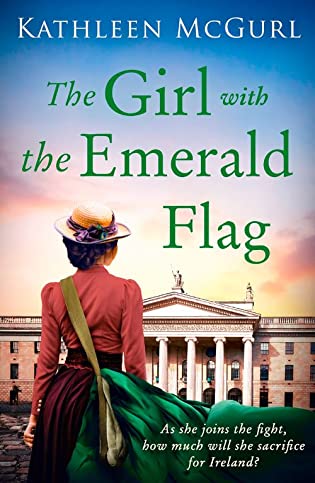
Review: The Girl with the Emerald Flag by Kathleen McGurl

Review: The Girl with the Emerald Flag by Kathleen McGurlThe Girl with the Emerald Flag by Kathleen McGurl
Format: eARC
Source: supplied by publisher via NetGalley
Formats available: paperback, ebook, audiobook
Genres: historical fiction, timeslip fiction
Pages: 384
Published by Harper Collins on November 11, 2022
Purchasing Info: Author's WebsitePublisher's WebsiteAmazonBarnes & NobleKoboBookshop.org
Goodreads

A country rebelling
It’s 1916 and, as war rages in Europe, Gráinne leaves her job in a department store to join Countess Markiewicz’s revolutionary efforts. It is a decision which will change her life forever. A rebellion is brewing, and as Dublin’s streets become a battleground, Gráinne soon discovers the personal cost of fighting for what you believe in…
A forgotten sacrifice
Decades on, student Nicky is recovering from a break-up when a research project leads her to her great-grandmother’s experiences in revolutionary Ireland. When Nicky finds a long-forgotten handkerchief amongst her great-grandmother’s things, it leads to the revelation of a heartbreaking story of tragedy and courage, and those who sacrificed everything for their country.
Inspired by a heartbreaking true story, this emotional historical novel will sweep you away to the Emerald Isle. Perfect for fans of Jean Grainger, Sandy Taylor and Fiona Valpy.

My Review:

“Those that fail to learn from history are doomed to repeat it,” or so claimed both Winston Churchill and Nicky Waters, the late 20th century protagonist of this dual-timeline story about Ireland’s Easter Rising. But another quote about history, from another continent is equally apropos. As Martin Luther King Jr. said, “The arc of the moral universe is long, but it bends toward justice.”

The early 20th century heroine of this story, that girl with the emerald flag herself, Gráinne MacDowd, witnessed the bending of that arc from its beginning in the Eastern Rising to what seems like its right, proper and fitting ending in the signing of the Good Friday Agreement, bringing peace – more or less – between the Republic of Ireland and a Northern Ireland still controlled by Britain.

But it all begins, or at least this version of it, with a college student both being rebellious and studying rebellions, and her great-grandmother – who she calls Supergran (best name for a great-grandmother EVER) – who was in the rooms where a lot of a real and significant 20th century rebellion happened.

And has a story that she has been waiting nearly a century for someone to finally want to hear.

Escape Rating A-: Nicky Waters and Gráinne MacDowd are the same age at the opposite ends of their century. It’s only Gráinne’s long life and continued good health and mental acuity that allows this story to happen.

(It’s more plausible than one might think. A friend’s grandmother, not even his ‘Supergran’, crossed the US in a covered wagon with one of the last of the wagon trains and lived to see Neil Armstrong walk on the moon.)

I digress.

This story is told in two timelines. In 1998, the year that the Good Friday Agreement was, well, agreed to, Nicky Waters is a bit spoiled, a bit selfish, a lot self-indulgent, and trying to stretch her wings at uni. It’s her need for a project on historic rebellions that kicks things off – even though she resents her mother’s suggestion that Supergran’s experiences would make a fantastic springboard for her project.

But then, she resents her mother a lot at this point in her life. They love each other but don’t seem to be sympatico at all. Some mother-daughter relationships just go that way.

The heart of the book, both literally and figuratively, is Gráinne telling her story to Nicky. And telling it to the reader as she does.

Gráinne’s story takes place over an intense period of time from the fall of 1915 when she becomes the right-hand-woman of Countess Constance Markiewicz (see quote and picture above) through the Rising itself in its glory and its inevitable defeat. And its immediate aftermath, the nights when the survivors huddled together in Kilmainham Gaol and the mornings when they heard but could not see their leaders facing one firing squad after another.

Gráinne’s story brings Nicky up short, letting her see that rebellion without good purpose has no meaning. Nicky’s turnaround was a bit abrupt, but the harrowing events that her Supergran lived through make the story shine – even if sometimes with tears.

What makes this story so touching – although that’s nearly a big enough word – is the way that it allows the reader to experience this history making and in some ways history shattering event in a way that brings the Rising and the people who gave their lives for it to vivid life.

Gráinne and her beau Emmett are the only important characters in the story who are fictional. All of the leaders of the Rising are presented as they were, and this event is more than close enough in history that documentation exists for much of what Gráinne saw, heard and felt. Including the heartbreaking jailhouse wedding between Joseph Plunkett and Grace Gifford. (I honestly expected that to be a bit of literary license but it was NOT.)

Gráinne as a character reads as both plausible and aspirational. Women really did all the jobs she performed during the Rising, and she makes the reader hope that they would have done as well in the same cause. At the same time, her example leads her great-granddaughter to do and be better, by example and not by exhortation.

Any reader who loves historical fiction, or has any interest at all in Irish history and the Easter Rising will fall in love with The Girl with the Emerald Flag as much as I did. This story is terrific, and it’s told in way that both tugs at the heartstrings and practically compels the reader to look for more.

One final note. That arc of history is still bending. In the Good Friday Agreement, the politicians on both sides basically finessed some of long-standing issues through both countries’ membership in the European Union. Brexit brought many of those issues, particularly the economic ones – as well as questions about how to deal with the border – back to life. While this is not exactly part of this story, considering that it ends when it does as a way of attempting to close the circle, it’s difficult not to point out that the circle keeps on turning.

About the Author:

Kathleen McGurl lives near the coast in Christchurch, England. She writes dual timeline novels in which a historical mystery is uncovered and resolved in the present day. She is married to an Irishman and has two adult sons. She enjoys travelling, especially in her motorhome around Europe and has of course visited Ireland many times.

Social Media Links – 

https://kathleenmcgurl.com/

https://www.facebook.com/KathleenMcGurl

https://twitter.com/KathMcGurl