
#BookReview: A Lady for All Seasons by T.J. Alexander

#BookReview: A Lady for All Seasons by T.J. AlexanderA Lady for All Seasons by T.J. Alexander
Format: eARC
Source: supplied by publisher via NetGalley
Formats available: paperback, ebook, audiobook
Genres: historical romance, queer romance, regency romance
Pages: 304
Published by Vintage on March 10, 2026
Purchasing Info: Author's WebsitePublisher's WebsiteAmazonBarnes & NobleKoboBookshop.orgBetter World Books
Goodreads

From the acclaimed author of Chef's Kiss and A Gentleman's Gentleman comes a riotous Regency romp, featuring a charming and unforgettable bigender lead.
It is a truth universally acknowledged that a single noblewoman who has lost her fortune (no thanks to her father’s terrible business dealings) must be in need (not want) of a husband.
It’s the end of the 1820 London season, King George III is dead, and there are no suitable suitors in sight. Beautiful, cunning, formerly wealthy Verbena Montrose must devise a new plan to secure a position for herself and save her odious family from abject poverty. Fortunately, what she lacks in a dowry, she makes up for in the currency of gossip. 
When she hears an alarming rumor about her very dear, very queer friend Etienne that could put him at risk of ruin (or worse), she comes to his aid with a proposal—for a marriage of convenience, that is. But when Verbena discovers that a mysterious poet by the name of Flora Witcombe has been gaining popularity and publishing poems that hint she is onto their scheme, Verbena has no choice but to pretend to be a poet herself to confront her in a local salon. And—unexpectedly—be charmed by her.
Flora agrees to rectify the issue she’s caused, not least of all because she’s terrified by and smitten with Verbena in equal measure. After all, she holds a secret of her she is also William Forsyth, a struggling fiction writer and fifth son of a minor noble family. And if circumstances don’t allow Flora to woo Verbena, perhaps William will. Faced with two suitors and a fiancé, Verbena, who has always had to know everything about everyone to survive in society, may need to learn more about herself to discover whether true happiness actually lies outside of society’s constraints.

My Review:

Verbena Montrose (a terrific name for a terrific character, TRULY) is on the horns of the same dilemma that the Bennet sisters faced in Pride and Prejudice – although Verbena’s character more closely resembles Emma from her story without Emma’s financial resources. Also, Verbena’s mother makes Mrs. Bennet look – and sound – like a saint.

Portrait of Lord Byron, c1813

Nevertheless, this is very much a Regency ‘comedy of manners’ in the style of Jane Austen, both in its setup and its language. I want to say this isn’t Austen’s world, but it most likely was. It’s just that A Lady for All Seasons delves into aspects of that world that Austen could not have written about safely. But aspects we know existed because George Gordon, Lord Byron, was every bit as ‘mad, bad and dangerous to know’ as he was painted and he is one of the secondary characters in Verbena’s story.

The story opens with Verbena. It may not, precisely be her story, and it certainly isn’t in its entirety, but she is the prime mover and shaker of events – even if often hidden in the wings. As she prefers, because that’s where she can overhear all the gossip that she frequently weaponizes for her own protection or gain.

Verbena, at least in the privacy of her own sharp mind, is extremely realistic about the way the world of the ton operates – particularly for women. Her family has lost its fortunes because her father was frankly an idiot, but Verbena is the one who is blamed AND the one who is castigated for not securing a wealthy husband. She is supposed to save the family that has denigrated her at every turn (see above comment about her mother) in order to become the property of a man who will ignore her at best and abuse her at worst.

And she knows it.

So she hatches a scheme to rescue a friend as well as herself. A marriage of convenience to her friend Étienne Charbonneau, will save him from the stocks – or worse – for being homosexual, will save her family’s fortunes, provide her with safety and security and get her out from under her mother’s control. Verbena and Étienne are honest with each other about what their marriage will be – but they are the only ones who know the secret. (Not Étienne’s secret because it isn’t really a secret in their circles, but the secret that they are both going into this arrangement willingly and with full knowledge. If her parents knew, they’d stop it even though it will rescue them as well.)

Which is where Flora Witcombe and William Forsyth come into the story. Together, because they are one and the same person. Forsyth writes novels as himself, and turns gossip into poetry as Flora. Flora is considerably more successful. She is also a fully realized individual who goes out into the world as Flora. As does William.

And thereby hangs this tale. Because Flora’s poetry threatens Verbena’s arrangements. Flora’s dear friendship with Verbena threatens Verbena’s willingness to enter into the marriage of convenience with Étienne. While Verbena’s attraction to William makes her doubt herself, in that a woman who had little interest in either romance or sex does not know how to act or react when she can’t decide between two potential lovers.

Flora / William may not be sure of their identity in any number of ways, but they’re certain they are wholeheartedly in love with Verbena. And that neither of them can have her. Unless they ALL start being honest with themselves and each other.

A situation fraught with danger and ringed by disaster, because if any of their secrets are revealed to the wrong person, ALL will be lost.

Escape Rating B-: This is a story whose reach may have exceeded its grasp. Or it didn’t grasp me nearly as much as I expected it to. Or both. In other words, definitely a mixed feelings review.

I really wanted to like this book. The premise reminded me quite a bit of Cat Sebastian’s Unmasked by the Marquess, which I loved. But part of what I enjoyed about that is that the story was more straightforward than this one is because Charity/Robert is aware of her own identity and her own motives. She may not be sure how she’s going to pull it off for the rest of her life, but she’s still sure of who she is and what she wants. Even if that want includes a life in breeches publicly playing the part of a young man with all the social privileges thereof.

So all the obfuscations were outward in that story. Here, at least in part because Verbena can’t retreat to a male persona, she’s putting on a mask 100% of the time and as much to herself and to others. I love that she’s honest about the way that her society treats women, but the way that she pretends to everyone around her AND herself gets, not so much confusing as limiting. And also results, frequently and often, in the situation I call a ‘misunderstandammit’, where so much of the conflict could be resolved if she would just have an honest five minute conversation with someone – including herself.

It’s also true that I’m not fond of the ‘comedy of manners’ style as a whole, because it practically guarantees this sort of obfuscation. So much of everyone’s surface is entirely false, everyone knows the real score and no one can ever say anything about it for fear of social ruin and ostracization. I recognize that it’s the convention of this particular kind of story, but that doesn’t mean I enjoy it.

There’s also a question about whether this is a romance or a farce. It did remind me of many of Shakespeare’s comedies, particularly As You Like It and Much Ado About Nothing, that also involve masks and changes of gender and identity and the confusion those switches in persona and personality engender. The farcical elements in A Lady for All Seasons are a huge part of the events at the country house party, as both Flora and William are guests and spend a great deal of energy pursuing Verbena in both personas and desperately flailing around to not be caught in the midst of those changes.

This has already gotten too long, so to sum things up, I liked many of the ideas that power this story. Not just Verbena’s plight of needing to find a husband without admitting that she either needs to find a husband, or needs to find a husband for his money, or really doesn’t want to find one at all and recognizes that she shouldn’t have to. As well as her recognition that she wouldn’t need one if the society she lives in didn’t force her into a straitjacket.

Flora/William’s dilemma, as we first meet them, has more depth. They are caught not just between what society demands and who they are, but also between two poles that society believes are immutable. Their crisis of identity is dangerous, potentially both heartbreaking and life threatening. They can never be themselves unless they find a partner who loves them as they are. Which requires a level of trust that means their end in both personas if they get it wrong.

In other words, this had a tremendous amount of possibility that it reached for but didn’t quite achieve. Putting it another way, this was a gallon’s worth of excellent story possibilities that only had a quart-sized number of pages to deal with everything it had on its plate and piled too much too high in order to fit everything in. Your reading mileage most likely varies.

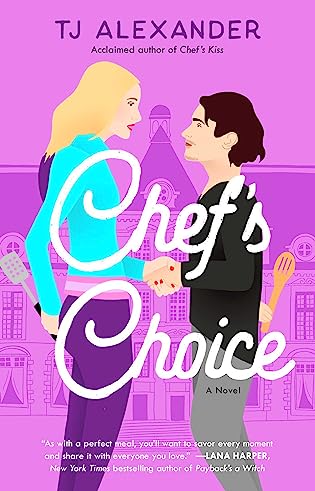
Guest Review: Chef’s Choice by TJ Alexander

Guest Review: Chef’s Choice by TJ AlexanderChef's Choice (Chef's Kiss, #2) by T.J. Alexander
Format: ebook
Source: purchased from Amazon
Formats available: paperback, ebook, audiobook
Genres: contemporary romance, queer romance, romantic suspense
Series: Chef's Kiss #2
Pages: 336
Published by Emily Bestler Books on May 30, 2023
Purchasing Info: Author's WebsitePublisher's WebsiteAmazonBarnes & NobleKoboBookshop.orgBetter World Books
Goodreads

A fake dating arrangement turns to real love in this deliciously delightful queer rom-com from the author of the sweetly satisfying Chef’s Kiss.
When Luna O’Shea is unceremoniously fired from her frustrating office job, she tries to count her blessings: she’s a proud trans woman who has plenty of friends, a wonderful roommate, and a good life in New York City. But blessings don’t pay the bills.
Enter Jean-Pierre, a laissez-faire trans man and the heir to a huge culinary empire—which he’ll only inherit if he can jump through all the hoops his celebrity chef grandfather has placed in his path. First hoop: he needs a girlfriend, a role that Luna is happy to play…for the right price. She’s got rent to pay, after all! Second hoop: they both need to learn how to cook a series of elaborate, world-renowned family recipes to prove that Jean-Pierre is a worthy heir. Admittedly, Luna doesn’t even know how to crack an egg, but she’s not going to let that—or any pesky feelings for Jean-Pierre—stop her.
Another swoon-worthy and heartwarming queer love story from a charming new voice in romance.

(More chefs! More queer folk!  Now I just need the sci-fi. Marlene’s recommendation in a comment on my last post has been added to my reading list, so look for a review on that once conference season is over for me.)

Guest Review by Amy: The opening chapter of this book hit me like a shovel to the face; Luna O’Shea gets fired, abruptly, for no other apparent reason than for being transgender. This is something that is unfortunately common among gender non-conforming people in the United States, and  that sort of discrimination is not even prohibited  by law in much of the country. Having had a number of friends this has happened to, I found the chapter very triggering and unpleasant, and I had to put the book down and sleep on it, complete with nightmares of me being treated that way.  I was tempted to tell Marlene this was a “DNF,” a book that I simply could not finish. But I knew deep in my soul somewhere that author TJ Alexander would not do us dirty like that, and there was something good right behind that painful setup. Turns out, I was right, and I’m glad I kept reading. Once you’re past the rocks and shoals of that first chapter, there’s a lovely, fun story to be had here.

Escape Rating: A+. “Wealthy heir-apparent must appear to be in a relationship to inherit, so he gets a fake girlfriend” is a tried-and-true plot; the romance industry has made use of it for decades, and it’s a great venue for some really comedic scenes. TJ Alexander gives us a slight twist on it here; the wealthy young Frenchman Jean-Pierre isn’t simply an idling playboy, he’s also a transgender man, so there’s some family-acceptance issues in his life, too. His famous chef grandfather has set him a challenge:  recreate a pretentious, difficult nine-course meal that he is famous for, and he’s the heir. Fail, and he’s out of the will.  He needs a fast cover story for why he’s in New York, instead of talking to his (also famous chef) grandmother from the other side of the family, and transwoman Luna takes the bait – money, of course – and finds herself embroiled in family drama.  They’re going to take Papi’s challenge…but neither of them have a clue how to cook.
Our story begins a few months after the end of the companion story, Chef’s Kiss, and Simone and Ray figure in heavily, along with some of the other supporting cast from the earlier novel. I was delighted to see this, as I had really enjoyed the development of their relationship, and seeing what it looked like some months later as an established relationship was nice for me. It gave me a sort of Nora Roberts-esque wish that there was a third story to tell here somewhere, that could be plugged in around these two.

Meanwhile, back to the future in Chef’s Choice…as simply must happen, the not-couple is forced to act like a couple by circumstance way too early, when Luna’s mom shows up, drawn to town by the paparazzi pictures of her daughter with the young man, and a visit to Luna’s weekly friends-gathering at the local pub. Smooth, urbane Jean-Pierre handles all this with a healthy dose of Gallic stubbornness, but when Luna points out that their arrangement is little different from sex work, he loses his cool for a bit. There’s some back and forth – these two complicated people are trying really hard to make it look like they’re the perfect couple, and the challenges pile up fast.

The pair spend a weekend at his grandmother’s lavish condo being taught to cook by Simone and Ray, and we get some of the first hints that something more might be afoot for Luna and her “JP.”  Ray is non-binary, and when introduced, Jean-Pierre takes some time to make sure he has their pronouns right in both French and English. Luna finds that sort of caring unspeakably hot – she wants to “shove JP against the labeled shelves and grind like a freaking pepper mill.” That particular statement had me laughing loudly. The book is liberally garnished with fantastic one-liners and in-jokes like that, and it helps make the well-trodden plot a light, fun read, even through all the trials and tribulations.

I shan’t ruin the ending for you. In my review of Chef’s Kiss, I gigged the book slightly for its abrupt ending. I have no such complaint here; Jean-Pierre and Luna go to France for the cook-off, and the various threads of the story come together into a smooth, satisfying end. Along the way, Alexander grasps the question of “what makes a man, a man?” in their development of Jean-Pierre’s character, and touches on how gender non-conforming folks may struggle with the choice of how to interact with the world around them. Both questions are handled in a most gentle way, giving the reader space to consider these matters for themselves without struggle or pain.

Normally, in a book review, we don’t spend much time on the author’s acknowledgements, but this bit at the very end stuck out to me:

So if you’re reading this, you beautiful, powerful, tired trans person, please know that this was my love letter to you. I hope it brought you a little joy; you deserve every bit you can get.

Both of the tales in this series absolutely did. TJ, if you ever read this: thank you, from the bottom of my non-binary transgender heart.

TJ Alexander writes with mandoline-sharp wit, a clever eye for details, and a deep understanding of queer life and culture. This work, like its predecessor, gets my strongest possible recommendation.
Guest Review: Chef’s Kiss by TJ Alexander

Guest Review: Chef’s Kiss by TJ AlexanderChef's Kiss (Chef's Kiss, #1) by T.J. Alexander
Format: paperback
Source: publisher
Formats available: paperback, ebook, audiobook
Genres: contemporary romance, queer romance, romantic comedy
Series: Chef's Kiss #1
Pages: 308
Published by Emily Bestler Books on May 3, 2022
Purchasing Info: Author's WebsitePublisher's WebsiteAmazonBarnes & NobleKoboBookshop.orgBetter World Books
Goodreads

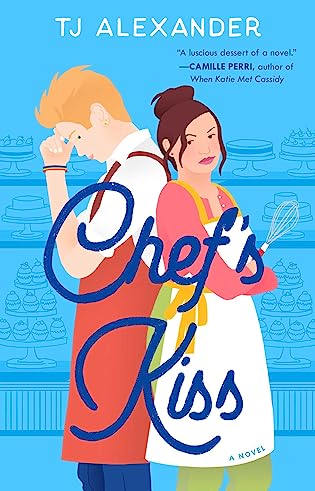
A high-strung pastry chef’s professional goals are interrupted by an unexpected career transition and the introduction of her wildly attractive nonbinary kitchen manager in this deliciously fresh and witty queer rom-com.
Simone Larkspur is a perfectionist pastry expert with a dream job at The Discerning Chef, a venerable cookbook publisher in New York City. All she wants to do is create the perfect loaf of sourdough and develop recipes, but when The Discerning Chef decides to bring their brand into the 21st century by pivoting to video, Simone is thrust into the spotlight and finds herself failing at something for the first time in her life.
To make matters worse, Simone has to deal with Ray Lyton, the new test kitchen manager, whose obnoxious cheer and outgoing personality are like oil to Simone’s water. When Ray accidentally becomes a viral YouTube sensation with a series of homebrewing videos, their eccentric editor in chief forces Simone to work alongside the chipper upstart or else risk her beloved job. But the more they work together, the more Simone realizes her heart may be softening like butter for Ray.
Things get even more complicated when Ray comes out at work as nonbinary to mixed reactions—and Simone must choose between the career she fought so hard for and the person who just might take the cake (and her heart).

Note from Amy: I realized as I was writing this that I’ve been gone from these pages since the beginning the COVID-19 pandemic; my last review was for Melanie Yaun’s PsyTek. In the early days of the pandemic, just weeks after that review was posted, we lost Melanie, so the rest of that story, sadly, is lost to us, as is her brilliant work at our shared day job, her joyous wit, and her dear, dear friendship.  In the time since then, I’ve not been as much of a reader or writer as I have been in the past. But the subject of today’s post, perhaps, marks a turning point for me, where I can get back at the keyboard.

Guest Review by Amy: Two people, who get a crush on each other and spend most of the book circling around that fact through an assortment of tribulations, until one of them apologizes and says they’ll never mention it again, and the other says, “wait, what?” and they ride off into the sunset together.  Tropey as it comes, right?  That’s the basic recipe for a rom-com, isn’t it?

When I saw a queer romance, involving a chef, I was all-in. I love to cook (ask Marlene!) and I love queer romance almost as much as I love sci-fi.  If there’s ever a queer romance set on a spaceship involving the ship’s cook, I may spontaneously combust. (Marlene’s comment: Ryka Aoki’s marvelous Light from Uncommon Stars is more cooking than cheffing, but there’s a spaceship and a queer romance and donuts and it’s marvelous. I’ll be prepared to pick up your pieces if you combust upon reading.) 

Escape Rating: A+:  One of the things that makes a whole lot of romances work is that they draw the reader – usually a female – into identifying with the – usually a female – protagonist.  It’s a formula that has driven Harlequin’s success since before Marlene or I were born.  But what happens when the reader is not drawn into the world of the protagonist from whose eyes we are seeing the story, but to their love interest?  In my case, that is what happened in Chef’s Kiss.  Our protagonist, and the lens through which we see author TJ Alexander’s New York City setting, is Simone, a trained chef, who works at a fairly staid old media company producing recipes in a test kitchen. She’s happy with her situation; it’s her dream job!  Sure, it doesn’t pay as well as it could, perhaps, but the magazine has been losing subscriptions for a while now, because 21st century, you know…

Other reviewers, and indeed, the book’s back cover, call Simone “high-strung,” but to my eyes, that is kind of a cheap shot, as no one calls her that between the covers of the book, and I’m just not seeing that. She’s a bit uptight, perhaps, something of a perfectionist, and rather resistant to change, certainly.  So when the publisher of the magazine calls her in and tells her their whole business model is changing to creating video content, and then she discovers that the long-time kitchen manager has been replaced by a much younger and more energetic person who is going to change literally everything in her orderly world, she is, to put it mildly, kind of agitated about it. I get that, and I don’t think that classifies as “high-strung.”  She’s just behaving…well, like I might, in her shoes.  And I’m not high-strung.  Am I? (Marlene’s comment: No, you’re not. Or I am too and we’re NOT going there because cheap shot is still cheap.)

It doesn’t take long, of course, until the bisexual Simone falls for the tall, good-looking and energetic new soul in the kitchen, though – Ray is super-cute, enjoys wearing a leather apron, and looks really good in it. But they’re just colleagues, you know…then, just friends, of course…

The publisher’s video guy accidentally posts a clip of Ray being hilarious and awesome on the magazine’s channel, and it goes viral, and all of a sudden, the strategy for media is changed, and Simone and Ray are co-hosting a hit show on YouTube, much to the chagrin of the company’s arrogant social media manager.  Things rock on pretty well, until…

Okay, I’m going to have to level with you here. I’m not an unbiased reader; Ray is non-binary, tending toward masculine, and I’m non-binary, tending feminine. When Ray comes out at work, they have mixed results. While Simone and the other kitchen staff are supportive, management (including that snooty social media maven) are not, continually dead-naming and misgendering them. And Ray tells their allies in the kitchen to not make a fuss, because they cannot lose this job – and when we as readers are informed of why, when Ray tells Simone, my heart just broke for them.

Yes, this story is a rom-com. And yes, it’s got all the classic elements of one – the not-quite-understanding each other’s subtexts, the “I said things when I was drunk” night, the “we’ll never mention this again.” But there is a second story here, and it’s one that Simone shows us in some pretty sharp detail – Ray’s struggle for their identity and acceptance. Simone is there for Ray, as they are Going Through It, tending to them through what – for both Ray, and for me – are some of the toughest moments of their life. Ray’s path, because it mirrors my own, resonated forcefully with me, even though the details of their path are quite a bit different from my own. It’s the same struggle, really: the struggle to be themselves.  It is a struggle I have lived with for over a decade now, and seeing Ray’s life through Simone’s eyes brought me back to some of the difficult moments of that period.

Simone is going through her own struggle, too, being a mostly-closeted bisexual woman, and when she outs herself to her manager (in the discussion over Ray’s coming-out), you see her own frustration with the struggle she sees coming. It’s not on the scale of Ray’s, but it’s there, and we get to see her respond to that in a really rewarding way when she points out to her boss that “You’re the only straight person in the room.”

Cisgender and/or straight readers might not get that resonance, and for those readers who don’t, this is still a fantastically cute, sassy, well-crafted rom-com with a little steam and some great food for thoughtful reflection. If you’re one of those readers, that’s okay, though this reviewer’s hope is that seeing Ray and Simone’s struggles educate you a bit, and give you a better feeling for those people around you who may not fit in the same mold you do. For queer folk and their allies, though, there’s so much more to see and feel here. My one gripe about this book is that the ending came too quickly, the resolution a little bit deus ex machina for my tastes – the happy-for-now ending came quite abruptly, even though it was a good end to the tale. This was TJ Alexander’s first work, and I am going to read their second work, the follow-on Chef’s Choice, right away. I’m hungry for more.