
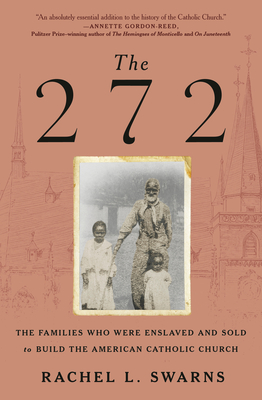
 The 272: The Families Who Were Enslaved and Sold to Build the American Catholic Church by Rachel L. Swarns
 Format: ebook
Source: publisher
Formats available: hardcover, ebook, audiobook
Genres: African American History, history, U.S. history
Pages: 326
Published by Random House on June 13, 2023
Purchasing Info: Author's Website, Publisher's Website, Amazon, Barnes & Noble, Kobo, Bookshop.org, Better World Books
Goodreads
“An absolutely essential addition to the history of the Catholic Church, whose involvement in New World slavery sustained the Church and, thereby, helped to entrench enslavement in American society.”—Annette Gordon-Reed, Pulitzer Prize–winning author of The Hemingses of Monticello and On Juneteenth
In 1838, a group of America’s most prominent Catholic priests sold 272 enslaved people to save their largest mission project, what is now Georgetown University. In this groundbreaking account, journalist, author, and professor Rachel L. Swarns follows one family through nearly two centuries of indentured servitude and enslavement to uncover the harrowing origin story of the Catholic Church in the United States.
Through the saga of the Mahoney family, Swarns illustrates how the Church relied on slave labor and slave sales to sustain its operations and to help finance its expansion. The story begins with Ann Joice, a free Black woman and the matriarch of the Mahoney family. Joice sailed to Maryland in the late 1600s as an indentured servant, but her contract was burned and her freedom stolen. Her descendants, who were enslaved by Jesuit priests, passed down the story of that broken promise for centuries. One of those descendants, Harry Mahoney, saved lives and the church’s money in the War of 1812, but his children, including Louisa and Anna, were put up for sale in 1838. One daughter managed to escape. The other was sold and shipped to Louisiana. Their descendants would remain apart until Rachel Swarns’s reporting in The New York Times finally reunited them. They would go on to join other GU272 descendants who pressed Georgetown and the Catholic Church to make amends, prodding the institutions to break new ground in the movement for reparations and reconciliation in America.
Swarns’s journalism has already started a national conversation about universities with ties to slavery. The 272 tells a bigger story, demonstrating how slavery fueled the growth of the Catholic Church in America and bringing to light the enslaved people whose forced labor helped to build the largest religious denomination in the nation.
My Review:
The 272 is a book that asks the questions, “What does the past owe to the present?” with the inevitable follow-up, “If a debt is owed, how and to whom does it, can it, should it, get paid?” Putting it another way, it’s a book that exemplifies the famous quote from William Faulkner, “The past is never dead. It’s not even past.”
That Faulkner, at least according to his Wikipedia page, was “a towering figure in Southern literature” adds more than a bit of irony to the mind-boggling appropriateness of the quote, as the history that is detailed in The 272 and the issues that history raises, are very things that Southern literature often dealt with through stereotyping and/or sweeping narratives dealing with issues of race and racism under the biggest rug they could find.
The 272 lifts that rug, on the slaveholding and slave trading history of the Catholic Jesuit Order in the United States and the early years of the Jesuit’s first American college, now Georgetown University – and their creation of all the Jesuit colleges that followed. It does so by taking the reader into the history of one family, the Mahoneys, who were owned by the Jesuits, sold by them, broken apart by them, and tracing that family’s history through sales, relocations, forced separations and joyous reunions, from the first documented member of that family, a woman whose freedom was easily stolen because she was black, all the way down to a man who is sitting in his own office at Georgetown University as his distant cousin relays to him that his employer once owned his ancestors.
There are two “stories’ being told in The 272 that weave together in a braid that begins with one indentured black woman on a Maryland plantation in 1676 (during this period both blacks and whites came to America as indentured servants to be freed at the end of their term of indenture) and ends with her hundreds of living descendents learning that they are all part of one family that was bought, sold, twisted and torn by a single institution. An institution that still exists and was able to survive to the present day because of the money that institution received for selling the crops and goods their direct ancestors produced and finally selling their ancestors themselves in one massive slave sale that was hidden in plain sight in Georgetown University’s records.
And there’s the flip side of that story, of the priests and the church that they served, mendaciously espousing the idea that it was more important to save those same slaves’ souls than it was to care for their bodies or, most especially, to grant them the freedom that their very order had come to America for. And to never see the contradiction and the hypocrisy in their teaching and their practices. To only see the money that could be made by selling their labor or their bodies. That money kept Georgetown itself financially afloat after years of mismanagement AND provided the seed money for the network of Jesuit colleges that exists to this day.
“The past is a foreign country; they do things differently there.” Or so goes the other famous quote about the past, attributed to L.P. Hartley. Which leads to the questions raised at the very beginning of this review, the question of what does that past owe to its descendants in the present? What does Georgetown University, the institution that still exists today because of that mass slave sale back in 1838, owe to those people in that past, and re-sold and torn apart by that same institution, even though that debt can only be paid to their descendants in this present day? It’s a question that is still in the process of being answered.
Reality Rating A-: Nonfiction is always hard to rate, because there are two factors involved. There’s the story being told, and then there’s the way that story is being told. The two parts don’t have to be in sync, and they aren’t quite here.
The story that’s being told in The 272 is a compelling one. It deals with racism and history and politics and money and religion. That’s not merely lot but any of those topics are more than meaty all by themselves to have the potential for a thought-provoking or even mind-altering book. And The 272 certainly does both.
The history, although in the main the story follows a pattern that is well-known, by focusing that pattern of promises made, promises broken, families broken, freedom sought, sometimes found and always abrogated by the reality of who holds power over whom on a single family traced through history the reader is made to feel its effects in the way that the dry recitations of history often do not.
That being said, the story as written is still just a bit dry. It is history and it does relate a lot of archival details that I personally found interesting. But the author resisted the temptation to put words or feelings into the heads of people whose words and feelings were not left in the historical record. (Which has the potential to be a whole discussion of its own.) That choice makes the history feel authentic, but also puts the reader at more of a distance from the narrative.
What does, however, add to the compulsion to read The 272 in pretty much one sitting is that the words and thoughts of the Jesuit priests who conducted this, let’s call it a legal atrocity and crime against humanity were recorded in their own words, and that racism, self-serving stereotyping and self-dealing hypocrisy ring off every page. It’s a drumbeat that echoes in the reader’s head long after the last page is turned.
The sale was never hidden, because it never needed to be. Which should be a crime in and of itself. But it faded into the shadows of history and seems to have been quietly swept under that rug until the mid-2010s. That’s when buildings named for the two perpetrators of this heinousness were being remodeled and research blew the dust off the archives sheltering the reputations of those ‘founding fathers’ of the University. Which led to a series of articles in the New York Times, the renaming of the buildings, this book, a family reunion of the Mahoney family from all parts of their eventual diaspora, and an ongoing series of dialogs between the University and the descendants on that question of what does that past owe to this present.
What brought me to this book this week is Banned Books Week. Not because this book has been banned or challenged – at least not yet – if only because it was just published in June 2023. However, this is a book that absolutely has the potential to be challenged and even banned because of the very questions that it addresses. The book challenges the ‘accepted’ narratives not just around slavery but also around the Catholic Church, which is the single largest denomination in the U.S. today. (There are more Protestants, but the Protestants are split among multiple denominations.)
The common thread among the books that get banned and challenged is that they tell stories that question accepted narratives and history. There are ongoing attempts to rewrite the history of slavery in the United States, trying to reframe it in ways that make it seem anywhere from less awful to downright benevolent, that have the goal of erasing the proven concept that the history of racism and slavery in the U.S. has a continued effect in this country and especially on the People of Color within it to the present day that still needs to be addressed.
The 272 asks questions, similar to the questions raised in The 1619 Project, which has been banned and challenged repeatedly in the years since it was published. The 272 has a tighter focus, but will still cause the same discomfort among the same people who The 1619 Project made uncomfortable. As a consequence, I will not be surprised, although I will be frustrated, disappointed and angry, to see The 272 on the list of banned and challenged books in the years to come – even if this is one of those times when I would very much prefer to be wrong.