
#AudioBookReview: Hot Chocolate on Thursday by Michiko Aoyama translated by E. Madison Shimoda

#AudioBookReview: Hot Chocolate on Thursday by Michiko Aoyama translated by E. Madison ShimodaHot Chocolate on Thursday (Marble Cafe, #1) by Michiko Aoyama
Translator: E. Madison Shimoda
Narrator: Ami Okumura Jones, Daniel Bunton, Nicky Talacko, Winson Ting
Format: audiobook, eARC
Source: purchased from Audible, supplied free by publisher via Edelweiss
Formats available: hardcover, ebook, audiobook
Genres: healing fiction, relationship fiction, translated fiction, world literature
Series: Marble Cafe #1
Pages: 208
Length: 3 hours and 36 minutes
Published by Hanover Square Press, Harlequin Audio on February 17, 2026
Purchasing Info: Author's WebsitePublisher's WebsiteAmazonBarnes & NobleKoboBookshop.orgBetter World Books
Goodreads

Across a bridge in a quiet neighborhood in Tokyo, a seasonal cherry blossom sits on the river. Nearby is the Marble Cafe, where a woman writes in a notebook and a young waiter prepares her favorite hot drink. Both wonder about each other and about the other lives of the clientele who frequent this charming little cafe behind the trees...
Without even realizing it, we may touch and change someone else's life.
Taking a walk along the river, cooking the best tamagoyaki, ordering hot chocolate, forgetting to remove our nail polish... The small, everyday acts that we do can lead to unexpected encounters and reverberate far beyond your own circle and ultimately make a difference in the world.
Hot Chocolate on Thursday is a tapestry of slice-of-life moments that each open and close with a woman ordering her regular hot chocolate at the mysterious Marble Cafe. What happens in between will touch and swell your heart, as we connect with a community of untold unfolding lives.

My Review:

This interconnected collection of short stories begins, and ends, with a young woman arriving at the cozy little Marble Cafe in Tokyo to order a hot chocolate. On Thursday. Always on Thursday, always at 3 pm.

It makes a delightful little treat for her, for the cafe’s manager, and for the reader as well. Because the story in between that manager’s perspective of her and her regular visits at the beginning and her perspective at the end is every bit as round as a marble, just like the cafe’s name.

The story is passed from one character to the next, each linked to the one before and the one after. Taken as a whole, they represent a community holding hands, one to another – and occasionally stretching across – until the circle is complete – and neverending.

And it’s all due to one man’s, one Maestro’s, orchestration. Not in a negative or manipulative way, but through the links that he facilitates simply because he enjoys the thrill of discovering a new talent or just a new possibility within the circle of life.

It begins in the Maestro’s Marble Cafe, where he is hoping to find a full-time manager so that he can travel the world orchestrating meetings and connections – and just generally bringing people together and bringing both talent and joy to the attention of those who will appreciate them.

His new manager walks in off the street looking for a job, the Maestro hires him on sight and is off on his adventures – while the new manager makes the place his own and falls in love with the woman he calls ‘Miss Hot Chocolate’ for her weekly habit of coming in and brightening his day.

Between the two of them, Miss Hot Chocolate and her just as secret regard for the manager she thinks of as ‘Mr. Hot Chocolate’ for the caring way he treated a very young customer (and his father) who ordered hot chocolate the first time she visited the cafe, they connect to every other story.

From that little boy and his frantic working mother and her artist husband, to the child’s teacher and her best friend, and outward to another artist, Miss Hot Chocolate’s best friend in Sydney, and around the circle of friendship and love and life.

As one of the characters says in the story, “All that breathes on this Earth is interconnected.” A truth that is delightfully portrayed by every story that begins with one young woman’s order of hot chocolate on Thursday.

Escape Rating B: When I’m in the right mood, looking for a reading – or in this case listening – pick-me-up but not wanting to dive into something big or deep or especially dark and depressing, I pick up one of these novellas. There are a LOT of them available in translation now, all inspired in one way or another by Before the Coffee Gets Cold.

They’re always a treat, whether entirely sweet as this one is or a bit bittersweet like Coffee – whether there’s as much chocolate in the story as this one has or not. This author’s first available book, What You Are Looking For Is In the Library, is still one of my favorites of the genre.

While this one doesn’t quite rise to that level, I did enjoy it just a bit more than I did The Healing Hippo of Hinode Park by the same author. However, I’m pretty sure that’s a ‘me’ thing as that book included several stories told from a child’s point of view where the narrators’ voicing didn’t quite match up to the child-like perspectives.

Hot Chocolate on Thursday worked particularly well on audio, as there are not one but four narrators who skillfully portrayed multiple characters in the story. (Consider this comment an abridged version of my usual rant about multi-cast audiobooks NOT including the details of who narrated which characters or sections. Because credit is certainly due!)

One of the things that worked really well in this collection is the way that the stories clearly linked to each other from the beginning. The links between the individuals, the Maestro, and the cafe were often subtle, with the full extent of the Maestro’s involvement not at all obvious until near the end, but that didn’t matter as the links between the stories – or rather between the people in the stories, were explicit without hitting the reader over the head.

In other words, the handoffs were very well done and the themes that emerged came about organically in a way that was just as sweet as the chocolate in the story. I enjoyed my listening to Hot Chocolate on Thursday, and it was just the right length for the time I had this week. Now I’m looking forward to my next visit to the Marble Cafe with Matcha on Monday, coming in July.

#AudioBookReview: The Healing Hippo of Hinode Park by Michiko Aoyama, translated by Takami Nieda

#AudioBookReview: The Healing Hippo of Hinode Park by Michiko Aoyama, translated by Takami NiedaThe Healing Hippo of Hinode Park by Michiko Aoyama
Translator: Takami Nieda
Narrator: Naruto Komatsu, Kenichiro Thomson, Susan Momoko Hingley, Yuriri Naka, Ami Okumura Jones
Format: audiobook, eARC
Formats available: hardcover, paperback, ebook, audiobook
Genres: relationship fiction, sad fluff, translated fiction, world literature
Pages: 256
Length: 4 hours and 57 minutes
Published by Hanover Square Press, Harlequin Audio on September 23, 2025
Purchasing Info: Author's WebsitePublisher's WebsiteAmazonBarnes & NobleKoboBookshop.orgBetter World Books
Goodreads

The enchanting new novel by the multimillion-copy bestselling author of What You Are Looking For Is in the Library, about five strangers who each seek comfort from a healing hippo ride.
Nestled at the bottom of a five-story apartment block in the community of Advance Hill is the children's playground in Hinode Park, where you will find a very special age-old hippo ride named Kabahiko. According to urban legend, if you touch the exact part of the hippo where you have an ailment or wound, you will see swift signs of recovery. They call it "Healing Hippo."
In The Healing Hippo of Hinode Park, the apartment residents each find their way to Kabahiko, confessing their troubles and drawing upon the hippo's rumored abilities. From a struggling student who pets the hippo's head to reverse his poor academic performance to the lonely new mother who hopes that touching the hippo's mouth will allow her to better express herself, this heartwarming, eclectic cast of characters will all come to Kabahiko for healing in their lives—though they may not always find it in the ways they expect.
With Aoyama's classic charm and emotional power, The Healing Hippo of Hinode Park is a deeply moving celebration of kindness, community and understanding.

My Review:

I picked this up because I LOVED the author’s first book, What You Are Looking For Is in the Library and was hoping for more just like it. That particular book is one of my favorites among the current trend of mostly light, slightly bittersweet, loosely linked stories that are more about healing and interconnected relationships than they are anything else. Often, these stories have just a touch of magical realism, as was particularly true in the book that seems to have started the trend, Before the Coffee Gets Cold.

The “Healing Hippo of Hinode Park”, the playground statue at the center of this neighborhood and the people who come to perch on the hippo Kabahiko’s back in hopes of fixing whatever part of them is currently broken, is not magical in any demonstrable sense. Although neither was the library in the author’s first book.

The magic in Kabahiko is really the magic of the human spirit. The hippo just gives that spirit a bit of focus. Or perhaps that’s clarity. It could just be that Kabahiko provides a listening ear and an open heart into which someone, several someones, can pour their troubles and hear THEMSELVES and what’s at the heart of their current predicament.

The theme behind these interactions with the hippo seems to be that “It’s never too late to be what you might have been.” It’s also never too early.

In each person who comes to Kabahiko for healing, whether child or teen or adult, it seems, or it feels, or both, that they have a physical ailment. Each chapter is named for the part that the person thinks they need to heal.

But the stories here aren’t about the physical. They’re about anxiety manifesting physically. They’re about suppressing one’s own voice out of fear of what others will think. Or fear of embarrassment or being ostracized or of looking out of touch with the world. Each person has closed themselves off from their authentic self – but the part that they’ve locked away has to find another avenue for drawing attention to itself so that the situation can be resolved. Which means that something hurts in the physical sense as a way for the body to express the emotional pain. Or blockage. Or both. Definitely both.

The individual stories, from the student who discovers he can no longer skate through school to the mother who lets a ‘mum group’ she doesn’t even like walk all over her to a middle-aged man resenting the changes that the years have brought instead of making the life he has the best it can be, are individually lovely and heartwarming and utterly real in their exploration of human nature and human relationships.

Which just makes the reader hope for, long for, or perhaps even look for, a Kabahiko somewhere near so that they, too, can be healed.

Escape Rating B: I have to confess that while I did like this one, I didn’t like it quite as much as I did the author’s first book. Which probably has a whole lot to do with the library setting of that first book, AND that I didn’t personally get into quite as many of the individual scenarios in this book as I did in the Library. Because, well, library.

Howsomever, when I listened to The Healing Hippo of Hinode Park, it turned out to the perfect listen for a busy week as each chapter was precisely the right length for my drive. It felt like each day I’d gotten a whole story, a happy ending, with nothing hanging over me but the anticipation of a new story the next day.

This is a multi-cast recording, and the readers for each individual story generally fit well into their characters, although as usual I have to register a tiny complaint that I don’t know who read whom so that I can look for the voice actors in other audiobooks.

I especially enjoyed the way that the overall theme made the individual stories have a more universal feel than I initially expected. The ‘mum group’ story drove me a bit batty until she stopped being a doormat but that’s definitely a ‘me’ thing.

In general, books like this are ones that I turn to when I need a quietly happy comfort read instead of a cathartic and generally murderous comfort read. I love the way the individual stories ‘magically’ get connected in the end, and they all seem to have just the right amount of fluff, but real fluff and sad fluff, to fit this kind of mood.

So if you’re looking for a light reading pick-me-up, pick up The Healing Hippo of Hinode Park, What You Are Looking For Is in the Library, or my other personal fave, The Kamogawa Food Detectives, and leave the world behind for a light and emotionally refreshing story.

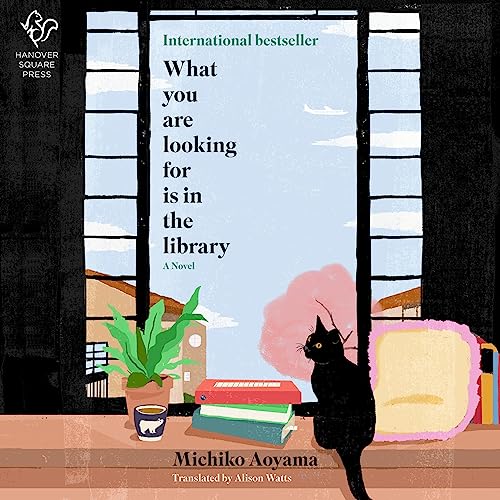
Grade A #AudioBookReview: What You Are Looking For Is in the Library by Michiko Aoyama, translated by Alison Watts

Grade A #AudioBookReview: What You Are Looking For Is in the Library by Michiko Aoyama, translated by Alison WattsWhat You Are Looking For Is in the Library by Michiko Aoyama
Translator: Alison Watts
Narrator: Hanako Footman, Susan Momoko Hingley, Kenichiro Thomson, Winson Ting, Shiro Kawai
Format: audiobook, eARC
Source: purchased from Audible
Formats available: hardcover, paperback, large print, ebook, audiobook
Genres: books and reading, magical realism
Pages: 304
Length: 7 hours and 19 minutes
Published by Hanover Square Press, Harlequin Audio on September 5, 2023
Purchasing Info: Author's WebsitePublisher's WebsiteAmazonBarnes & NobleKoboBookshop.orgBetter World Books
Goodreads

For fans of The Midnight Library and Before the Coffee Gets Cold, this charming Japanese novel shows how the perfect book recommendation can change a reader's life.
What are you looking for?
This is the famous question routinely asked by Tokyo’s most enigmatic librarian, Sayuri Komachi. Like most librarians, Komachi has read every book lining her shelves—but she also has the unique ability to read the souls of her library guests. For anyone who walks through her door, Komachi can sense exactly what they’re looking for in life and provide just the book recommendation they never knew they needed to help them find it.
Each visitor comes to her library from a different juncture in their careers and dreams, from the restless sales attendant who feels stuck at her job to the struggling working mother who longs to be a magazine editor. The conversation that they have with Sayuri Komachi—and the surprise book she lends each of them—will have life-altering consequences.
With heartwarming charm and wisdom, What You Are Looking For Is in the Library is a paean to the magic of libraries, friendship and community, perfect for anyone who has ever found themselves at an impasse in their life and in need of a little inspiration.

My Review:

A 21-year old sales assistant, a 35-year old accounts manager, a 40-year old former magazine editor, a 65-year old recent retiree and a 30-year old who hasn’t found his way. Three men and two women. Different ages, different stages of life, different choices IN life. What do they have in common?

Each of these characters is at a crossroads in their lives, and each of them has taken the fork in the road that leads to the library. But not just any library, but the library in the Hatori Community Center, where Sayuri Komachi reigns over the reference desk as she relentlessly stabs her needle into her latest felting project.

Ms. Komachi has a gift, and not just for handicraft.

The characters in this collection of individual stories find their way to Mr. Komachi’s desk in the middle of their first-person narratives. So the reader – or in my case listener – already has an idea of what’s going on in their life at this particular moment and what decision – or lack thereof – has brought them into the busy, bustling Community Center to face its stabbing librarian.

(One of the narrators, that 30-year old who sees himself as a failed artist, both sees and hears Ms. Komachi with her furious needle as a fearsome character from a famous manga that both he and the librarian are familiar with.)

The librarian’s gift is to be the best this librarian has ever heard of at conducting what we call a “reference interview”. Ms. Komachi doesn’t just listen to what each person manages to say that they want, but also to intuit what each one actually wants and what information they need to make that happen – even if they had no idea themselves what was lurking in their heart of hearts.

She gives each person a ‘bonus gift’ from her box of complete handicrafts and sends them on their way, often with puzzled expressions on their faces as they try to figure out how what they blurted out resulted in something never expected but needed all the same.

Escape Rating A: Obviously I picked this up for the title, and I doubt that anyone is surprised by that. However, while I expected to like this book, I was surprised by just how charmed I was by each of the individual stories – whether or not I was feeling that particular character’s particular angst – or not – as they began their narrative.

Each story is individual – at least as it begins – with the initial link between the characters only in their encounter with the Community Center and Ms. Komachi. It’s only as we proceed from one to another we realize that they ARE interconnected, one directly to another, and that their collective connections form a community and ultimately a society.

Which also the theme of the retiree’s story that closes the book.

Because these stories are initially separate, and are told from each narrator’s first-person perspective, the choice the producers made to have a different voice actor for each section feels like the correct one. Each voice actor embodied their character while also making the voices of the people they encountered along their way distinctive.

That different characters therefore voiced Ms. Komachi rather differently, which also reflected their individual perspectives and worked particularly well. Even though by listening I missed the artist’s rendering of the individual characters that accompanied each story, I’m still happy that I listened to the audio instead.
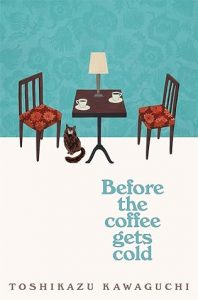
As much as I enjoyed the narration, which I very much did, it’s the stories themselves that give the collection its charm, as was true in similar books such as The Kamogawa Food Detectives and Before the Coffee Gets Cold – the latter of which this book is frequently compared to, along with The Midnight Library of which this reader is considerably less certain but now rather curious about.

The stories in THIS book are all slices of life, and slices of very familiar lives; a young woman in her first full-time job not sure if it’s what she really wants or what she wants to do with the life in front of her before it passes her by, a more established man who KNOWS he’s not doing what he wants to do with his life but is afraid to give up security to pursue his dream, a working mother whose work dreams have been sacrificed to the care of a loved and wanted child but is having difficulty reconciling her plans with her reality, a 30 year old still living at home who has no confidence in himself and a retired ‘company man’ who can’t figure out who he is or how he fits in a world where he has no job and no set place in that world.

They all read like real people, their crises all feel like part of the real world, and the solutions all seem very possible. But there’s still just a bit of magic in these seemingly mundane tales, and it’s not just the magic of Ms. Komachi and her knack for finding the right book for the right person at the right time.

It’s the magic of getting caught up in, not just one lovely story, but five lovely stories – all with just the right touch of honeyed sweetness in their endings.