
A- #BookReview: The Heist of Hollow London by Eddie Robson

A- #BookReview: The Heist of Hollow London by Eddie RobsonThe Heist of Hollow London by Eddie Robson
Format: eARC
Source: supplied by publisher via Edelweiss
Formats available: hardcover, paperback, ebook, audiobook
Genres: post apocalyptic, science fiction, science fiction mystery
Pages: 288
Published by Tor Books on September 30, 2025
Purchasing Info: Author's WebsitePublisher's WebsiteAmazonBarnes & NobleKoboBookshop.orgBetter World Books
Goodreads

In games of betrayal everyone loses.

Arlo and Drienne are ‘mades’―clones of company executives, deemed important enough to be saved should their health fail. Mades work around the clock to pay off the debt incurred by their creation, though most are Reaped―killed and harvested for organs when their corporate counterparts are in medical need.

But when the impossible happens and the too-big-to-fail company that owns them collapses, Arlo and Drienne find themselves purchased by a scientist who has a job for them.

The reward: Debt paid off, freedom from servitude, and enough cash to last a lifetime.

The job: Infiltrate a highly secure corporate reclamation facility in the heart of dead London and steal a data drive.

They’re going to need a team.

My Review:

This is a caper story. It says so right there on the label, doesn’t it? And it does not disappoint – even though this isn’t quite the caper that the reader thinks it will be. It’s not even the caper that the crew participating in it think it will be. Which, of course, is part of the caper itself, because they are the ones being conned and defrauded along with pretty much everyone else.

We first meet Arlo and Drienne while they are sneaking into someplace they shouldn’t be – because it’s sponsored by a megacorp that is a bitter rival of the megacorp that owns them.

Which is where we start to see just how effed up the world has become in this not-too-distant future post-climate-apocalypse story. Arlo and Drienne are clones. They aren’t merely second-class citizens, although they certainly are that. They are slaves, owned by the megacorp that created them to serve as disposable, low-wage workers until they are needed as spare parts for the VIPs who provided their genetic material.

Unless they can manage to earn enough credits to pay off the ‘debt’ they owe to their megacorp, Oakseed, to pay off the costs of their creation and training. Which happens so rarely that it might as well be a fairy tale.

Megacorps like Oakseed are, at least theoretically, too big to fail. But reality doesn’t give a damn about theoretical models, and that’s exactly what happens here. Oakseed fails – and it fails big. Global collapse-size big, creating a tsunami of chaos that spreads to every single Oakseed installation and figuratively drowns every single one of Oakseed’s assets in its wake.

Including all those clones, who become part of Oakseed’s assets, just waiting for their ‘contracts’ to be sold. Or exploited, along with all that chaos.

Someone wants to make one last really big score out of Oakseed’s catastrophic fall. All they need is a crew to do the deed and a patsy to take the fall. Which is where Arlo, Drienne and a select group of their fellow clones come in.

They ARE disposable. There’s no need for them to know the real purpose that they are being disposed of for. Which doesn’t stop them from figuring it all out – and turning the tables on the whole scheme – after all.

Escape Rating A-: I picked this up because I adored the author’s earlier SF mystery, Drunk on All Your Strange New Words, and was hoping for something in a similar vein – or at least similarly good. I got more of the second than the first, even though Heist is also an SF mystery. It’s just not the same kind of mystery. Words was a locked-room mystery, while Heist is pretty much anything but.

The Heist of Hollow London is about a heist. A caper. A big job that needs just the right crew to get it done. The form of the story, of the con and the score and the planning to get it done, has a lot of familiar parts to it. We’ve seen plenty of stories like this, and if you like those sort of stories you’ll like this one too, even if the SF setting isn’t quite your jam.

But it’s the SF setting of this story that sets it apart from the usual run of caper stories, and that’s what dragged me in and kept me glued to my seat for a bit over three hours. Because that setting has one hell of a set of layers to unpack.

The first layer is the cloning. As it turns out, it’s a bit of the last layer too. But the application here is old and new at once, as the megacorps go to great lengths to convince everyone, especially the clones, that they are not slaves. Even though they most definitely are.

Then there’s the reason for the cloning, and the reason why it’s not exactly working, from a scientific/medical/mercantile standpoint. Which leads back into another layer of the story – that this takes place in a world that is very much post-apocalyptic of the climate kind. It’s a bit like the world of Down in the Sea of Angels, only much closer to the ‘Collapse’ that world is recovering from. Or it’s the post-apocalypse of The Annual Migration of Clouds and The Knight and the Butcherbird, where the world is barely surviving the ravaging of ecological disaster.

Which is where one reaches the next layer, which is a humans are gonna human kind of story, in that the way that the megacorps control their corporate fiefdoms may be short term profitable but is not long term sustainable, and when that rug gets pulled it takes a whole lot out with it.

And all of that circles back to the caper itself. Someone needs to steal a macguffin from one of Oakseed’s installations before that installation gets shut down in the collapse of the company. They put together the crew that includes Arlo and Drienne by first, buying out their contracts and second, promising them freedom when the job is completed. Or, alternatively, selling their contracts to jobs they are guaranteed not to survive if they won’t play along.

Of course they’re being conned. Anything too good to be true usually is. While it’s equally true that you can’t cheat an honest person, Arlo, Drienne and their fellow clones know they can’t win, can’t break even, and are not in a position where they can even legally get out of this game. But they can cheat the people who are cheating them. If they can figure out the true goal of this wild scheme and turn it around before it’s too late.

That they are able to turn things around on everyone who intends to use them and throw them away made the heel turns of the plot, and the plot around the plot, and their own plot, all that much more satisfying – even if or especially because parts of that turn turn out to be bittersweet.

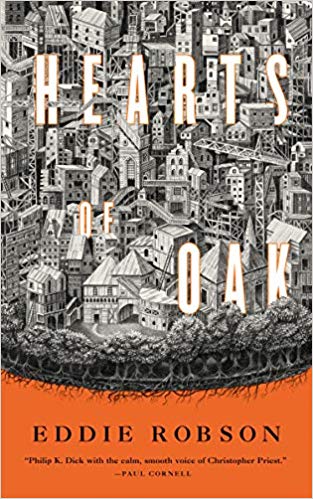
Review: Hearts of Oak by Eddie Robson

Review: Hearts of Oak by Eddie RobsonHearts of Oak by Eddie Robson
Format: eARC
Source: supplied by publisher via NetGalley
Formats available: paperback, ebook
Genres: fantasy, science fiction
Pages: 266
Published by Tordotcom on March 17, 2020
Purchasing Info: Author's WebsitePublisher's WebsiteAmazonBarnes & NobleKoboBookshop.org
Goodreads

The buildings grow.

And the city expands.

And the people of the land are starting to behave abnormally.

Or perhaps they’ve always behaved that way, and it’s normality that’s at fault.

And the king of the land confers with his best friend, who happens to be his closest advisor, who also happens to be a talking cat. But that’s all perfectly natural and not at all weird.

And when chief architect Iona wakes from a long period of blindly accepting the status quo, she realizes there’s a mystery to be solved. A strange, somewhat bizarre mystery, to be sure, but no less dangerous for its improbability.

And the cat is almost certainly involved!

My Review:

Talking cats are generally an indicator that you are either reading a cozy mystery or an animal odyssey like Watership Down or Redwall.

Or, that something is really, really wrong. Because cats aren’t supposed to speak in complete English sentences – or whatever language you might speak. Any story where the king’s wisest counselor and closest adviser is a talking cat is either a fantasy of some sort or a story where things have gone really, really off-kilter at the very least.

With that talking cat at the center of it all. Having played more than one game where a villain took the form of a talking cat, I was expecting the very, very wrong.

The situation in Hearts of Oak was wronger than that. Also weirder. Much, much weirder.

At first it merely seems as if the cat is manipulative – as they are – the king is a chucklehead and the elderly architect who is our point of view character is a bit too far past it to figure just what it is about the city that feels so -odd

She’s certainly aware that something feels “off” but can’t quite get her mind to wrap around exactly what – at least not until the cremation ceremony when a member of the audience leaps onto the casket just as its about to be engulfed by the flames.

At that point, it’s pretty obvious that something is amiss, but just not what.

At that point we are all, like the architect Iona, pretty much invested in the fantasy-like scenario of the ever-growing city, the slightly oblivious king and the dreamlike, slightly soporific quality of the place.

And that’s the point where it all goes pear-shaped, and  all of the perspectives, especially Iona’s and our own, get turned on their heads.

When we – and Iona – discover that nothing about this world has ever been as it seemed.

That’s the point where the oh-so-subtle wrong becomes very, very interesting. And Iona’s situation goes far more pear-shaped than she – and the reader – ever imagined.

Escape Rating B: The story at its beginning has kind of a dreamlike quality. It feels obvious to the reader – at least to this reader – that things are not as they seem and that the cat is at the heart of it all. That particular reveal didn’t feel like all that big of a discovery.

But the point where Iona’s perspective goes through its sudden and dramatic shift takes the story in a direction that absolutely was not expected – nor should it have been. I expected that Iona’s world was stranger than she imagined, but had no clue that it was stranger in the particular way that it is.

There’s more than a bit of charm to this story and the way that its told, as well as a bit of pathos in Iona’s ultimate fate. At the same time, looking back on the story now that it’s over, it feels like there were a whole bunch of themes and plot points that were plucked from different branches of speculative fiction and melded into the whole of Hearts of Oak.

In other words, there were plenty of moments where I felt like I’d read that part of the story before – or seen it on one or more SFF TV show. At the same time, the whole was, not so much greater than the sum of its parts as completely different from the sum of its parts. A feeling that makes no sense but still feels true.

Hearts of Oak is a fun, quirky read that takes itself places that the reader never expects. It’s not really character driven, and when I think about it it doesn’t feel plot-driven either. If I had to describe it – and I kind of do – I’d have to say that it’s really twist-and-turn driven. Just about the time when you think you know where it’s going – or at least begin to recognize where it’s been – it takes a completely different twist and you have to re-evaluate the parts you’ve already read.

If you like stories as puzzles, this one is fascinating. With a twist in the end that cuts like a knife.