#AudioBookReview: Every Day I Read by Hwang Bo-Reum, translated by Shanna Tan

#AudioBookReview: Every Day I Read by Hwang Bo-Reum, translated by Shanna TanEvery Day I Read: 53 Ways to Get Closer to Books by Hwang Bo-reum
Translator: Shanna Tan
Narrator: Rosa Escoda
Format: audiobook, eARC
Source: supplied by publisher via Edelweiss, supplied by publisher via Libro.fm
Formats available: hardcover, ebook, audiobook
Genres: books and reading, essays, memoir
Pages: 240
Length: 3 hours and 49 minutes
on December 2, 2025
Purchasing Info: Author's WebsitePublisher's WebsiteAmazonBarnes & NobleKoboBookshop.orgBetter World Books
Goodreads

From the internationally bestselling author of Welcome to the Hyunam-dong Bookshop comes a warm and reflective collection of essays inviting us to reflect on our relationship with reading.
Why do we read? What is it that we hope to take away from the intimate, personal experience of reading for pleasure?
Rarely do we ask these profound, expansive questions of ourselves and of our relationship to the joy of reading. In each of the essays in Every Day I Read, Hwang Bo-reum contemplates what living a life immersed in reading means. She goes beyond the usual questions of what to read and how often, exploring the relationship between reading and writing, when to turn to a bestseller vs. browse the corners of a bookstore, the value of reading outside of your favorite genre, falling in love with book characters, and more.
Every Day I Read provides many quiet moments for introspection and reflection, encouraging book-lovers to explore what reading means to each of us. While this is a book about books, at its heart is an attitude to life, one outside capitalism and climbing the corporate ladder. Lifelong and new readers will take away something from it, including a treasure trove of book recommendations blended seamlessly within.

My Review:

I was SO tempted to begin this review with snark – and just keep right on snarking all the way through. Obviously, I chose to begin with a bit of snark, because, well, I do too. Read every day, that is. Reading is life.

Not ALL of life, but a lot of life, and all of my life has been filled with books and reading. So I picked this up with a lot of empathy for the writer, because from an outside perspective we’re coming from a similar place. From the inside perspective provided by this book, clearly not – and not just the obvious differences of age, location and pretty much everything else except gender.

We may both read every day, but we don’t read the same, either the same things or the same way or for (most) of the same reasons.

But I agree wholeheartedly with something the author says in THIS book, that “Books are like a spider’s web: you’ll only get more attached.” We’re both clearly enmeshed, we’re both biblioholics, and neither of us ever plans on getting treatment for the condition.

I know I wouldn’t have it any other way. After reading Every Day I Read, I believe that the author feels the same.

Reality Rating B: This one doesn’t get an escape rating because I didn’t – which was kind of the point of it. (I often found myself talking back to the excellent audio while listening in the car.) I was looking to read a book by someone who reads A LOT and lives a chunk of their life in and through books. (I also found this book through a fellow reading addict’s article about the book intending to get even more people hooked on the joy of reading. This whole reading thing is addictive!)

One of the ways in which the author and I read differently is that the author loves to collect quotations from the books she reads. Collecting the quotes is part of her process of reading and jotting them down is part of her process of, well, processing and understanding the books she’s read. (Sometimes things stick with me, but it’s not what I’m there for.)

I’m going to use one of her examples as a way of furthering my response to the book. This quote is her quote from Lee Kwonwoo’s book, Learning to Write Begins with Reading a Book, “The focus isn’t on the book, but on the reader, and your experience reading it.” in regards to a reader’s response to a book as opposed to a professional book critic’s response or review.

And that’s what this “review” is intending to be, my response, as a reader, to this book about her thoughts about the reading life, the reading experience, and ways that others can themselves become habitual readers.

From this reader’s perspective, there’s a difference between getting pleasure out of reading vs. reading for pleasure – and I think the author and I are on opposite sides of that divide. She clearly does receive a great deal of pleasure from her reading – but her process is, well, definitely a PROCESS. Like the quotes. Or setting a timer so as to read a certain number of minutes each day. Or it could simply be that all the books she references and quotes from are all “improving” in some way – either they are classics, they are literary fiction, or they are nonfiction.

Telling humans to do ANYTHING because they “should” is not a way to get people to do something. Telling people they would love the classics if they just gave them another chance is not a message that’s going to resonate with as many people as “if you need an escape from the crisis of the day this will let you leave it behind for a bit.”

Reading itself is the pleasure and the escape, and some days a cozy mystery is just what the “book” doctor ordered. It doesn’t have to be “good” from a literary perspective or impart a particular lesson. “Fiction is (still) the lie through which we tell the truth,” to quote philosopher Albert Camus, and that’s just as true for a so-called trashy romance or a sweeping epic fantasy as it is the highest of highbrow literary fiction.

Your reading mileage may vary. The author of this book’s certainly seems to.

Here’s the point where I get up on my soapbox, because I need to let this out. There’s an essay in this book about ebooks, and it pretty much parrots all the negative stuff that gets repeated that reading an ebook isn’t “as good” as reading print. I have problems with this. In fact, I have LOTS of problems with this.

The study that was used as justification for this pronouncement compared readers’ behavior (by tracking eye movement) when reading “web pages” with readers’ behavior when reading a printed book. That is an apples to oranges comparison. Back in the days when print was all we had, readers didn’t read newspapers or magazine articles the same way they read books – because those things are not the same. So I wouldn’t expect readers’ behavior to be the same and whoever created the study shouldn’t have either unless they were looking for proof of a point they had already decided on.

Second, and more important from my personal perspective, is that the all the articles that “prove” that reading ebooks is somewhat less real or less true or simply a lesser experience than reading print books just cuts off vast swaths of readers from continuing to read once the inevitable vision changes of middle age – and older – set in. While large print books have existed for decades, the number and types of books that are published in large print have always been limited. (Specifically, I read fantasy and science fiction and the amount of either genre that is published in large print is vanishingly small. Without ebooks, I’d have had to give up the genres I have loved for my entire reading life.) This is not the way to keep people who love reading reading.

To put it another way, all that the articles and essays that denigrate ebook reading do is shame readers who read ebooks for whatever reason. As a librarian, shaming the reader for their reading preferences is anathema.

Stepping down off my soapbox now to conclude by answering a question the author poses in her essays about reading books that change one’s life. My own answer explains my passion when it comes to ebooks by reaching back into my early days as a lover of reading. When I was 8 years old someone loaned me a copy of J.R.R. Tolkien’s The Hobbit, with the promise that if I liked it and more importantly returned it, there were MORE. That one book was the right book at the right time to influence all of my reading for the sixty years and counting that have followed. It was the right book at the right time in that it swept me away into a vast, fully realized and utterly absorbing world filled with characters that touched me and made me think and feel, that it told a story that STILL resonates all these years later, and that grew with me as I grew up and reread it and got more and deeper into it each and every time.

It doesn’t matter whether the book that changes or influences your life is the most literate, or the most improving, or the most popular or the most highly thought of or most award winning. What matters is that it works for you. And that if you haven’t already found it, it’s still out there waiting for you to discover it.

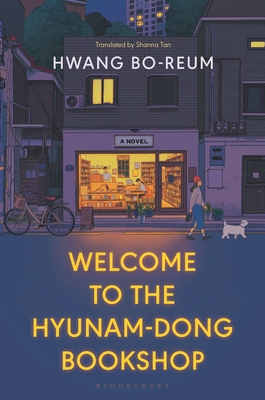
#BookReview: Welcome to the Hyunam-dong Bookshop by Hwang Bo-Reum translated by Shanna Tan

#BookReview: Welcome to the Hyunam-dong Bookshop by Hwang Bo-Reum translated by Shanna TanWelcome to the Hyunam-Dong Bookshop by Hwang Bo-reum, Shanna Tan
Format: eARC
Source: supplied by publisher via Edelweiss
Formats available: hardcover, paperback, ebook, audiobook
Genres: books and reading, literary fiction, world literature
Pages: 320
Published by Bloomsbury Publishing on February 20, 2024
Purchasing Info: Author's WebsitePublisher's WebsiteAmazonBarnes & NobleKoboBookshop.orgBetter World Books
Goodreads

The Korean smash hit available for the first time in English, a slice-of-life novel for readers of Matt Haig's The Midnight Library and Gabrielle Zevin's The Storied Life of AJ Fikry.
Yeongju is burned out. With her high-flying career, demanding marriage, and busy life in Seoul, she knows she should feel successful, but all she feels is drained. Yet an abandoned dream nags at her, and in a leap of faith, she leaves her old life behind. Quitting her job and divorcing her husband, Yeongju moves to a small residential neighborhood outside the city, where she opens the Hyunam-dong Bookshop.
For the first few months, all Yeongju does is cry, deterring visitors. But the long hours in the shop give her time to mull over what makes a good bookseller and store, and as she starts to read hungrily, host author events, and develop her own bookselling philosophy, she begins to ease into her new setting. Surrounded by friends, writers, and the books that connect them all, she finds her new story as the Hyunam-dong Bookshop transforms into an inviting space for lost souls to rest, heal, and remember that it's never too late to scrap the plot and start again.

My Review:

The title of the book makes the point of the story, as 30something, utterly stressed out Yeongju transforms herself into an independent bookstore owner in a close-knit but off the beaten path community.

Just as her high-pressure job and her equally pressured marriage once consumed Yeongju – sending her into a spiral of depression – opening the bookstore and returning to her childhood love of reading starts out as the antidote to those feelings.

Not that either the reader nor her concerned customers are entirely aware of that at first. We’re all aware of her depression, as her initial months of opening the store consist of her sitting on a stool inside the store with tears running down her face.

She’s clearly hit bottom in a whole lot of ways, but neither the reader nor her potential customers know precisely why. Not that her customers necessarily should, at least not until she’s willing to tell someone, but she’s drowning so hard that she’s closed off her internal life to the reader as well.
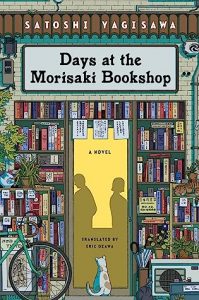
Which is similar in a lot of ways to the opening of the utterly charming and absolutely marvelous Days at the Morisaki Bookshop – with one critical difference. The reader gets a much more thorough picture of that protagonist, Takako, and her internal, utterly depressed, life because even though Takako isn’t talking much her mother and her uncle talk at her, to her, and about her enough for the reader to see inside her slough of despond and start to feel for her even as she starts to pull herself out.

At first, we know very little of what brought Yeongju to the bookshop or much of why she’s sitting in the midst of it weeping. But we do see the bookshop-owning butterfly emerge from her dark and tattered cocoon to take stock of the life she actually has and start looking towards its sustainability – for herself and for the people who come to see her bookshop as part of the warp and weft of their lives as much as she does.

And as Yeongju invests herself in welcoming others to the Hyunam-dong Bookshop, we finally begin to see glimpses of what drives her, what occasionally drives her back into her shell of depression, and the way that once she begins reaching out to others, they all begin to sustain each other.
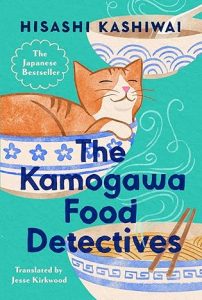
Escape Rating C: I fell in love with both last week’s The Kamogawa Food Detectives and Days at the Morisaki Bookshop and picked this up hoping for something similar – or even in a sweet spot in between the two.

Sadly, that was not to be.

As much as I love books about books and reading, especially stories about bookstores and bookstore owners, I had a hard time getting into this one. It took me a while – entirely too long for the sake of my own personal reading schedule, in fact – to figure out that what was missing here that both of those books I hoped it would be a readalike for had was a central character or characters to carry the story.

Not that Yeongju isn’t there, but, well, for the first half of the book she really isn’t all there. She’s going through the motions, but we don’t see inside her nearly enough to be certain about what has brought her to that initial, depressing pass or get truly invested in how she gets herself out.
As she comes back to herself, and the bookshop reaches out to its community and the wider world as a result, we do start getting glimpses into what brings the other characters in the story to become part of the shop and the stories within, but Yeongju uses the increasing busy-ness of the shop and the life she has focused around it as a way of not looking back at what brought her there in the first place.

In the end, this was okay but not what I was hoping for. It has some of the elements of the two books that brought me here, that journey from depression to healing through the power of books and reading and community that is at the heart of Days at the Morisaki Bookshop and the loosely linked slices of life stories of The Kamogawa Food Detectives, but it doesn’t have the strong, central linchpin character to carry the book as a whole the way that both of those books did.

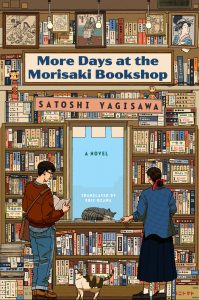
Which leaves me looking forward that much more and harder to the follow-up to Days at the Morisaki Bookshop, titled More Days at the Morisaki Bookshop, coming in July. Because I do, still, very much, love books about books and reading and the transformative power of the two and have high hopes that the second book in that series will hit the same sweet spot as the first.