
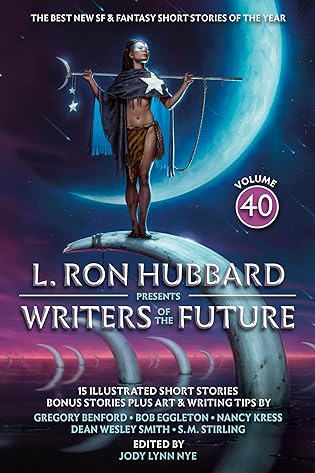
 L. Ron Hubbard Presents: Writers of the Future, Volume 40 by L. Ron Hubbard, Jody Lynn Nye, Nancy Kress, S.M. Stirling, Gregory Benford, Bob Eggleton, Amir Agoora, James Davies, Kal M, Sky McKinnon, Jack Nash, Rosalyn Robilliard, Lance Robinson, John Eric Schleicher, Lisa Silverthorne, Stephannie Tallent, Tom Vandermolen, Galen Westlake, Mary Wordsmith, Dan Dos Santos, Ashley Cassaday, Gigi Hooper, Jennifer Mellen, Pedro Nascimento, Steve Bentley, Connor Chamberlain, Selena Meraki, Guelly Rivera, Tyler Vail, Carina Zhang, May Zheng, Lucas Durham, Chris Arias
 Format: eARC
Source: supplied by publisher via NetGalley
Formats available: paperback, ebook, audiobook
Genres: fantasy, science fiction, short stories
Series: Writers of the Future #40
Pages: 471
Published by Galaxy Press on May 7, 2024
Purchasing Info: Author's Website, Publisher's Website, Amazon, Barnes & Noble, Kobo, Bookshop.org, Better World Books
Goodreads
Spine-tingling
Breathtaking
Mind-blowing
Experience these powerful new voices—vivid, visceral, and visionary—as they explore uncharted worlds and reveal unlimited possibilities.
Open the Writers of the Future and be carried away by stories—and illustrations—that will make you think, make you laugh, and make you see the world in ways you never imagined.
Twelve captivating tales from the best new writers of the year as selected by Writers of the Future Contest judges accompanied by three more from L. Ron Hubbard, Nancy Kress, S.M. Stirling. Each is accompanied by a full-color illustration.
Plus Bonus Art and Writing Tips from Gregory Benford, Bob Eggleton, L. Ron Hubbard, Dean Wesley Smith
“When her owner goes missing, a digital housecat must become more than simulation to find her dearest companion through the virtual world.—“The Edge of Where My Light Is Cast” by Sky McKinnon, art by Carina Zhang
No one came to his brother’s funeral. Not even the spirits. Étienne knew it was his fault.—“Son, Spirit, Snake” by Jack Nash, art by Pedro N.
Man overboard is a nightmare scenario for any sailor, but Lieutenant Susan Guidry is also running out of air—and the nearest help is light years away.—“Nonzero” by Tom Vandermolen, art by Jennifer Mellen
Mac wanted to invent a cocktail to burn itself upon the pages of history—but this one had some unexpected side effects.—“The Last Drop” by L. Ron Hubbard and L. Sprague de Camp, art by Chris Arias
Dementia has landed Dan Kennedy in Graydon Manor, and what’s left of his life ahead seems dismal, but a pair of impossible visitors bring unexpected hope.—“The Imagalisk” by Galen Westlake, art by Arthur Haywood
When a teenage swamp witch fears her mama will be killed, she utilizes her wits and the magic of the bayou—no matter the cost to her own soul.—“Life and Death and Love in the Bayou” by Stephannie Tallent, art by Ashley Cassaday
Our exodus family awoke on the new world—a paradise inexplicably teeming with Earth life, the Promise fulfilled. But 154 of us are missing.…—“Five Days Until Sunset” by Lance Robinson, art by Steve Bentley
Spirits were supposed to lurk beneath the Lake of Death, hungry and patient and hostile to all life.—“Shaman Dreams” by S.M. Stirling, art by Dan dos Santos
A new app lets users see through the eyes of any human in history, but it’s not long before the secrets of the past catch up with the present.—“The Wall Isn’t a Circle” by Rosalyn Robilliard, art by Guelly Rivera
In the shadows of Teddy Roosevelt’s wendigo hunt, a Native American boy resolves to turn the tables on his captors, setting his sights on the ultimate prey—America’s Great Chief.—“Da-ko-ta” by Amir Agoora, art by Connor Chamberlain
When squids from outer space take over, a punk-rock P.I. must crawl out of her own miserable existence to find her client’s daughter—and maybe a way out.—“Squiddy” by John Eric Schleicher, art by Tyler Vail
Another outbreak? This time it’s a virus with an eighty percent infection rate that affects personality changes … permanently.—“Halo” by Nancy Kress, art by Lucas Durham
Planet K2-18b is almost dead, humanity is enslaved, and it’s Rickard’s fault.
My Review:
The “Writers of the Future” Contest sponsored by Galaxy Press has been going on for, obviously, forty years now, which is why this is #40 in the series. I hadn’t picked a single one up until last year’s 39th volume, because short story collections just aren’t my thing, and the whole L. Ron Hubbard/Scientology connection STILL gives me the heebie-jeebies.
 Howsomever, this time last year I was assigned to review that 39th volume for Library Journal, and learned that my hesitations on both the format and the origin notwithstanding, the collection itself was good. Damn good, in fact.
So good that when the opportunity to review this 40th volume in the series came up, I jumped at it – and was very glad that I did.
As with most collections, there were a couple of stories that just didn’t work for me, but for the most part the stories worked and worked well and I’d be thrilled to see more work from pretty much all of these award winning authors.
Which means that I have brief thoughts of a review-type and rating for each of the new individual stories, and a concluding rating that’s going to require some higher math and a bit of a fudge-factor to get into a single letter grade even with pluses and minuses available!
“The Edge of Where My Light is Cast” by Sky McKinnon
This is a story that anyone who has ever had a ‘heart cat’ – or other companion animal, one who is not merely loved but holds a singular place in one’s heart long after they are gone will find both utterly adorable and heartbreakingly sad at the same time. Tabitha was her person’s heart cat, so when Tabita went to the Rainbow Bridge her person turned her into a virtual reality cat so that they could be together for always. When her person goes ‘to the light’, Tabitha breaks all the laws of time and space and physics so that they can be together, forever in the light of the datastreams they now both call home. Grade A because there is so much dust in this one and my eyes are still tearing up.
“Son, Spirit, Snake” by Jack Nash
This one has the feel of a myth being retold as fantasy, although its an original work. It could also fit into many post-apocalyptic futures as well. A young man is dead, his mother performs the funeral rites, but the neighbors scoff and the gods do not attend as they always have. His younger brother runs in search of solace but finds only Death – but the anthropomorphization and not the event, because his mother refuses to let the gods dictate her actions a second longer – and she scares them WAY more than they scare her. Grade B because it feels like the attempt to make the myth universal sanded off a few too many of the edges that might have made it a bit more fixed in time and space – which was the intent but made it a bit more difficult to get stuck into at first.
“Nonzero” by Tom Vandermolen
As far as she knows, she’s the only survivor of her spaceship crew, out in the black in a spacesuit with no ship in sight and no chance of reaching one. She dreams of the past, while her suit’s AI does its best to awaken her to her very limited choices: whether to let her oxygen run out – and die, self-terminate using the drugs stored in her suit – and die, or take a cryogenic cocktail of drugs, let herself be put in suspended animation, and hope that the nonzero chance of survival comes through. We’ll never know. Grade A- for her snark in the face of logic and annihilation even though we’re pretty sure from the beginning that we know which path she’ll take.
“The Imagalisk” by Galen Westlake
Anyone who ever had an imaginary friend will find a bit of hope – or a light at the end of an inevitable long, dark tunnel – in this tale of an elderly man entering the hazy world of Alzheimer’s and tossed into a nursing home by his son. Only to discover that he’s been granted a marvelous gift, that for the residents of Graydon Manor the make-believe friends of their first childhoods have returned to help them ‘play’ the rest of their lives away in their second. If he can just hold only his present memory long enough to keep their gift from being stolen by a greedy former resident. Grade A- for being the saddest of sad fluff on the horns of the reader’s dilemma of whether this is one last grand caper or if this entire tale is just a product of the disease that brought him to Graydon Manor in the first place.
“Life and Death and Love in the Bayou” by Stephannie Tallent
One of two stories in the collection about magic and power and love and death and sacrifice that’s made even better because the sacrifice is willing and the love isn’t romantic. This one is haunting, not horror but definitely on the verge of it – but then again, if any place is haunted it’s the bayou country of Louisiana. Grade A- for the story and A+ for the art for this one which is beautiful.
“Five Days Until Sunset” by Lance Robinson
In spite of what a whole lot of SF would have one believe, the likelihood is that early colony ships will be a fairly iffy proposition. Which means that this reminds me a bit of Mickey7 but definitely without the humorous bits. Although in this case, it’s not that the planet is barely habitable, but rather that it’s not habitable in the way that the colonists dreamed of. It’s a story about adapting your dreams to your circumstances instead of attempting to force the circumstances to match your dreams. Grade A because the story is good and so complete in its very short length and it even manages to deal well with religion in the future which is really, really hard even in the present.
“Shaman Dreams” by S.M. Stirling
This one is new for the collection – which I wasn’t expecting. It’s also the story inspired by the gorgeous cover art. Even though this is set in the far distant past, as the last Ice Age is fading away, the story it reminds me of most and rather surprisingly a lot is The Tusks of Extinction – quite possibly crossed a bit with Jean Auel’s Clan of the Cave Bear series. Grade A+
“The Wall Isn’t a Circle” by Rosalyn Robilliard
Very SFnal, but exceedingly horrifying in its implications. It starts out as time travel – and that’s fun with interesting possibilities. The scare in this one is that it doesn’t stay there, and where it leaps to is a question of just how far – and how far over the line of morality – someone will go to get justice and where the line blurs between justice and revenge. Grade A for the wild ride of the story’s ultimate WOW.
“Da-ko-ta” by Amir Agoora
This one didn’t work for me. The bones of something really terrific are here, and I think it potentially had a lot to say about colonialism and culture erasure and just how terrible manifest destiny was but it may have just needed to be longer so that its ideas got fully on the page and weren’t merely teased out. Grade C
“Squiddy” by John Eric Schleicher
Squiddy gets its toes right up to the line of SF horror and then sticks there with tentacles. Literal, actual tentacles, in an invasion of squid-like monsters that are an addictive drug that requires sticking the squid-like creature up one’s nose. So also gross-out horror. But underneath that is a story about a drug addled dystopia, one woman who refuses to use or be used and another woman who sees her as a beacon to follow to a better, squid-free future. Grade B because this one was interesting and had a kind of wild/weird west feel but just wasn’t my jam – or calamari.
“Halo” by Nancy Kress
This is the second new-for-this-collection story by a well-known author rather than a contest winner. It’s laboratory based SF, and jumps off from the recent pandemic, but doesn’t go anywhere one thinks it will go because it’s a story about human behavior and human intelligence and the power of inspiration and how much the latter is worth saving if engineering the former can do so much ‘good’ – depending on who is determining that good. A thought-provoking Grade A story.
“Ashes to Ashes, Blood to Carbonfiber” by James Davies
There are always at least a couple of stories in any collection that don’t work for an individual reader and this was my other one. I may have been trying to read too late in the evening, or it may be that the bleakness of this particular dystopia just didn’t work for me, or the nature of the sacrifice required to break out was a bit too much even as it was talked more around than directly about. I did like that it worked out to a much better ending than I was expecting, but it just didn’t work for me. Grade C
“Summer of Thirty Years” by Lisa Silverthorne
This is the other story in the collection about sacrifice and power and love and death – done in a completely different way from the bayou story and still not about romantic love after all – although at the beginning it looks like it might be. It’s sweet and sad and haunting and beautiful, if not quite as profound as “Life and Death and Love in the Bayou” still an excellent story. Grade A-
“Butter Side Down” by Kal M
There had to be a story that managed to invoke Murderbot, and this was it. What made it fun was that the whole thing is a trial transcript, as the lone human on this particular spaceship’s crew is on trial for rescuing a planet-killing AI, falling in love with it and helping it escape. It seems like the fears of what this ultimate weapon of mass destruction – that Joe Smith has nicknamed “Breddy” can do to the whole, entire universe are very real – but that Joe is convinced that “Breddy” has decided not to. And he’s right and they’re all wrong. While the story is more lighthearted than one might imagine, in the end it’s a story about always extending the hand of friendship – and being rewarded with friendship in return to the nth degree. Grade A+
Escape Rating A- for the collection as a whole, because I mostly did escape – even in the couple of stories that weren’t quite my cuppa after all. I am still a bit surprised to say this, all things considered, but I’m honestly looking forward to getting that 41st volume in the series, this time next year.