
A- #BookReview: L. Ron Hubbard Presents Writers of the Future, Volume 42 edited by Jody Lynn Nye

A- #BookReview: L. Ron Hubbard Presents Writers of the Future, Volume 42 edited by Jody Lynn NyeL. Ron Hubbard Presents Writers of the Future Volume 42: Illustrated Edition Featuring the Next Generation of Science Fiction & Fantasy by L. Ron Hubbard, Jody Lynn Nye, Ciruelo, Orson Scott Card, Nina Kirki Hoffman, Brian C Hailes, Larry Niven, Thomas R Eggenberger, Dorothy de Kok, Michael T Kuester, Elina Kumra, Mark McWaters, Brenda Posey, Zach Poulter, Kathleen Powell, Joseph Sidari, Thomas K. Slee, S.J. Stevenson, Mike Strickland, BAFU, Nathan Deiwert, Tracy Eire, Art Ikuta, Anna Malone, Josie Moore, Amuri Morris, Karah Richardson, Tray Streeter, Roddy Taylor, Zhang Haotian "Allen"
Format: eARC
Source: supplied by publisher via NetGalley
Formats available: paperback, ebook, audiobook
Genres: fantasy, science fiction, short stories
Series: Writers of the Future #42
Pages: 480
Published by Galaxy Press on April 28, 2026
Purchasing Info: Author's WebsitePublisher's WebsiteAmazonBarnes & NobleKoboBookshop.orgBetter World Books
Goodreads

The Future Is Here.
If 42 is the answer to life, the universe, and everything, Volume 42 asks the questions worth thinking about.
Discover the next generation of science fiction and fantasy with twelve emerging authors and three powerhouse storytellers. These unforgettable short stories deliver everything readers love—time travel, first contact, magical realism, monsters, fairy-tale twists, and pulse-pounding science fiction and fantasy—crafted to surprise, thrill, and keep you turning pages.
Dive into a time-rescue gone wrong, a beauty treatment with a terrifying side effect, a detective battling a body-hopping killer, and a homesteader uncovering a truth that rewrites Earth itself. Explore whimsical, high-stakes fantasy as a baker braves the fairy underworld; confront supernatural horror in “Ghost Dog”; and experience the emotional and ethical tension of love trapped in virtual reality in “As Long as You Both Shall Live.” Whether you’re seeking the genre-bending innovation of “Bloom Decay,” the emotional epic of “A Girl and Her Dragon,” the humor and chaos of “The Triceratops Effect,” or the visionary mystery of “Skinny-Shins,” this volume delivers standout stories readers will recommend, review, and remember.
Featuring original stories by Orson Scott Card and Nina Kiriki Hoffman.
Perfect for fans of:
Orson Scott Card, Nina Kiriki Hoffman, Blake Crouch, Brandon Sanderson, V. E. Schwab, Naomi Novik, Michael Crichton, Ted Chiang, Ken Liu, and Black Mirror.
Includes:
*12 illustrated stories from emerging stars of speculative fiction*3 bonus stories by bestselling authors*3 articles on the craft and business of writing and illustrating from top creators
Selected from thousands of entries worldwide, Writers of the Future Volume 42 brings together a new generation of emerging authors and illustrators—your launchpad into the future of science fiction and fantasy.
Get it now.

My Review:

This is now my fourth review of the annual Writers of the Future collection, and I think I’m starting to get the hang of things. By that I mean sussing out the themes of the year’s collection. It’s not that the collection starts out having a theme – because it doesn’t. These stories were the top three in each of the quarterly Writers of the Future contests last year. But this is a Fantasy and Science Fiction collection, all of whose stories were written or at least finalized during roughly the same time period.

The world, as always, is with us, and the stories tend to speak to something about their present moment. Something that is true in this collection as well.

Among this year’s winners, there are several stories that successfully combine science fiction with mystery, particularly mystery of the hard-boiled noir school. I’m not sure whether the number of these stories in the collection means anything more than just that SF/mystery is having a moment – which it is – but I’m delighted either way. Time travel and its consequences are more widely represented this year than they have been at least in the last few collections. While this year’s collection is more weighted towards SF, there are several standout fantasy stories so there’s plenty here for every reader of short-form SF and Fantasy to love.

As I said in previous years’ review, and I’ll repeat it because it’s still absolutely true, as with most collections, there were a couple of stories that just didn’t work for me, but for the most part the stories worked and worked well. I’d be thrilled to see more work from all of these award-winning authors.

While I will do some very fudgy math at the end to come up with an overall rating for the collection, that’s not fair to the individual stories, so I have brief thoughts of a review type and a rating for each of those new, individual stories so you can see which ones were the best of the best – at least in one reviewer’s humble opinion.

“Form 14B: Application for Certification of Consciousness Transfer (Post-Mortem)” by Thomas Slee, illustrated by Art Ikuta
This didn’t go quite where I thought it would go. I thought it was going the same place as Scalzi’s “3 Days, 9 Months, 27 Years” in being a story about the bureaucratic red tape that is likely to surround the most SFnal of future possibilities when they intersect with humans. Instead, OTOH it’s a story about potential fraud, and OTOH, and much more importantly, it’s a story about a real, true, honest-to-paperwork possibility of a fresh start provided by a tired but still vigilant bureaucrat. And it’s a redemption story, even if that redemption comes secondhand. Escape Rating A-

“Saffron and Marigolds” by Kathleen Powell, illustrated by Bafu
A human, a fairy, and a dragon. It sounds like the start of a really cute story – and it could have gone that way but is better because it doesn’t. It’s a story about love (not just romantic love), a story about wanting, and a story about wishes that really do have power, especially in the sense of the kind of power that corrupts until it becomes absolute and absolutely corrupting.

Arthur’s life was saved – and damned – when he baked a gingerbread cake that the fae king coveted so much that he sent his best agent to kidnap Arthur. Only she refused, leaving Arthur and her pet dragon while she did her damndest to work off her debt to a fae king who was NEVER going to free her. Arthur – and Wandley the dragon – decide to fix that all by themselves, and find a way to get the fairy Menura out from under her debt for all their sakes. This could have been a slight and simple story about the power of friendship, but the deeper it – and Wandley – got into the faery Underearth, the better and more powerful the story became. Escape Rating A

“Bloom Decay” by Elina Kumra, illustrated by Tray Streeter
In the end, this one reminded me of Thomas Ha’s Hugo nominated novelette, The Brotherhood of Montague St. Video, mixed with a whole lot about the way that “the algorithm” narrows our individual worlds by ‘optimizing’ what we see and hear, whether that’s in service of following our own preferences and predilections, in service of optimizing profit that can be raised from us in the marketplace, or in service of the prevailing winds of government or merely the status quo.

It begins by focusing on the homogenization of art through the packaging of artists and creators, then it expands outward into the world that serves, the company that promotes it and profits from it, and then turns its eye inside out to bring those who fight against it from the shadows. Not that they fight through weapons of war, but that they resist the dying of the light of creativity by protecting those who hold its spirit. The story was utterly human, totally thought provoking, and overwhelmingly beautiful. Escape Rating A+

“Shell Game” by Zach Poulter, illustrated by Tracy Eire
This has the gritty noir sensibilities of John Scalzi’s Dispatcher series. The central concept is that there are beings among us who are more than human, who are able to wear ordinary humans as meat-suits. It’s not that gruesome, except when it is. Because those with the ability dip into our minds see the world through our eyes for just a little bit at a time – except when they take over. But they are human in the worst ways, in that some of them get greedy for power and money and ‘clients’ and experiences so they muscle in on each other’s territories – meaning us – to take what they want.

In the end, like the Dispatcher series, this is also an SFnal noir mystery series, in that one ordinary human cop joins forces with one of these beings in order to stop a killer of both kinds of ‘people’ and they form an alliance. It might be the start of a beautiful friendship. But it makes for a fascinating story even if it isn’t. Escape Rating A-

“Canary” by Brenda Posey, illustrated by Roddy Taylor
This was interesting. I’m on the horns of the dilemma that it was a good story but it just didn’t grab me personally. The idea that someone would want to live ‘off grid’, especially in the midst of an ever-worsening climate apocalypse, has been done. That she’s so aggressive about being alone, also seems sensible. That an alien race would preserve humanity as an experiment is even plausible – and in some senses has been done and reminds me a bit of And Side by Side They Wander. I do love that she worked out a deal with the aliens that preserved both her choices AND still saved humanity. But it just didn’t gel for me and I think it’s a me thing. A good story but not a fave. Escape Rating B

“The Triceratops Effect” by S.J. Stevenson, illustrated by Art Ikuta
This was just fun. Also a bit sad in its way. It combines bits of Parker’s Making History, Boy with Accidental Dinosaur, Kaiju Preservation Society, Extremity by Nicholas Binge and pretty much every story about time travel, causality and human nature’s tendency to fuck up whatever it touches.

In the same way – but opposite – that I could see that Canary was a good story but it didn’t work for me, “The Triceratops Effect” just plain worked for me BECAUSE it carried so many elements of those other stories, all of which I enjoyed for either their very charismatic megafauna or the way they played around with time travel and its inevitable consequences. It’s hard to go wrong with a dinosaur story. Escape Rating A

“A Ready-Made Bubble of Light” by Thomas Rudolf Eggenberger, illustrated by Haotian Allen Zhang
This one was just plain weird. I mean really weird. Or it didn’t work for me. Or it’s so busy trying to be mysterious that it turns out to be impenetrable. Or all of the above.

The idea is very solidly SF, and in a peculiar way it’s similar to “The Triceratops Effect” – it just doesn’t work as well. It’s also very noir in the way that “Shell Game” is noir. The idea, and we’re back to “Triceratops” again, is that humans have figured out how to play with time travel and have broken causality. But differently, because in this case they’re breaking time and causality and putting time out of sync in the process – kind of like the way that long-haul space travel at near the speed of light takes the traveler out of sync with their time. Except that’s a universal constant while in this story the lack of sync is not. To the point where it’s going to break the universe. And, much like climate change, which it’s a stand in for, no one is going to believe it’s happening until it’s too late to fix – only with universe spanning consequences.

But that story is wrapped in a story about a mega-corporation playing with the time travel mechanisms in order to understand and then break them, as the story gets told to two time technicians who KNOW a crime has been committed but don’t believe in the justification, which might not be right in the first place. Escape Rating C because this one got to be a slog long before it ended.

“Thickly” by Dorothy de Kok, illustrated by Tracy Eire
I think this story works on two levels. From one perspective, it’s about the beauty industry, and the way it convinces women that they are not “beautiful” enough to be worthy of happiness or a successful future or marriage or all of the above. Local standards of beauty may vary, but the concept itself is unfortunately universal.

And on the other hand, and much more SFnal, is that this is a story about women taking up more space in the world, about being seen, and about refusing to suppress their own voices. But the way that happens is through questionable pharmaceuticals that, at least on the surface, seem to be ‘improving’ the women but in truth is turning them into more popularly acceptable versions while reducing their original selves to ghosts on the fringes of what used to be their own lives.

This is a story that you think about a LOT after it’s finished because the implications can be taken in multiple ways and they’re all chilling. Escape Rating B+

“Ghost Dog” by Mark McWaters, illustrated by Anna Malone c2026
I loved this one because it pulled at my heartstrings really hard, and if you’ve loved and lost companion animals over the years it will yours too. On the surface, it’s a story about a haunting, along with more than a bit of a good ‘old skool’ paranormal romance. But the ghost doing the haunting isn’t human, it’s a spectral hellhound who wants to horn in on the beautiful relationship between tiny, fierce Bentley, a cute little Westie, and Mark, a human who has loved each and every one of his best dogs over the years with a fierce and wonderful affection. When the hellhound breaks in, it’s not just the little Westie that protects his person, it’s the ghosts of all the dogs who have come before him, just waiting for the chance to save their mutual best friend, beat off the interloper, and help their person get his happy ever after. Escape Rating A+ and be prepared for the dust in your eyes at the end.

“In Living Color” by Michael Thomas Kuester, illustrated by Nathan Deiwert
This is definitely noir in the same vein as another entry in the collection, “Shell Game”. It’s a police procedural investigation into a serial killer, but set in a world where ‘Talents’ are on the rise. In this particular case, it’s centered around a ‘Talent’ who helps the police with his psychometry. He can see the past of what he touches through pictures. He’s touched pictures of multiple crime scenes drenched in blood like ink with a killer who is a complete emotional and psychological void at their center. The reluctant investigator and the gleeful killer circle around each other, manifesting opposing aspects of the same Talent, until a chance encounter puts them in each other’s path for one brief and decisive moment. Escape Rating A: if you like SF mysteries, and I do, this one is terrific.

“As Long as You Both Shall Live” by Michael Strickland, illustrated by Karah Richardson
Coming close to the end of the collection, this story made me realize that there are no robots or artificial intelligence stories in the collection at all. That’s neither a good or a bad thing, more a comment on how commonplace AI stories have become in real life that they might be too ‘real’ to be SF. This story is the closest, although it’s not an AI story. It’s a story about living in a completely AI constructed world, and what that means for the humans who are living within it. It’s also a romance, but the romantic aspects made the story surprisingly predictable and made the story a bit lighter, in multiple ways, than most of the collection. A fun read but not all that deep. Escape Rating B

“A Girl and Her Dragon: A Life in Four Parts” by Joseph Sidari, illustrated by Josie Moore
This one, on the other hand, went very deep, was very nearly heartbreaking, and yet still managed to pull a light and happy ending out of a whole lot of angst. It’s a bit of alternate history, in that it takes place in our world, even in our time period, but a world where dragons and other magical creatures not only exist but have long and storied true histories.

But it’s also VERY much our world in the way that humans are gonna human – and be litigious – especially towards large, predatory animals that might be dangerous. So the last dragon is chained in the Bronx Zoo for decades, his only champion one young girl who believes in his magic and campaigns her entire life to get poor Ash unchained. It’s told from her perspective in a series of letters and letters to the editor of various newspapers and newspaper reports and ‘tweets’ and other social media posts. But the message is one that no one wants to hear because the powers-that-be have decided that Ash is dangerous and that he might hurt someone and that he needs to be chained for everyone else’s own good even if it is literally killing him. Which is when his lone champion, looking at the waning years of her own life, decides to stage a jailbreak – and find the land of Honah Lee that she’s been searching for all of her life. Escape Rating A+ and a fitting end to the collection.

Escape Rating A- for the collection as a whole, which fits as well as it did in previous years because I really do escape into these collections. Mostly one or two stories at a time – or an evening – because the whole thing is a lot. Generally delicious, but still a lot. I keep having a grand time with these collections, even though there are always one or two that don’t quite work because that’s the nature of the beast.

What it does mean is that I’ll be back next year with the 43rd volume in the series, with expectations of another collection of great stories that I expect to be fulfilled!

A- #BookReview: L. Ron Hubbard Presents Writers of the Future, Volume 41 edited by Jody Lynn Nye

A- #BookReview: L. Ron Hubbard Presents Writers of the Future, Volume 41 edited by Jody Lynn NyeL. Ron Hubbard Presents Writers of the Future Volume 41: The Best New SF & Fantasy of the Year by L. Ron Hubbard, Jody Lynn Nye, Tim Powers, Robert J. Sawyer, Sean Williams, Tom Wood, Seth Atwater Jr., Randyn C. J. Bartholomew, Barlow Crassmont, Andrew Jackson, Ian Keith, Robert F. Lowell, Patrick MacPhee, Lauren McGuire, T.R. Naus, Joel C. Scoberg, Sandra Skalski, Jefferson Snow, Craig Elliott, John Barlow, Cam Collins, Haileigh Enriquez, CL Fors, Dwayne Harris, David Hoffrichter, Gigi Hooper, HeatherAnne Lee, Marianna Mester, Daniel Montifar, Breanda Petsch, Jordan Smajstrla, Tremani Sutcliffe
Format: eARC
Source: supplied by publisher via NetGalley
Formats available: paperback, ebook, audiobook
Genres: fantasy, science fiction, short stories
Series: Writers of the Future #41
Pages: 448
Published by Galaxy Press on April 22, 2025
Purchasing Info: Author's WebsitePublisher's WebsiteAmazonBarnes & NobleKoboBookshop.orgBetter World Books
Goodreads

Step into the extraordinary with L. Ron Hubbard Presents Writers of the Future Volume 41—an anthology that promises the unexpected, the thought-provoking, and the unforgettable. Celebrating the best new voices in speculative fiction, this collection offers gripping tales of science fiction, fantasy, and beyond.

Discover Distant Worlds
Explore alien landscapes, futuristic technologies, and hidden realms. From time-traveling adventures to battles for survival in dystopian societies, these stories transport you far beyond the limits of imagination.

Meet Extraordinary Heroes
Follow protagonists who face impossible odds—from a young constable on a harsh alien frontier to a reclusive writer sharing a ride with a sentient car. These characters redefine courage, resilience, and what it means to be human.

Experience Visual Wonder
Every story is brought to life with breathtaking original illustrations. These commissioned works add depth, color, and vibrancy to the collection, making it a visual and literary masterpiece.

Learn from the Legends
Gain inspiration from essays by L. Ron Hubbard, Robert J. Sawyer, and Tom Wood, offering rare insights into storytelling and creative mastery.

Discover Tomorrow's Stars
This volume continues the legacy of Writers of the Future, the competition that has launched myriad bestselling authors. These rising talents are reshaping speculative fiction as we know it.

Whether you love heart-pounding action, thought-provoking “what ifs,” or stories that blur the line between science and magic, Volume 41 is your gateway to new dimensions. With tales and illustrations that linger long after the final page, this anthology invites you to take the leap into worlds uncharted.

My Review:

The “Writers of the Future” Contest sponsored by Galaxy Press has been going on for forty-one years now. Doing the time math, which runs straight into that whole mental thing that the 1980s feel like they were only twenty years ago when in fact they were FORTY years ago, dammit, means that this thing started in 1985.

I’ve always been a bit skeptical about the whole thing, and short stories generally aren’t my jam, so I hadn’t paid much attention until the 39th collection two years ago. I reviewed that one for Library Journal, and enjoyed it so much that I signed up to do the 40th collection last year and now the 41st collection this year.

Overall, I enjoyed this collection every bit as much as the previous two, but it was different in one particular way. Collections 39 and 40 were all over the speculative fiction map, pretty evenly divided between SF and fantasy and even sticking a toe or two over the line into outright horror. Those years didn’t have themes – although after finishing this one I have to wonder about whether the COVID years had a theme even if it was unintentional.

This year has a theme, or a lot of the writers were speaking to the moment, or a bit of both. Out of this year’s collection of fourteen stories (12 contest winners plus 2 new stories from established authors), five are SF featuring time travel in various ways – as SF does, and three are SF centered around robotics and artificial intelligence. Which doesn’t leave a lot of room for Fantasy, although the ones that are included were good to excellent if more than a bit dark and dystopian. Which speaks to the moment in its own way.

As I said in last year’s review, and I’ll repeat it because it’s still absolutely true, as with most collections, there were a couple of stories that just didn’t work for me, but for the most part the stories worked and worked well. I’d be thrilled to see more work from all of these award-winning authors.

While I will do some very fudgy math at the end to come up with an overall rating for the collection, that’s not fair to the individual stories, so I have brief thoughts of a review type and a rating for each of those new, individual stories so you can see which ones were the best of the best – at least in one reviewer’s humble opinion.

“Storm Damage” by T.R. Naus, illustrated by Haileigh Enriquez
I liked this but didn’t love it. The whole thing revolves – and does it ever revolve – around the naivete of scientists in regards to government contracts and that’s just a plot device that’s getting old, particularly in the current political climate. The idea behind the story is that humanity has gotten too close to extinction too many times through its own actions, so there’s a built-in failsafe to reset the situation JUST before it gallops past the point of no return. This is the story of a specific instance leading up to one of those resets. While the idea is interesting, the characters who have to carry its water feel like we’ve read them before. But then again, if the story is true, we have. Escape Rating B-

“Blackbird Stone” by Ian Keith, illustrated by Marianna Mester
From one perspective, this is Orpheus and Eurydice or pretty much any myth or fairy tale where one protagonist tells the other very specifically NOT to do something that relates to them personally – and they break the rule and the relationship is OVER. It’s clever that this time around things don’t end because someone is messing with time and causality, but the male protagonist in the romance part of this story just was not listening and assumed his not listening was a gift and in the end I couldn’t even with him although I did like the way it resolved. Escape Rating B-

“Kill Switch” by Robert F. Lowell, illustrated by Jordan Smajstrla
One of my absolute favorites in this collection. Robocop turns into Murderbot – and the other way around in this one, which also reminded me a LOT of the robot child in Luminous. This particular robot cop is on the scrap heap, believing that they are being awakened for one last righteous arrest. Which they both are and aren’t. It is righteous, but it isn’t an arrest. Their owner may intend for it to be their last, most definitely in the sense of the road to hell being paved with intentions of one sort or another. That the story is told from the robot’s first person perspective – and that they very much have a personality and desires of their own, while embodying the same desire that humans have to continue to have purpose in their chosen line of work, well, something in this one just really worked for me, and I needed one to after the first two which didn’t. Escape Rating A+

“Karma Birds” by Lauren McGuire, illustrated by Breanda Petsch
This dystopian short story creeps right up to the edge of horror and then steps across that line in a swirl of dark feathers. It also manages to speak to this moment in time even as though for most of its length it reads like a classic dystopian tale where we don’t know why “they” came or even who “they” are – we just know the devastation they left behind. But the title is a hint I didn’t catch up front, that this is a story about karma, and that we have met the enemy and he is us, even though part of the creepiness of the story is the way that the protagonist learns just how easily the enemy could be herself. It reminds me a lot of The Knight and the Butcherbird and not because of the birds. Escape Rating A.

“The Boy from Elsewhen” by Barlow Crassmont, illustrated by Daniel Montifar
At first I took this to be a fairly familiar story railing against our constantly plugged in society. And it certainly is that, along with a bit about how truly feral schoolchildren can be when someone refuses to conform, but there’s also a hidden message about the way that being plugged in allows people to get programmed by what comes down the pipe and how constant entertainment kills creativity and critical thinking. It’s all told from the perspective of another child who discovers the point in the aftermath not because it’s preached at her, but because she learns it for herself – because she’s chosen to unplug. Escape Rating A-

“Code L1” by Andrew Jackson, illustrated by HeatherAnne Lee
This reminded me of a combination of This World is Not Yours by Kemi Ashing-Giwa and Mickey7 by Edward Ashton. It’s a horror story about a survey team biting off way more than they can chew in the search for habitable planets – and for creatures they can’t fight taking an even bigger bite out of them. Good, creepy story about the fallacies of finding so-called ‘golden worlds’ and the way that nature finds a way to overcome technology if you give it long enough. Escape Rating B

“Under False Colours” by Sean Williams, inspired by Craig Elliott’s cover art, Creature of the Storm
This was interesting, and I’m saying that because I can’t think of a better way to put it. I’m not quite sure we have enough for the story to really work, although the way it makes its point about the fallacies of AI and computer translation between languages and species that don’t have anything like the same frame of reference – and just how badly that can go really far astray – was a good one. The story just didn’t have enough meat on its bones to really shine. Escape Rating B

“Ascii” by Randyn C. J. Bartholomew, illustrated by Tremani Sutcliffe
If you combine Emergent Properties by Aimee Ogden with The Passengers by John Marrs, you get something like this story – at least on the surface. The title character of this story is a self-driving taxi, which really means that “Ascii” has enough sentience to analyze their passengers to keep them happy, and has some free will, but can be reined in by an “Authority” if they get too far out of line. Which they regularly do, out of ungovernable curiosity. Which, in the context of this story set in a post-scarcity earth, leads Ascii to commit murder for reasons that look like, and possibly even are, for the ‘greater good’. The way that this story speaks to both the possibilities and excesses of artificial intelligence AND to the dangers of misinformation at the same time is well done. Escape Rating A

“Slip Stone” by Sandra Skalski, illustrated by Haileigh Enriquez
This turned out to be the best of the time travel stories. Even better, its tone reminds me a LOT of Jack Finley’s classic Time and Again. From one perspective it seems like young Carlos has either been the victim of a scam, caught up in a criminal conspiracy, or gone on a magic time-travel ride of adventure – or all of the above. That the result of this temporal cold war – or perhaps not so cold war – takes him back not to his own time but to a forever home in the past turned this romp into a bit of a heartbreaker in the best way. Escape Rating A

“The Stench of Freedom” by Joel C. Scoberg, illustrated by John Barlow
Big, dark fantasy in a small package that also comments on how people don’t see bigotry and other evils that seem to benefit them until their own ox gets gored. I’m not doing this justice at all because this one was incredibly haunting and just plain damn awesome. The story is riveting, the protagonist is evil but doesn’t know he’s evil until the forces that he has been aiding and abetting for so long come for someone he loves and the scales fall from his eyes but no one lets him forget that his road to redemption is long and he’s barely taken the first step and seemingly ONLY because he’s changing the focus of his self-absorbed self-serving. Escape Rating A+

“My Name Was Tom” by Tim Powers (c2025), illustrated by Gigi Hooper
This one was a fever dream of a story, which fits the author’s oeuvre rather well. I still have haunted memories of this author’s The Anubis Gates from a very long time ago. I think this story didn’t have quite enough resolution for this reader, but that’s a me thing. Those who love stories that travel far into strange eldritch places will love it. Escape Rating B

“The Rune Witch” by Jefferson Snow, illustrated by David Hoffrichter
This one is a heartbreaker, and also manages to be frightening in its implications on multiple axes. It’s both a story about how those who serve get ostracized and isolated and taken for granted because the service they perform is unthinkable – and it’s about a mother, a daughter and a terrible duty, and it’s about the temptation for retribution and the human need to be loved and cared for – along with several other things packed into a relatively short but awesome story. Escape Rating A

“Thirty Minutes or It’s a Paradox” by Patrick MacPhee, illustrated by Cam Collins
A lot of the stories in this collection play with time travel in one way or another. This isn’t the best of the lot but it certainly is the most bonkers. It does its damndest to deal with the inherent paradoxes of time travel, that the problem with changing things is that things change and then you don’t know what’s going to happen next. Except that in this case the time traveling doppelgängers do while the original doesn’t and it all goes terribly, horribly wrong until it doesn’t. In the end, it was fun but I was nearly as confused as the original protagonist. Escape Rating B

“A World of Repetitions” by Seth Atwater Jr., illustrated by CL Fors
This is a story about the pandemic – that isn’t actually about the pandemic – crossed with a takeoff on Groundhog Day that is not remotely played for laughs. It’s pretty much every SF story about time loops but without the big, terrible crisis that provides the dramatic tension in Edge of Tomorrow. Instead, it’s a very lovely story about the resilience of humans – as long as they continue to make connections with each other. Along with a bit about just how generous people can be once the profit motives get removed. This was a terrific ending for this year’s collection and I closed the book with a smile on the surprising and delightful happy ending. Escape Rating A+

Escape Rating A- for the collection as a whole, which fits as well as it did last year because I really did escape. Howsomever, and this is sort of a warning for any reader – if you’re reading from cover to cover don’t give up hope after the first two stories. The first two were my least liked in the whole collection and I started out a bit disappointed. Then that third story, “Kill Switch”, turned out to be one of the best in the whole thing and I was glad I persevered.

Which means that, again, I’m looking forward to getting the 42nd volume in this series, hopefully this time next year.

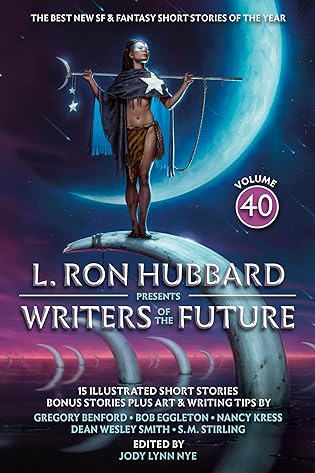
A- #BookReview: L. Ron Hubbard Presents: Writers of the Future, Volume 40 edited by Jody Lynn Nye

A- #BookReview: L. Ron Hubbard Presents: Writers of the Future, Volume 40 edited by Jody Lynn NyeL. Ron Hubbard Presents: Writers of the Future, Volume 40 by L. Ron Hubbard, Jody Lynn Nye, Nancy Kress, S.M. Stirling, Gregory Benford, Bob Eggleton, Amir Agoora, James Davies, Kal M, Sky McKinnon, Jack Nash, Rosalyn Robilliard, Lance Robinson, John Eric Schleicher, Lisa Silverthorne, Stephannie Tallent, Tom Vandermolen, Galen Westlake, Mary Wordsmith, Dan Dos Santos, Ashley Cassaday, Gigi Hooper, Jennifer Mellen, Pedro Nascimento, Steve Bentley, Connor Chamberlain, Selena Meraki, Guelly Rivera, Tyler Vail, Carina Zhang, May Zheng, Lucas Durham, Chris Arias
Format: eARC
Source: supplied by publisher via NetGalley
Formats available: paperback, ebook, audiobook
Genres: fantasy, science fiction, short stories
Series: Writers of the Future #40
Pages: 471
Published by Galaxy Press on May 7, 2024
Purchasing Info: Author's WebsitePublisher's WebsiteAmazonBarnes & NobleKoboBookshop.orgBetter World Books
Goodreads

Spine-tingling
Breathtaking
Mind-blowing
Experience these powerful new voices—vivid, visceral, and visionary—as they explore uncharted worlds and reveal unlimited possibilities.
Open the Writers of the Future and be carried away by stories—and illustrations—that will make you think, make you laugh, and make you see the world in ways you never imagined.
Twelve captivating tales from the best new writers of the year as selected by Writers of the Future Contest judges accompanied by three more from L. Ron Hubbard, Nancy Kress, S.M. Stirling. Each is accompanied by a full-color illustration.
Plus Bonus Art and Writing Tips from Gregory Benford, Bob Eggleton, L. Ron Hubbard, Dean Wesley Smith
“When her owner goes missing, a digital housecat must become more than simulation to find her dearest companion through the virtual world.—“The Edge of Where My Light Is Cast” by Sky McKinnon, art by Carina Zhang
No one came to his brother’s funeral. Not even the spirits. Étienne knew it was his fault.—“Son, Spirit, Snake” by Jack Nash, art by Pedro N.
Man overboard is a nightmare scenario for any sailor, but Lieutenant Susan Guidry is also running out of air—and the nearest help is light years away.—“Nonzero” by Tom Vandermolen, art by Jennifer Mellen
Mac wanted to invent a cocktail to burn itself upon the pages of history—but this one had some unexpected side effects.—“The Last Drop” by L. Ron Hubbard and L. Sprague de Camp, art by Chris Arias
Dementia has landed Dan Kennedy in Graydon Manor, and what’s left of his life ahead seems dismal, but a pair of impossible visitors bring unexpected hope.—“The Imagalisk” by Galen Westlake, art by Arthur Haywood
When a teenage swamp witch fears her mama will be killed, she utilizes her wits and the magic of the bayou—no matter the cost to her own soul.—“Life and Death and Love in the Bayou” by Stephannie Tallent, art by Ashley Cassaday
Our exodus family awoke on the new world—a paradise inexplicably teeming with Earth life, the Promise fulfilled. But 154 of us are missing.…—“Five Days Until Sunset” by Lance Robinson, art by Steve Bentley
Spirits were supposed to lurk beneath the Lake of Death, hungry and patient and hostile to all life.—“Shaman Dreams” by S.M. Stirling, art by Dan dos Santos
A new app lets users see through the eyes of any human in history, but it’s not long before the secrets of the past catch up with the present.—“The Wall Isn’t a Circle” by Rosalyn Robilliard, art by Guelly Rivera
In the shadows of Teddy Roosevelt’s wendigo hunt, a Native American boy resolves to turn the tables on his captors, setting his sights on the ultimate prey—America’s Great Chief.—“Da-ko-ta” by Amir Agoora, art by Connor Chamberlain
When squids from outer space take over, a punk-rock P.I. must crawl out of her own miserable existence to find her client’s daughter—and maybe a way out.—“Squiddy” by John Eric Schleicher, art by Tyler Vail
Another outbreak? This time it’s a virus with an eighty percent infection rate that affects personality changes … permanently.—“Halo” by Nancy Kress, art by Lucas Durham
Planet K2-18b is almost dead, humanity is enslaved, and it’s Rickard’s fault.

My Review:

The “Writers of the Future” Contest sponsored by Galaxy Press has been going on for, obviously, forty years now, which is why this is #40 in the series. I hadn’t picked a single one up until last year’s 39th volume, because short story collections just aren’t my thing, and the whole L. Ron Hubbard/Scientology connection STILL gives me the heebie-jeebies.

Howsomever, this time last year I was assigned to review that 39th volume for Library Journal, and learned that my hesitations on both the format and the origin notwithstanding, the collection itself was good. Damn good, in fact.

So good that when the opportunity to review this 40th volume in the series came up, I jumped at it – and was very glad that I did.

As with most collections, there were a couple of stories that just didn’t work for me, but for the most part the stories worked and worked well and I’d be thrilled to see more work from pretty much all of these award winning authors.

Which means that I have brief thoughts of a review-type and rating for each of the new individual stories, and a concluding rating that’s going to require some higher math and a bit of a fudge-factor to get into a single letter grade even with pluses and minuses available!

“The Edge of Where My Light is Cast” by Sky McKinnon
This is a story that anyone who has ever had a ‘heart cat’ – or other companion animal, one who is not merely loved but holds a singular place in one’s heart long after they are gone will find both utterly adorable and heartbreakingly sad at the same time. Tabitha was her person’s heart cat, so when Tabita went to the Rainbow Bridge her person turned her into a virtual reality cat so that they could be together for always. When her person goes ‘to the light’, Tabitha breaks all the laws of time and space and physics so that they can be together, forever in the light of the datastreams they now both call home. Grade A because there is so much dust in this one and my eyes are still tearing up.

“Son, Spirit, Snake” by Jack Nash
This one has the feel of a myth being retold as fantasy, although its an original work. It could also fit into many post-apocalyptic futures as well. A young man is dead, his mother performs the funeral rites, but the neighbors scoff and the gods do not attend as they always have. His younger brother runs in search of solace but finds only Death – but the anthropomorphization and not the event, because his mother refuses to let the gods dictate her actions a second longer – and she scares them WAY more than they scare her. Grade B because it feels like the attempt to make the myth universal sanded off a few too many of the edges that might have made it a bit more fixed in time and space – which was the intent but made it a bit more difficult to get stuck into at first.

“Nonzero” by Tom Vandermolen
As far as she knows, she’s the only survivor of her spaceship crew, out in the black in a spacesuit with no ship in sight and no chance of reaching one. She dreams of the past, while her suit’s AI does its best to awaken her to her very limited choices: whether to let her oxygen run out – and die, self-terminate using the drugs stored in her suit – and die, or take a cryogenic cocktail of drugs, let herself be put in suspended animation, and hope that the nonzero chance of survival comes through. We’ll never know. Grade A- for her snark in the face of logic and annihilation even though we’re pretty sure from the beginning that we know which path she’ll take.

“The Imagalisk” by Galen Westlake
Anyone who ever had an imaginary friend will find a bit of hope – or a light at the end of an inevitable long, dark tunnel – in this tale of an elderly man entering the hazy world of Alzheimer’s and tossed into a nursing home by his son.  Only to discover that he’s been granted a marvelous gift, that for the residents of Graydon Manor the make-believe friends of their first childhoods have returned to help them ‘play’ the rest of their lives away in their second. If he can just hold only his present memory long enough to keep their gift from being stolen by a greedy former resident. Grade A- for being the saddest of sad fluff on the horns of the reader’s dilemma of whether this is one last grand caper or if this entire tale is just a product of the disease that brought him to Graydon Manor in the first place.

“Life and Death and Love in the Bayou” by Stephannie Tallent
One of two stories in the collection about magic and power and love and death and sacrifice that’s made even better because the sacrifice is willing and the love isn’t romantic. This one is haunting, not horror but definitely on the verge of it – but then again, if any place is haunted it’s the bayou country of Louisiana. Grade A- for the story and A+ for the art for this one which is beautiful.

“Five Days Until Sunset” by Lance Robinson
In spite of what a whole lot of SF would have one believe, the likelihood is that early colony ships will be a fairly iffy proposition. Which means that this reminds me a bit of Mickey7 but definitely without the humorous bits. Although in this case, it’s not that the planet is barely habitable, but rather that it’s not habitable in the way that the colonists dreamed of. It’s a story about adapting your dreams to your circumstances instead of attempting to force the circumstances to match your dreams. Grade A because the story is good and so complete in its very short length and it even manages to deal well with religion in the future which is really, really hard even in the present.

“Shaman Dreams” by S.M. Stirling
This one is new for the collection – which I wasn’t expecting. It’s also the story inspired by the gorgeous cover art. Even though this is set in the far distant past, as the last Ice Age is fading away, the story it reminds me of most and rather surprisingly a lot is The Tusks of Extinction – quite possibly crossed a bit with Jean Auel’s Clan of the Cave Bear series. Grade A+

“The Wall Isn’t a Circle” by Rosalyn Robilliard
Very SFnal, but exceedingly horrifying in its implications. It starts out as time travel – and that’s fun with interesting possibilities. The scare in this one is that it doesn’t stay there, and where it leaps to is a question of just how far – and how far over the line of morality – someone will go to get justice and where the line blurs between justice and revenge. Grade A for the wild ride of the story’s ultimate WOW.

“Da-ko-ta” by Amir Agoora
This one didn’t work for me. The bones of something really terrific are here, and I think it potentially had a lot to say about colonialism and culture erasure and just how terrible manifest destiny was but it may have just needed to be longer so that its ideas got fully on the page and weren’t merely teased out. Grade C

“Squiddy” by John Eric Schleicher
Squiddy gets its toes right up to the line of SF horror and then sticks there with tentacles. Literal, actual tentacles, in an invasion of squid-like monsters that are an addictive drug that requires sticking the squid-like creature up one’s nose. So also gross-out horror. But underneath that is a story about a drug addled dystopia, one woman who refuses to use or be used and another woman who sees her as a beacon to follow to a better, squid-free future. Grade B because this one was interesting and had a kind of wild/weird west feel but just wasn’t my jam – or calamari.

“Halo” by Nancy Kress
This is the second new-for-this-collection story by a well-known author rather than a contest winner. It’s laboratory based SF, and jumps off from the recent pandemic, but doesn’t go anywhere one thinks it will go because it’s a story about human behavior and human intelligence and the power of inspiration and how much the latter is worth saving if engineering the former can do so much ‘good’ – depending on who is determining that good. A thought-provoking Grade A story.

“Ashes to Ashes, Blood to Carbonfiber” by James Davies
There are always at least a couple of stories in any collection that don’t work for an individual reader and this was my other one. I may have been trying to read too late in the evening, or it may be that the bleakness of this particular dystopia just didn’t work for me, or the nature of the sacrifice required to break out was a bit too much even as it was talked more around than directly about. I did like that it worked out to a much better ending than I was expecting, but it just didn’t work for me. Grade C

“Summer of Thirty Years” by Lisa Silverthorne
This is the other story in the collection about sacrifice and power and love and death – done in a completely different way from the bayou story and still not about romantic love after all – although at the beginning it looks like it might be. It’s sweet and sad and haunting and beautiful, if not quite as profound as “Life and Death and Love in the Bayou” still an excellent story. Grade A-

“Butter Side Down” by Kal M
There had to be a story that managed to invoke Murderbot, and this was it. What made it fun was that the whole thing is a trial transcript, as the lone human on this particular spaceship’s crew is on trial for rescuing a planet-killing AI, falling in love with it and helping it escape. It seems like the fears of what this ultimate weapon of mass destruction – that Joe Smith has nicknamed “Breddy” can do to the whole, entire universe are very real – but that Joe is convinced that “Breddy” has decided not to. And he’s right and they’re all wrong. While the story is more lighthearted than one might imagine, in the end it’s a story about always extending the hand of friendship – and being rewarded with friendship in return to the nth degree. Grade A+

Escape Rating A- for the collection as a whole, because I mostly did escape – even in the couple of stories that weren’t quite my cuppa after all. I am still a bit surprised to say this, all things considered, but I’m honestly looking forward to getting that 41st volume in the series, this time next year.