A+ #BookReview: Villain by Natalie Zina Walschots

A+ #BookReview: Villain by Natalie Zina WalschotsVillain (Hench, #2) by Natalie Zina Walschots
Format: eARC
Source: supplied by publisher via Edelweiss
Formats available: hardcover, paperback, ebook, audiobook
Genres: science fiction, superheroes, fantasy, urban fantasy
Series: Hench #2
Pages: 464
Published by William Morrow Books on May 19, 2026
Purchasing Info: Author's WebsitePublisher's WebsiteAmazonBarnes & NobleKoboBookshop.orgBetter World Books
Goodreads

The Boys meets Starter Villain and Assistant to the Villain in Natalie Zina Walschots’s electrifying, sharp, violent, and hilarious sequel to the highly acclaimed novel, Hench, in which the Auditor must confront the near-impossible in order to right the many wrongs in the superhuman industry…or cause more of them. She’s not picky.
Anna, better known to superheroes as the Auditor, has carved out a name for herself. Any hero unlucky enough to cross her path knows her potential and powers. Surely, success should taste she has an incredible job with lots of perks, and her boss will literally annihilate anyone who crosses her, and her greatest enemy, the former hero Supercollider, has been utterly defeated and literally ground to a pulp.
But Anna still has her sights set on a greater destroying the Draft, the organization that makes, trains, and manages the world’s most powerful superheroes. These “heroes” have shown time and time again that they do more harm than good, and now is the time to stop the damage at its source.
Yet all is not well for the Auditor and her fellow evildoers. Her employer, Leviathan—the world’s most feared supervillain—is not coping well with Supercollider’s defeat at someone else’s hands. Moreover, her unlikely ally and unexpected friend, Quantum Entanglement, has vanished without a trace, leaving Anna to examine all the ways they deceived each other. Tension and uncertainty fill the air, and fear that this moment of triumph is about to crumble looms over all of them.
Anna soon finds herself facing down an opponent unlike any she’s taken on before—not another superhero, but someone like her…someone much more the Draft’s Chief Marketing Officer. This isn’t a test of physical prowess, but ideas, and as the fight spirals deeper and deeper, with new foes popping up every day—she’ll need more than just her superpower—data research—to keep ascending through the supervillain ranks.
It’s guerrilla ad warfare, and the Auditor might have finally met her match.

My Review:

The story in Villain picks up immediately where Hench left off. I mean immediately, meaning that Villain is not a standalone and you need to start with Hench. And it’s SO worth it.

But the location is, surprisingly from the Auditor’s perspective, in a complete and absolute slough of despond at Leviathan HQ. Leviathan’s arch-nemesis Supercollider has been reduced to a puddle of goo – literally – but Leviathan isn’t the one responsible for reducing his greatest enemy to a living sludge-pile. That honor goes to Quantum Entanglement. Leviathan is standing on that fine line between hate and love – because Supercollider was his lifelong nemesis, they even trained together before Leviathan turned to the darkside – and he’s grieving and can’t either admit it or deal with it.

The Auditor doesn’t actually care who disposed of the bastard, just that he’s out of the superhero business. What Quantum Entanglement’s name implies is what she actually did. Supercollider may be technically alive – but he can’t be fixed. No one is certain he can even be killed because of the nature of his superpowers.

But they are absolutely certain he is out of the game – even if Superhero HQ, AKA the Draft – is lying through their collective teeth rather than let that particular cat out of the super-secret bag.

The Auditor wants to kick the Draft while they’re down. But Leviathan is emotionally AWOL. His staff and followers believe that he died in the showdown that took Supercollider out. The Auditor is one of the few that know the truth – and it’s just about killing her to keep the secret from her own people.

Her weaponization of spreadsheets has turned into a position of crisis management – and she pretty much hates it. Nearly as much as she loves her not-exactly-human boss who isn’t exactly talking to her at the moment.

The reader feels her frustration at the delay of action in both her professional AND personal lives. Not that they aren’t pretty much one and the same by this point in her career as Leviathan’s right hand hench.

Once the Draft’s lies about Supercollider start exploding in their faces, they kick the can right down the road to Leviathan’s court. They blame him for the death of their hero, a death the Draft itself caused as either a last-ditch medical attempt to unentangle the blob – or a mercy killing.

The Draft brings Leviathan back from the metaphorically dead – and it works. It works for their PR machine, but it also works for Leviathan’s psyche. He’s back, he’s in charge, and he’s eager to let the Auditor, HIS Auditor, take up the reins of being evil to her heart’s content, yet again.

Even as the Draft makes a “Hail, Mary” pass at converting the Auditor back to their side – along with any other hench they can manage to convince that good is better. Even if, or especially because, true hench know that the Superhero side isn’t better – it’s actually worse.

Made even more so by being such sanctimonious, hypocritical, twats about the vast amount of damage that they do – especially to their own.

Escape Rating A+: Villain is an utterly compelling story about crisis management and the truly villainous power of SPREADSHEETS!

It’s also, and more notably, the follow-up to the extremely awesome Hench, which was – and still is – “decadently delicious villainous competence porn” as I said in my review of Hench back in September 2020, OMG during the pandemic, and have been hoping for a sequel for FIVE AND A HALF YEARS. I kind of gave up hope.

Which doesn’t mean that I wasn’t thrilled to see this appear, and that I didn’t gobble the whole book down in a day. (Howsomever, if the final copy of this book is REALLY the estimated 368 pages of the estimate the type is going to be miniscule. My kindle eARC had over 7000 kindle locs – which means it was approximately twice that long. I STILL finished it in a day – admittedly a long one.) (I wrote this review several months ago. The page count has been revised UPWARDS by 100 pages. Which feels a whole lot more realistic. OTOH The Draft obfuscates and hyperbolizes JUST LIKE THIS.)

However, I’m over here still trying to tone my SQUEE down and it’s not working. #sorrynotsorry

Stories about the toxicity of the superhero concept have been done – I’m thinking particularly of the TV series The Boys. Stories based on what the real world costs of superheroes among us have also been done. Hench was one of those stories, along with the Assistant to the Villain series. (Hench predates Assistant by several years. BTW.) It’s kind of an obvious idea to play with if you think about the damage to NYC in Marvel’s Avengers and wonder who the hell paid to fix it? (If you wonder a LOT there’s plenty of fanfiction that plays with THAT concept)

In Hench, Anna, now “The Auditor” embodied that damage. Literally. Supercollider broke her body, mostly by accident, and both he and the Draft ignored her – and other victims just like her. Then Supercollider targeted her – for fun.

No wonder she turned completely to the ‘dark side’. At least supervillains own the things they do.

This second book digs deeper, in multiple directions. The Auditor’s superpowered data analysis uncovers more dirt about the Draft and the damage it deliberately does to the budding superheroes it, well, drafts. She exposes their dark underbelly – and it’s very dark indeed under there.

At the same time, she’s at a crossroads in her own life – one that the Draft is more than willing to exploit after all the data analysis they’ve done on her. She became a hench, because she wanted to fight against the superheroes using the only talent available to her, data analysis. But her nemesis is out of the game. Her revenge fueled work is done. If she continues from this point, then it’s because she wants to be evil.

(This reader found herself wondering about the nature of evil in this story, because it feels like the same “evil is a matter of perspective” scenario as the Queens of Villainy fantasy series. Leviathan – and by extension his Auditor – is called evil because he regularly thwarts the plans of the supposedly good superheroes of the Draft. But the side of good is objectively not truly good. If the superheroes are not good, does that mean that the supervillains are not evil? I’m still mulling this one over. A lot.)

The one thing she’s certain she does want is Leviathan himself. There’s a romance there that I’m not sure is a good thing for the Auditor and not just because it reminds me a LOT of the very unequal power balance of the romance in But Not Too Bold – which was a borderline horror story. The physical power imbalance between Leviathan and the Auditor is inescapable, but the way that he exploits the many other facets of the power he has over her – he’s her lover and her boss, and because the perks of her job include her on-site luxury apartment he’s her landlord as well. If she gets fired, if she displeases him, she’s jobless, homeless and likely dead. But the icing on this particular squicky cake is that he has performed body modifications to her that give him the ability to see out of her eyes and hear from her ears 24/7 without her consent. She can’t even tell when he’s watching.

They do manage to negotiate a less inequitable relationship, but there was a lot of squicky non-consensual stuff going on for a while and I’m not sure whether the story as a whole was helped or hindered by it. It’s my mixed feelings on this particular score that made this an A+ review instead of an A++ review as Hench was.

Because as much as I worried over Anna’s situation, and as icky as she – and I – felt about Leviathan’s potential for constant surveillance and his overwhelming possessiveness and desire for control, I was still powerfully sucked into this story and could not tear myself away. Not that I tried terribly hard.

I think there is plenty more story in store for the Auditor. Now that she’s fully invested in being a Villain, and the superheroes and their Draft are on the ropes yet again, it’s time for her to climb the ranks of supervillain alongside Leviathan. Unless she decides to forge her own path – or it gets forged FOR her. Either way, I hope we see her again – at the top of her game – in a future book in this series. Because this one was definitely worth the wait!

Review: Starter Villain by John Scalzi

Review: Starter Villain by John ScalziStarter Villain by John Scalzi
Narrator: Wil Wheaton
Format: audiobook, eARC
Source: publisher, supplied by publisher via Edelweiss
Formats available: hardcover, ebook, audiobook
Genres: science fiction, superheroes
Pages: 272
Length: 8 hrs 5 mins
Published by Audible Studios, Tor Books on September 19, 2023
Purchasing Info: Author's WebsitePublisher's WebsiteAmazonBarnes & NobleKoboBookshop.orgBetter World Books
Goodreads

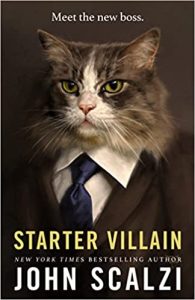
Following the bestselling The Kaiju Preservation Society, John Scalzi returns with Starter Villain, another unique sci-fi caper set in the strangest of all worlds, present-day Earth.
Inheriting your mysterious uncle's supervillain business is more complicated than you might imagine.
Sure, there are the things you'd expect. The undersea volcano lairs. The minions. The plots to take over the world. The international networks of rivals who want you dead.
Much harder to get used to...are the the sentient, language-using, computer-savvy cats.
And the fact that in the overall organization, they're management...

My Review:

It’s a truism that “dogs have owners, cats have staff” and in that context, Charlie Fitzer is absolutely the staffer for ‘his’ cat, Hera, and her newly adopted kitten sister Persephone. In fact, Charlie is more Hera’s pet than she is his, something that he is forced to become all too aware of as Charlie’s situation sinks its teeth into him – figuratively and even literally.

As the story begins, Charlie is so far down that he can’t even see ‘up’ from where he’s standing. He’s a journalist without a job because journalism is dying. He’s divorced. The dad he spent the last several years taking care of is dead, and Charlie is living in his dad’s house but only owns one quarter of said house – while his three siblings want him OUT so they can sell it. He wants to buy a local bar so he can get out of substitute teaching and maybe build a life again.

And his great uncle Jake just died, which Charlie only knows about because he used to be a finance journalist – and a good one – and he still can’t resist listening to the finance news. He’s not expecting a legacy from Uncle Jake because Charlie hasn’t seen Uncle Jake since he was FIVE and barely remembers the man nearly 30 years later.

But Uncle Jake, who Charlie always believed was a parking lot magnate – which he was – was also something else. Something Charlie gets more than a glimpse of when he attends Uncle Jake’s funeral and one of the other attendees attempts to stab the corpse.

Uncle Jake was clearly not just in the parking lot business. And now, neither is Charlie. Which is how he discovers that Hera isn’t just a cat, and that truth is not only infinitely stranger than fiction – but that it downright inspires it in ways that Charlie could never have imagined.

At least not until he found himself mediating labor disputes between the management of the not-exactly-secret, über high-tech, super villain headquarters that Charlie himself is now in charge of and a pod of genetically engineered, super-intelligent and seriously pissed off dolphins who are planning to go on strike.
Escape Rating A: Charlie starts out Starter Villain in WAY, WAY over his head. Part of his charm is that he never loses sight of that fact. He’s always aware that he hasn’t got a clue, and isn’t likely to get one any time soon, and is secretly panicking about it every other minute. Which is a big chunk of why we like him and end up rooting for him so hard, because his inner voice is asking the same questions that a lot of us would be asking in his place.

The setup of Charlie’s world is hilarious and frightening AF at the same time. So much of what happens is utterly silly and bizarre, but with Charlie as our window into this universe we get to secretly giggle – sometimes guffaw – and Kermit-flail in panic right along with him. What makes it work is that the only thing about the over-the-top-ness of it all that Charlie takes seriously are the murders and death threats – which are legion. The trappings of wealth and power are hollow – at least as they apply to him – and he takes all of it with a grain of salt and a look behind the curtain.

So Starter Villain starts out looking like a short course in how to become a supervillain in a few, not so easy, morally ambiguous lessons, only for both Charlie and the reader to ultimately learn that they’ve been outvillained every single hilarious step of the way – and so has everyone else.

There are a couple of niggles that kept this from being an A+ grade, and one that almost put it over the top anyway, because in the end I had an absolute ball with Starter Villain, and not just because of the cats. Although they certainly helped – in exactly the way that cats always do.

The early part of the story is a really hard read – pretty much right up to the point where ‘Tobias the Stabber’ tries to stab Uncle Jake’s corpse to make sure the old man is really dead this time. It’s hard because Charlie is just so far down during that first part of the story, and circumstances continuously hammer that point home to both Charlie and the reader to the point where it feels a bit like ‘piling on’. That’s probably intentional, but it still makes that first part a bit more of a slog than I generally expect from this author.

Speaking of whom, the other niggle that is not a ‘me’ thing but may be a ‘you’ thing is that Charlie is very much the author’s avatar in this one. The bleed through from the author’s public persona to Charlie’s character is obvious. I like the author’s public persona, I’ve been to a whole bunch of his readings and events and often read his blog, Whatever, for his signature brand of giggles, snark and well-thought-out malleting. But I recognize that he’s an acquired taste. I’ve been rather thoroughly infected, and clearly so have a lot of others or his books wouldn’t make the New York Times Bestseller list on the regular. But if you’re not at least neutral to that taste, Charlie Fitzer may not be your jam. If so, I think you’re missing out but YMMV.

The thing that almost put Starter Villain over the top into an A+ anyway is that this is my second ‘read’ of Starter Villain. The first time around, I read it for a Library Journal review, which turned out to be Starred Review and the SFF Pick of the Month that month. So I did love it but that first bit was just hard. (I liked Charlie too much to enjoy watching him suffer – especially from inside his own head.)

This time around I was able to listen to the audiobook (THANK YOU TOR BOOKS!), narrated by Wil Wheaton of Star Trek: Next Gen fame. Wheaton is channeling the author’s public persona so hard and so well that I nearly caught myself checking a couple of times that it really was him and not the author himself – who does do an excellent job of reading his own work at conventions and on book tours.

But all of the above means that, as the character reads like an avatar of the author’s public persona, and the actor is excellent at channeling that same voice, the reading feels almost seamless, like we’re directly in Charlie’s head the whole time and Kermit-flailing right along with him.

In short – which I realize I haven’t been AT ALL – this means that you really, really need to read Starter Villain – especially if you like cats and are sure they’re the ones really in charge of you, your house, and pretty much everything else in the world. And if you have or can create an opportunity where listening to this book in audio will work for you, make it so because it’s even better in audio.
Review: Hench by Natalie Zina Walschots

Review: Hench by Natalie Zina WalschotsHench by Natalie Zina Walschots
Format: eARC
Source: supplied by publisher via Edelweiss
Formats available: hardcover, paperback, large print, ebook, audiobook
Genres: fantasy, science fiction, superheroes, urban fantasy
Series: Hench #1
Pages: 416
Published by William Morrow on September 22, 2020
Purchasing Info: Author's WebsitePublisher's WebsiteAmazonBarnes & NobleKoboBookshop.org
Goodreads

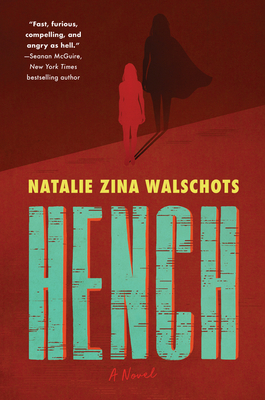
Anna does boring things for terrible people because even criminals need office help and she needs a job. Working for a monster lurking beneath the surface of the world isn’t glamorous. But is it really worse than working for an oil conglomerate or an insurance company? In this economy? As a temp, she’s just a cog in the machine. But when she finally gets a promising assignment, everything goes very wrong, and an encounter with the so-called “hero” leaves her badly injured.  And, to her horror, compared to the other bodies strewn about, she’s the lucky one.
So, of course, then she gets laid off.
With no money and no mobility, with only her anger and internet research acumen, she discovers her suffering at the hands of a hero is far from unique. When people start listening to the story that her data tells, she realizes she might not be as powerless as she thinks.
Because the key to everything is data: knowing how to collate it, how to manipulate it, and how to weaponize it. By tallying up the human cost these caped forces of nature wreak upon the world, she discovers that the line between good and evil is mostly marketing.  And with social media and viral videos, she can control that appearance.
It’s not too long before she’s employed once more, this time by one of the worst villains on earth. As she becomes an increasingly valuable lieutenant, she might just save the world.

My Review:

Hench is decadently delicious villainous competence porn.

I loved every page of it. Which doesn’t mean that I wasn’t a bit squicked out at some of Anna’s decisions. But then, so is Anna. She just goes ahead and does them anyway – and generally does them very, very well.

Still, she makes us wonder what she might have been – and we’re supposed to. That’s part, but only part, of her story.

In a way, Anna’s story is the behind-the-scenes of what would happen if the Avengers – and all of the other superhero stories, were real life. Because that entire mess in the first Avengers movie, where Loki and his forces seriously mess up New York City? There would be one hell of a lot of collateral damage.

How much will it cost to clean all that up? Who pays for all of the many hospitalizations and years if not decades of physical and psychological therapy that all the survivors are going to need? Who pays all their bills while they’re incapacitated? We’re meant to think that the villains got their just desserts, but the ordinary people who just happened to be on one of the skyscrapers that got crashed or trashed – what about them?

There have been superhero stories before where society has taken a look at that damage and decided that it just isn’t worth it, like the marvelous After the Golden Age by Carrie Vaughn. Even The Incredibles, under its golly-gee-whiz-bang, begins in a place where all the supers have been forced to stand down for everyone else’s own good.

In a whole lot of ways, Hench takes that story and backtracks it into a story of supervillain vs superhero vs the tyranny of spreadsheets, and gives us a story about all the “little people” who stand behind a superhero or supervillain. After all, someone has to do the jobs that Gru assigned to his Minions in the Despicable Me series.

I could say that this is a story where one of those minions becomes a supervillain in their own right. Or certainly rises from being merely a hench to an actual kick, meaning a sidekick. Because this isn’t Leviathan’s story. It isn’t Supercollider’s story, either.

It’s the story of Anna, a hench caught in the middle between a supervillain and a superhero, who decides to get her life back by taking down that superhero the only way she can – with spreadsheets.

Escape Rating A++: There are two ways to read this story. One is that it is simply a delightful supervillain vs. superhero story where the villain actually wins. Sorta/kinda. But on the surface this is a romp and it’s easy to ignore the collateral damage of Anna’s actions, or blame them on her opponents – as superhero stories generally do.

And that’s the level I initially read the story at, because I was looking for a world to sink into for a few hours, and Hench certainly provided that escape.

But that’s not all there is to the story.

The first layer underneath is still a lot of fun stuff about the world in which superheroes and villains operate. That while creatures like the Minions make for fun cartoons, in a world of real supers there would be real work that would need to get done.

That’s where Anna and her friends and colleagues come in. They are all henches. Or meat. Henches are functionaries, hanging around to make the supervillain look important, doing the jobs that any large organization needs to get done. Meat are muscle, the people who make the supe look deadly and dangerous. They all effectively sign up to be cannon fodder if an encounter with a supe goes badly.

They are there to do a job, and quite often a job that could be done as easily in a non-supe organization. Which, come to think of it, might have every bit as evil a purpose as the average supervillain. Which is kind of the point.

Anna and her friends are just regular people doing regular jobs who just happen to be doing that job for supervillains. The portrait of their lives, their work and especially their friendships underpins the whole story with a sense of reality.

They’re real folks doing an unreal job.

But dig deeper, and there’s even more about the nature of heroism and villainy, and who decides which is which. That Supercollider believes that superheroes create their own nemeses feels truer than true. He created his own downfall with his own actions, and he was enabled by organizations that have a vested interest in protecting the labeling of heroes vs. villains at any cost.

Because, in the end, it turns out that they create both.