
Grade A #AudioBookReview: The Architect of New York by Javier Moro, translated by Peter J. Hearn

Grade A #AudioBookReview: The Architect of New York by Javier Moro, translated by Peter J. HearnThe Architect of New York by Javier Moro
Translator: Peter J. Hearn
Narrator: Robert Fass
Format: audiobook, eARC
Source: supplied by publisher via NetGalley
Formats available: hardcover, ebook, audiobook
Genres: autobiography, biography, historical fiction, memoir
Pages: 352
Length: 12 hours and 33 minutes
Published by Brilliance Audio, Counterpoint on January 6, 2026
Purchasing Info: Author's WebsitePublisher's WebsiteAmazonBarnes & NobleKoboBookshop.orgBetter World Books
Goodreads

A transportive work of historical fiction chronicling the life, loves, and larger-than-life successes of Rafael Guastavino, an influential yet largely forgotten Spanish architect of New York’s Gilded Era
Iconoclast. Genius. Womanizer. Architect Rafael Guastavino’s signature vaulted tile ceilings revolutionized Gilded Age New York City. The Oyster Bar in Grand Central, the Prospect Park Boathouse, and the iconic Old City Hall subway stop, number among his masterpieces. But while his works continue to imbue the city with the glamor of a bygone era, the man himself has been largely forgotten. Until now.
Told through the eyes of Guastavino’s son and business partner, Javier Moro’s magnetic prose brings to life the remarkable rags-to-riches journey of this influential immigrant family. Guastavino was a stubborn man, enamored of his own sense of destiny, but he was also a deeply compassionate father, as committed to his family as he was to his work, and equally defined by his successes in the latter realm as by his failures in the former.
Set against historical events including the Chicago World's Fair and the sinking of the Titanic, The Architect of New York is a moving and entertaining father-son story filled with finely developed and deeply researched real-life characters (including figures like Stanford White) that captures the glamor and drama of a bygone era while offering a perrenial glimpse into the human heart.

My Review:

They called him “the architect of New York” in his New York Times obituary dated February 2, 1908. And he was. Or rather, THEY were. The title in the obituary, at the time it was written, referred to the elder Guastavino, Rafael Guastavino Moreno, but even then it could have referred to either Rafael Guastavino, the father or the son he named for himself and trained to be his protegee, his right-hand man, and his shadow.

As told in this fictionalized biography/autobiography, not even the two Rafaels Guastavino could tell where the one ended and the other began. And by the end of this story, it’s clear that, as much as he might have wanted to stand apart from his father as a young man, once his beloved father was gone he wished he’d never been forced to discover where that line was drawn.

Rafael Guastavino (1842-1908)

The story reads as if it was intended to be a biography of the older Guastavino. But that biography is written as if from the perspective of the younger, and he tells his own story just as much – if not at points a bit more – than he does his father’s. After all, he knows his own story better AND remembers what he thought and felt as the events he witnessed actually happened.

His father was often a closed book, partly because this story begins when the younger Guastavino, called Rafaelito to distinguish him from the larger-than-life persona of his father, was merely nine years old. A boy, recently immigrated to the United States, with his parents and his older sisters, in the midst of his family tearing itself apart due to stresses that he was, at the time, too young to understand.

But also, and more prominently as Rafaelito’s story continues and he grows in maturity and understanding, because the bits of his father’s life in their native Spain that his father reluctantly reveals over the years contains a great deal of truly messy embarrassments and outright scandals, and the father doesn’t want to tarnish the worship in his son’s eyes.

As much as Guastavino senior had been at the (first) height of his career as an architect and builder when he fled Spain for America on borrowed – and possibly swindled – money, as a human being he was a bit of a louse. More than a bit when it came to his relationships with women.

Part of Rafaelito’s growing up included the discovery that his mother was not his father’s wife, that older his sisters were his half-sisters AND that he had older half-brothers (sons of his father’s first and at the time legal wife) that he’d never met, that the woman in New York City who loved him like a mother couldn’t legally marry his father, and that dear old dad cheated on her, too, repeatedly.

Senior also sent the family – however untraditionally it was constituted – into desperate financial straits over and over again because he could not manage money to save either his soul or whatever building company he was operating at the time.

He always meant well, but he didn’t always do well – at least not personally. Professionally, Guastavino senior was a bit of a dreamer – but he was often right and always visionary. His ability to execute those visions, when he was forced to rely on others outside himself, was hampered by his inability to see the way the world really worked.

But his buildings assuredly did – beautifully so – and in many cases, still do.

The elder Guastavino’s story is a compelling one. It’s a riches to rags to riches to rags to riches story told from the perspective of a person who knew him intimately, shared his life, his work, his profession and his company – and loved him much too much to have anything like an unbiased opinion on anything to do with the man he saw as larger than life until long after the end of it.

That their identities became so intertwined that the many, many buildings they created or helped to create, including parts of Vanderbilt’s famous Biltmore Estate, the Boston Public Library, the Spanish Pavilion at the 1893 Chicago World’s Fair, and several glorious and iconic New York City Subway Stations are now often credited to the company they shared rather than either of them individually.

So, in the process of telling his father’s story, a labor of love for a man now old enough to look back and see a bit more of his father’s truth, Rafael Guastavino, Jr. also does a heartfelt and heart wrenching job of telling his own.

Guastavino Vault in the Boston Public Library Entrance TODAY

Escape/Reality Rating A: To quote Mark Twain, one of the elder Guastavino’s contemporaries, “Truth is stranger than fiction, but it is because Fiction is obliged to stick to possibilities; Truth isn’t.” The story that Rafaelito tells in The Architect of New York is so wild that it seems over the top at many points – and yet it’s all based on the known facts of the man’s life and the work that he – and his son – left behind all over New York City, most of the Eastern Seaboard and all the way across the country.

Which is why this is both an Escape and a Reality rating. As a reader/listener (mostly listener), I certainly escaped into this story. As someone fascinated with history, that the bones of this story are both true and not well known made for a delightful voyage of discovery. The Guastavino designs remain gorgeous examples of New York City’s Gilded Age and Art Deco periods, with their sweeping vaulted ceilings and glorious ceramic tilework.

At the same time, because this is a fictionalized version of a real life it’s difficult to separate what happened from how it’s being told. I both don’t want to critique the man’s actual life – but I also do because his personal life was, to put it in 21st century terms, a hot mess. One of his own making, at that. While he didn’t actually marry all of the women involved, he did also kind of bypass bigamy on the way to trigamy – just not in a legal sense which would have gotten him in even more hot water than he was already in up to his neck.

By telling the story through Rafaelito it allows the author to put a bit of gauze over the lens of objectivity, and also puts the focus more on the work they did together. It turns the story of a truly wild life into a story about the relationship between fathers and sons, the relationship between the immigrant generation and the more formally educated second generation, and, in a business sense, the relationship between the hard driven founding generation and the softer, more privileged generation that comes after them. Those stories, those relationships, are universal and are beautifully explored here.

Rafaelito’s later-in-life reflections on just how much he STILL misses his father, on how much he regrets their frequent arguments, how heartbreakingly often he wishes he could go back in time and tell his father how much he loved him just once more, will bring tears to the eyes of anyone with a heart – especially those who lost their own fathers before they had a chance to realize everything they would miss.

The Architect of New York is a beautiful, absorbing LOT of a story. The audio, read by Robert Fass, was also very well done. Something in the narrator’s voice allowed me to sink right into the story, and that was just right as the story is more than dramatic enough to the point that too much vocal embellishment would take away from it.

Rafael Guastavino, Jr. (1872-1950)

In the end, I was surprised by how much I enjoyed this book, both for its story and for its peek into the Gilded Age and turn of 20th century America, as well as for its tale of love and independence and fathers and sons. If you enjoy stories of fascinating characters with big dreams, even bigger accomplishments, and feet of clay up to the knees, it’s a compelling journey from beginning to end.

One final note; Throughout my absorption in this book, as I listened to the narrator there was a song running through my head. The song, which has reached earworm status and I can’t get it out, is “Leader of the Band” by Dan Fogelberg. Because, the story in that song, the story of Fogelberg’s love for his own father and appreciation of his legacy, may refer to a different shared profession but is very much the same story. A story about a son whose life “has been a poor attempt to imitate the man” and feels as though he’s “just a living legacy” to the father he loved and worshiped.

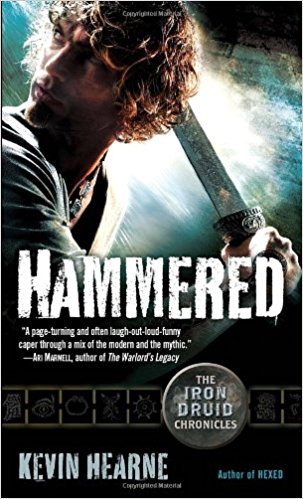
Review: Hammered by Kevin Hearne

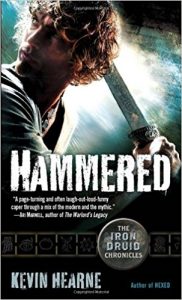
Review: Hammered by Kevin HearneHammered (The Iron Druid Chronicles, #3) by Kevin Hearne, Luke Daniels
Format: audiobook
Source: purchased from Audible
Formats available: paperback, ebook, audiobook
Genres: urban fantasy
Series: Iron Druid Chronicles #3
Pages: 336
Published by Brilliance Audio on July 5, 2011
Purchasing Info: Author's WebsitePublisher's WebsiteAmazonBarnes & NobleKoboBookshop.org
Goodreads

Thor, the Norse god of thunder, is worse than a blowhard and a bully — he’s ruined countless lives and killed scores of innocents. After centuries, Viking vampire Leif Helgarson is ready to get his vengeance, and he’s asked his friend Atticus O’Sullivan, the last of the Druids, to help take down this Norse nightmare. One survival strategy has worked for Atticus for more than two thousand years: stay away from the guy with the lightning bolts. But things are heating up in Atticus’s home base of Tempe, Arizona. There’s a vampire turf war brewing, and Russian demon hunters who call themselves the Hammers of God are running rampant. Despite multiple warnings and portents of dire consequences, Atticus and Leif journey to the Norse plane of Asgard, where they team up with a werewolf, a sorcerer, and an army of frost giants for an epic showdown against vicious Valkyries, angry gods, and the hammer-wielding Thunder Thug himself.

“Kevin Hearne breathes new life into old myths, creating a world both eerily familiar and startlingly original.” —NICOLE PEELER, author of Tempest Rising__________Unabridged, 8 audio discs, 9 hours 43 minutes

My Review:

I mostly listened to this, and usually while working out. But I finished up reading the ebook, because my workout ended in the middle of the climactic battle, and I just couldn’t wait to see how issues resolved.

They mostly didn’t. And that’s probably as it should be. The book ends with a lot of loose ends still jangling.
Hammered feels like the “turning point” book in the Iron Druid Chronicles. Although Atticus faced a certain amount of trouble in the first two books, Hounded and Hexed, at the end of each book Atticus was able to settle down after a job well done and live what counts as his normal life while waiting for the next crisis to jump up and bite him in the ass.

Hammered has a much different tone, and there was a strong sense throughout the story that however things ended, life was never going back to what passed for “business as usual” for Atticus, his Irish wolfhound Oberon, and his apprentice Granuaile, no matter how things turned out.

The warnings from both the Morrigan and Jesus that Atticus was stepping into a pile of shit that was going to rain crap all over everyone were not the only hints that he was messing with something that should never have been messed with, but they were the biggest and certainly the freakiest.

And of course they don’t stop him. He gave his vampire friend his word that he would take him to Asgard to help him kill Thor – no matter what it takes, and no matter what it costs.

Even if that cost is higher than he ever wanted to pay.

Escape Rating A: I’ve made no secret of the fact that I am absolutely loving this series in audio. I’m not sure how consuming one right after another would work if I were reading them, but as something to listen to on the treadmill, Atticus’ snarky sense of humor read in Luke Daniels’ marvelous voice is just about perfect.

I smirk, I chuckle, I snigger and occasionally I even laugh out loud. A lot. The scene where Jesus shows up to have a beer with Atticus and deliver his warnings – along with a rather painful lesson – had some fantastic laughter inducing moments.

But the overall tone of Hammered is pretty darn serious. Atticus is making plans to take his vampire friend and lawyer Lief as well as his werewolf friend and lawyer Gunnar to Asgard so that they can finally get revenge on Thor for some pretty seriously awful stuff.

Atticus spends a lot of the book making contingency plans. If he comes back, he knows that the gods, not just the Norse gods but multiple pantheons of gods, are going to be after him, and he needs to leave Tempe and lie very, very low for a while, along with Oberon and Granuaile. He does a lot of serious leave-taking all around, and his farewell to the Widow MacDonagh had me sniffling.

But Atticus is also planning for the reality that he might not come back, something that Granuaile doesn’t want to hear or deal with, and who can blame her?

It’s obvious throughout the story that whatever happens in Asgard, it certainly won’t stay in Asgard. Some of their very assorted company will not make it back, and even if they do, Atticus life will be irrevocably changed. The creatures who will be coming after him will be bigger, badder and a lot more powerful.

The story is going to get darker from here – and it’s going to be one hell of a ride. Even if that’s where it goes.
I have a feeling that the events in Hammered are going to be crucial for the events in the next several books, And I can’t wait to find out. I’ve already got the audio of the next book, Tricked, cued up and ready to begin.

One final comment. As Atticus and Lief’s very motley crew get ready for the trip to Asgard, there are several chapters where all the participants tell their individual stories of just why they are willing to possibly throw their lives away for a shot at Thor. The individual stories are absolutely riveting, and all are ultimately tragic. But the storytelling sequence itself reminded me very much of the author’s epic fantasy, A Plague of Giants, which is told in its entirety as a bard telling stories to a crowd. I found myself wondering if the genesis of that book might be in this sequence. Whether it is or not, A Plague of Giants is marvelous!
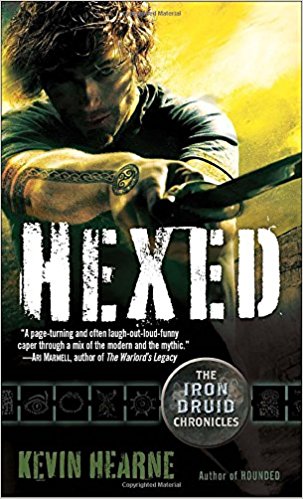
Review: Hexed by Kevin Hearne

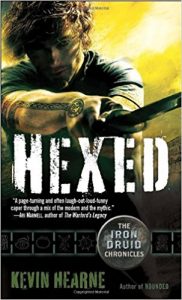
Review: Hexed by Kevin HearneHexed (The Iron Druid Chronicles, #2) by Kevin Hearne
Formats available: paperback, large print, ebook, audiobook
Series: Iron Druid Chronicles #2
Pages: 296
on June 7th 2011
Purchasing Info: Author's WebsiteAmazonBarnes & NobleKoboBookshop.org
Goodreads

Atticus O’Sullivan, last of the Druids, doesn’t care much for witches. Still, he’s about to make nice with the local coven by signing a mutually beneficial nonaggression treaty—when suddenly the witch population in modern-day Tempe, Arizona, quadruples overnight. And the new girls are not just bad, they’re badasses with a dark history on the German side of World War II.

With a fallen angel feasting on local high school students, a horde of Bacchants blowing in from Vegas with their special brand of deadly decadence, and a dangerously sexy Celtic goddess of fire vying for his attention, Atticus is having trouble scheduling the witch hunt. But aided by his magical sword, his neighbor’s rocket-propelled grenade launcher, and his vampire attorney, Atticus is ready to sweep the town and show the witchy women they picked the wrong Druid to hex.

My Review:

The usual pattern with urban fantasy is that the hero or heroine finds themselves going into darker and darker places, fighting bigger and more powerful evils, as the series continues. But when you open the series by defeating a vengeful god, it’s a bit difficult to get anything bigger or more powerful.

That doesn’t stop things in Hexed from upping the darkness scale, finding Atticus and his allies fighting the witches that seem to have fanned the flames of World War II – with even more flames.

In this second entry in the series, the one and only remaining Druid, now calling himself Atticus O’Sullivan, is dealing with the fallout from events in the previous book, Hounded. And while I think that enough backstory is provided that a person could read Hexed without reading Hounded, I’m not sure why anyone who likes urban fantasy would ever want to.

Atticus’ epic battle with the Celtic god Angus Og at Tony Cabin in the Superstition Mountains created a whole lot of collateral damage, beginning with his Viking vampire lawyer (say that three times fast) and Leif’s hate-on for Thor. Not that there’s not a long line of people who hate Thor. He’s not a quarter as handsome or reasonable as the movie version.

But in this universe where not only all the pantheons but all the versions of all the pantheons seem to exist, Atticus is not exactly eager to step up to the plate and bat at all the various versions of Thor, one after another.

He has enough problems dealing with the version of Coyote who shows up at his doorstep, expecting Atticus to kill one of the leftover demons from his fight – the one that is messing with Coyote’s people in Tempe. Not that Atticus doesn’t get tricked in the process, because that’s what Coyote does.

In the end, the big bad that Atticus has to take care of in this story is one that he has wanted to beat on for years, decades in fact. There’s a coven of very evil witches that wants to move to Tempe to unseat the local coven. A local coven that is now vulnerable and at reduced strength, after having gotten caught in the middle of Atticus’ fight with Angus Og.

While Atticus doesn’t really trust witches, he is about to sign an alliance with the remainder of the local coven. He may not exactly trust Malina and her coven, but he is convinced that he, they and the werewolf pack are a big part of what’s keeping Tempe a nice place to live.

And he’s been hunting for their mutual enemies (and vice versa) since the dark days of the Holocaust. He wants payback – but so does everyone else. Even with the help of the local witches and that Viking vampire lawyer, the good guys may have bitten off more than they can chew.

They might get chewed, instead. And not in a good way. Not even like one of Oberon’s tennis balls.

Escape Rating A: If you are ever looking for an audiobook with while to while away untold numbers of hours while going from laughs to thrills to giggles to chills and back again, I can’t recommend the Iron Druid series as read by Luke Daniels enough. I listened to most of Hexed while on a treadmill, and it made the miles just fly by.

Admittedly, the people who were next to me probably wondered about the shit-eating grin on my face. The story is told by Atticus O’Sullivan in the first person, in Luke Daniels’ Audible Narrator Hall of Fame voice, and this is a case where the first person perspective really, really works.

Especially since the reader/listener gets to hear the thoughts in Atticus’ head, which are usually even snarkier than whatever comes out of his mouth.

As the second book in the series, Hexed offers readers an even deeper dive into both its main character and the world in which he lives, including much more information about his friends, associates and enemies. Including his nosy neighbor with the rocket launcher in his garage.

A big part of Hexed is Atticus being forced to look back at a past he usually buries – his actions as a maquisard in World War II, helping to smuggle Jews out of occupied France to reach the port in Lisbon where they could leave Europe’s charnel house. His recitation of this particular snippet of his history is absolutely riveting.

This story also marks a turning point for Atticus, as he comes to the realization that he is no longer on the run from Angus Og, as he has been for almost the entire Common Era. He finally figures out that he has put down roots in Tempe that are worth defending, and has made friends that he wants to keep and needs to protect from anyone else who might – make that almost certainly will – come after him in the future.

Hexed has absolutely everything that those of us who love urban fantasy read it to find, a terrific, kick ass, thoughtful and snarky hero, a great bunch of sidekicks and irregulars, and a world full of magic that just might be our own.
I can’t wait to get Hammered, and I probably won’t.

Review: Hounded by Kevin Hearne

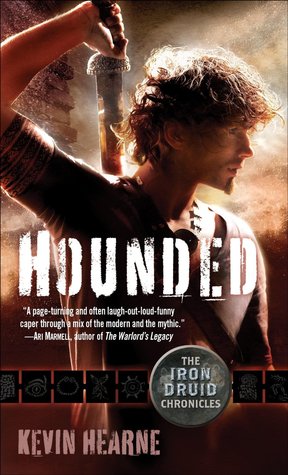
Review: Hounded by Kevin HearneHounded (The Iron Druid Chronicles, #1) by Kevin Hearne, Luke Daniels
Formats available: paperback, ebook, audiobook
Series: Iron Druid Chronicles #1
Pages: 292
Published by Brilliance Audio on October 28th 2014
Purchasing Info: Author's WebsitePublisher's WebsiteAmazonBarnes & NobleKoboBookshop.org
Goodreads

Atticus O’Sullivan, last of the Druids, lives peacefully in Arizona, running an occult bookshop and shape-shifting in his spare time to hunt with his Irish wolfhound. His neighbors and customers think that this handsome, tattooed Irish dude is about twenty-one years old—when in actuality, he’s twenty-one centuries old. Not to mention: He draws his power from the earth, possesses a sharp wit, and wields an even sharper magical sword known as Fragarach, the Answerer.
Unfortunately, a very angry Celtic god wants that sword, and he’s hounded Atticus for centuries. Now the determined deity has tracked him down, and Atticus will need all his power—plus the help of a seductive goddess of death, his vampire and werewolf team of attorneys, a bartender possessed by a Hindu witch, and some good old-fashioned luck of the Irish—to kick some Celtic arse and deliver himself from evil.

My Review:

Because I love urban fantasy, friends have been recommending the Iron Druid series to me for years, and because I get perverse when people push too hard, I haven’t gotten around to it. Until now. And one of these days maybe I’ll learn to ignore that particular quirk of mine, because just like other books that friends have frequently and heartily recommended (I’m thinking of Legion and Thieftaker here), the Iron Druid series, at least on first introduction, is absolutely awesome.

Hounded is just full of the kind of irreverent snark that I expect from the best urban fantasy, while telling a great story that is anchored in the real world. And as the first book in the series, it introduced me to a fantastic character (in multiple senses of fantastic) in Atticus O’Sullivan, the last remaining druid.

Atticus claims to be 21, and looks the part, as the cover pictures indicate fairly well. But Atticus isn’t 21 years old, as he lets people assume. He’s 21 centuries old, and was born in Celtic Ireland a millennium before the Common Era began.

And all the gods are real. Not just the Celtic pantheon to which Atticus still owes some allegiance, and to some of whom he still bears some grudges. But ALL the gods of all the pantheons either existed or have existed. (If this reminds you a bit of American Gods, it does me, too).

But speaking of those grudges, one of those Celtic gods is still harassing Atticus, centuries after losing a famous sword to the Druid in an epic battle. It turns out that the Celtic god of love is actually a selfish, self-centered and manipulative arsehole. And I just insulted arseholes, but in a way that Atticus would probably have approved.

So the short version of this story is that it is all about Angus Og manipulating people and events in order to finally get the great sword Fragarach back from Atticus. The long version of the story is much, much more interesting, as it introduces us to Atticus and all the people in his world, from his werewolf and vampire lawyers (all Vikings) to his slightly dotty old neighbor, to his absolutely marvelous Irish wolfhound, Oberon, who always has his eye on his next sausage breakfast and dreams of harems of French poodles.

Along the way, we meet witches and demons, and get introduced to the gods of the Fae who still deign to mess with the lives of mortals, or at least with the life of Atticus O’Sullivan. Whether that’s for his good or his ill, or even a bit of both, is just part of the wonder of this story.

Escape Rating A: I loved this. And I can’t wait to go back. But this was such a marvelous treat, that I know I need to space them out a bit. Like Halloween candy. But even better, because no calories.

The story is told from the Atticus’ first-person perspective, something that worked particularly well in the audiobook. We hear what he hears, and we also hear what he thinks inside his own head, which is usually much snarkier than what comes out of his mouth – but not always. Listening to the book is like listening to Atticus’ own voice inside his head. It works.

One of the things that works really well is that Atticus is able to communicate with his dog Oberon. And Oberon, while slightly more intelligent than the average, is still very “doggy”. Oberon mostly lives in the now, and that’s a perspective that the 2100 year old Atticus needs to be reminded of every so often, and he recognizes it.

Also, Oberon’s comments on the events are frequently laugh out loud funny, and it’s impossible to resist smirking along with him. This can be a bit problematic if one is listening in public. Or at work.

As much as I enjoyed Atticus’ interesting blend of snark and sweet (his relationship with his elderly neighbor is precious – at least when they aren’t hiding dead bodies together) it is the action and adventure of the story that kept me on the edge of my seat, or sitting in my car waiting for Atticus to find his way out of whatever mess he’d just been dropped into. He’s been hiding in Tempe Arizona for years, and is none too happy when the Morrigan comes to tell him that Angus Og is after him yet again. But this time he decides to stand and defend the life he’s made, and it’s a marvelous tale from beginning to end.

Hexed is up next. Atticus doesn’t trust witches. And there’s a good reason. Again. Fantastic!