A+ #BookReview: Haze by Katharine Kerr

A+ #BookReview: Haze by Katharine KerrHaze by Katharine Kerr
Format: eARC
Source: supplied by publisher via Edelweiss
Formats available: hardcover, ebook, audiobook
Genres: cyberpunk, science fiction, space opera
Pages: 428
Published by Caezik SF & Fantasy on November 11, 2025
Purchasing Info: Author's WebsitePublisher's WebsiteAmazonBarnes & NobleKoboBookshop.orgBetter World Books
Goodreads

Three thousand years in the future, a starship pilot battling addiction becomes the unexpected key to unraveling a mystery that threatens the very foundation of space travel.
In the tradition of Kim Stanley Robinson's deeply researched science fiction and Lois McMaster Bujold's thrilling space opera adventures, HAZE transports readers to a multi-alien society governed by the Rim Council, a loose republic of planets protected by the formidable military force known simply as The Fleet. Interstellar civilization hinges on the use of hyperspace "shunts" for travel, but alarming rumors suggest that this crucial system is under threat.
In response, The Fleet deploys a reconnaissance team from its Special Ops branch to investigate. This team includes a washed-up, drug-dependent star pilot with a talent for finding hidden paths in hyperspace, an AI wrangler with an extensive network of artificial intelligences, a soldier gifted in detecting patterns in time and space, an alien gunner with impeccable aim, and a steadfast female captain who keeps them all in line. Together, this motley crew of space misfits discovers far more than they bargained for, uncovering secrets that could shake their society to its core.
Haze is a character-driven novel featuring a diverse cast of POC and alien characters, set in a future where humanity embraces bisexuality and polyamory, adding layers of complexity to an already captivating narrative.

My Review:

As much as I’ve loved this author’s fantasy series, the sprawling and awesome Deverry Cycle, I couldn’t have stopped myself from diving into Haze if I tried. Her fantasies are so good that I couldn’t resist the impulse to see if her science fiction would be just as addictive.

Which is an appropriate turn of phrase with which to open a review of Haze, because its strung-out, washed up protagonist is irrevocably addicted to the drug Haze, and has not even a flickering impulse to go to rehab, no matter how low he has to sink in pursuit of his next fix.

Which turns out to be as low as it gets. In a place called Nowhere Street on a dead end planet, crawling in search of someone who will buy his ass so he take the money to the nearest dealer afterwards. It’s definitely NOT a living after the Fleet dishonorably discharged him for being addicted to the drug they encouraged him to use to improve his piloting skills.

Dan thinks there’s nowhere left to go but death until a dubious rescue arrives in the form of Fleet reinstatement AND a guaranteed supply of Haze AND permission to use it as needed arrives in the form of new orders and a clandestine mission. He’s more than willing to sign because even if the job kills him, because, well, that’s where he was heading anyway.

At least this way he has a chance of going out in a haze of altered consciousness among the stars, riding the light.

Because that’s what Haze does, at least for starship pilots. It helps them literally ride the light through ‘shunt space’ that makes interstellar travel possible, and forms the backbone of the Rim Coalition of sapient species. Without the mysterious but providential stargates, and pilots with the genetic legacy to guide ships through them, the far flung coalition, its government and its commerce, could not exist.

Which is what makes it such an emergency that rumors have sprung up around the Coalition that the stargates are disappearing. One did. ONCE. Nearly 400 years ago. It happened, it was big news and a huge tragedy as there were colony ships lost in that event, but it dropped out of the news when nothing happened again. Now those old rumors are being riled up. Even worse, anyone who even hints at investigating either the original event or the new focus on it, gets disappeared. Or kidnapped. Or killed along with the ship they happen to be on.

Fleet is worried, because these are just the kind of rumors that lead to panic, which leads to violence, which destabilizes the Coalition. They want to nip this in the bud before the teacup this tempest is boiling in gets any bigger.

And that’s where Dan Brennan comes in. He’s the most talented pilot the Fleet has ever produced. He’s also the most deeply addicted to Haze, and those two things may be more connected than anyone even thought to imagine.

Keeping Dan functional becomes most of the focus of the crew of the Merchant ship Dancing Mary, part of a clandestine Fleet operation to find the source of the rumor and shut it down. As a part of a ‘Black Op’, the captain of the Mary can get Dan’s drugs and ignore the amount of time he spends sleeping off those drugs as long as he’s functional when it counts. Which he is.

So Dan pilots the ship and pursues the high he gets from Haze while the ship pursues the rumors and follows the money that seems to be behind them while the ship’s AI – and the whole entire network of AIs – seems to be pursuing an agenda of their own.

And it all comes together at the speed of light, when Dan’s addiction turns out to be the key to unlocking more different mysteries than the crew of the Dancing Mary – and in fact the whole entire Fleet – ever had an inkling might be being covered up by one panic-inducing rumor.

Escape Rating A+: I expected good things, but this turned out to be simply fantastic space opera, and an absolutely compelling read from beginning to surprising, utterly satisfying end. Which turned out to be an EXCELLENT thing all the way around, as the original estimated page count of 290 turned out to be a severe underestimate. Fortunately, it flies by at the speed of light.

On the surface, Dan Brennan seems like a poor choice for the hero of a space opera, and technically, he probably isn’t actually. The hero, that is. But he is our entry point to this far future world, showing just what it looks like from the very bottom of the ladder.

Also, and this may take a bit of a trigger warning, this is not his redemption story, well, not exactly. He does not get clean and sober. Instead, he discovers that his addiction to Haze is what he’s meant to do, and it gives him the talents that save them all. It’s a weird sideways evolutionary step forward and that’s not a narrative that gets looked for ever – even in SF.

What the story does do is combine the military operations/investigations backbone of K.G. Wagers’ NeoG series with its mercantile empire universe building of corporate greed and corruption. So there’s a mystery within a mystery within a plot to drive profits higher than a pilot on Haze. Hidden behind that, there’s a second mystery about human immortality by transferring consciousness, while underneath that there’s a big of good old-fashioned space piracy just to keep the plots from ever becoming clear.

I keep saying Dan isn’t the hero. The hero isn’t one person, it’s the crew of the Dancing Mary as a whole – including its ever so helpful but just a touch insubordinate AIs. One of the things that makes this story so much fun is that the four species that make up the Rim Coalition have recognized AIs as persons, and that the different species traditions and imperatives among them have meant that tolerance for others’ personal preferences and predilections is the norm for behavior and personal choice. There’s no soapbox about any of this, it simply is what it is in this universe and it’s lovely.

And I’m not saying that because this is a utopian future. People, even for an expanded definition of people, are always going to find something to hate and fear based on bigotry and prejudice. Howsomever, in this universe those things are not skin color, gender representation, sexual preferences or even gender itself. Instead, the triggers for that hate and fear are new, and they engender new and interesting responses even though the beings ginning up those prejudices are using the same old playbook.

The story in Haze, not so much Dan’s story as the story of the Dancing Mary’s mission, reminded me a LOT of K.B. Wagers’ NeoG series, but also Lois McMaster Bujold’s Vorkosigan Saga, as well as a bit of Tanya Huff’s Valor/Confederation/Peacekeeper series, Elizabeth Moon’s Vatta’s War and Vatta’s Peace, and even John Scalzi’s Old Man’s War. All of which are/were long-running series and I wouldn’t mind AT ALL if Haze turned out to be the first entry in something similar.

Which it absolutely looks like it is! Dan Brennan’s second adventure, Zyon, is coming out in March. YAY!

Review: Cyber Mage by Saad Z. Hossain

Review: Cyber Mage by Saad Z. HossainCyber Mage by Saad Hossain
Format: eARC
Source: supplied by publisher via Edelweiss
Formats available: paperback, ebook
Genres: climate fiction, cyberpunk, post apocalyptic, science fiction
Pages: 288
Published by The Unnamed Press on December 7, 2021
Purchasing Info: Author's WebsitePublisher's WebsiteAmazonBarnes & NobleKoboBookshop.org
Goodreads

Welcome to Dhaka, Bangladesh in 2089. A city notorious for its extreme population density has found an unexpected way to not just survive a global climate apocalypse, but thrive: pump enough biological nanotech into the neighborhood and all of the bodies together form a self-sustaining, and even temperate, microclimate. Of course, this means that millions of humans have to stay put in order to maintain a livable temperature, and people are getting restless. All of the nanotech has also led to some surprises: certain people no longer need food or water while others can live without functioning organs.
So the mercenary Djibrel has to carry a machete wherever he goes. Only a swift beheading can ensure the job gets done anymore. Djibrel navigates the crowded streets, humans teeming with genetic mutations, looking for answers about what happened to the Djinn, a magical super race of genies who seem to have disappeared, or merged, with humans for survival. What Djibrel doesn't know is that his every move is being tracked by the infamous Cyber Mage—better known to his parents as Murzak, a privileged snarky teenager who regularly works for a Russian crime syndicate with a band of elite hackers, like his best friend ReGi, who resides in North Africa's FEZ (Free Economic Zone). Respected and feared online, Murzak is about to embark on one of his biggest challenges: attending high school IRL. But when he discovers a brand new type of AI, operating on a dark web from the abandoned Kingdom of Bahrain that he thought was just an urban myth, Murzak and Djibrel will have to face the unimaginable in an already inconceivable world.
In this laugh-out-loud-funny and totally original new novel, Saad Z. Hossain continues his signature genre mashup of SF and fantasy, challenging and subverting everything previously imagined about our future and climate change. A scathing critique of corporate greed, Hossain shows us how to think beyond the naïve ideas of preening moguls like Jeff Bezos and Elon Musk.

My Review:
I wanted to read this book because I absolutely loved The Gurkha and the Lord of Tuesday and hoped there would be more like that. Which, as it turns out, there are – and more than I originally thought. Which is definitely good news!

In fact, having read Gurkha, this and Kundo Wakes Up (to be reviewed closer to its March pub. date), after looking at the blurbs for the author’s other work, I’m starting to think that they are all set in the same dystopian, post-apocalyptic future. And what a fascinating world it is.

This is a future where the world has descended into dystopia as a result of an ecological rather than an economic catastrophe. This particular view of this future is also a bit of a twist on Ready Player One – but it’s a twist where Wade Watts is one of the privileged few instead of the disadvantaged many, pursuing a quest fueled by artificial intelligence and unearned privilege instead of desperation. In a world where the Virtuality is run on greed instead of nostalgia.

And this is also a coming of age story, because the Cyber Mage who is both admired and feared as one of the greatest hackers ever in the Virtuality is a spoiled, overprivileged, lovesick teenage boy who has decided to leave his ergonomically designed and engineered chair in his parents’ apartment in order to chase after the girl of his dreams. The girl he’s been cyberstalking like, well, a lovesick teenage boy.

He’s going to enroll himself in high school – even though he’s a genius who has already passed all the classes – in order to meet his dreamgirl in person and impress her. Even if he honestly doesn’t know what to do after that.

It turns out that what he’s going to do after that is defend the entire school from an invasion. And grow up.
Escape Rating A: There are a couple of things about this story, and the other books I’ve read by this author, that have absolutely made me fall in love with his work. One is the extremely high snark quotient. It seems like most of his characters are possessed of a very smart mouth. In Cyber Mage, the only ones who don’t are the parents of Murzak, the Cyber Mage himself. I’m not entirely sure that their refusal to acknowledge so many of his ultimatums isn’t actually a form of passive-aggressive snark.

The other thing, and the bigger one over the course of this story and his other work so far, are the constant and continuing reversals of both expectation and fortune.

Murzak himself is a prime example. He is, probably, as smart as he thinks he is. But it’s all book-smart. His ability to apply all those smarts to real life is a bit lacking. Putting it another way, he’s simply naïve, not a surprise as he’s still of an age to attend high school. Fitting in is another matter entirely. But he doesn’t have the knowledge of the way the world – and the people in it – really work to keep his mouth from writing checks that the rest of him can’t really cash because he doesn’t yet understand what he’s working towards. He only thinks he does.

If Murzak were an adult with his attitude, he’d be insufferable. As a teenager, he’s a bit of an accident and an attitude waiting to happen. That he’s lying all around – to himself, to his fellow students, to the extremely dangerous people who employ him – that accident is definitely barreling towards him at breakneck speed.

So a huge part of this story is him stepping up to the plate, getting involved in how the world really works, and discovering that adulting is no fun at all but that it’s a job that has to be done. And that he’s the best man to do at least some of it.

But the other part of this story that runs counter to expectations – at least unless one has read some of the author’s previous work – is the way that the effects of the ecological disaster have been handled.

A lot of post-apocalyptic stories show desolate, deadly landscapes where the remaining human population ekes out a marginal existence on a world that is killing them, whether slowly or quickly.

This post-apocalypse, utilizing a still heavily populated Southeast Asian setting, turns the large population into a climate-recovery asset, implanted with nanobots that monitor their every move and inject life-giving climate repair and pollution cleanup with every breath. All controlled by huge, advanced artificial intelligences which keep the cities mostly balanced while still privileging the wealthy and keeping the majority of the population on a universal basic income that keeps them alive, disaffected, and bored. Which doesn’t matter, as long as their nanobots help clean the air and keep them entertained enough to go on living.

But the balance is so complex that the A.I.s are the ones really running everything. And they have minds of their own. Literally. Which puts an entirely new player on the board who has more oversight and control than even the most paranoid doomsayers ever imagined.

And in the midst of all this technology, there really are djinn, and they really do have an agenda of their own. An agenda – and agents to carry it out – that neither the privileged humans or the pampering A.I.s ever put into their calculations of who – or what – is truly in control.
Review: In the Watchful City by S. Qiouyi Lu

Review: In the Watchful City by S. Qiouyi LuIn the Watchful City by S. Qiouyi Lu
Format: eARC
Source: supplied by publisher via NetGalley
Genres: biopunk, cyberpunk, fantasy, science fiction
Pages: 192
Published by Tordotcom on August 31, 2021
Purchasing Info: Author's WebsitePublisher's WebsiteAmazonBarnes & NobleKoboBookshop.org
Goodreads

In the Watchful City explores borders, power, diaspora, and transformation in an Asian-inspired mosaic novella that melds the futurism of Lavie Tidhar’s Central Station with the magical wonder of Catherynne M. Valente’s Palimpsest.
The city of Ora uses a complex living network called the Gleaming to surveil its inhabitants and maintain harmony. Anima is one of the cloistered extrasensory humans tasked with watching over Ora's citizens. Although ær world is restricted to what æ can see and experience through the Gleaming, Anima takes pride and comfort in keeping Ora safe from all harm.
All that changes when a mysterious visitor enters the city carrying a cabinet of curiosities from around the world, with a story attached to each item. As Anima’s world expands beyond the borders of Ora to places—and possibilities—æ never before imagined to exist, æ finds ærself asking a question that throws into doubt ær entire purpose: What good is a city if it can’t protect its people?

My Review:

I’m not sure I got what I expected with this novella, but then I’m also not sure what I expected. I certainly didn’t get that the point of the story was supposed to be the question asked at the end of the blurb. And none of that mattered, because once I got into the story I was hooked.

This is knd of a Scherezade meets a Collector and facilitates a rescue type of story. Or an escape. Or simply an opening of the eyes story. Or even, if you squint, opening the bars of the gilded cage and letting the bird out story. Or perhaps all of the above.

There are interesting political questions that lie behind, and under, and all around the story of Vessel telling stories to Anima about the artifacts collected in the cabinet that has been illegally smuggled into Ora, but there wasn’t quite enough of that part for this reader to hold onto.

Just enough to glimpse that the underlying story would be fascinating if we got it, but it’s not necessary to enjoy the stories, poems, vignettes and thought-pieces that Vessel relates to Anima.

But as much as I wondered about the world that produced this situation, that Anima is just one node in an ever-watchful neural network that observes and protects the city-state of Ora, what I loved were those little stories and the way that they opened Anima’s eyes to possibilities of other lives and other futures – not for the city but for Anima alone – if Anima is willing to cut Ærself off from the network that has sustained Ær whole life.

Escape Rating A-: As I said, I loved this one for the stories, but puzzled a bit – okay, a lot of bits – about the universe in which they are set. There’s a biopunk AND cyberpunk feel to the whole thing, as Anima is both an individual with individual thoughts and feelings AND a node on a city-wide network with the capacity for omnipresence if not any other deity-like powers.

The intrusion of the psychopomp Vessel both upsets and opens Anima’s closed world-view. Vessel is a smuggler, who is not supposed to be in Ora, and is not supposed to have been able to enter Ora without being caught.

For Anima, Vessel is both a puzzlement and a siren, luring Anima into viewing other lives and other worlds, allowing the person-who-is-a-node to see that there are other possible ways and places to live.

The individual stories range from heartbreakers to morality tales. (The story about the difference between raising the dead and resurrecting the dead is dark and heartbreaking and a gem all at the same time.) They are little jewels, revealing ever more facets to the universe of possibilities if only Anima is willing to reach out and grab them. And it’s only at the end that the reader realizes that opening Anima’s eyes was the point all along, and that THAT was the thread that linked all the stories. Pulling all of the “might have beens” into a thread of possibility for Anima – and for Vessel.

Review: Automatic Reload by Ferrett Steinmetz

Review: Automatic Reload by Ferrett SteinmetzAutomatic Reload by Ferrett Steinmetz
Format: eARC
Source: supplied by publisher via Edelweiss
Formats available: paperback, ebook, audiobook
Genres: cyberpunk, dystopian, romantic comedy, romantic suspense, science fiction
Pages: 304
Published by Tor Books on July 28, 2020
Purchasing Info: Author's WebsitePublisher's WebsiteAmazonBarnes & NobleKoboBookshop.org
Goodreads

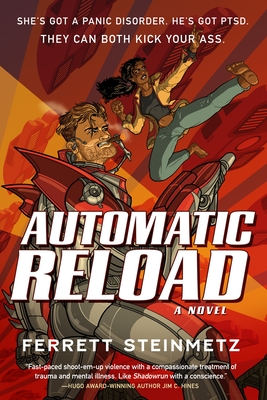
Ferrett Steinmetz's quirky, genre-mashing cyberpunk romance Automatic Reload a high-octane adventure about a grizzled mercenary with machine gun arms who unexpectedly falls in love with a bio-engineered assassin
In the near-future, automation is king, and Mat is the top mercenary working the black market. He's your solider's solider, with military-grade weapons instead of arms...and a haunted past that keeps him awake at night. On a mission that promises the biggest score of his life, he discovers that the top secret shipment he's been sent to guard is not a package, but a person: Silvia.
Silvia is genetically-altered to be the deadliest woman on the planet--her only weakness is her panic disorder. When Mat decides to free her, both of them become targets of the most powerful shadow organization in the world. They go on the lam, determined to stop a sinister plot to create more super assassins like Silvia. Between bloody gunfights, rampant car chases and drone attacks, Mat and Silvia team up to survive...and unexpectedly realize their messed up brain-chemistry cannot overpower their very real chemistry.
Automatic Reload is the genre's most unexpectedly heartfelt romantic comedy with explosions, perfect for fans of both Die Hard and Mr. and Mrs. Smith."Steinmetz has mixed fast-paced shoot-em-up violence with a compassionate treatment of trauma and mental illness to create an engaging page-turner. Like Shadowrun with a conscience."-- Hugo Award-winning author Jim. C Hines
"Automatic Reload is for everyone who ever wished the Transformers movies were less Michael Bay, more transformation sequences; it luxuriates in the intricate beauty that is technology, exults in the mechanics of cyberpunk. And it does all this while being a rom-com with a lot of explosions." --Cassandra Khaw, finalist for the British Fantasy and Locus Awards for Hammers on Bone

My Review:

Automatic Reload was a wild ride from beginning to end. The kind of wild ride you get when you cross cyberpunk with dystopia and throw in a bit of romantic suspense for spice – and extra body. Make that bodies, definitely plural, bodies.

The genre of this book has been bent so much that it’s a pretzel. But I LOVE pretzels – and I’m sure I’m not alone.

The future that is posited in this story reminded me of a lot of things, and not just the idea that this is a possible future that we can see from here – without even having to squint too hard.

In a way, it’s the future that The Passengers by John Marrs was trying to warn against – at least until that story takes a hard left turn into more traditional suspense. But the idea that powers most of that book, that computers are controlling too much and making too many decisions based on programming rather than human ideals or human compassion is at the core of this story – even though it turned out not to be in that one.

There just aren’t a lot of jobs left for people. Computers even design and program other computers. They’re more efficient and more effective at nearly everything. Especially, as it turns out, warfare.

And that’s where our hero comes in. Mat started out as a drone soldier. He piloted the machines that made the actual war, and that distance was supposed to keep him from suffering all of the mental anguish that soldiers have to go through when they make the decision to kill an enemy. Because that decision can go wrong all too easily, wiping out an innocent, or a noncombatant, or a child.

But the distance doesn’t take away the pain, or the PTSD that Mat suffers after the drone he’s piloting kills a child who just happened to be in the wrong place at the wrong time.

Mat’s way of dealing with the thoughts that won’t leave him is to overcompensate, both physically and mentally. He becomes, not exactly a cyborg, or they’re not called that, but a black market mercenary with four artificial limbs optimized for war. And he fine tunes the programming for all of his various alternate limbs to optimize his every routine and subroutine to eliminate – if possible – any chance of accidentally killing someone he shouldn’t. He does his level best, and it is very, very good, to remove any possibility of collateral damage.

Because the automation of all of his weaponry operates faster than he or any human can think. Once he gets into a situation the weapons are on automatic reload. But he can’t bear the thought of killing another innocent.

He’s done his best to make a living – because maintenance on his hardware and software is damn expensive – without putting himself into the cross-hairs of the IAC. A shadowy company that operates very much outside the law – because they control the law, the media, and pretty much any damn thing they want.

If the IAC decides he’s worth bothering, they’ll be able to trace his every networked movement since the dawn of time. They’ll know his every strength, his every weakness, his every move, even before he does. He’s done his best to stay far away from the “YAK”, as the IAC is usually referred to. Mostly in frightened whispers, because they really are everywhere, watching and listening to EVERYTHING.

It’s just supposed to be one very lucrative and very quick job. So of course it all goes pear-shaped, leaving Mat squarely in the YAK’s sights. But the reasons it’s gone so far down the rabbit hole is that the cargo he was supposed to deliver wasn’t just black market goods – it was a black market person named Silvia. A woman who had been altered against her will to be a deadly stealthy weapon – only her programming isn’t finished yet.

And if Mat has his way, it never will be. Because Mat’s PTSD and Silvia’s panic disorders mesh in a way that makes their whole much greater than the sum of any number of parts. A whole that the YAK must destroy no matter how much collateral damage it takes.

Unless the YAK has something else altogether up its sleeves – if it even has sleeves, that is.

Escape Rating A: Automatic Reload wasn’t anything I expected. At all. But it was a wonderful, totally wild ride in all of the best ways.

The mash-up is delightful and keeps throwing surprising things into its blender – which is definitely on high.

The world feels like an answer to The Passengers, mixed with the dystopia of Junkyard Cats by Faith Hunter. I can’t even articulate why Junkyard Cats, although I think some of it has to do with just how bad things are for most humans, and the amount of autonomy that her protagonist has programmed into her many mechanical friends and helpers. That one is a stretch.

The Passengers, on the other hand, is dead on for the worldbuilding rather than any of the characters. Both stories deal with the issues that we’re starting to face in the here and now. What do people do, and how do people support themselves, when the number of jobs that require a human being is on a downward trajectory. After all, it’s not immigration that has killed off so many jobs, it’s automation, and that’s a trend that’s going to continue.

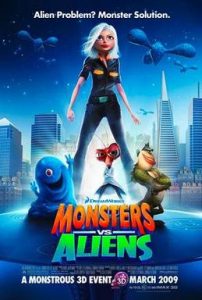
I’ll admit that I also kept seeing Silvia as the character in the movie Monsters vs. Aliens, or at least the character in the movie poster. She’s not 50-feet tall, in fact she’s human proportioned on purpose in order to infiltrate better – to be a more effective assassin. But the issues she faces with suddenly discovering that she’s not who she used to be feel similar.

Although Silvia’s problems do not begin with her physical transformation. One of the strongest – and sweetest – elements of this story is the way that Mat and Silvia come to love each other for who they are, and that they both acknowledge that they both have a lot of mental issues that they compensate for in their own ways. Their mental illnesses are never swept under the rug, and love doesn’t cure them. But they make each other a bit stronger in their broken places in ways that are lovely to see, especially when they’re done well. As they certainly are in this case.

Initially I thought that the dystopian setup had elements of the worldbuilding of Ready Player One. And it definitely does. I just didn’t expect the plot to, in its own pretzel-twisty way, actually go there explicitly. But it does, with classic movies substituting – in a way – for 1980s pop culture trivia. And it happens in a way that will still totally surprise you.

So come to Automatic Reload for the dystopian world and especially the explosions. Stay for the brighter future that rises, somewhat shakily but delightfully on the horizon.