
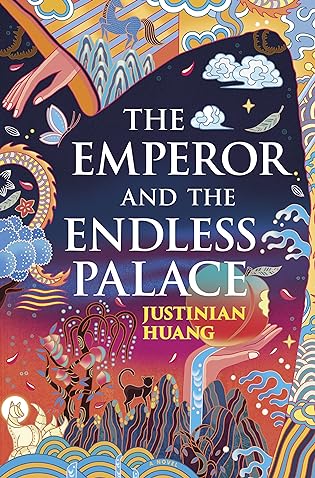
 The Emperor and the Endless Palace by Justinian Huang
 Format: eARC
Source: supplied by publisher via Edelweiss
Formats available: hardcover, ebook, audiobook
Genres: fantasy romance, historical fantasy, M/M romance, magical realism, romantasy
Pages: 312
Published by Mira on March 26, 2024
Purchasing Info: Author's Website, Publisher's Website, Amazon, Barnes & Noble, Kobo, Bookshop.org, Better World Books
Goodreads
“What if I told you that the feeling we call love is actually the feeling of metaphysical recognition, when your soul remembers someone from a previous life?”
In the year 4 BCE, an ambitious courtier is called upon to seduce the young emperor—but quickly discovers they are both ruled by blood, sex and intrigue.
In 1740, a lonely innkeeper agrees to help a mysterious visitor procure a rare medicine, only to unleash an otherworldly terror instead.
And in present-day Los Angeles, a college student meets a beautiful stranger and cannot shake the feeling they’ve met before.
Across these seemingly unrelated timelines woven together only by the twists and turns of fate, two men are reborn, lifetime after lifetime. Within the treacherous walls of an ancient palace and the boundless forests of the Asian wilderness to the heart-pounding cement floors of underground rave scenes, our lovers are inexplicably drawn to each other, constantly tested by the worlds around them.
As their many lives intertwine, they begin to realize the power of their undying love—a power that transcends time itself…but one that might consume them both.
An unpredictable roller coaster of a debut novel, The Emperor and the Endless Palace is a genre-bending romantasy that challenges everything we think we know about true love.
My Review:
Three roads converge in the midst of a labyrinth. Three fates collide in never ending repetition. No matter where or when the tragedy recurs, nothing ever makes a difference in the ultimate outcome.
In other words, no matter where you go, there you are.
An emperor and a clerk in 4 BCE, an innkeeper and a mysterious stranger in 1740, a medical student and an artist in the now. Three times, three places, three romances, three tragedies.
Different incarnations, different times, different lives but the same results. Because this isn’t just a story of love lost and found, but a story of love lost because it has been betrayed, over and over again. An eternal triangle that hinges on the heart of the one who always remembers everything, and yet can’t stop himself from repeating the same old mistakes. Over and over and over again.
Because even death seems incapable of doing their spirits apart. Perhaps next time, because even if nothing else is certain, there will certainly be one.
Escape Rating A-: This story walks three paths, and at first it doesn’t seem like one has much to do with the other. It reminded me of stories about walking a maze of trials that leads to a central point, a trail of trials that no matter which path is walked that ultimately leads to the same place – and all too frequently the same goal or battle or contest or tragedy. A progression that, as the path is walked and the spiral gets tighter, allows brief glimpses into the spirals on either side.
But at the beginning, the relationship between Dong Xian’s precarious climb up the ladder in Imperial China, He Shican’s nighttime wanderings in the woods around his remote inn in the mid-18th century, and River’s drug-induced hallucinations of the circuit party scene in today’s Los Angeles don’t have a connection that the reader can see.
It’s only in the dreams, nightmares and drug-induced ecstasy that the characters experience in each of the timelines that the stories begin, hazily at first, to reach out for each other – even as the contemporary characters in this never-ending story, River and Joey and Winston, come together and ultimately drive each other away.
Each of the stories begins slowly, but as they draw towards their individual conclusions that are all the same tragic ending, the inward spirals get faster and faster and tighter and tighter – like the loop of a noose closing around the throats of ALL the stories, leaving the reader breathless at the end.
An ending which may not be one at all.
I’m not sure what I was expecting when I started this book, although a friend’s absolute rave about it induced me to give this debut novel a try. And I’m glad I did because in the end I was completely blown away by this sexy, queer romantasy AND that it’s the author’s first.
I can’t wait to see what he does for an encore!
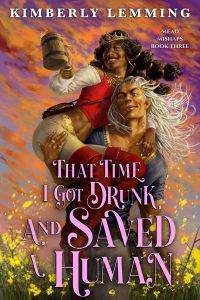
 That Time I Got Drunk and Saved a Human (Mead Mishaps, 3) by
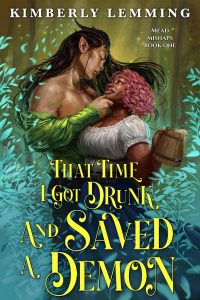
  Which is the story of Cherry’s current life when the story begins. Because yes, that’s Cherry Hotpepper, the missing and presumed dead sister of the heroine of the place where this whole thing started in
  Escape Rating B: In the end, I enjoyed this nearly as much as I did the previous books in the series,
 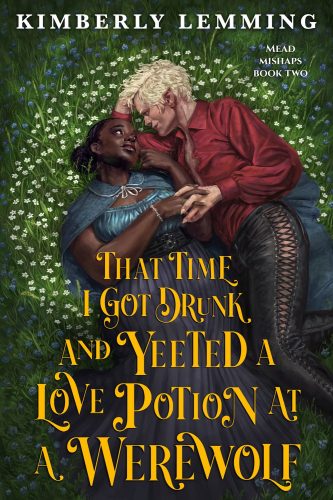 That Time I Got Drunk and Yeeted a Love Potion at a Werewolf (Mead Mishaps, 2) by
  I just started in the middle, didn’t I? That’s actually kind of apropos, as That Time I Got Drunk and Yeeted a Love Potion at a Werewolf is the second or even more on point, the middle book in the
  And just like in the previous book, and just as much fun as that first time around, this second cozy fantasy with sexytimes combines (frequently and often but not nearly as frequently and often as either Felix or Brie REALLY want) two tastes that go really GREAT together. There’s a surprisingly sweet romance between a girl who wants to do the right thing even if kills her and a werewolf who is sure that what they are doing IS the right thing if only she’d stop worrying about the love potion – at least right up until the point he realizes that he really, Really, REALLY should have worried a bit more about the love potion. And on the other hand, the need to foil a terrible plot to fill the worldwide vacancy in the deity department with a new face slapped on the same old trickster.
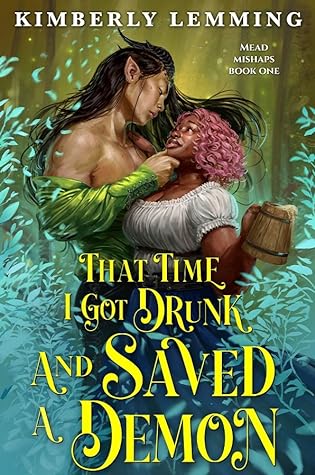 That Time I Got Drunk and Saved a Demon (Mead Mishaps, #1) by
 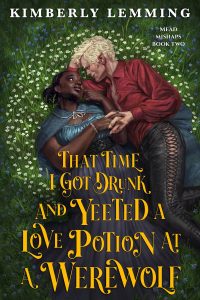 The hard part of that journey, in so many senses of the word, many of which are played for salacious titters to VERY good effect, is the progress of the romance between the demon Fallon and the Spice Girl (literally, Cin’s full name is Cinnamon, she grows cinnamon on her family’s spice farm). It’s clear to everyone except Cin that Fallon is all in on their relationship – if not yet into all of Cin’s private places – from the moment they meet. Cin’s the one who needs some convincing – not about whether she and Fallon set each other on fire – but whether his fire and her desire to never get burned again have a chance at a future.
 Paladin's Faith (The Saint of Steel, #4) by
  There’s a classic saying about large organizations at cross-purposes within themselves, that the right-hand doesn’t know what the left hand is doing. Marguerite Florian’s problem with the Red Sail mercantile empire is that their “right hand does not know who the left is killing”.
 Marguerite just has to stay alive long enough to find the artificer. For that, she’ll need bodyguards who can’t be bribed or bought, seduced or suborned. She needs a paladin – or two.
 Howsomever, by the nature of that waiting game a LOT of this story is extremely interesting character development with a fair bit of adding to the depth of the worldbuilding but one does, like one of the side characters, Davith, want them to just ‘get on with it’ one way or another, either to get a move on in their mission or just make a move on each other.