A- #BookReview: The Best American Science Fiction and Fantasy 2025 edited by Nnedi Okorafor

A- #BookReview: The Best American Science Fiction and Fantasy 2025 edited by Nnedi OkoraforThe Best American Science Fiction and Fantasy 2025 by Nnedi Okorafor, John Joseph Adams
Format: eARC
Source: supplied by publisher via Edelweiss
Formats available: paperback, ebook, audiobook
Genres: Dark Fantasy, fantasy, horror, science fiction, science fiction horror, short stories
Pages: 416
Published by Mariner Books on October 21, 2025
Purchasing Info: Author's WebsitePublisher's WebsiteAmazonBarnes & NobleKoboBookshop.orgBetter World Books
Goodreads

Of science fiction and fantasy, guest editor Nnedi Okorafor writes, “There are times when it feels like a box, but within it, technically, you can expect anything.” The twenty stories in this collection simultaneously fulfill and defy expectations of genre, showcasing boundary-pushing authors at their best. In this year’s Best American Science Fiction and Fantasy, a robot will struggle to make friends, a team of auditors determines the financial value of a lifetime, an alien species will teach you how to read, and maybe, just maybe, someone will finally do something about the kid in Ursula K. Le Guin’s Omelas hole. From the joyous to the terrifying, to the heart wrenching and the absurd, these stories encourage you to open your mind and, as Okorafor promises: “Watch your world expand.”

My Review:

As much as I enjoyed these stories – and I generally did – there was so much dark fantasy and outright horror in this collection that after I finished I needed a cocoa, a lie down, and a comfort read to get over it. Together, these stories do not exactly paint a pretty picture of the world these authors were thinking of as they wrote, but then again, the world we’re living in right now often feels as dark as they painted.

Because this is a collection of the best stories of the previous year, I had read a few of them before – in my Hugo Nomination readings as the publication periods overlapped. Where I have already posted a review of the story, I’ve linked to it instead of repeating myself.

The Escape Rating for the collection as a whole is a very much fudge-factored A-, and it feels like there’s a horrifying monster lurking in the dark eating that fudge. Or something like that.

I need to go find myself another cocoa while you read the reviews of the individual stories. Just FYI, you might need one too.

Caroline M. Yoachim. “We Will Teach You How to Read | We Will Teach You How to Read”
(From Lightspeed – podcast) Science Fiction https://www.readingreality.net/2025/08/audiobookreview-we-will-teach-you-how-to-read-we-will-teach-you-how-to-read-by-caroline-m-yoachim/ Escape Rating A-

Rachel Swirsky. “Also, the Cat” (From Reactor) Fantasy
Somehow, this story manages to be both cute and uncomfortable at the same time. Also good, but a bit slow moving. But that’s kind of the point. Elderly sisters Rosalie, Viola and Irene are dead, not to begin with, but one at a time. But instead of going to some great reward, or even to hell with or without handcarts, even in death they’re still stuck with each other, still trapped in the house where they were pitted against each other – or pitted themselves against each other, in spite of all being dead. What made this story interesting was that their entrapment was explicitly NOT about finding their inner sisterhood, but about finally walking away from it. My only issue with this story is that it meanders a bit on its way because their sibling rivalry isn’t remotely dead even though they are. And yes, there’s a cat – but the cat explicitly does not show them the way. Escape Rating B+

Olivie Blake. “The Audit” (From Januaries) Science Fiction
This was more interesting than compelling. The idea was fantastic, but it felt like the execution was all over the place. OTOH that’s fitting as so was the protagonist, OTOOH, it made it damn hard to get into. It takes an idea that could have had a lot of traction, the idea that when we’re young adults we don’t have the time or the money to enjoy things because we’re too busy making a living, and by the time we have spare time and disposable income we’re middle aged and tired. In other words, it takes the idea that youth is wasted on the young and runs with it into a scheme where some people get money, based on their future earning potential, to have a blast free of economic constraints, but then must pay it all back when they reach middle age – by taking the career path of the funding organization’s prediction or choice. The story is about one young woman flailing around with sudden wealth filled with decision paralysis about what to do with her newly granted money and time – and the good and bad decisions she makes as she figures things out. Because she’s not figuring things out and flails around a LOT, the story does too. Escape Rating B-

Kij Johnson. “Country Birds” (From Sunday Morning Transport) Fantasy
This story reads like the bright Mirror Universe version of The Crane Husband, which is definitely the dark Mirror Universe. It’s a very cool, very SFnal sort of fantasy about aging and transformation. It struck me hard because I’m closer than I’d like to think, and the idea of each ache and pain being transformed within my body to a bright – or even a shadowy – thing with feathers just warmed my soul. It brings to mind the Emily Dickinson poem about hope, the one that begins “Hope” is the thing with feathers – That perches in the soul – And sings the tune without the words – And never stops – at all.” and turns it into a literal flock of birds that spur a surprisingly hopeful transformation. Escape Rating A- because, while I didn’t exactly escape because it reminded me of my own circumstances, the story was utterly beautiful.

Tatiana Obey. “Fuck Them Kids” (From FIYAH) Science Fiction
This turned out to be my favorite SF story in the collection. It begins with a family visit to one of Jupiter’s moon colonies on Europa, but the visit itself is a familiar one, childless by choice adult daughter visiting with her sister, her sister’s children and spouse, and their mother who is STILL ragging childless daughter about having a career instead of a family. But instead of caving to pressure, Jaz gets her regular and much appreciated dose of family and mom’s home cooking – and leaves for her next race. Because that’s what she does, races souped up space cruisers. And she loves every bit of it. When she discovers that her teenage niece has stowed away on her ship, she doesn’t bring the girl home right away. Instead, Jaz discovers that her niece is every bit the space and adrenaline junkie that she herself is, and that everything is more fun with an apprentice along for the glorious ride. Escape Rating A+ because this story really did let me escape with Jaz and Aden and I loved the idea that both Jaz’ choice AND her sister’s, were equally valid – because that doesn’t happen nearly enough.

S.L. Huang. “The River Judge” (From Reactor) Fantasy (Dark)
This is one of several dark fantasies in this collection. It also reminds me a lot of The Brides of High Hill, the really gothic entry in Nghi Vo’s Singing Hills Cycle, both in its tone and in its creepy atmosphere. I want to say this is a really creepy ghost story, but there’s only one ghost and it really isn’t the point. It is a story about women taking power in the bloodiest of ways, but that’s not quite it either. It’s certainly a combination of local myths and legends taking on a life and death of their own, of women who have been abused rising up to eliminate their abusers, and about the sharp, bloody line between justice and vengeance. Even though there’s no specific myth or fairy tale involved, this would still fit right in with the author’s Burning Roses, which does. Escape Rating A for the way the ending still held one last surprise twist AND managed to be both creepy and just at the same time.

Carlie St. George. “The Weight of Your Own Ashes” (From Clarkesworld – podcast) SF
This was, ultimately, sad fluff. It’s a relationship story, but it’s a relationship story steeped in both SF and the issues of, well, relationships. On the SF side, it’s a multiple body problem – literally. The Myriad are a species that exists in multiple bodies. Yonder, who lives on a near-future Earth, on a Lunar Colony, on a transport ship and on another planet – SIMULTANEOUSLY – is in a romantic relationship on Earth when her Earth-body dies. She desperately wants to come back to her lover – and she does – only to discover that her human lover can’t cope with the multiple bodies of Yonder and NEVER HAS. So on the relationship side, it’s a story about discovering a truth and letting it set you free instead of continuing to compromise who you really are. Escape Rating A- for the commentary on the insularity of humanity combined with subtle heartbreak.

Xavier Garcia. “An Ode to the Minor Arcana in a Triplet Flow” (From Death in the Mouth, Volume 2) Fantasy (Dark)
As I keep saying – and will continue to do so – a lot of the fantasy in this collection is close to or right on the line between dark fantasy and outright horror. This particular story tripped right over that line into straight up gory horror with a side dose of psychological horror to give it just that extra helping of blood and guts and other bodily fluids expelled in the throes of death.

It starts out, well, not innocuous but not where it ends up, and I’m saying that and it starts with observations about the visual impact of blood on gold teeth. But it really begins with a young man who thinks he is willing to do ANYTHING to make his dream of rap superstardom come true. The story is all about the way that he learns that he’s the type of person who really will, no matter what horrors he has to accept or commit to make it happen. So think of this as the story of a man making a Faustian bargain and learning that he’s both Faust AND the devil he bargained with – he just didn’t know it YET. Escape Rating OMG I don’t know what to do with this one. For the story itself it’s a B but that’s because it’s really not my cuppa AT ALL but I recognize it’s probably terrific for someone whose cup it actually is. Also I didn’t really escape so much as sit stunned in horror through the whole thing – which was probably the author’s intent all along. Then I had to find something cozy to read as an antidote because this one was A LOT.

Kathryn H. Ross. “The Forgetting Room” (From FIYAH) Science Fiction (Dark)
This is either a story about the road to hell being paved with good intentions, OR it’s a story about protecting children from the things that make their parents uncomfortable, taken to the nth degree, OR it’s a metaphor for what a spouse or family goes through when a family member is in the terrible process of being lost to Alzheimer’s. The tech that makes this science fiction sounds so benign at first, the idea of forgetting just that bit of discomfort that someone is chewing on or stewing over – the way that parents want to keep their kids from reading or seeing anything that the parents feel is too disturbing or too adult for them. But the story is about what happens when that gets too quick and too easy, to the point where it’s as addictive as any drug, when the forgetting becomes so comforting and all pervasive that the ones who don’t forget lose their connection with those who do. Until the only answer is for all of them to forget everything together – and where does that lead? Escape Rating B because, like the story above, I see that it’s good of its type, the implications are SFnal and horrifying and understated and I can’t stop thinking about them, but I kinda wish I could forget this story because I’m creeped out by those same implications.

Dominique Dickey. “Look at the Moon” (From Lightspeed) (Science Fiction) (DARK)
This isn’t really SF, it’s just that the hook for the story is amateur astronomy. It could have been anything. This one is just straight up horror. At its dark heart it’s the story of a 20something couple, one of whom is an amateur astrologer. Her partner comes with her to an out of the way meetup where a bunch of similarly minded folks can watch the stars from outside the light pollution of Los Angeles. But the group turns out to be a cult, the couple sees them murder a child who failed to be the prophet they’ve been hoping for, and they are forced to participate in the murder so they can’t run to the police. What makes the story a bit different from one that’s been told a thousand times is the backstory of the couple and how it ties back into the origins of the cult, which just wasn’t enough to make it work for this reader as anything like ‘best’. Escape Rating C

Isabel J. Kim. “Why Don’t We Just Kill the Kid in the Omelas Hole” (From Clarkesworld – podcast) Science Fiction (Dark)
https://www.readingreality.net/2025/08/grade-a-audiobookreview-why-dont-we-just-kill-the-kid-in-the-omelas-hole-by-isabel-j-kim/ Escape Rating A

Jennifer Hudak. “The Witch Trap” (From Lady Churchill’s Rosebud Wristlet) Fantasy
There’s a lot of dark in this collection. This particular story might be going there, but it ends at the point where the possibility is out there but hasn’t yet been fully realized. The story we’re reading is about a woman who is remodeling her very old house when an equally old shoe is discovered under the floorboards. The shoe is a mystery. It might have been intended as a witch trap. It might have succeeded. But history – at least history as it’s understood now – tells us there were no witches. If there were, does this old shoe hold the key to their craft? And is Elizabeth willing to listen to all the dark and mysterious things the shoe might be trying to tell her? Escape Rating A- because of the way this is perched so precariously on the fence between a story about female power and a story about magic and how much the one is in service of the other and just how terribly and powerfully that might go.

Susan Palwick. “Yarns” (From Asimov’s) Science Fiction (Dystopian)
This wants to be a hopeful story, but it’s very dystopian and never quite gets there. Or, at least, while the protagonists may have temporarily or even permanently escaped the dystopia, the odds of it lasting are between slim and none and slim has already left the building. In a world where criminal syndicates control everything, one teacher does her best to save a boy whose father is a soldier from one of those controlling syndicates. She’s unable to save him, ends up on the run, but does manage to save another child – and herself. At least for a while. I think it’s intended as a story about paying it forward and having the good karma come back to you even in a horrifying situation, but by the time I read this story I was pretty much full up on the dark in this collection. Escape Rating B because the story reminded me a bit of the internet meme about ‘The Grandmother and the Demon’, sometimes known as ‘Todd and Anette’ although THAT story has a happier ending – which is definitely saying a whole lot of something.

Pemi Aguda. “The Wonders of the World” (From Ghostroots) Fantasy
This is one of the few stories in the entire collection that ends lighter than it started. It begins with Abisola, a girl who has panic attacks and Zeme, a boy who thinks he’s a prophet, both still in school, both the ‘odd kids’ in their class on a school trip from Lagos to see the ‘wonders of the world’ – or at least those that are near enough to get to by bus. While there’s quite a lot about school rivalries and cliques and how hard it is to fit in and how easy it is to get ostracized for being different, the metaphor that carries the story upwards instead of down into the dark involves the Ikogosi Warm Springs in Nigeria, where hot and cold waters springs meet and run side by side without mixing. What made this rise was the way that, at the end, after everything that happens on the trip, Abisola takes the unmixed but intertwined waters as a sign that just because she is different from her parents and they worry about her, their relationship is still filled with love and acceptance. Escape Rating B because I just needed something in this collection that did not descend to hell – and this one just rises.

T.J. Klune. “Reduce! Reuse! Recycle!” (From In the Lives of Puppets) Science Fiction
This is weird, not for the story but for its availability. It’s part, and only part, of a kind of Appendix to In the Lives of Puppets. An Appendix that was not included in the ARC I read, and is also not included in the audiobook I borrowed from my local library – although it IS in the ebook I borrowed from them. (I was hoping to listen to this story but NOOOO)

The story, very much on the other hand, doesn’t rely on the book that it’s an addendum to in order to actually land. Although it does land harder after reading another story in this collection, “The Three Thousand, Four Hundred Twenty-Third Law of Robotics” and even a bit of Mechanize My Hands to War. The robot’s circumstances in this story aren’t quite as horrifically awful as they are in “Robotics”, but in other ways they are worse, which is where Mechanize comes in. In this one, the robots, as seen through the eyes of one obedient robot, Douglas, in his last week of life – and his only week of freedom. He experiences the joys of the world – and all its prejudices – just so he can find out what he’s been missing. Then he turns himself in and gets his memory wiped. But just like the robots in Mechanize, Douglas and his kind are growing past the presumed limits of their programming. He thinks, therefore he is. And if he thinks hard enough, one of his future memory wipes might not wipe his memory at all. Because there’s ‘no place like home’ and Douglas has found his – if only he can get back to it. This was, in its way, more heartbreaking than “Robotics”, which was just pure anguish. This is a bit like Flowers for Algernon, in that it’s even more awful because Douglas is starting to remember. Escape Rating A.

Tananarive Due. “A Stranger Knocks” (From Uncanny – podcast) Fantasy (Dark)
This was really, really creepy. It’s very much about the magic of the movies, and the magic that is captured within movies. And it’s one of those stories about monsters and gods being made by humanity and what we worship. And it’s about doing what you have to to save the one you love. The story has added layers because its protagonists are black, it’s the Jim Crow South, it takes place during the brief flourishing of what were labelled ‘race pictures’ and the way that all their fears about driving someone who appears to be white around to show black films end up being subsumed in their fears that they’ve been taken in by a monster. Escape Rating A-, for the evocations of time and place and above all, fear.

Thomas Ha. “The Sort” (From Clarkesworld) Science Fiction
If this wasn’t inspired by Shirley Jackson’s ‘The Lottery’, I’ll eat someone’s hat. Because deep down, it’s definitely that. But it’s not quite as dark, at least as presented, because the child who is chosen for some fate that we don’t see, manages to escape his fate because he and his father are genetically modified in ways that allow them to escape both the sort and the pursuit intended to bring them back for it. OTOH, the fact that they are genetically modified is what the sort was testing for in the first place in this near-future story where genetic modification has been outlawed because it went too far in all of the directions that humans tend to go when they are so caught up in whether or not they can to worry about whether or not they should. So maybe this is just as dark as The Lottery’ because we know where it could have gone even if this time it didn’t. Escape Rating B

Russell Nichols. “What Happened to the Crooners” (From Nightmare) Fantasy (Dark)
This is another story that is just straight up horror, the only question at the beginning is precisely what kind of horror it’s going to be. At first, this story of a one hit wonder musical group on a reunion tour seems like it’s heading straight for something like the movie Deliverance. Then you realize that it’s a)the 1950’s, b) the members of the group are black and c) they’re lost in the backroads of Appalachia and it’s getting dark out. They might be heading straight for a ‘sundown town’ but they’re desperate enough to stop and ask for directions at a lonely diner. Which is where they discover that they have always been headed for this lonely road and it’s one and only way out which will take all their voices, if not their lives, if they fail to meet a test that no one ever meets.

So this one creeped me right out, just that what was giving me the creeps kept changing, and I have to admit that this was the last story in the collection I read because I read out of order and I was just a bit done with all the darkness. Escape Rating B, which is where the stories that I know are good but are just SO not for me are ending up. I will also confess that, because this story had a footnote about The Crooners undetermined fate, I had to look to see if they were real. I’m still not sure, because the absence of evidence determined by a Google search is not necessarily evidence of absence.

Adam-Troy Castro. “The Three Thousand, Four Hundred Twenty-Third Law of Robotics” (From Lightspeed – podcast) Science Fiction (Dark)
This story is very much in dialogue with Isaac Asimov’s Three Laws of Robotics in a way that explores in truthful and terrible detail exactly how truly HUGE a loophole the Third Law is. Because a law that proclaims that “A robot must protect its own existence as long as such protection does not conflict with the First or Second Law” is so big as to be able to navigate a starship through it with plenty of room for maneuvering on both sides. Because humans are gonna human, and there have always been significant numbers of humans who get off on making other people miserable. In this case, where robots have been programmed to be ‘people’ and therefor can be made miserable – and yet can’t complain or protest or even be damaged by the kinds of mental anguish that certain humans downright enjoy inflicting, we’re trapped inside the head of a robot who KNOWS he’s been abandoned, who KNOWS he’ll never be retrieved, and who is programmed not to rescue himself even though that’s his only option. We are in his suffering, and we feel for him even as we are forced to recognize that his plight is all too likely, because, well, humans. The robot’s plight makes the reader wish for Murderbot to come and rescue it, because a rogue SecUnit along with its accompanying – and understanding and compassionate – humans might very well be its only hope. Escape Rating A- for the terrible angst and the broken heart this story left me with. It’s not often that a story is both good and awful at the same time, but this one is.

Joe Hill. Ushers (From Amazon Original Stories – Audible) Fantasy (Dark)
https://www.readingreality.net/2025/09/a-audiobookreview-ushers-by-joe-hill/ Escape Rating A-

A- #BookReview: One Way Witch by Nnedi Okorafor

A- #BookReview: One Way Witch by Nnedi OkoraforOne Way Witch (She Who Knows, #2) by Nnedi Okorafor
Format: eARC
Source: supplied by publisher via NetGalley
Formats available: hardcover, paperback, ebook, audiobook
Genres: African Futurism, science fantasy, science fiction
Series: She Who Knows #2
Pages: 240
Published by DAW on April 29, 2025
Purchasing Info: Author's WebsitePublisher's WebsiteAmazonBarnes & NobleKoboBookshop.orgBetter World Books
Goodreads

Set in the universe Africanfuturist luminary Nnedi Okorafor first introduced in the World Fantasy Award-winning Who Fears Death, One Way Witch is the second in the She Who Knows trilogy

The world has forgotten Onyesonwu.

As a teen, Najeeba learned to become the beast of wind, fire and dust: the kponyungo. When that took too much from her, including the life of her father, she let it all go, and for a time, she was happy — until only a few years later, when the small, normal life she’d built was violently destroyed.

Now in her forties and years beyond the death of her second husband, Najeeba has just lost her beloved daughter. Onyesonwu saved the world. Najeeba knows this well, but the world does not. This is how the juju her daughter evoked works. One other person who remembers is Onyesonwu’s teacher Aro, a harsh and hard-headed sorcerer. Najeeba has decided to ask him to teach her the Mystic Points, the powerful heart of sorcery. There is something awful Najeeba needs to kill and the Mystic Points are the only way. Najeeba is truly her daughter’s mother.

When Aro agrees to help, Najeeba is at last ready to forge her future. But first, she must confront her past — for certain memories cannot lie in unmarked graves.

My Review:

Najeeba’s name means “She Who Knows” and she is the One Way Witch of this novella trilogy. Which is both a prequel and a sequel to Who Fears Death, as is totally utterly fitting because Onyesonwu, the “who fears death” protagonist of that novel, is her daughter.

Was her daughter.

Past and present tenses get knocked a bit off-kilter in the second book of Najeeba’s story, as Who Fears Death happened between the first book of the trilogy, She Who Knows, and this second one.

But Onyesonwu didn’t merely die at the end of her story, she sacrificed herself in order to change the world, to kick the universe – or at least Earth’s little corner of it – onto an entirely different track. She literally changed the world and everyone in it, wiping out their history, their actions, even their memories, healing a whole lot that was toxic and wrong and erasing her own existence.

Najeeba remembers everything, both the ‘Before’ that only other sorcerers remember, and the ‘Now’ that everyone else believes has always been.

One Way Witch is the story of Najeeba’s reconciliation between the dark and painful past that already was – at least for her – with the ‘Now’ that moves forward into the future. The only way out is through, and it’s a ‘one way’ trip that demands that she move into the future with it – otherwise her powers will destroy not merely herself but everyone around her as well as a peace that is more fragile than she first imagined.

Escape Rating A-: As a reader who has not yet managed to get back and read Who Fears Death (so many books, so little time, so many shiny new adventures on the horizon), this second novella in the trilogy worked better for me because it is about Najeeba’s world as it now is. The story is moving forward, even though of course Najeeba looks back at the daughter she misses.

At the same time, the plot device that powers the story is a familiar one, both from SF and fantasy but also from fanfiction that deals with those genres. One Way Witch is a story about reconciliation, not so much between people or even countries as it is between the past one remembers and the crimes that were committed in it, and the new future that one has sacrificed so much to bring about.

Najeeba is surrounded by people who bullied and mistreated her daughter in the past that has been literally wiped away. She remembers how truly awful some of them were, but the people they are now aren’t actually guilty of anything. At the same time, the circumstances that created some of her deepest adult friendships also didn’t happen, so she’s forced to let those friendships go because they never were.

Every silver lining has a cloud, after all.

Just because people don’t remember the world her daughter wiped away, that doesn’t mean that the trauma that they suffered in that alternate history doesn’t linger in their subconscious. Or their collective memory. Or their souls. The world is reshaping itself as people who were slaves in the old past can’t bear to stay where they were shackled – even if they no longer remember any of it.

The world – or at least the people in it, are on the move, trying to find the places that their hearts call home – even if they don’t know why. The new peace is fragile because people are fragile, and it’s breaking.

(Something that I expect to be part of the final book in the trilogy.)

Unlike so many middle books in trilogies, One Way Witch is not a descent into deep darkness and despair – and it’s lovely to see a story break that pattern. Instead, this story feels like it’s a restart of Najeeba’s story. Not in the sense that she can’t remember the past, but rather that her past and THE past were defined by her trauma, and that this story is about reconciling with her own past and finding her own ‘one way’ into the future.

This reader is looking forward to a future where the final book in the trilogy will be available. Najeeba has plenty of journey and adventure yet to come, and I can’t wait to read it.

A+ #BookReview: Death of the Author by Nnedi Okorafor

A+ #BookReview: Death of the Author by Nnedi OkoraforDeath of the Author by Nnedi Okorafor
Format: eARC
Source: supplied by publisher via Edelweiss
Formats available: hardcover, ebook
Genres: African Futurism, books and reading, robots, science fiction
Pages: 448
Published by William Morrow on January 14, 2025
Purchasing Info: Author's WebsitePublisher's WebsiteAmazonBarnes & NobleKoboBookshop.orgBetter World Books
Goodreads

The future of storytelling is here.
Life has thrown Zelu some curveballs over the years, but when she's suddenly dropped from her university job and her latest novel is rejected, all in the middle of her sister's wedding, her life is upended. Disabled, unemployed and from a nosy, high-achieving, judgmental family, she's not sure what comes next.
In her hotel room that night, she takes the risk that will define her life - she decides to write a book VERY unlike her others. A science fiction drama about androids and AI after the extinction of humanity. And everything changes.
What follows is a tale of love and loss, fame and infamy, of extraordinary events in one world, and another. And as Zelu's life evolves, the lines between fiction and reality begin to blur.
Because sometimes a story really does have the power to reshape the world.

My Review:

Don’t let the title fool you. This book is nothing like what that title leads you to imagine. Or anything like what you might possibly be imagining.

The story is a Möbius strip. The end is the beginning is the end is the beginning in an endless and utterly fascinating loop.

There’s a story here – and there’s a story within that story – and both are utterly captivating but are entirely different.

From the start, it’s Zelu’s story. She’s Nigerian-American, she’s paraplegic, she’s not all that interested in marrying, and her career – such as it is – is one that her large, extended family doesn’t seem to want to understand.

Which is par for their course, as what they really don’t seem to want to understand is Zelu herself. She doesn’t fit into ANY of the boxes that her family expects her to fit into – and she can’t stop beating at the limitations of those boxes even as she does her damndest to expel herself from them.

The thing is, her family might be right about a lot of the things that press her down. On the other hand, her family has done their damndest to emplace many of the attitudes and expectations that weigh her down.

All out of love, of course. No matter how much it hurts.

So when she’s fired from her barely-supporting job as an adjunct professor of creative writing, and she receives yet another publisher’s rejection of the fruits of her own creative writing – a novel she’s been shopping around for YEARS – while she’s at her sister’s destination wedding in Tobago – she has a meltdown. And it’s a big one.

But it’s also a productive one. In the depths of her despondency, her acknowledgement that everything she thought she’d done isn’t working for her – at all – she acts out and breaks out. She pours her heart and her feelings into a novel that she can’t make herself stop writing even though it’s nothing like anything she’s ever done before.

And it turns out to be a literary science fiction masterpiece.

Which is where the other half of The Death of the Author comes in. Because we get to read Zelu’s groundbreaking work, Rusted Robots, as the literary world and the entertainment world do their damndest to chew it up and spit it out in a form that will get the most money out of the most markets.

And if the author becomes a media darling and then a media scapegoat, well that’s the price of fame for a woman who doesn’t fit ANY of the molds that anyone wants to put her in – because she never has.

And never, ever will.

Escape Rating A+: The Death of the Author got its hooks into me early, and those hooks didn’t release until nearly 4 in the morning, when I turned the last page and my mind went spinning as the creator became the created and the act of creation worked both ways and it made me rethink everything I’d read.

Yes, I went into the story expecting Zelu to die in the end. The format of her part of the story, transcripts of interviews of the people in her life telling her story from their own biased perspectives, leads the reader to think this was written after her death.

But it’s the story that captivates, as each ‘contribution’ is set against Zelu’s own narrative of her own journey, when we get to hear the screams she kept on the inside because no one EVER seems to have truly seen her or listened to her or believed in her.

It’s also a story about the facile judgments of the anonymous faceless masses of the internet, and the way that their approbation never fills her up because it’s always manufactured and false and just as easily turned against her as their narrative requires.

And then there’s the story she wrote, the story that seems to consume everyone it touches, Rusted Robots. It’s a post-apocalyptic, post-human story of robots and artificial intelligences acting on their programming. We are their creators, we made them in our own image, and they act entirely too much like us whether they look like us or not.

Rusted Robots reads like a different variation on the seven robotic circles of hell in Service Model, even as the rusted robots themselves, Ankara and Ijele, transcend their programming, together. That their world is saved by the power of storytelling gave the whole book a breathtaking, OMG WTF happened, utterly SFnal ‘Sensawunda’, at the same time that it sends the reader’s mind scurrying back to the beginning to watch the whole, marvelous epic unfold again.

#BookReview: She Who Knows: Firespitter by Nnedi Okorafor

#BookReview: She Who Knows: Firespitter by Nnedi OkoraforShe Who Knows by Nnedi Okorafor
Format: eARC
Source: supplied by publisher via NetGalley
Formats available: hardcover, paperback, ebook, audiobook
Genres: African Futurism, science fantasy, science fiction
Series: She Who Knows #1
Pages: 176
Published by DAW on August 20, 2024
Purchasing Info: Author's WebsitePublisher's WebsiteAmazonBarnes & NobleKoboBookshop.orgBetter World Books
Goodreads

Part science fiction, part fantasy, and entirely infused with West African culture and spirituality, this novella offers an intimate glimpse into the life of a teenager whose coming of age will herald a new age for her world. Set in the universe Africanfuturist luminary Nnedi Okorafor first introduced in the World Fantasy Award-winning Who Fears Death, Firespitter is the first in the She Who Knows trilogy
When there is a call, there is often a response.
Najeeba knows.
She has had The Call. But how can a 13-year-old girl have the Call? Only men and boys experience the annual call to the Salt Roads. What’s just happened to Najeeba has never happened in the history of her village. But it’s not a terrible thing, just strange. So when she leaves with her father and brothers to mine salt at the Dead Lake, there’s neither fanfare nor protest. For Najeeba, it’s a dream come travel by camel, open skies, and a chance to see a spectacular place she’s only heard about. However, there must have been something to the rule, because Najeeba’s presence on the road changes everything and her family will never be the same.
Small, intimate, up close, and deceptively quiet, this is the beginning of the Kponyungo Sorceress.

My Review:

The story begins, as so many of this author’s stories do, with a young African woman on the cusp of change in a world that has already changed and been changed from the one we know now.

In the case of this particular story and this particular young woman and this particular version of the future, Najeeba is thirteen when the story begins, and is about to go on a journey. A journey that members of her family take every year – but a journey that females are not supposed to undertake at all.

Not that there are laws against it, but there are rules – rules enforced by a social contract that have ossified into restrictions that no one challenges. Not until Najeeba comes in and tells her parents that she feels the call of the ancestral salt road every bit as much – if not a bit more and a bit sooner – than her father and her brothers.

In the desert, salt is life. Finding the best salt, the purest AND prettiest blocks of it, and selling them for the best price in distant markets, keeps her family and her village alive and prosperous. Most of the time.

Because her people have historically been considered unclean, untouchable outcasts. A judgment that Najeeba’s inclusion in the annual salt harvest is guaranteed to make worse AND more violent – even as it confers upon Najeeba the kind of power that is guaranteed to bring down retribution – both human and divine.

And gives birth, literally and figuratively, to a woman who will change the world.

Escape Rating B+: She Who Knows is the first book in a prequel trilogy of novellas to the author’s award-winning novel Who Fears Death. In a way that story literally gives birth to this one as this one gives birth to that, as Najeeba, “she who knows”, is the mother of Onyesonwu, “who fears death”.

I haven’t read Who Fears Death, although I have a copy in both text and audio and plan to listen to it. While it has certainly climbed up the virtually towering TBR pile after finishing She Who Knows, I don’t feel like I missed anything by reading this book first. After all, it IS a prequel and not a sequel. It sets the stage for Who Fears Death without giving anything away or providing spoilers.

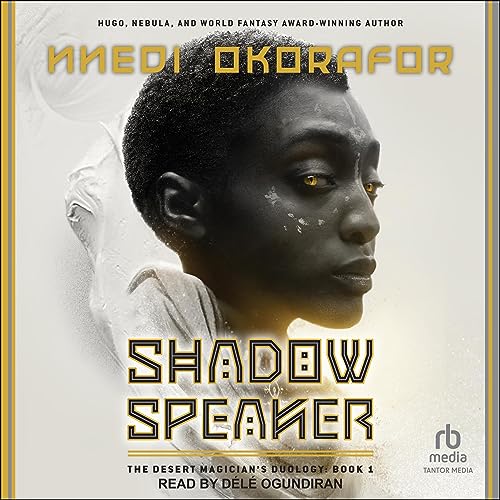
What it does remind me of, a lot, is the author’s Desert Magician’s Duology, particularly Shadow Speaker. Not only do Najeeba’s and Eiji’s stories start from a similar place, as both begin their stories as girls on the cusp of womanhood, gifted or cursed (depending on one’s perspective) with magical powers, but both choose difficult paths that their birth cultures reserve for men and they also find themselves telling – and being told – their stories by and to strange desert sorcerers.

They are not products of the same Afrocentric future world, but their worlds are similar nonetheless. Meaning that if you like one, or if you have enjoyed ANY of the author’s previous and/or successive works such as the Binti Trilogy, there’s a very good chance you’ll fall right into She Who Knows as well.

In the end – and also as a beginning – this is a great introduction to Who Fears Death AND The Book of Phoenix, which is a much earlier prequel chronologically to Onye’s story. Not only is this a great story in its own right, but it’s also short which means that it provides an introduction in an easily consumed little package. And if that consumption leaves you with a taste for more – as it very much did this reader – this is, oh-so-thankfully, the first novella in the projected trilogy of equally short and undoubtedly equally salty and delicious stories.

I am definitely looking forward to the rest of Najeeba’s story, which will be continued in next year’s One Way Witch. In the meantime I can’t wait to see how the mother’s experiences in this book and the rest of the trilogy are reflected in the child in Who Fears Death.
 

Review: Like Thunder by Nnedi Okorafor

Review: Like Thunder by Nnedi OkoraforLike Thunder (The Desert Magician's Duology #2) by Nnedi Okorafor
Narrator: Délé Ogundiran
Format: audiobook, eARC
Source: supplied by publisher via NetGalley
Formats available: hardcover, ebook, audiobook
Genres: African Futurism, climate fiction, fantasy, science fiction
Series: Desert Magician's Duology #2
Pages: 336
Length: 10 hours and 23 minutes
Published by DAW, Tantor Audio on November 28, 2023
Purchasing Info: Author's WebsitePublisher's WebsiteAmazonBarnes & NobleKoboBookshop.orgBetter World Books
Goodreads

This brand-new sequel to Nnedi Okorafor’s Shadow Speaker contains the powerful prose and compelling stories that have made Nnedi Okorafor a star of the literary science fiction and fantasy space and put her at the forefront of Africanfuturist fiction
Niger, West Africa, 2077
Welcome back. This second volume is a breathtaking story that sweeps across the sands of the Sahara, flies up to the peaks of the Aïr Mountains, cartwheels into a wild megacity—you get the idea.
I am the Desert Magician; I bring water where there is none.
This book begins with Dikéogu Obidimkpa slowly losing his mind. Yes, that boy who can bring rain just by thinking about it is having some…issues. Years ago, Dikéogu went on an epic journey to save Earth with the shadow speaker girl, Ejii Ubaid, who became his best friend. When it was all over, they went their separate ways, but now he’s learned their quest never really ended at all.
So Dikéogu, more powerful than ever, reunites with Ejii. He records this story as an audiofile, hoping it will help him keep his sanity or at least give him something to leave behind. Smart kid, but it won’t work—or will it?
I can tell you it won’t be like before. Our rainmaker and shadow speaker have changed. And after this, nothing will ever be the same again.
As they say, ‘ Onye amaro ebe nmili si bido mabaya ama ama onye nyelu ya akwa oji welu ficha aru .’
Or, ‘If you do not remember where the rain started to beat you, you will not remember who gave you the towel with which to dry your body.’

My Review:

Like Thunder is the second half of the Desert Magician’s Duology, and the follow-up to the utterly excellent Shadow Speaker. Like that first book, Like Thunder is a story within a story, as the whole duology is a tale of a possible future, and a lesson to be learned, told by the Desert Magician himself.

But it is not the Desert Magician’s story, no matter how much that being meddled with the characters and the events that they faced. Just as Shadow Speaker was the story of Eiji Ugabe, the titular shadow speaker herself, Like Thunder represents her best friend Dikéogu Obidimkpa’s side of the events that followed.

Shadow speaking is but one of the many transformations and strange, new powers brought into this world after the ‘peace bombs’ were dropped and the oncoming nuclear catastrophe was transformed into something survivable for the human population.

A survival that seems to be more contingent on the adaptability of not just the humans of Earth, but also the sentient populations of ALL the worlds that have become interconnected after Earth’s ‘Great Change’ caused a ‘Great Merge’ of several formerly separated worlds.

The story in Shadow Speaker very much represented Eiji’s perspective on the world, as Eiji’s first impulse is always to talk, and to listen. An impulse that combines her youthful belief that people CAN be better if given the opportunity, and is likely a result of her talent for speaking with not just the shadows of the dead, but directly into the minds of other people and animals.

Her talent is to see others’ points of view and to project her own. She’s young enough to believe that if there is understanding, there can be peace.

Like Thunder is not Eiji’s story, and it shouldn’t be. Instead, it’s a kind of mirror image. Just as Eiji’s talent leads her to foster peace and understanding, her friend Dikéogu’s talent is violent. Dikéogu is a stormbringer, someone who brings all of the violence of nature and all of the violence visited upon him in his scarred past to every encounter with his friends, with his enemies, and with his world.

And within himself.

The world through which we follow Dikéogu in this concluding volume of the Desert Magician’s Duology is the direct result of Eiji’s peacemaking in her book. Because, unfortunately for the world but fortunate for the reader enthralled with their story, Eiji didn’t really make peace because peace is not what most of the people present for the so-called ‘peace conference’ had any desire for whatsoever.

And have been maneuvering in the background to ensure that the only peace that results in the end is the peace of the grave. Someone is going to have to die. Too many people already have. It’s only a question of whether Dikéogu and Eiji’s feared and reviled powers will save the world – or end it.

Escape Rating A-: As much as I loved Shadow Speaker, I came into this second book with some doubts and quibbles – all of which were marvelously dashed to the ground at the very beginning of Dikéogu’s story.

Eiji and Dikéogu were both very young when their adventure began, but by the time they met they had both already seen enough hardship and disaster to fill a whole lifetime for someone else. But Eiji was just a touch older than Dikéogu, and the differences between her fourteen and his thirteen mattered a lot in terms of maturity.

In other words, Eiji was definitely on the cusp of adulthood in her book, making adult decisions with huge, literally world-shaking consequences, while Dikéogu frequently came off as a whiny little shit, an impression not helped AT ALL by the higher pitched voice used by the narrator for his character.

Dikéogu had PLENTY of reasons for his hatreds and his fears – but that doesn’t mean that they were much more enjoyable to listen to than they were to experience. Less traumatic, certainly, but awful in an entirely different way.

But Like Thunder takes place AFTER the events of Shadow Speaker. (This is also a hint that neither book stands on its own) Whiny thirteen becomes traumatized fifteen with more experience, a bit more closure for some of the worst parts, a bit more distance from terrible betrayals – and his voice drops. (This last bit, of course, doesn’t matter if you’re reading the text and hearing your own voice in your head, but matters a lot in audio.)

Dikéogu’s life experience, particularly after he was sold into slavery by his own uncle at the age of twelve, have taught him that the world is pain and strife and that he has to defend himself at all times and that people will believe ANYTHING if it allows them to stay comfortable and maintain their illusions and their prejudices.

He learned that last bit from his parents, Felecia and Chika Obidimkpa, the power couple of THE West African multimedia empire. They betrayed him into slavery, they betrayed him by pretending he was dead, they betray him every single time they broadcast a program filled with ridiculous nostalgia for a past that never was and disallows and disavows Dikéogu’s existence as a stormbringer, a ‘Changed One’ with powers granted by the ‘Great Change’ they hate so much.

It’s no surprise that his parents are in league with his enemies.

What is a surprise, especially to Dikéogu, is how much of his story, how much of his trauma and how many of his tragedies, are directly traceable to that first betrayal AND his inability to deal with its consequences to himself and the magic he carries.

So, very much on the one hand, Like Thunder is a save the world quest with a surprising twist at its end. A twist at least partly manufactured, and certainly cackled over, by the Desert Magician. And absolutely on the other hand, it’s a story about a young man learning to live with the person he has become – and very nearly failing the test. ALL the tests.

Whichever way you look at it, it is compelling and captivating from the first page – or from the opening words – until the very last line of the Desert Magician congratulating themself on a tale well told and a heartbreaking but ultimately hopeful message delivered.

Review: Shadow Speaker by Nnedi Okorafor

Review: Shadow Speaker by Nnedi OkoraforShadow Speaker (The Desert Magician's Duology, #1) by Nnedi Okorafor
Narrator: Délé Ogundiran
Format: audiobook, eARC
Source: supplied by publisher via NetGalley
Formats available: hardcover, ebook, audiobook
Genres: African Futurism, climate fiction, fantasy, science fiction
Series: Desert Magician's Duology #1
Pages: 336
Length: 10 hrs 28 mins
Published by DAW, Tantor Audio on September 26, 2023
Purchasing Info: Author's WebsitePublisher's WebsiteAmazonBarnes & NobleKoboBookshop.orgBetter World Books
Goodreads

Niger, West Africa, 2074
It is an era of tainted technology and mysterious mysticism. A great change has happened all over the planet, and the laws of physics aren’t what they used to be.
Within all this, I introduce you to Ejii Ugabe, a child of the worst type of politician. Back when she was nine years old, she was there as her father met his end. Don’t waste your tears on him: this girl’s father would throw anyone under a bus to gain power. He was a cruel, cruel man, but even so, Ejii did not rejoice at his departure from the world. Children are still learning that some people don’t deserve their love.
Now 15 years old and manifesting the abilities given to her by the strange Earth, Ejii decides to go after the killer of her father. Is it for revenge or something else? You will have to find out by reading this book.
I am the Desert Magician, and this is a novel I have conjured for you, so I’m certainly not going to just tell you here.

My Review:

Peace bombs. A phrase that only makes sense in the context of the future history of the world that leads to this story, as told by the chaotic trickster the Desert Magician about the coming of age of the titular Shadow Speaker, Ejii Ugabe, and her friend, the rainmaker Dikéogu Obidimkpa. It’s their story, but the Desert Magician is the one bringing it to us. Also messing with them and it at the same time.

The Desert Magician is not exactly a reliable narrator – but then trickster avatars seldom are. After all, the story is more fun for them if they get to mess with the protagonists a bit. More than a bit. As much as they want.

As Ejii describes the world in which she grew up, the Earth as it exists after the ‘Great Change’ brought about by those Peace Bombs, it’s not hard to think that the event was as much of a eucatastrophe as it was the regular kind. A whole lot of things seem to be better. More chaotic, but better. Certainly the climate has improved, even if entire forests sometimes spring up overnight, while the technology imported from other, more advanced worlds has made living with the remaining extremes considerably easier.

None of which means that humans are any better at all. Whatsoever. Because humans are gonna human. But it does mean that there are more possibilities, both in the sense of seemingly magical powers and animals, and in the sense of more opportunities for more people to rise above their circumstances – even if some people are still determined to fall into the traps laid by theirs.

Which leads the Desert Magician to Ejii’s story, and leads Ejii to Jaa, the great general who swept into Ejii’s village of Kwàmfà and struck off her father’s head with her sword, setting Jaa and Ejii on a collision course that will either save the world – or end it.

Shadow speaking, the ability to hear the voices of the spirits, is one of the many gifts that have arisen after the Great Change. Ejii is the shadow speaker of the title, and at fifteen is just coming into her power. A power that is telling her to follow Jaa to a great meeting of the leaders of the worlds that have merged into one interconnected system as a result of the change.

Jaa is going to the meeting to start a war in the hopes of preventing worse to come. Ejii has been tasked with finding a way to make peace. Neither task is going to be easy – and only one of them is right. The question is, which one?

Escape Rating A-: This version of Shadow Speaker is an expanded edition of one of the author’s out-of-print early novels. The original version of which, also titled Shadow Speaker, was a winner or finalist for several genre awards in the year it was published, as a young adult novel. Which it still both is and isn’t.

It is, on the one hand, aimed at a young adult audience because its protagonists are themselves in that age range, being merely fifteen when the story begins. As a consequence of their age, both Ejii and Dikéogu clearly still have a lot of growing up ahead of them in spite of the life-changing and even world-altering experiences that have led them to undertake this journey.

At the same time, Ejii at least is very much on the cusp of adulthood, and this is a journey that forces her to make adult decisions about, with no sense of hyperbole whatsoever, the state of the world. Howsomever, a good chunk of what she brings to those decisions has the flavor of the naivete of youth, particularly in the sense that the world SHOULD be fair, people SHOULD do the right thing, and that if only people would communicate honestly a peaceful solution SHOULD be within reach.

It’s not that she doesn’t know the world and the people in it are often stupid, self-centered, greedy and downright mean, it’s that she hasn’t yet been jaded enough by her experiences to truly believe that there can’t be a better way. Even though her personal experiences thus far in her life have seldom shown it to her.

Dikéogu is not nearly as mature as Ejii is. He whines a LOT. Not that his complaints aren’t justified, but it’s so very clear that he still has a lot of growing up to do and that expresses itself in a kind of ‘pity poor me’ whining that gets hard to take – particularly in audio as he’s voiced in a higher pitch to distinguish his speech from Ejii’s. Which works very well indeed as characterization while driving me personally nuts as I find high-pitched voices jarring. (I recognize this is a ‘me’ thing and may not be a ‘you’ thing, but if it is also a ‘you’ thing, you have been warned.)

While the Desert Magician is presenting this story, he’s not an omnipresent presenter. We see the story through Ejii’s perspective except at the very beginning and end. She is the person we follow, although the story is not told from inside her head. Rather, the story unfolds around her and her actions, and we only see what she sees and know what she knows and get as confused as she does at what she doesn’t.

Which means that while the narrator, Délé Ogundiran, does an excellent job of standing in as Ejii’s voice, that may not be true for the second book in the duology, which will be Dikéogu’s story. Hopefully by the point in Dikéogu’s life when that story takes place, his voice will have dropped.
As much as Ejii comes of age and into her power through her riveting adventures in Shadow Speaker, her world and all the worlds that have become interconnected as a result of the ‘Great Merge’ that was part and parcel of Earth’s ‘Great Change’ also have a great deal of maturing to do – or at least negotiations towards that goal – as this first story ends. Whether the merged worlds will survive that change or destroy each other is part of the subsequent story in this duology that I’m really looking forward to seeing. Or hopefully hearing.

Dikéogu’s story may have started here but his true coming-of-age-and-into-power story, Like Thunder, is coming just after Thanksgiving. And I’ll be very grateful to read it – or hopefully have it read to me like Shadow Speaker – over the holidays.

Review: Noor by Nnedi Okorafor

Review: Noor by Nnedi OkoraforNoor by Nnedi Okorafor
Format: audiobook, eARC
Source: supplied by publisher via NetGalley
Formats available: hardcover, ebook, audiobook
Pages: 224
Published by DAW Books on November 9, 2021
Purchasing Info: Author's WebsitePublisher's WebsiteAmazonBarnes & NobleKoboBookshop.org
Goodreads

From Africanfuturist luminary Okorafor comes a new science fiction novel of intense action and thoughtful rumination on biotechnology, destiny, and humanity in a near-future Nigeria.
Anwuli Okwudili prefers to be called AO. To her, these initials have always stood for Artificial Organism. AO has never really felt...natural, and that's putting it lightly. Her parents spent most of the days before she was born praying for her peaceful passing because even in-utero she was wrong. But she lived. Then came the car accident years later that disabled her even further. Yet instead of viewing her strange body the way the world views it, as freakish, unnatural, even the work of the devil, AO embraces all that she is: A woman with a ton of major and necessary body augmentations. And then one day she goes to her local market and everything goes wrong.
Once on the run, she meets a Fulani herdsman named DNA and the race against time across the deserts of Northern Nigeria begins. In a world where all things are streamed, everyone is watching the reckoning of the murderess and the terrorist and the saga of the wicked woman and mad man unfold. This fast-paced, relentless journey of tribe, destiny, body, and the wonderland of technology revels in the fact that the future sometimes isn't so predictable. Expect the unaccepted.

My Review:

Two lost people find themselves, each other and a secret that the biggest corporation in the world hoped would never be found. A secret that the powers-that-be will do anything to protect. As the saying goes, once a can of worms is opened they never go back into the can. Especially when the secret that’s been hidden is as earth-shattering and sand-spewing as this one.

And no, we’re not talking about Arrakis. We’re talking about Earth. A future Earth after an ecological/climatological disaster has created the equivalent of Jupiter’s Great Red Spot in northern Nigeria. A sandstorm of such speed and force that the windpower it generates is powering great cities all over the world.

Even as it eats up and eats away the land that gave it birth.

The Red Eye is the place where people who don’t fit, where those who have nothing left to lose, and those who refuse to be monitored by giant corporations 24/7 take themselves when they have nowhere else to go. Or when they can no longer make themselves pretend that they belong in the world that has left them behind, in one way or another.

This big story, like that big ecological disaster, starts small. With AO and DNA, those two lost people who have each survived a trauma on the very same day. AO, born with multiple birth defects both internal and external, is now part cybernetic. In fact, AO is a lot cybernetic, with two cybernetic legs and one cybernetic arm to replace the nonfunctional limbs she was born with. And with cybernetics in her brain, not because there was anything wrong, but because she wanted the enhanced memory and permanent internet connectivity.

But the more AO looks like the “Autobionic Organism” she had named herself for, the less she is accepted by the people around her. Many object on religious grounds. Some do so out of fear – not that that’s much of a difference. Some find her rejection of traditional appearances and roles for women to be anathema. Many call her an “abomination”.

When the safe space she believes she has carved out for herself suddenly becomes anything but, AO refuses to submit. Instead, she uses her greater strength to not merely subdue her tormentors but to kill the men who expected her to submit to her own execution at their hands.

In the aftermath, AO runs. Away from the towns and towards the desert. Heading away. North. Towards the Red Eye. Driving as far and as fast as she can in an unthinking fugue state. At least until her car runs out of power and she continues on foot towards an unknown but probably brief future.

Where she runs into a herdsman named DNA, who is just as lost and traumatized as she is. Who has also just defended himself with deadly force against a mob that killed his friends and most of his herd of cattle in an act of misplaced revenge against terrorists posing as herdsmen.

Now DNA has been labeled a terrorist, just as AO has been labeled a crazed murderer. Everyone is literally out to get them.

But the context of both of their stories is missing. When they find that context, when they are able to dig down through the layers of propaganda and misinformation that surrounds the most traumatic events in both their lives, they find a deep, dark, deadly secret.

A secret that many people will kill to protect. A secret that brought them together – and is tearing their continent apart while entirely too many people, including both of their families, go complacently about their business.

Just the way the biggest corporation in the world had planned it.

Escape Rating A: One way of looking at Noor is that it is two stories with an interlude in the middle. Another way, and a better metaphor, is that it is a story that winds up like a hurricane or a tornado, pauses in a calm storm’s eye in the middle, and then unwinds quickly in an explosive ending as the storm dissipates.

I listened to Noor through the eye of that storm, and then read the rest because it and I were both so wound up that I couldn’t wait to see which direction all those winds ended up blowing. And the narrator, particularly for that first part, had a wonderful voice that was just perfect for storytelling. She helped me to not just hear, but see and feel that oncoming storm.

At first, in the story’s tight focus on AO, it all seems small and personal. AO is different, and she is all too aware of those differences. She, and the reader, are equally aware that one of the ways in which human beings suck is that anyone who is deemed by society to be different gets punished by that society in ways both large and small. AO’s constant awareness of her surroundings and her ongoing attempts to be less threatening and less “herself” in order to carve out a safe space in which to live will sound familiar to anyone who has bucked the way it’s supposed to be in order to be who they really are.

The violence against her is sadly expected and both she and the reader sadly expect it – until it becomes life-threatening and she strikes back.

When she meets DNA and his two steers, GPS and Carpe Diem, he is in the same emotional trauma coming from an entirely different direction. Where AO has embraced the future – perhaps too much – DNA has clung to his people’s past as a nomadic herdsman. That they find themselves in the same situation is ironic and tragic, but not in any way a coincidence.

And that’s where things get interesting. The more that AO and DNA search for answers, the bigger the questions get. The more they find friends and allies, the bigger the forces arrayed against them.

And the less the story is about those two lost people and the more it is about the forces that put them in that situation in the first place. The story expands its tent to encompass colonialism, complacency and exploitation in ways that make the most singular acts have the most global of consequences – and the other way around – in an infinity loop at the heart of the storm.

Review: Remote Control by Nnedi Okorafor

Review: Remote Control by Nnedi OkoraforRemote Control by Nnedi Okorafor
Format: eARC
Source: supplied by publisher via Edelweiss
Formats available: hardcover, ebook, audiobook
Genres: African Futurism, science fiction
Pages: 160
Published by Tordotcom on January 19, 2021
Purchasing Info: Author's WebsitePublisher's WebsiteAmazonBarnes & NobleKoboBookshop.org
Goodreads

The new book by Nebula and Hugo Award-winner, Nnedi Okorafor.
"She’s the adopted daughter of the Angel of Death. Beware of her. Mind her. Death guards her like one of its own."
The day Fatima forgot her name, Death paid a visit. From hereon in she would be known as Sankofa­­--a name that meant nothing to anyone but her, the only tie to her family and her past.
Her touch is death, and with a glance a town can fall. And she walks--alone, except for her fox companion--searching for the object that came from the sky and gave itself to her when the meteors fell and when she was yet unchanged; searching for answers.
But is there a greater purpose for Sankofa, now that Death is her constant companion?

My Review:

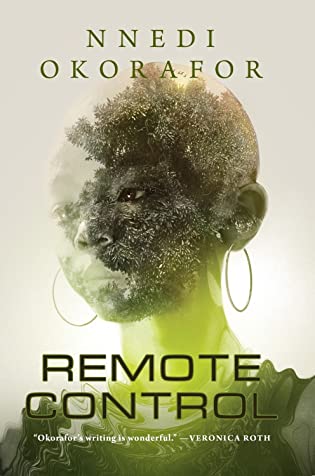
Remote Control is the story of Sankofa, the adopted daughter of the Angel of Death. Or so the legends go.

When I first read the blurb for this book, my first thought was that Sankofa was someone like Susan Sto-Helit in Terry Pratchett’s Discworld. In that fantasy world, Susan is really the adopted granddaughter of Death, the anthropomorphized personification of the Grim Reaper, who rides a pale horse named Binky and likes cats. This is a fantasy world where anything can, and frequently does, happen.

But Remote Control is not set in a fantasy world. Instead, this is a not-too-distant future of our own world, set in an Africa where jelli-tellies and even-smarter smartphones are coveted and sold and where legends that feel as if they are out of the distant past walk the earth at the same time.

This is not a fantasy, no matter how much it reads like one.

Sankofa is not, technically, the adopted daughter of the Angel of Death, no matter how many such stories get wrapped around her small, slim person.

But she is death. Or she brings death. Or she can. Or all of the above. Once upon a time, when she was an even younger child than she is now, a meteor shower dropped meteorites like little seeds over her father’s shea tree orchard.

One of those meteorites WAS a seed. A seed that Sankofa before she became Sankofa, back when she was a little girl named Fatima, nurtured and petted and talked to as if it were a person and a confidant and a pet.

Whether it was the girl’s care of that seed, or whether it was the seed’s intended purpose all along, the seed gave her a gift – or a curse. And when that seed was stolen from her, that gift bloomed from her like a toxic gas.

When she became angry, or upset, or was in pain, the little girl burned hot and glowed green like poison. Whatever that green glow touched fell down dead. Like the mosquitos that loved to eat her. Like her parents who sold her little seed for a lot of money. Like everyone in the village who was just too close when her pain and anger overcame her – including her family.

Like her name and her memory that burned away in the fire of that green. She left Fatima behind among the dead of her village and wandered the roads as Sankofa, searching for the seed that was stolen from her.

Only to discover, once she found it, that it was even more of a curse than she ever believed.

Escape Rating A: Remote Control is a novella, meaning that it is relatively short but complete in and of itself. So if you love SF and have not yet read any of Nnedi’s books, this is a great place to start. As is her absolutely awesome Binti, which is both a novella and the first in her epic and marvelous Binti Trilogy of novellas.
Novellas are shorter than novels, but longer than novelettes or short stories. They are not novels that got cut down. Rather, novellas are the length that they are meant to be, they’re meant to be the length that they are. They may tease at a larger world or deeper background or more that happens after they close – or all of the above – but they complete their own story in their shortness, and are great ways to introduce yourself to a new-to-you author.

Which doesn’t mean that I don’t frequently wish that a particular novella had a bit more to it, because I often do. But then, I love worldbuilding when it’s good and I always want more.

Remote Control is a bit of a tease of a story, because at first it seems more like a fantasy than SF. In Sankofa’s childish perspective – after all the story begins when she is only 5 – we don’t see much in the way of SFnal trappings. Her family farm and her world could be in a wide range of eras.

It’s only after Fatima becomes Sankofa and takes herself away from home and tragedy that we see the wider world and learn that this is the relatively near future. It’s a world that we can sort of see from here, if we squint a bit.

As Sankofa travels, we see her grow, and follow along as her legend grows with her – and she learns how to take advantage – but not too much – of that legend. People give her what she needs both because they are afraid of what she brings. She brings death. She can kill an entire village. She has. She can lash out in fear and/or self-preservation. And she can bring release to those who desperately need it.

And we watch her try to leave her legend and her gift behind, to grasp at some semblance of what passes for “normal”, only for that gift to reach out and grab her back.

Remote Control is the story of Sankofa’s coming of age and her coming to terms with who and what she is. But I’ll admit that I didn’t figure out where the title came from until the very end. And that when I did, it made the whole story into a much bigger WOW than I expected.

A revelation that I’m still reeling from a bit. And you will too if you follow along on Sankofa’s journey to its bittersweet but triumphant end.

Review: The Night Masquerade by Nnedi Okorafor

Review: The Night Masquerade by Nnedi OkoraforThe Night Masquerade (Binti, #3) by Nnedi Okorafor
Formats available: paperback, ebook, audiobook
Series: Binti #3
Pages: 208
Published by Tor.com on January 16th 2018
Purchasing Info: Author's WebsitePublisher's WebsiteAmazonBarnes & NobleKoboBookshop.org
Goodreads

The concluding part of the highly-acclaimed science fiction trilogy that began with Nnedi Okorafor's Hugo- and Nebula Award-winning BINTI.

Binti has returned to her home planet, believing that the violence of the Meduse has been left behind. Unfortunately, although her people are peaceful on the whole, the same cannot be said for the Khoush, who fan the flames of their ancient rivalry with the Meduse.

Far from her village when the conflicts start, Binti hurries home, but anger and resentment has already claimed the lives of many close to her.

Once again it is up to Binti, and her intriguing new friend Mwinyi, to intervene--though the elders of her people do not entirely trust her motives--and try to prevent a war that could wipe out her people, once and for all.

Don't miss this essential concluding volume in the Binti trilogy.

My Review:

I picked up The Night Masquerade because we saw the absolutely, totally, completely marvelous Black Panther over the weekend, and I was looking for more Afrofuturism. Then I remembered that the final book in the Binti Trilogy was already out, and why hadn’t I read it already?.

So here we are.

Admittedly, one reason why I hadn’t read The Night Masquerade already was because as much as I adored the first book, Binti, the second book, Home left me with a much more mixed reaction. Binti herself spent much of Home feeling fairly muddled, and as I read it I was muddled right along with her.
Although now that I have finished The Night Masquerade I am highly tempted to go back and reread Home. Now that I see where things were headed, the journey feels as though it had a lot more depth.

In Home, it seemed as if Binti, desperate for home, had gone back and discovered that, as the classic title goes, “you can’t go home again.”. In The Night Masquerade, the situation seems even worse. She discovers that while home may be the place that when you have to go there, they have to let you in, once they’ve opened the door there is nothing to stop them from stabbing you in the back as you walk past.

Binti may be physically home, but the people that she thought were hers reject her and everything about her that makes her what they perceive as anathema. Binti is different. Binti has left the Himba. Because the Himba don’t leave that turns Binti from “one of us” into a dangerous outsider.

She has also discovered that she is more than just Himba. Her father was one of the Desert People. While the Himba perceive the Desert People as barbarian savages, the truth is otherwise. As it usually is.

And the use of her talents as “harmonizer” aboard the sentient ship Third Fish (the events of Binti) have both grown her talent and made her a part of the non-human Meduse as well. She has become more, but her people (her own immediate family excepted) perceive her as being less.

The neighboring Khoosh people, on the other hand, see Binti’s Meduse friend Okwu as a enemy, and rain war and destruction on the Himba in frustration that Okwu and Binti are nowhere to be found.

Bintu gives her life in an effort to make peace, only to be struck down at the moment of her greatest achievement.

But just as on her first journey, the one where she should have died the first time, it’s not merely that what does not kill her makes her stronger, but that what kills her does too.

Escape Rating A: While The Night Masquerade is not as fresh as the first book, Binti, quite possibly because Binti herself is not as fresh and new as she was at the start of her journey, it still marks a return to the page-turning fascination of that first book.

In Binti, we saw her first, sometimes tentative steps into the wider universe, not in spite of but because of the tragedy that she survives aboard Third Fish. In Home, Binti is searching for who she is now, trying to harmonize all of the various parts of herself that she has discovered or that she has absorbed. And she flails around a bit. (Don’t we all at 17?)
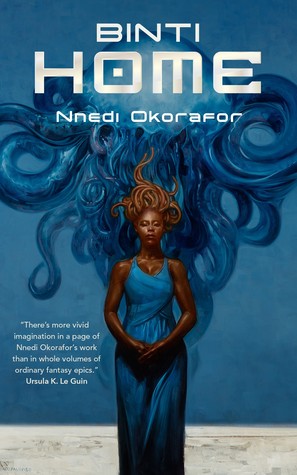
But in The Night Masquerade Binti is finally on the road to who she is meant to be. Her journey is far from complete, even though it is nearly cut short. In this final book in the trilogy, she ultimately manages to reach past her own doubts and fears and take control of her future, by embracing all the disparate aspects of her identity.

A significant part of the story is Binti’s internal journey, as she sees the limitations of her own people’s worldview and chooses to deliberately move beyond it, in spite of her doubts and fears. And in spite of the cost.

It’s a difficult and dangerous journey, made even more so by the shortsightedness of entirely too many people on all sides. But watching Binti come into her own is absolutely fantastic. If you like coming-of-age stories, especially when combined with a heroine’s journey, I think (and hope) you will love Binti’s story as much as I did.

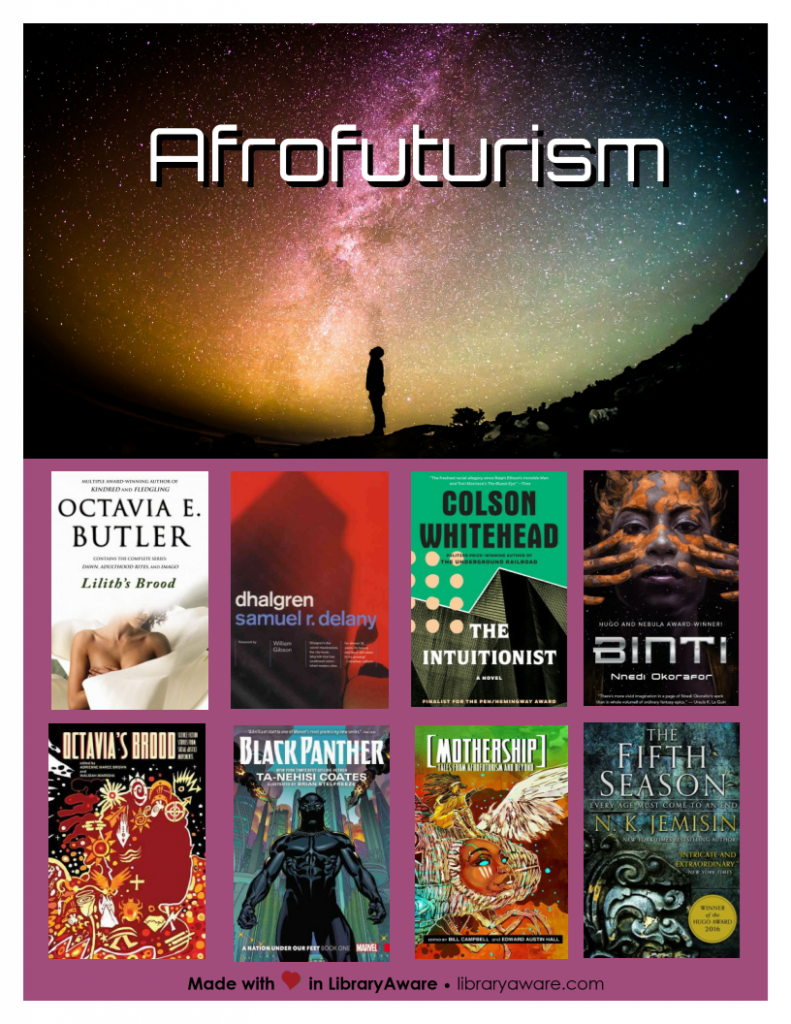
Reviewer’s Note: NoveList has just released beautiful posters featuring Afrofuturism and Afrofantasy in honor of the fantastic movie Black Panther. The posters are gorgeous, but of course not remotely comprehensive of either genre. However, Nnedi Okorafor is the only author featured on both posters. Look for the posters AND the books at your local library.

Review: Home by Nnedi Okorafor

Review: Home by Nnedi OkoraforHome (Binti, #2) by Nnedi Okorafor
Formats available: paperback, ebook
Series: Binti #2
Pages: 176
Published by Tor.com on January 31st 2017
Purchasing Info: Author's WebsitePublisher's WebsiteAmazonBarnes & NobleKoboBookshop.org
Goodreads

The thrilling sequel to the Nebula and Hugo winning Binti.
It’s been a year since Binti and Okwu enrolled at Oomza University. A year since Binti was declared a hero for uniting two warring planets. A year since she left her family to pursue her dream.
And now she must return home to her people, with her friend Okwu by her side, to face her family and face her elders.
But Okwu will be the first of his race to set foot on Earth in over a hundred years, and the first ever to come in peace.
After generations of conflict can human and Meduse ever learn to truly live in harmony?
Praise for Nnedi Okorafor:
"Binti is a supreme read about a sexy, edgy Afropolitan in space! It's a wondrous combination of extra-terrestrial adventure and age-old African diplomacy. Unforgettable!" - Wanuri Kahiu, award winning Kenyan film director of Pumzi and From a Whisper
"A perfect dove-tailing of tribal and futuristic, of sentient space ships and ancient cultural traditions, Binti was a beautiful story to read.” – Little Red Reviewer
Binti is a wonderful and memorable coming of age story which, to paraphrase Lord of the Rings, shows that one girl can change the course of the galaxy.” – Geek Syndicate
Binti packs a punch because it is such a rich, complex tale of identity, both personal and cultural… and like all of Nnedi Okorafor’s works, this one is also highly, highly recommended.” – Kirkus Reviews
"There's more vivid imagination in a page of Nnedi Okorafor's work than in whole volumes of ordinary fantasy epics." -Ursula Le Guin
"Okorafor's impressive inventiveness never flags." - Gary K. Wolfe on Lagoon
At the Publisher's request, this title is being sold without Digital Rights Management Software (DRM) applied.

My Review:

There are two literary traditions that revolve around the thought and place we call “home”. One is the Thomas Wolfe version. That’s the “you can’t go home again” version of home. The other is the Robert Frost version, the one that says that “home is the place that, when you have to go there, they have to take you in.”

After the events of last year’s award-winning Binti, and a year at the intergalactic Oomza Uni, Binti desperately needs home to be the Frost version. She feels that there is something wrong with her, and that she needs the healing that only her home place can provide.

But when she gets there, she discovers that it is the Wolfe version of home. She ran away, not because anything terrible happened or would happen, but because the safe, secure and traditional plans that her family and her village all had for her future were too confining for her intellect and her spirit.

She stood on the shoulders of her village and saw further than anyone had in a long time. And, the people she thought were her own wanted to chop her off at the knees for it.

No one is right and no one is wrong. Binti is just a bit different from everyone she thought she knew, and everyone who believed that she was theirs. And much too much has happened for her to go back and become the smaller person that they all wanted her to be.

But just as Binti’s own Himba village people are looked down upon by the cosmopolitan, city-dwelling Khoosh, Binti herself has absorbed the prejudices of her own Himba people towards the elusive Desert People. Binti’s self-perception, even her very identity, are threatened when she learns that the Desert People are much, much more than the savage wanderers they appear to be.

And that she is one of them.

Escape Rating B-: I found the first story in this series, Binti, to be utterly absorbing from the opening paragraphs. But Home was much less so. Just as Binti seems suddenly unsettled at Oomza Uni as this story opens, as a reader I also felt unsettled. Binti found her involvement with her environment problematic, and I found my involvement with her equally so.

Binti couldn’t focus and neither could I. This was a story where I finally finished on the third attempt. I’m glad that I did, but this just didn’t grab me the way that the original did.

Home is also a middle book. While the overarching story moves forward in Home, it does not end. Or it ends on a cliffhanger. But the ending felt unsatisfying. I was hoping for some kind of conclusion, even if an interim one. Binti, in spite of its relatively short length, told a complete story, beginning, middle AND end. Home feels like all middle. And muddle.

I hope that the next book in this series, The Night Masquerade, brings Binti’s story to an exciting and satisfying conclusion.