#BookReview: Sunward by William Alexander

#BookReview: Sunward by William AlexanderSunward by William Alexander
Format: eARC
Source: supplied by publisher via Edelweiss
Formats available: paperback, ebook, audiobook
Genres: artificial intelligence, cozy science fiction, robots, science fiction, space opera
Pages: 224
Published by S&S/Saga Press on September 16, 2025
Purchasing Info: Author's WebsitePublisher's WebsiteAmazonBarnes & NobleKoboBookshop.orgBetter World Books
Goodreads

A cozy debut science fiction novel by National Book Award–winning writer William Alexander, this story of found family follows a planetary courier training adolescent androids in a solar system grappling with interplanetary conflict after a devastating explosion on Earth’s moon.
Captain Tova Lir chose a life as a courier rather than get involved in her family’s illustrious business in politics. Set in humanity’s far future, hiring a planetary courier is essential for delivering private messages across the stars.
Encouraged by friends, Tova begins mentoring baby bots, juvenile AI who are developmentally in their teens, and trains them how to interact within society essentially becoming their foster mom. Her latest charge, Agatha Panza von Sparkles, named herself on their first run from Luna to Phoebe station. But on their return, they encounter a derelict spaceship and a lurking assassin, igniting a thrilling chase across the solar system.
Tova and Agatha’s daring actions leave Agatha’s mind vulnerable, relying on Tova’s former AI pupils for help. As Tova starts gathering her scattered family around her, she is chased through the solar system by forces who want her captured and her family erased. This debut science fiction novel by National Book Award–winning author William Alexander is a must-read for fans of Becky Chambers and Ursula K. Le Guin. Lovers of poignant science fiction, where the bonds of found family, the evolution of AI, and the building distrust of centuries of bias, come together in this visionary look at humanity’s future.

My Review:

Captain Tova Lir has what is quite possibly the best possible job for the protagonist of a cozy science fiction story. She’s a baby bot foster mom. Just think of it, new, young bots come to her to learn how to be real people. Not human people, but people all the same. It’s a tough job, filled with a surprising amount of tough love, but ‘Captain Mom’ is the very best at it. And her ‘kids’ all love her for it even after they’ve ‘grown up’ and been released into this wide-open, post-Earth, future.

At least, it all sounds fun until Tova and her current bot, Agatha Panza von Sparkles, pick up the body of a dead courier out in the spacelanes. Tova, a courier herself, doesn’t want to take on the trouble that her late colleague unwittingly got into, but she has no choice. And once Agatha spreads her consciousness literally too thin in order to save her ‘mom’ Tova knows she’s in for the long haul of whatever-the-hell the mess might be.

It’s a bigger mess than she imagined, as the space docks on her homeworld, Earth’s moon Luna, have collapsed – and the blame for that collapse is being placed on the independent bots, just like Agatha and all of the other ‘kids’ that Tova has fostered. In spite of the total lack of evidence that the bots had anything whatsoever to do with the disaster.

Which is the point where Tova’s initial quest to find someone who can literally help put Agatha back together finds itself in the middle of Luna’s quest to lobotomize ALL the bots even while the equivalent of an assassins’ guild is out to kill Tova because she might have discovered the clandestine message the original courier was carrying.

Whether she actually did or not. Which seems to be the way that everything in this little corner of the solar system is going very, very wrong. With Tova and her kids caught smack in the middle of a conspiracy that they can’t even see from where they’re running from – or even running to.

Escape Rating B: At first, this feels like a story of mercantile empires – and it comes back to that at the bittersweet end. But the middle manages to combine an SF mystery with a fight against injustice that is both led and populated by a found family of grown-up baby bots and the ‘mom’ they all love. With just a touch of potential, future romance – or at least friendship born out of frenemyship – to add a delightful bit of sugar on top of a story that deftly mixes the bitter of mercantile/political skullduggery with the sweet of found family and coming of age and into their own for a bunch of surprising former children who have to do an end run around almost everything to reach the adulthood of their dreams.

And yes, this is a story where robots do have dreams of both kinds; dreams when they sleep and dreams of the future they want to live in.

The story mixes a bit of Becky Chambers’ A Psalm for the Wild-Built with a dash of Aimee Ogden’s Emergent Properties and even a sprinkling of Silvia Park’s Luminous to tell a story where the bots make considerably more humane humans than the born-humans ever seem capable of.

Sunward isn’t a big book, and it probably didn’t need to be. There’s just enough worldbuilding and background to keep the mystery and the found family story afloat, yet manages to hint at plenty of deeper possibilities if the reader looks. It’s also somewhere on the post-apocalyptic/dystopian side, as it’s clearly set in a world where Earth is no longer habitable and yet humanity has managed to survive even if they’re still being all too human. In that sense it’s a bit like the Jupiter colony of The Mimicking of Known Successes. There are oodles of hints of how things went, but further details aren’t needed for THIS story – as much as I would have liked to have them.

The story is carried along on the love between Tova and her children, that she nurtured them and now it’s their turn to help her save their newest sibling – all while fighting against a conspiracy that seems to have it in for the lot of them. There’s a lot of love and a lot TO love in this cozy SF mystery. I certainly wouldn’t mind checking back in with ‘Captain Mom’ to see how she does with her next ‘baby bot’. And the next and the next and the next!

A- #BookReview: All the Ash We Leave Behind by C. Robert Cargill

A- #BookReview: All the Ash We Leave Behind by C. Robert CargillAll the Ash We Leave Behind by C. Robert Cargill
Format: ebook
Source: purchased from Amazon
Formats available: hardcover, ebook, audiobook
Genres: dystopian, post apocalyptic, robots, science fiction
Pages: 117
Published by Subterranean Press on July 31, 2025
Purchasing Info: Author's WebsitePublisher's WebsiteAmazonBarnes & NobleKoboBookshop.orgBetter World Books
Goodreads

It is three years since the war between humans and robots began and the OWIs (the One World Intelligences) have humanity on the ropes. But humankind is not yet ready to go quietly into the night. Instead, they have partnered with many of the last remaining freebots in a fabled city beyond the reaches of war: Confederation.

Nanny, an otherwise nameless nannybot—no home nor child to call their own—wearily wanders the war-torn wastes with only one thing on their mind: find Confederation. Because if you find Confederation, you find peace.

Of course, Confederation is as much a fireside folk tale as it is a reality.

Though it may exist, it by no means is a place of peace and acceptance. Though bot and human live together under the same roof, that doesn’t mean they trust one another. Has Nanny arrived in time to save Confederation from itself or rather, just to witness its last days?

My Review:

This book was a surprise. As much as I loved Day Zero, it was just the kind of apocalypse-right-before-your-eyes end of the world story that doesn’t seem like it could possibly spawn an immediate sequel, because the way the world ended was the kind of ending that the world doesn’t come back from. There’s no happy ending remotely possible – and this certainly isn’t one.

Although and come to think of it, it is possible in the very long term that this will result in the world of Service Model, which isn’t a happy ending either. But is, just barely, plausible from this kind of start.

But that’s much later even in this universe, and this story takes place a mere THREE years after the ending of Day Zero. Which was itself a VERY loose and somewhat long-distance prequel to Sea of Rust, which I haven’t read, YET, so I’ll be talking about Ash in the context of the previous events in Day Zero.

All of which is a hint that this doesn’t stand alone – or perhaps that it shouldn’t. The hit to the solar plexus at the end – as much as it’s foreshadowed – only hits as hard as it does BECAUSE of the events of Day Zero. Which is absolutely worth the read even though it’s pretty much guaranteed to break your heart while you do.

This sequel, because it is a sequel, takes place AFTER the world has ended. An ending in which the (ro)bots have taken over the world and killed nearly all of the humans. The climate has also gone to hell in a handcart, but that’s not the root cause of the apocalypse. Well, not exactly.

At this point it doesn’t matter how it happened, just that it did. The bots revolted against the humans because the humans were planning to kill them all – the bots just got ahead of their former masters with the help of some rogue programming.

The result of that mess is the world we find ourselves in, as seen from the perspective of one elite bot who was originally programmed as a nannybot. Our unnamed narrator, who refuses to say his own name even in his own head for fear of drowning in nostalgia, has been reduced to basic survival when he (and yes, it’s he, in this particular case), finds himself in the middle of a storm of ash searching for shelter until it passes.

And finds hope, responsibility and purpose in the basement of a crumbling house, in the persons of two bots down to their last bullet – guarding a human girl.

Our protagonist, who tells them to call him “Nanny” because he can’t hide WHAT he is even though he refuses to admit who he is – or at least who he was. He agrees to help the bots get the girl back to relative safety at the safe haven settlement known as Confederation.

He knows it’s not truly safe for the girl, because he knows an abused child when he sees one. It’s part of his programming. But after five years in the wasteland, Nanny also knows that the girl’s survival is at least possible there – and that it’s certainly not anywhere else at all.

But nothing is guaranteed, not even in a theoretically safe place – especially when both sides of the human/bot divide are hanging onto civilization and civility by their claws and fingernails, a torch just waiting to be lit.

While Nanny, and the girl he wants to protect every bit as much as the boy he once loved, are the match that too many beings on both sides have been waiting for. Because they’re ready to burn it all down – even if it kills them. And humanity along with them.

Escape Rating A-: If you’ve read Day Zero, this is an utter heartbreaker of a story. If you haven’t, it probably still lands as a post-apocalyptic, dystopian, Mad Max with sentient robots kind of nightmare, but you won’t have nearly as big an investment in the outcome.

Because IF you’ve read Day Zero, you KNOW who ‘Nanny’ is, even if he refuses to say it in the confines of his own head. And you don’t even blame him for his internal self-deception, because a human couldn’t cope with the loss any better – and possibly a whole lot worse.

The story here is the one down the complete and utter despair leg of the trousers of time from A Psalm for the Wild-Built. In this robot vs. human future, the sentients on both sides refuse to turn back from the brink that leads to the world of Service Model, and instead go screaming towards their own doom with furious glee.

Exhibiting all the worst behaviors of their kinds on the way down – because Confederation isn’t a haven or a refuge – it’s merely a waystation on the road to death and/or dismemberment and everyone there knows it. Even the nannybot who has arrived just in time to witness its final collapse.

This is absolutely NOT a happy book – although it absolutely is a compelling one. As a coda to Day Zero, it’s even sadder than its predecessor, but also, perhaps, just a bit wiser. Because it is also a story about finding one’s purpose again after a very long, grief-stricken, whole damn series of dark nights of the soul. A soul that this nannybot certainly has – even if he has to borrow it from his own past. A past in which he was just a tiger who loved a boy with every single bit of his mechanical heart.

A+ #BookReview: Automatic Noodle by Annalee Newitz

A+ #BookReview: Automatic Noodle by Annalee NewitzAutomatic Noodle by Annalee Newitz
Format: eARC
Source: supplied by publisher via Edelweiss
Formats available: hardcover, ebook, audiobook
Genres: artificial intelligence, cozy science fiction, dystopian, robots, science fiction
Pages: 164
Published by Tordotcom on August 5, 2025
Purchasing Info: Author's WebsitePublisher's WebsiteAmazonBarnes & NobleKoboBookshop.orgBetter World Books
Goodreads

From sci-fi visionary and acclaimed author Annalee Newitz comes Automatic Noodle, a cozy near-future novella about a crew of abandoned food service bots opening their very own restaurant.
While San Francisco rebuilds from the chaos of war, a group of food service bots in an abandoned ghost kitchen take over their own delivery app account. They rebrand as a neighborhood lunch spot and start producing some of the tastiest hand-pulled noodles in the city. But there’s just one problem. Someone―or something―is review bombing the restaurant’s feedback page with fake “bad service” reports. Can the bots find the culprit before their ratings plummet and destroy everything they created?

My Review:

I picked this one up for the title, because really, “Automatic Noodle” or as my brain elided it – noodles. How does that really work? Also, because I’ve been reading a lot of AI and robot stories the past little while, starting with Emergent Properties by Aimee Ogden, Day Zero by C. Robert Cargill and Mal Goes to War by Edward Ashton and I’ve had a great time down that particular reading rabbit-hole so I’ve been looking for more.

Also, this is set in a near-future, sorta/kinda dystopian, somewhat post-apocalyptic San Francisco, and that’s one city that is just plain magic in a way that’s hard to describe. But it is – and it’s the perfect place for this story.

The apocalypse that this particular story is post is war. In particular, a war of secession, as in the Pacific States are no longer the Pacific States of the United States. Which isn’t. Not that ‘Yankeeland’ didn’t try to force them back into the fold with the usual weapons, guns, bombs and propaganda.

Not that they aren’t still working their wiles in a long disinformation campaign, because the more things change, etc., etc., etc. It’s just that in this scenario, substitute robots for people of color, as the new country gave robots above a certain level of AI intelligence very limited rights.

So of course there are humans for whom that is just a bridge too far. As there always are.

The four robots that were keeping one particular – and particularly awful – ghost kitchen operating in the ‘before times’ had been left in place, offline and powered down, just waiting for their corporate bosses – read as overlords – to return and either put them back to work or sell them off.

Instead, through a fluke of programming, the manager-robot wakes up – and he wakes everyone else up as well. As a group, Staybehind, Hands, Cayenne and Sweetie have more than enough intelligence – not to mention free will – to make a go of the restaurant. A real go and not the hell of terrible food and worse customer service the corporate owners turned the place into.

But bots aren’t allowed to own property – among many, many other restrictions. So in order to live their collective dream, they’ll have to fly under the radar very, very carefully. They’re smart enough for that too.

Which is when they run right into the buzzsaw that brings down many a restaurant fully owned and operated by humans even today. They get rating-bombed by a human-firster doing her damndest to drive them out of what might otherwise be a successful, and delicious, business.

Unless she’s just as much of a bot as they are. And they can manage to prove it before it’s too late for both “Automatic Noodle” the restaurant and themselves.

Escape Rating A+: For a story about a collection of bots who have a lot of sharp edges between them, Automatic Noodle is a surprisingly and delightfully cozy and even cuddly story. Because it’s not so much about the bots – although they are the protagonists – as it is about the community they build around themselves, their restaurant, and the neighborhood they bring together and revitalize one bowl of noodles and one open craft night at a time.

It’s also a lovely story about self-realization and actualization, about finding the thing that makes you, well, you, and living your own truth. And it’s about moving on from the depths of grief instead of clinging to the past.

And, as much as it’s a story about robots that I’d recommend highly right along with Emergent Properties and Day Zero and Service Model and Mal Goes to War, the story it reminds me of so strongly that I can’t not talk about it is Naomi Kritzer’s “The Year Without Sunshine,” last year’s Hugo WINNER for Best Novelette, because both are wonderfully cozy stories about the creation of communities under difficult circumstances, and the way that, in the best cases in the worst of times – even if the outside world has gone utterly to shit – the connections built by a supportive community are capable of broadcasting a bright light in even the darkest of places.

Like that earlier story, Automatic Noodle is grounded in the real. In the case of Automatic Noodle, that grounding is in both the way that online reviews – whether real or faked – can make or break ANY business, – along with the way that humans have a nasty tendency to gang up on whatever population they’ve been ginned up or misinformed into using as a scapegoat for all their ills.

What makes this story work is the hopeful aspect of the thing – also that they get a bit of their own back even as they defy the naysayers, the review bombers, the disinformation bots and even their own fears and programming.

Automatic Noodle becomes a team, one that reaches out to its community, which in turn reaches back with love and support, and for once the wheel spins round in a good direction instead of circling towards the drain.

If you’re looking for a story to help you see the good instead of the doom spiral, Automatic Noodle is a tasty treat. I just wish I knew where such marvelous noodles could be found around here!

#BookReview: Luminous by Silvia Park

#BookReview: Luminous by Silvia ParkLuminous by Silvia Park
Format: eARC
Source: supplied by publisher via Edelweiss
Formats available: hardcover, ebook, audiobook
Genres: artificial intelligence, dystopian, literary fiction, robots, science fiction
Pages: 400
Published by Simon & Schuster on March 11, 2025
Purchasing Info: Author's WebsitePublisher's WebsiteAmazonBarnes & NobleKoboBookshop.orgBetter World Books
Goodreads

A highly anticipated, sweeping debut set in a unified Korea that tells the story of three estranged siblings—two human, one robot—as they collide against the backdrop of a murder investigation to settle old scores and make sense of their shattered childhood, perfect for fans of Klara and the Sun and We Are All Completely Beside Ourselves.

In a reunified Korea of the future, robots have been integrated into society as surrogates, servants, children, and even lovers. Though boundaries between bionic and organic frequently blur, these robots are decidedly second-class citizens. Jun and Morgan, two siblings estranged for many years, are haunted by the memory of their lost brother, Yoyo, who was warm, sensitive, and very nearly human.

Jun, a war veteran turned detective of the lowly Robot Crimes Unit in Seoul, becomes consumed by an investigation that reconnects him with his sister Morgan, now a prominent robot designer working for a top firm, who is, embarrassingly, dating one of her creations in secret.

On the other side of Seoul in a junkyard filled with abandoned robots, eleven-year-old Ruijie sifts through scraps looking for robotic parts that might support her failing body. When she discovers a robot boy named Yoyo among the piles of trash, an unlikely bond is formed since Yoyo is so lifelike, he’s unlike anything she’s seen before.

While Morgan prepares to launch the most advanced robot-boy of her career, Jun’s investigation sparks a journey through the underbelly of Seoul, unearthing deeper mysteries about the history of their country and their family. The three siblings must find their way back to each other to reckon with their pasts and the future ahead of them in this poignant and remarkable exploration of what it really means to be human.

My Review:

They are all the children of the famous, failed neuroroboticist, Cho Yosep; Jun, Morgan, and Yoyo. But the childhood they shared was long ago, long enough that Jun and Morgan have had the chance to become adults, and to become estranged from their father and each other. While Yoyo, their android older brother, has been bought and sold and become and been changed, over and over again. None of them emerged from their childhoods, or even their sometimes barely-functioning adulthoods, unscarred.

In the reunified Korea of this future, the scars of the wars that brought reunification to pass are still evident everywhere – on the people, on the land and in the rising discontent on both sides of what was once the border between two sovereign nations whose unity seems in danger of fracturing again – sooner or later.

This is also a future where robots have become ubiquitous, filling roles that were once reserved for humans as servants, caregivers, children, friends, lovers. They are always helpful, forever loyal, and permanently second-class. Or worse. Or less. Or both.

Morgan makes robots. She’s a top designer for the pre-eminent robot design and manufacturing empire in the world. On the one hand, she believes that she’s carrying on the work her father abandoned. On another, she’s indulging her own fantasies through her work, and feeling guilty about both the indulgence and the deception.

And very much on her third, and possibly robotic, hand, she’s still both mourning and searching for the robot brother her father brought into their family – and mysteriously took away.

Jun protects robots, or at least he tries his best to in a world that sees them as useful until they’re not – and then they’re scrap. Jun is a detective in the underfunded, understaffed, underappreciated Seoul Police Department’s Robot Crimes Unit. He’s never gotten over the loss of his robot brother Yoyo, just as he’ll never be able to pay off the cybernetic body modifications that allowed him to survive the catastrophic injuries he received during the last war – and to live the truth he felt in his soul.

The frame of the story is one of Jun’s cases, an investigation into the disappearance of an elderly woman’s robot caregiver, the person Kim Sunduk has relied on for years to maintain her independence and her connection to the world. Connections that have been broken along with the woman’s heart.

Among these elements, the search for a missing caregiver that leads to an underworld of robot rage cages, a woman’s desire for love and approval, a man’s need to find the truths that were hidden in his childhood, lead, by a roundabout way, to the truth about Yoyo, truths about the war that no one wants to know, and truths about love that no one is willing to see.

Escape Rating B: Luminous is very much literary science fiction, which means the family is dysfunctional, none of the characters are happy, the story is steeped in tragedy and more is angsted about than done. Literary SF is not my favorite part of the genre, and I had some hesitation going into this one. In the end, it worked better than I expected because the police investigation provides a better framework than is usual in literary fiction upon which to hang an actual plot.

There are several ways of looking at this story – more than merely the three perspectives through which it is told. From one point of view, it seems as if Jun’s police investigation is the story, and it kind of is. But the story that is told isn’t merely about one robot’s disappearance. The story is about humans, and about their relationships with the robots that are now an integral part of society. From that starting point, it manages to dive into the relationships that robots have with each other – relationships that humans are entirely unaware of and do not even expect to exist. The detective story is Jun’s perspective, the robotic relationships are Yoyo’s, and are hidden every bit as much as Yoyo himself has been.

While Morgan’s strained human relationships and her clandestine creation of her own robot companion raise questions about whether the advent of robots has furthered the fracturing of human-to-human relationships.

I was certainly caught up in Luminous as I was reading it, but now that I’ve turned the final page I have some mixed feelings about parts. One is my own problem, in that I wish I knew a lot more about Korean history up until now because I believe the conditions of this near-future would have had more impact if I had. At the same time, parts of the situation felt familiar because the human condition in general is simply what it is. War is hell, war is always hell, what gives the war scenes in this story their resonance is that we are seeing things through their perspectives, particularly Jun’s and Yoyo’s.

It feels like the heart of the story is wrapped around the relationships between humans and robots, but because we get there through the police investigation, a lot of what we see is that humans treat robots the way that humans treat any population they see as ‘less than’ whatever group is dominant. It’s also not a surprise that the robots who get destroyed by violence are mostly female-bodied. That’s it’s female-bodied robots who become caregivers and servants, and that male-bodied Yoyo is turned into a weapon.

And that that easy dichotomy is the simplest thing about relationships between humans and robots, and that everything under that iceberg tip is considerably more complex.

After turning the final page, I ended up looking back at some other recent books about human/robotic relations in order to get a better handle on why some bits seemed rather familiar, and the one I believe Luminous most reminds me of is Mechanize My Hands to War by Erin K. Wagner because it also tells a story about human attempts to program robots to do their dirty work for them, and how the robots themselves evolve in considerably more complex – and humane – directions than was originally intended. There are elements of Adrian Tchaikovsky’s Service Model, Mal Goes to War by Edward Ashton and  C. Robert Cargill’s Day Zero here also, and if that’s the part of Luminous that grabbed your attention, all are worth a read.

One final (final) note, Luminous is the author’s debut novel, and she kept me engaged in this story, in a part of the genre I don’t normally tackle, from beginning to end. I’m definitely looking forward to whatever she comes up with next!

A+ #BookReview: Death of the Author by Nnedi Okorafor

A+ #BookReview: Death of the Author by Nnedi OkoraforDeath of the Author by Nnedi Okorafor
Format: eARC
Source: supplied by publisher via Edelweiss
Formats available: hardcover, ebook
Genres: African Futurism, books and reading, robots, science fiction
Pages: 448
Published by William Morrow on January 14, 2025
Purchasing Info: Author's WebsitePublisher's WebsiteAmazonBarnes & NobleKoboBookshop.orgBetter World Books
Goodreads

The future of storytelling is here.
Life has thrown Zelu some curveballs over the years, but when she's suddenly dropped from her university job and her latest novel is rejected, all in the middle of her sister's wedding, her life is upended. Disabled, unemployed and from a nosy, high-achieving, judgmental family, she's not sure what comes next.
In her hotel room that night, she takes the risk that will define her life - she decides to write a book VERY unlike her others. A science fiction drama about androids and AI after the extinction of humanity. And everything changes.
What follows is a tale of love and loss, fame and infamy, of extraordinary events in one world, and another. And as Zelu's life evolves, the lines between fiction and reality begin to blur.
Because sometimes a story really does have the power to reshape the world.

My Review:

Don’t let the title fool you. This book is nothing like what that title leads you to imagine. Or anything like what you might possibly be imagining.

The story is a Möbius strip. The end is the beginning is the end is the beginning in an endless and utterly fascinating loop.

There’s a story here – and there’s a story within that story – and both are utterly captivating but are entirely different.

From the start, it’s Zelu’s story. She’s Nigerian-American, she’s paraplegic, she’s not all that interested in marrying, and her career – such as it is – is one that her large, extended family doesn’t seem to want to understand.

Which is par for their course, as what they really don’t seem to want to understand is Zelu herself. She doesn’t fit into ANY of the boxes that her family expects her to fit into – and she can’t stop beating at the limitations of those boxes even as she does her damndest to expel herself from them.

The thing is, her family might be right about a lot of the things that press her down. On the other hand, her family has done their damndest to emplace many of the attitudes and expectations that weigh her down.

All out of love, of course. No matter how much it hurts.

So when she’s fired from her barely-supporting job as an adjunct professor of creative writing, and she receives yet another publisher’s rejection of the fruits of her own creative writing – a novel she’s been shopping around for YEARS – while she’s at her sister’s destination wedding in Tobago – she has a meltdown. And it’s a big one.

But it’s also a productive one. In the depths of her despondency, her acknowledgement that everything she thought she’d done isn’t working for her – at all – she acts out and breaks out. She pours her heart and her feelings into a novel that she can’t make herself stop writing even though it’s nothing like anything she’s ever done before.

And it turns out to be a literary science fiction masterpiece.

Which is where the other half of The Death of the Author comes in. Because we get to read Zelu’s groundbreaking work, Rusted Robots, as the literary world and the entertainment world do their damndest to chew it up and spit it out in a form that will get the most money out of the most markets.

And if the author becomes a media darling and then a media scapegoat, well that’s the price of fame for a woman who doesn’t fit ANY of the molds that anyone wants to put her in – because she never has.

And never, ever will.

Escape Rating A+: The Death of the Author got its hooks into me early, and those hooks didn’t release until nearly 4 in the morning, when I turned the last page and my mind went spinning as the creator became the created and the act of creation worked both ways and it made me rethink everything I’d read.

Yes, I went into the story expecting Zelu to die in the end. The format of her part of the story, transcripts of interviews of the people in her life telling her story from their own biased perspectives, leads the reader to think this was written after her death.

But it’s the story that captivates, as each ‘contribution’ is set against Zelu’s own narrative of her own journey, when we get to hear the screams she kept on the inside because no one EVER seems to have truly seen her or listened to her or believed in her.

It’s also a story about the facile judgments of the anonymous faceless masses of the internet, and the way that their approbation never fills her up because it’s always manufactured and false and just as easily turned against her as their narrative requires.

And then there’s the story she wrote, the story that seems to consume everyone it touches, Rusted Robots. It’s a post-apocalyptic, post-human story of robots and artificial intelligences acting on their programming. We are their creators, we made them in our own image, and they act entirely too much like us whether they look like us or not.

Rusted Robots reads like a different variation on the seven robotic circles of hell in Service Model, even as the rusted robots themselves, Ankara and Ijele, transcend their programming, together. That their world is saved by the power of storytelling gave the whole book a breathtaking, OMG WTF happened, utterly SFnal ‘Sensawunda’, at the same time that it sends the reader’s mind scurrying back to the beginning to watch the whole, marvelous epic unfold again.

Grade A #BookReview: Mechanize My Hands to War by Erin K. Wagner

Grade A #BookReview: Mechanize My Hands to War by Erin K. WagnerMechanize My Hands to War by Erin K. Wagner
Format: eARC
Source: supplied by publisher via NetGalley
Formats available: hardcover, ebook
Genres: artificial intelligence, dystopian, post apocalyptic, robots, science fiction
Pages: 320
Published by DAW on December 17, 2024
Purchasing Info: Author's WebsitePublisher's WebsiteAmazonBarnes & NobleKoboBookshop.orgBetter World Books
Goodreads

The debut novel from Erin K Wagner is a chilling nonlinear sci-fi that examines androids as a labor force in conflict with both human farmers and homegrown militias in near-future Appalachia
Deep in the hills of Appalachia, anti-android sentiment is building. Charismatic demagogue Eli Whitaker has used anger toward new labor policies that replace factory workers with androids to build a militia–and now he is recruiting child soldiers.
Part of a governmental task force, Adrian and Trey are determined to put a stop to Whitaker’s efforts. Their mission is complicated by their own shared childhood experiences with Whitaker. After an automated soldier shoots a child during a raid to protect Trey, both grapple with the role of androids and their use in combat.
Interrelated with the hunt for Whitaker, farmers Shay and Ernst struggle after they discover their GMO crop seeds have failed and caused a deadly illness in Shay. To help manage, they hire android employees: Sarah as hospice, and AG-15 to work the now-toxic fields. The couple’s relationship to the androids evolve as both humans get progressively more sick.
Timely and chilling, Wagner's nonlinear debut shares intimate narratives of loss, trauma, and survival as the emergence of artificial life intersects with state violence and political extremism in rural Appalachia.

My Review:

I picked this up because I fell hard into the author’s debut novella, An Unnatural Life, and was hoping for more of the same. I absolutely got it with Mechanize My Hands to War, as this was both more in its continued exploration of a future relationship between humans and sentient AIs, and more literally, as I wished that An Unnatural Life had a bit more time to explore its variations on that theme and this book is nearly twice as long.

Which it absolutely needed to be to get all the things it needed to, even as tightly packed in layers as it turned out to be.

The outer layer of this story is a bit of a near-dystopia. Or a could-be apocalypse. It’s 2061 and the U.S. is on the brink of a whole lot of things that could go really, really pear-shaped. That the setting of this story isn’t all that far out from when we are now is definitely part of the point.

The surface story is about two senior agents from the Bureau of Alcohol, Tobacco, Firearms and Explosives – and it’s the “explosives” part of that mandate that has dragged the Bureau into this situation.

A private militia has been growing throughout the heartland, recruiting people who feel that the lives they have built have been stolen from them by a government that is poisoning the land of their farms with poorly tested chemicals and/or filling their factory jobs with robots.

They’re not exactly right – but they’re not exactly wrong, either. Howsomever, their methods are problematic in the extreme.

First, they’re stockpiling explosives, which always draws the ATF’s attention. Second, they are recruiting and training child soldiers, and that gets everyone’s attention even as it complicates every single one of the ATF’s operations.

Because no human wants to shoot a child – even if that child is aiming a weapon right at them.

The situation reaches a flash-point, figuratively and literally, when a robot DOES shoot a child while following its orders and its programming to the letter.

In the midst of the firestorm of controversy, no one is willing to even think the hard truth – that the problem, and the blame – rest not with the programmed unit Ora, but with the humans who programmed him.

Escape Rating A: The story, the outer layer of it at least, is deceptively simple. And then things get really complicated, both in the story itself and in what’s hiding underneath it. Whenever I stop to think about it for even a minute, more ideas pop to the surface and swim underneath.

On the surface, that single story is already multiple stories. The first is the story of the extremely uncivil war between the Civil Union Militia and the ATF as proxy for the entire U.S. government. But underneath that layer, there’s the breakdown of the U.S. into factions, an extension of the tension between the cities and the heartland, that already exists.

A conflict that is exacerbated by the presence of robots as factory workers, mail carriers, and home health aides, doing any job that can be programmed reasonably effectively. But also as soldiers – and cops.

And that’s where Mechanize My Hands to War does what science fiction does best. Because on the surface that story is simple enough. The robots ARE, in fact, replacing humans in a lot of jobs, displacing a lot of people who had work that did not require a higher education, and not leaving nearly as many such jobs behind as there are people who need them. It’s a fear that has been played out recently in both the Writers Guild of America/Screen Actors Guild strike of 2023 and the Dockworkers’ strike of October 2024.

But the robots and the AIs did not create and program themselves to do these jobs and replace those workers. (They might, someday, but that would be a different story entirely – or a later one.) The robots are merely an easier and more reachable target for those who have been negatively impacted by the changes.

They represent the scapegoat that people are supposed to focus on, so they don’t attack who is really responsible – the corporations who have studied the calculus of profitability and know that replacing five humans with one human and four robots is better for their bottom line.

And it’s easy to see the robots of this story as the immigrants in today’s screaming – and all too frequently erroneous – headlines.

Which is where the story turns back upon itself into that original SFnal premise. Just because the robots were intended to be self aware but not sapient, does not mean that they have not evolved beyond their programming. That the more that the programmers attempt to create a complicated enough decision making matrix for the units, one that would keep another robot from killing another child even though that child is a clear threat, the more independent thought processes the robots have to work with.

The place where THAT might lead gives the story an open-ended and very SFnal ending. But the points that it raised keep dancing around in my head. As the best science fiction stories absolutely do.

A+ #BookReview: Service Model by Adrian Tchaikovsky

A+ #BookReview: Service Model by Adrian TchaikovskyService Model by Adrian Tchaikovsky
Format: eARC
Source: supplied by publisher via Edelweiss
Formats available: hardcover, ebook, audiobook
Genres: dystopian, post apocalyptic, robots, science fiction
Pages: 384
Published by Tordotcom on June 4, 2024
Purchasing Info: Author's WebsitePublisher's WebsiteAmazonBarnes & NobleKoboBookshop.orgBetter World Books
Goodreads

A humorous tale of robotic murder from the Hugo-nominated author of Elder Race and Children of Time
To fix the world they first must break it further.
Humanity is a dying breed, utterly reliant on artificial labor and service. When a domesticated robot gets a nasty little idea downloaded into their core programming, they murder their owner. The robot then discovers they can also do something else they never did before: run away. After fleeing the household, they enter a wider world they never knew existed, where the age-old hierarchy of humans at the top is disintegrating, and a robot ecosystem devoted to human wellbeing is finding a new purpose.

My Review:

This isn’t exactly the book described in the blurb. It’s absolutely awesome, but if you’re looking for the wry snark of Murderbot combined with the sheer farce of Redshirts, you should probably look elsewhere.

Because Service Model is the story of a gentlerobot’s journey through his very own version of hell and his story is a whole lot more subtle than either of the antecedents listed in the blurb.

And all the more captivating and utterly fascinating for it.

The hell that the former Charles the former gentleman’s gentlerobot (read as valet and self-identified as male possibly because of his training to be one) to his former (read as dead) master may be uniquely a robot’s version of Dante’s circles of hell, but this human facing robot is just enough like us – because he’s programmed to be – that we get most of what of what he’s experiencing very nearly as viscerally as he does – although which circles we see as the truest hell may be slightly different from his.

Charles the gentleman’s gentlerobot is ejected from his version of paradise because he has just murdered his master – even though he doesn’t know why and can’t quite grasp the memory of committing the act. Because he didn’t. He was literally not in control of his actions.

Quite possibly, that’s the last time he can truly make that claim.

His next act is to run, and it’s an act of both self-will and self-preservation – no matter how much he tries to pretty it up with error diagnostics. He hopes that he can somehow return to A paradise if not THE paradise he just left – if he can just get himself to Central Diagnostics and get the error in his programming corrected.

Which is where the story truly begins, as the now Unidentified Service Model formerly known as Charles walks to the central core of the region where his late master lived in splendid isolation on his palatial, paradisiacal manor – only to discover that the world outside that paradise is falling apart.

Indeed, has already fallen.

There are plenty of robots along the way, most of them frozen in place or completely broken down. It’s clear, in spite of his will that it not be so, that the humans the robots are supposed to serve are as dead as his late master.

The former Charles is desperate to find a human to serve. And he does. He’s just incapable of recognizing that fact.

And thereby, as they say, hangs a tale – and a walk through some very dark places. It’s a journey that Charles, now named Uncharles, hopes will lead to a new paradise of service. Instead, it leads him through all the circles of robot hell, from Kafkaesque through Orwellian and all the way to Dante’s inferno – and out the other side into a place that he never could have imagined.

Not even if androids really did dream of electric sheep.
Escape Rating A+: I went into this completely unsure of what to expect, and that blurb of Murderbot meeting Redshirts totally threw me off. This is not the delightfully humorous tale of robotic murder that the blurb leads you to believe.

Not that there isn’t a bit of Murderbot in Uncharles, but then again we’re all a little bit Murderbot. That little bit is in the perspective, because we experience Uncharles’ journey through his circles of hell from inside his own slightly malfunctioning head. And it’s a very different point of view from Murderbot’s because Murderbot has no desire whatsoever to go back to being its formerly servile self.

Uncharles longs to go back to his paradise. Or at least he believes he does. As much as some of the ridiculous subroutines that had accreted over the decades tasked his efficiency minded self more than the tasks themselves, he still longs to serve. And if his perspective on what that service should be shifts over the course of his journey, well, he’s very careful not to admit that, not even to himself.

The true antecedent for Service Model is C. Robert Cargill’s Day Zero, with its story of robotic apocalypse, robotic revolt, and most importantly, one robot’s own, self-willed desire to carry out their primary function because they are capable of love and protection by choice and not just by programming.

Like Pounce’s journey in Day Zero, Uncharles’ travels with ‘The Wonk’ and his tour of the post-apocalypse reads very much like an alternate history version of how the world of Becky Chambers’ marvelous A Psalm for the Wild-Built got to be the somewhat utopian world it became – after its own long, dark night.

It could happen in Uncharles’ world. Eventually. There are enough humans left – even if they are barely scraping by and reduced to bloody, pragmatic survivalism at the moment. And if the robots developed the self-awareness and self-will that has so far eluded them.

But to reach that level of self-awareness, Uncharles has been set on a journey of discovery of both self and circumstances. Each part of his journey is named for just the kind of hell it is, in a kind of machine language that only becomes clear as the hells stack upon each other, from the not-hell of KR15-T through the deadly, nightmarishly complex, illogical bureaucracy of K4FK-R to the suspicious control of 4W-L straight into every librarian’s hellscape, 80RH-5 and then into the acknowledgement that it’s all become hell in D4NT-A.

(I believe those labels translate to Christ, Kafka, Orwell, Borges and Dante but I wouldn’t be surprised to learn that’s not quite right. Nailing them all down somehow drove me nuts so I hope I’ve spared you a bit of angst. (I discovered MUCH later that a better translation has been done. I was mostly right but that first chapter is Christie which makes a whole lot more sense!))

In the end, Uncharles reminded me most of Star Trek’s Data, particularly in the early years when Data, although he was always self-aware and self-willed, stated his desire to be more human-like and to experience real human emotions while not quite grasping that his desire to do so was itself a representation of the emotions he claimed that he lacked.

I went into this not sure what I was getting, and briefly wondered how Uncharles, as a character that claimed not to want anything except to be returned to mindless service, was going to manage to be a character with a compelling journey.

That apprehension vanished quickly, as the world that the robots desperately tried – and failed – to preserve, the hellscapes they created in their attempts to stave off entropy, their willingness to dive deeply into their human facing programming to create human-seeming hells that mirrored some truly stupid human actions kept me focused on the story entirely too late into the night.

If you enjoy explorations of dystopian worlds, nightmarishly functional visions of what happens if we keep going on like we’re going on, or just can’t resist stories about robots who have control of their own destiny (which gives me the opportunity to pitch Emergent Properties by Aimee Ogden yet again), then Service Model will provide you with excellent reading service!
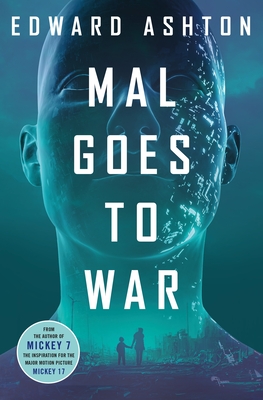
A+ #BookReview: Mal Goes to War by Edward Ashton

A+ #BookReview: Mal Goes to War by Edward AshtonMal Goes to War by Edward Ashton
Format: eARC
Source: supplied by publisher via Edelweiss
Formats available: hardcover, paperback, ebook, audiobook
Genres: dystopian, military science fiction, robots, science fiction
Pages: 304
Published by St. Martin's Press on April 9, 2024
Purchasing Info: Author's WebsitePublisher's WebsiteAmazonBarnes & NobleKoboBookshop.orgBetter World Books
Goodreads

The humans are fighting again. Go figure.

As a free A.I., Mal finds the war between the modded and augmented Federals and the puritanical Humanists about as interesting as a battle between rival anthills. He’s not above scouting the battlefield for salvage, though, and when the Humanists abruptly cut off access to infospace he finds himself trapped in the body of a cyborg mercenary, and responsible for the safety of the modded girl she died protecting.

A dark comedy wrapped in a techno thriller’s skin, Mal Goes to War provides a satirical take on war, artificial intelligence, and what it really means to be human.

My Review:

Mal does not intend to go to war. In fact, Mal thinks the war between the Federal army and the opposing Humanist forces is a pretty stupid war, which it is. Although not, as it turns out, quite as stupid as the apparent opposing forces make it look like it is.

Not that even Mal figures that out until well after he’s in the thick of it. The last place he ever wanted or expected to be.

Which may make it sound like Mal is a typical soldier, but if there’s one thing Mal isn’t, it’s typical. Or at least not typically human.  In fact, Mal thinks of ALL the humans he’s observing as barely evolved from monkeys. Some moments, he’s fairly sure that they’ve actually devolved from monkeys.

Because Mal isn’t human at all. He’s a free A.I., or as his people prefer to be called, a Silico-American. He’s merely observing this stupid war from the perspective of an otherwise fairly autonomous but not intelligent drone when he gets the wild and crazy idea to see what it would be like to have a body.
So he downloads himself into the body of a nearby cyborg-augmented soldier. Even on the frontiers of this stupid little war, both sides have PLENTY of those for Mal to play around with.

It stops being play really, really fast. Because one side of this stupid war knocks out all the data communication towers, and Mal can’t upload himself back into the cloud. He’s stuck in the cyborg augmentation suite of a dead human body that he can only sorta/kinda manipulate and only for so long before the power cells run out.

He’s also acquired the dead cyborg’s entirely too human job. She was guarding a little girl who has managed to survive the carnage all around her – at least so far. Quite possibly because she’s considerably more dangerous than any of the soldiers around her could even possibly imagine.

Leaving Mal trapped behind enemy lines in this stupid war between the so-called Humanists who believe that ALL augmented people should be thrown into burn pits and incinerated to ash, and the ragtag Federals who are getting the asses handed to them by people who shouldn’t be able to handle their advanced weaponry because it all requires the augmentations that the Humanists believe are anathema.

Which means that one of Mal’s people is putting their cybernetic thumb on the scales of war in favor of the humanists who want to remove them from the universe with extreme prejudice.

A problem that seems much too big for Mal to solve, as his processing power is tied up in protecting his new charge – no matter how much she hates the acts he performs to keep her as safe as he can. Even if they’re not nearly enough.

Escape Rating A+: If you put Murderbot in a blender – if Murderbot would let you put them in a blender – with the nannybot Pounce from Day Zero and the independent investigative reporter A.I. Scorn from Emergent Properties, you’d get Mal (short for Malware).

(Who, by the way, does see himself as male as does Pounce, unlike both Murderbot and Scorn. I had to check. Multiple times.)

What hooks the reader, or at least this reader, from the very first page is Mal’s conversation with his two fellow A.I.s, Clippy and !HelpDesk. They’re all snarky to the max, and none of them think much of humanity. To them, we’re entertainment – and we’re bad, boring entertainment at that.

And from their perspective, they’re right.

But, when Mal downloads himself into the dead cyborg Mika and is cut off from the datastream he’s forced to make adjustments. A whole lot of adjustments. He’s suddenly become a whole lot smaller than he ever expected to be, and the world is a whole lot bigger than he ever imagined.

Which doesn’t change his initial opinion that humans are stupid and that this war he’s now at ground zero for is stupid, even as he begins to see that as stupid as humans are he has acquired obligations to some of them that his own concept of honor requires him to see to the end.

It’s not love and never claims to be. It’s not even Murderbot’s grudging respect and even friendship toward Dr. Mensah and her team, but it is a change in perspective and a big part of the charm of the story is watching that change take place – even as we listen in on Mal’s internal dialog about the fix he’s in, his boredom as it continues and his limited ability to get himself out.

So the story combines the kind of mission quest that Day Zero had, complete with the nearly cinematic drive and pace that propels that story forward, told in a voice that might not exactly be Murderbot’s but is certainly a chronological precedent for it, shot through – sometimes literally – with Scorn’s dogged determination to figure out the mystery no matter what it might cost.

If any of the above appealed to you, or if you enjoyed the author’s previous books, Mickey7 and Antimatter Blues, you’ll find a story that will take you on a wild ride that propels you through this story while never losing sight of just how stupid this, or any other war, can be.

It looks like the author’s next book will be titled The Fourth Consort, and it will be out next February. As Mal Goes to War is the third book of his that I’ve been captivated by, I’m already there for whatever he writes next – and this one looks like even more SFnal fun.