
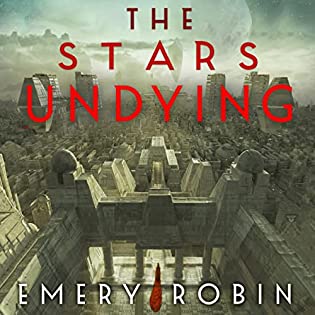
 The Stars Undying (Empire Without End, #1) by Emery Robin
 Narrator: Esther Wane, Tim Campbell
Format: audiobook, eARC
Source: supplied by publisher via NetGalley
Formats available: hardcover, paperback, ebook, audiobook
Genres: science fiction, space opera
Series: Empire Without End #1
Pages: 518
Length: 16 hours and 32 minutes
Published by Orbit on November 8, 2022
Purchasing Info: Author's Website, Publisher's Website, Amazon, Barnes & Noble, Kobo, Bookshop.org, Better World Books
Goodreads
In this spectacular space opera inspired by the lives and loves of Cleopatra and Julius Caesar, a princess stripped of her power finds control through an affair that could help regain her reign—perfect for readers of Ann Leckie and Arkady Martine.
Princess Altagracia has lost everything. After a bloody civil war, her twin sister has claimed not just the crown of their planet Szayet but the Pearl of its prophecy, a computer that contains the immortal soul of Szayet's god. Stripped of her birthright, Gracia flees the planet—just as Matheus Ceirran, Commander of the interstellar Empire of Ceiao, arrives in deadly pursuit with his volatile lieutenant, Anita. When Gracia and Ceirran's paths collide, Gracia sees an opportunity to win back her planet, her god, and her throne…if she can win the Commander and his right-hand officer over first.
But talking her way into Ceirran’s good graces, and his bed, is only the beginning. Dealing with the most powerful man in the galaxy is almost as dangerous as war, and Gracia is quickly torn between an alliance that fast becomes more than political and the wishes of the god—or machine—that whispers in her ear. For Szayet's sake, and her own, Gracia will need to become more than a princess with a silver tongue. She will have to become a queen as history has never seen before—even if it breaks an empire.
My Review:
The queen. The carpet. The conqueror. It’s an indelible image, even if it was fixed in the collective unconscious by a mistranslation of Plutarch combined with a desire for a salacious story rather than anything that might have happened in history. Several sumptuous movies cemented that image.
So it’s not exactly a surprise that this science fictionalized reimagining of the romance of Cleopatra and Julius Caesar, while it doesn’t start with that scene, features it prominently. And makes it every bit as captivating and unforgettable in this story of two towering giants at the center of the rise and fall of an intergalactic empire as it was in the same circumstances of the world-spanning empire.
At first, and on the surface, The Stars Undying reads as a grand romance. And it definitely is that – even if neither of the protagonists begin their relationship thinking that’s where they are heading and what it’s all going to be about.
Altagracia is a disgraced princess leading a rebellion against her twin sister – who has just become the Queen of Szayet and the Oracle of their god, Alekso the Undying. We experience her side of this space opera from her first-person perspective so we begin the story thinking that we’re inside her head – even as she admits that she’s lying both to us and to herself as she sets out to overthrow her sister’s divine rule and take the crown for herself.
Which is where Matheus Cierran, the Commander of all the fleets and armies of the vast Empire of Ceiao, enters the picture. And Gracia enters his quarters rolled into a rug. Gracia conquers the conqueror – not so much with her beauty as with her wit and charisma – and he conquers her sister on her behalf.
As their romance spans the galaxy between Szayet and Ceiao, we see their universe from their alternating, first-person viewpoints, never quite sure who truly conquered whom, who is lying to whom, and whose intentions are the most righteous. While we watch them fall deeper in love with each other, and while both fail to recognize who their true enemies are – and fatally underestimate those enemies and each other.
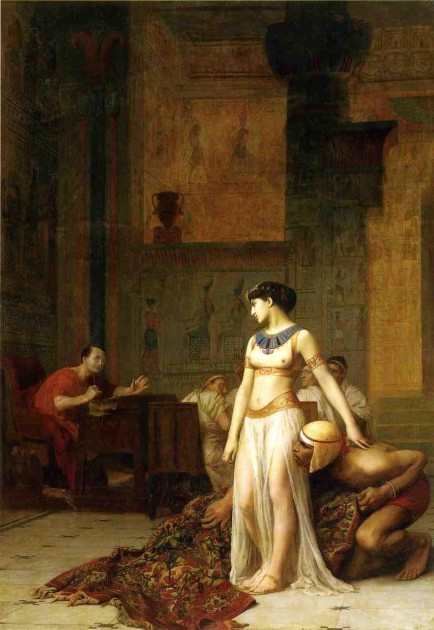
Jean-Léon Gérôme (1866)
Escape Rating A++: Because The Stars Undying is, most definitely, a reimagining of the relationship, both personal and absolutely political, between Cleopatra of Egypt and Julius Caesar, we do go into this story thinking that we know how it ends and even a bit of how it gets there. And just like Friday’s book, The Cleaving, that bit of foreknowledge does not keep the reader from frantically turning pages to see how it gets there.
In addition to the epic romance, and more important than that romance in the long run, The Stars Undying is also the story of the decline and fall of empire. As it begins, as it began, when Cleopatra rolled out of that rug – or more likely rose out of a sack – Rome was at the peak of its power. Just as Ceiao is when Gracia emerges from her carpet at Ceirran’s feet.
The thing about being at the peak of something is that from that highest point there is only one direction to go. Down. So this story is not about the crest of the peak but about the tip over it and into the decline that will inevitably follow – even if the principals can’t see it. Not yet anyway.
So the romance is how we get into this story, but that beginning takes us deeply into what one writer called “the romance of political agency” as we watch Gracia and Cierran jockey for power within their relationship and attempt to maneuver their way through and around the pitfalls of the densely factional political climate of Ceiao. An empire where the backstabbing never seems to end and Ceirran is always the target whether he recognizes it or not.
One of the fascinating things about the way that this story unfolds is just how tightly it gets wrapped around religion. Not any particular religion as we know it today, but religion and its seeming antithesis nevertheless. The Empire of Ceiao was founded on the basis of the disestablishment of ALL religions, which is carried to the point of being a religion unto itself.
Szayet, very much on the other hand, is not just a religiously backed monarchy but their religion is based on the idea that their god, Alekso Undying, lives on in an oracular artifact that is worn by each of his descendants as a symbol of their holiness and his godhood. It’s not even a myth. Gracia wears the Pearl and the spirit of Alekso within it does communicate with her frequently, often and always with disappointment in her and her actions. The only question in both the reader’s mind and Ceirran’s is whether the being she is communicating with is truly Alekso’s soul or merely his mind locked in a sophisticated machine.
That question, and both Ceirran’s and Ceiao’s reaction to any and all possible answers to it, turns out to hold the key both to his downfall and Gracia’s future in a way that surprises the reader and manages to seem inevitable at the same time. But then, all great leaders sow the seeds of their own destruction – at least in fiction.
The story in The Stars Undying reads like an unlikely amalgam of the Masters of Rome series by Colleen McCullough, The Memoirs of Cleopatra by Elizabeth George, Behind the Throne by K.B. Wagers, A Memory Called Empire by Arkady Martine and Engines of Empire by R.S. Ford. As a stew it shouldn’t work but most definitely does, combining the first-person perspective of the Memoirs with the deep dive into Roman history and politics of the McCullough series with the variations of the great empire not able to see or admit that it is past its prime in all three of the space opera series.
It’s not the stew that anyone would have expected but it’s absolutely glorious in its execution and now that I’ve read it I can’t help but wonder why no one got quite all the way here sooner. That the audiobook version that I listened to gave the two central figures, Gracia and Ceirran, their own separate, distinct and extremely well-acted voices was just icing on a very tasty cake.
(I had to switch to text near the end because I couldn’t bear to hear Gracia’s perspective on learning that Ceirran was gone in “her” voice, told from her internal, intimate, point of view. It would have been just too painful.)
That ending was so inevitable, based on the source material, that saying it happened does not feel like a spoiler. Howsomever, speaking of that source material, it is equally clear that the ending of The Stars Undying cannot possibly be the ending of the entire saga. This book, unbelievably the author’s debut novel, is listed as the first book in the Empire Without End duology. The second book in the duology is tentatively titled The Sea Unbounded and I can’t wait to read it whenever it appears. I might, maybe, possibly, have gotten over the book hangover from this book by then!