
 Fatal Enquiry (Barker & Llewelyn, #6) by Will Thomas
 Format: ebook
Source: purchased from Amazon
Formats available: hardcover, large print, paperback, ebook, audiobook
Genres: historical fiction, historical mystery, mystery
Series: Barker & Llewelyn #6
Pages: 293
Published by Minotaur Books on May 13, 2014
Purchasing Info: Author's Website, Publisher's Website, Amazon, Barnes & Noble, Kobo, Bookshop.org, Better World Books
Goodreads
Brimming with wit, atmosphere, and unforgettable characters, FATAL ENQUIRY reintroduces private enquiry agent Cyrus Barker and his assistant, Thomas Llewellyn, and their unforgettable world of Victorian London.
Some years ago, Cyrus Barker matched wits with Sebastian Nightwine, an aristocrat and sociopath, and in exposing his evil, sent Nightwine fleeing to hide from justice somewhere in the far corners of the earth. The last thing Barker ever expected was to encounter Nightwine again—but the British government, believing they need Nightwine's help, has granted him immunity for his past crimes, and brought him back to London. Nightwine, however, has more on his mind than redemption—and as Barker and Llewellyn set out to uncover and thwart Nightwine's real scheme, they find themselves in the gravest danger of their lives.
My Review:
 Most of the entries in the Barker & Llewelyn series, at least so far, begin with Thomas Llewelyn in some kind of VERY hot water, in the middle of a case that we haven’t yet seen the beginning of. Then his narrative winds back and we get to learn how he got into the pickle we opened with and the game is afoot.
This time around doesn’t seem like it starts in that ‘usual’ fashion, as Llewelyn and his ‘Guv’, private enquiry agent Cyrus Barker, are sitting peacefully in their offices negotiating the precise time at which Barker will let Llewelyn go for his half-day off.
Which is when the situation goes entirely pear-shaped, and they are suddenly on the run after a coded telephone call.
It’s not until somewhere in the middle of that run for their lives that the reader figures out that this was the standard opener after all. Because this is a pickle that Barker and Llewelyn have been in since the very first book in the series, Some Danger Involved.
Barker’s old nemesis, Sebastian Nightwine, has merely been biding his time – off running his usual con games somewhere out on the fringes of the British Raj – waiting for the right opportunity to bring him back to London where he can finally finish Barker off – once and for all.
Or at least that’s Nightwine’s plan – a plan which Barker must thwart to preserve his life, his reputation AND especially the lives of all those he holds dear – even as he is aware that on one count, at least, he’s already failed.
Each believes that the other is a pawn in their long game. Llewelyn, on the other hand, is certain that he’s a pawn in both their schemes. None of them are aware that they are all being played for fools, and that there is a puppet master operating in the wings pulling ALL of their strings.
Escape Rating A+: I knew when I started this book that it would finally break the two weeks of mostly ‘meh’ reading that’s been happening around here. And it absolutely did!
But there was one story during that ‘meh’ that did rise above, and that was “How to Raise a Kraken in Your Bathtub”. You’d think that story and this book wouldn’t have much in common – but they actually do. Because underlying both stories, in spite of their very different genres, is a story about the excesses of empire, the lengths that those who are in charge or those empires will go to continue their expansion, and the desperation and necessity of those who stand in their way.
That it’s the same empire turned out to be utterly fascinating.
In this case, however, the sixth case that Thomas Llewelyn has written about his work and adventures with his boss and mentor, Cyrus Barker, the story starts out much closer to home when Barker and Llewelyn flee theirs in order to stay out of the hands of the police – who have been led astray, by a very roundabout route, by people with big dreams of empire and one man willing to exploit those dreams for his own gain.
A gain that is intended to secure Barker’s downfall and death. Poor Thomas Llewelyn is merely collateral damage in this chess game of a mystery, as Barker sets his lifelong adversary Nightwine up for a big fall even as Nightwine does the same to him.
Along the way, we – along with Llewelyn – learn a LOT more about Barker’s mysterious past. Because that’s where this case has its origins. At the same time we see the operations of the levers of power and privilege being moved by a con man running a game that is too tempting for even the savviest government officials to resist.
 What makes the story rise to an A+, at least for this reader, was the delicious irony of the ending. Nightwine returns to London with deep, well-laid plans to eliminate Barker. Barker, forced to react rather than plan, still manages to maneuver Nightwine to what he believes will be his enemy’s downfall. It’s only after the results of that inevitable confrontation have been dealt with that Barker learns that both he and Nightwine have both been played by someone neither realized was even studying their board – let alone running it.
Someone who still has plans for Barker – or at least for Llewelyn – but only if this particular fly steps willingly back into the spider’s den.
I had a grand time with this entry in the series, so obviously I’ll be back to see Barker and Llewelyn try to get ahead of Jack the Ripper in the next book in this marvelous series, Anatomy of Evil, the next time I’m in the mood for murder – or just in search of a ripping good read!
 The Black Hand (Barker & Llewelyn, #5) by
  So far, at least, the
  Last but not least there’s the resonance to the now in this story that is very much steeped in the ‘then’. Because while the case may be about the Mafia, what’s behind their advent into London is a debate about immigration and immigrants and just how easy or difficult it should be and just how much enforcement is necessary and which way and upon whom the economic impacts have and will fall.
 Because I’ve enjoyed this series so much so far, it was an obvious choice for one of this week’s Blogo-Birthday giveaways – especially as the latest book in the series,
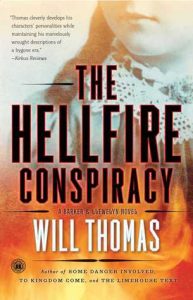
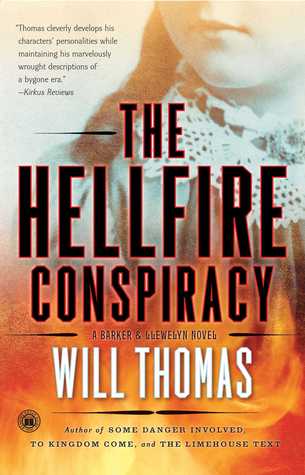 The Hellfire Conspiracy (Barker & Llewelyn, #4) by
  This fourth entry in the marvelously absorbing
  But it’s the characters of Cyrus Barker and Thomas Llewelyn themselves that keep the reader turning pages. Especially in a case like this one, where they go in knowing that the odds of a happy ending are very much against them, but determined to bring as much justice as can be had to all the victims of this atrocity; the living and the dead.
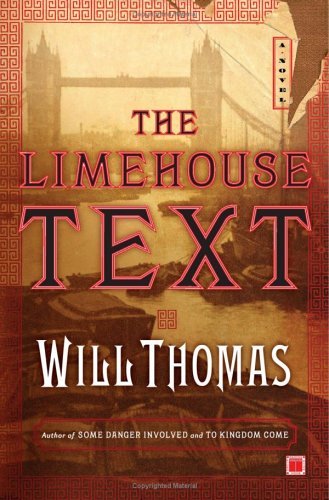 The Limehouse Text (Barker & Llewelyn, #3) by
  Escape Rating A+: One thing drove me utterly bananas during my reading of The Limehouse Text. I had the vague impression, not that I’d read this before, but that the Jeremy Brett Sherlock Holmes series had also tackled a story set in Limehouse – London’s Victorian version of Chinatown – but couldn’t track down precisely which story. I think it may have been
  In the end, this is a clever, convoluted mystery, solved but not truly resolved by fascinating characters, steeped in a culture and a perspective that was not treated with any kind of respect in its time and about which stereotypes promoted during this period still linger. The reader is inexorably drawn in by the mystery and the setting, and left with both the satisfaction of at least some just desserts being served – as a mystery should – while still reeling from the marvelously presented microcosm of all the reasons why ‘colonialism’ is such a disgustingly dirty word in so many places around the globe to this very day.
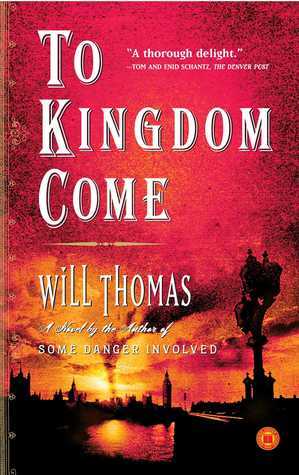 To Kingdom Come (Barker & Llewelyn, #2) by
 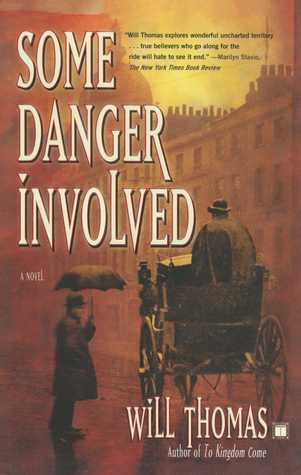 Some Danger Involved (Barker & Llewelyn, #1) by