
 Summers End (A Shady Hollow Mystery, #5) by Juneau Black
 Format: eARC
Source: supplied by publisher via Edelweiss
Formats available: paperback, ebook, audiobook
Genres: cozy fantasy, cozy mystery
Series: Shady Hollow #5
Pages: 288
Published by Vintage on July 9, 2024
Purchasing Info: Author's Website, Publisher's Website, Amazon, Barnes & Noble, Kobo, Bookshop.org, Better World Books
Goodreads
A unique take on dark academia, featuring everyone's favorite vulpine sleuth, Vera Vixen.
It's late August in Shady Hollow, and the heat has intrepid reporter Vera Vixen eager to get away. She agrees to chaperone the annual field trip to Summers End, an ancient tomb built by an early woodland culture, along with her good friend Lenore Lee to come with her.
But when the two enter the tomb, they find bones that are distinctly more...modern. Digging a little deeper, Vera and Lenore discover that the deceased was involved in a recent excavation at the site, and very unpopular with their colleagues. Now the fox and raven have to delve into the dark world of academia and archaeology to determine which creature thought they were clever enough to get away with the perfect murder.
My Review:
Shady Hollow is just the kind of small town that makes small-town cozy mysteries so very cozy. Which makes it very similar to Elyan Hollow in yesterday’s book. But with a singular difference.
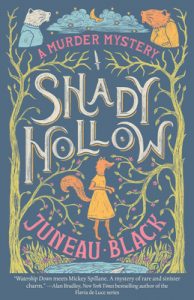 All the characters in Shady Hollow are animals. Which doesn’t mean that they aren’t people – because they absolutely are. Even if, or especially because, their species and its characteristics allows the story to overtly display certain facets of their personalities that have to be revealed a bit more obliquely in, let’s call them more traditional, cozy fantasies.
Take Vera Vixen for example. Vera is our protagonist, our amateur detective, and an ace investigative reporter for the local newspaper, the Shady Hollow Herald. The inquisitiveness and cunning of her fox species are assets in her chosen profession – no matter how much her boyfriend, Shady Hollow Police Chief Orville Braun – an actual bear – would prefer she be a bit more mouse-like and keep herself out of trouble.
Part of the magic of the series and the immersion in the place and the characters is that after the first few pages the human reader’s mind glosses over speculation about any details of how a romantic relationship between a fox and a bear would actually work – and what any resulting children would look like if there were any.
(I’ve always pictured those potential children as resembling the Cratchit Family in The Muppet Christmas Carol; the boys took after dad (Kermit) and the girls took after mom (Miss Piggy) – but your imagination may take you down other paths.)
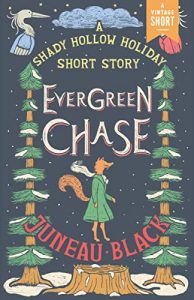
This entry in the series – after the Halloween short Phantom Pond – takes Vera out of her familiar Shady Hollow setting and away from her police bear beau and takes her – along with her best friend, Lenore Lee and a whole, literal, actual boatload of students up the river to Summers End to observe the phenomenon for which the famous archaeological and astronomical site was built back in the Woodlands’ equivalent of prehistory.
So this is supposed to be an educational trip for the students. Vera and Lenore are along as chaperones – and to get a bit of a vacation in a picturesque little town as well. Vera even has a student of her own, as she’s agreed to mentor a budding reporter for the week.
Vera felt a bit out of her element trying to take care of – and ride herd on – a bunch of tweens and teens. But she finds herself needing all of her investigative skills when the group’s sunrise view of the Summers End phenomenon is obstructed – by a corpse.
Naturally – at least for Vera – she can’t stop herself from bringing her reporter’s eye and investigative mind to the grisly sight – even though that’s the last thing that the local police want.
She’s sure she’s helping the investigation. But Police Chief Buckthorn acts an awful lot as if what Vera is really doing is interfering with his coverup. It looks like Buckthorn has already decided who the murderer was – or perhaps that’s will be. And Vera can’t let that miscarriage of justice stand, not when his prime suspect is her best friend’s sister.
 Escape Rating A-: This series has always struck me as being a bit of the case of the bear dancing – and pardon the pun about Orville Braun. But seriously, although the series NEVER takes itself too seriously, the whole thing has always struck me as something that one is not surprised is done well but that it’s done AT ALL.
But in this case it very much IS done well. Not that there isn’t a touch – or sometimes more than a touch – of whimsy involved. Howsomever, the heart of the story is ALWAYS the mystery, and the animal natures of the characters are very well played to poke at the vagaries and idiosyncrasies of human behavior – which are, of course, legion.
This particular entry in the series also struck me as being at the intersection of two points that I never expected to see intersect.
Summers End, the archaeological, anthropological and astronomical site, is guaranteed to make readers think of Stonehenge, possibly combined with something like Sutton Hoo to pull in the ancient burial ground aspect.
That combination allows for a whole lot of fascinating story points. There is a thread of dark academia running through the mystery, as Summers End is a huge archaeological site, there are still plenty of digs going on. Which means that the professors at the local university are constantly fighting over sites and rights and theories and tenure.
At the same time, as with any archaeological site, there are always artifacts being uncovered along with the temptations towards theft and fraud that follow. As do tourists who both want to visit the site AND take home a souvenir – legal or not.
But the part of the story that sticks – as the entries in this series often do – is the bit at that strange intersection. Because what gets found in Summers End – besides the murder and the mystery and cleanup of a whole lot of good old-fashioned – but not that old – corruption, is an old story that combines the famous but probably apocryphal quote from Margaret Mead that the earliest sign of civilization is “A healed femur” and the quip a tour guide at Stonehenge once made that the monument was built during the “loony Neolithic” because of just how much of the gross domestic product of the civilization that built it had to be devoted to something that provided neither food nor shelter nor seemingly anything else that a really primitive society would have needed really, seriously badly every single day.
So on the surface this is a murder mystery, a murder that happens for very prosaic and common reasons. The way that Vera and her friends pull together for the investigation is, as always, a whole lot of fun with just the right touch of intrigue and danger.
But it’s the uplift at the end, the way that the stories and legends of Summers End – and of the species who came together to build it at such an early period, and what that meant for the future of the region – that raises the whole thing just that bit higher while not taking a single jot of compulsive, page-turning, edge of the seat reading tension from the mystery and its fitting resolution.
Which is a big part of what makes me love the Shady Hollow series and leaves me always looking forward to the next. As I am right this minute.
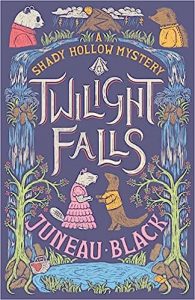
 Twilight Falls (Shady Hollow, #4) by
  It was also a delightful twisty little mystery, as the
  That their arguments seem to have found a violent resolution is just as typical for the cozy mystery genre as the rest of the story. And it’s all just a lovely and comforting read all the way around. Just like all cozy mystery series, if you’ve fallen for the regular ‘gang’ and the place they live – and I have – then it’s always wonderful to come back for a visit. And it certainly was this time around.
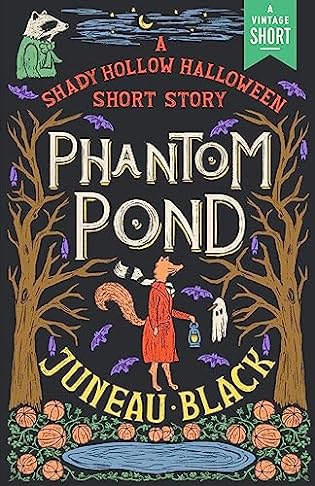 Phantom Pond: A Shady Hollow Halloween Short Story by
  When one of the little Mischief Night revelers doesn’t turn up the following morning, not at home, not at her best friend’s house, not anywhere – and a vaguely threatening missive from Creeping Juniper is found in her place – everyone fears the worst.
 Then it turns the whole scenario on its head, one more time, into the best kind of cathartic happy ending about mysterious misunderstandings until all their, and our, fears are laid peacefully to rest but no character is left under a ‘Rest in Peace’ marker.
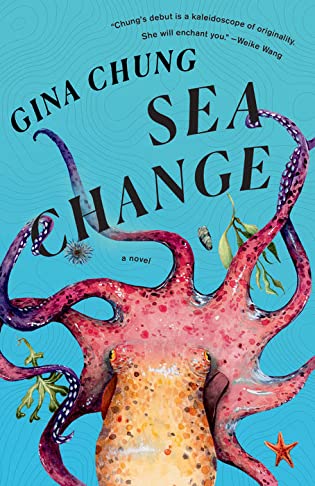 Sea Change by
  (It’s not specified exactly where or what this is, but it seems likely to be a combination of or an intrusion into the Bering Sea by the existing Polar Vortex. I could be completely off-base. One of the frustrating things about Sea Change is that it seems to be set in a near-future of our current world, but just how near or far is confusingly obscured. There are people who remember the song Hotel California from their own youth – as I do – but climate change is considerably further amuck than current conditions and a colony spaceship to MARS lifts off during the course of the story. The near-ish future setting of
  Escape Rating C+: For this reader, Sea Change was just ‘Too much Ro and not enough Lo’ as I said near the top. I hoped this would tilt more to the magical realism side of the equation, so that Dolores could be more of a character. Because Marcellus was so much of a character,