

#BookReview: The Potency of Ungovernable Impulses by Malka Older

#BookReview: The Potency of Ungovernable Impulses by Malka OlderThe Potency of Ungovernable Impulses (The Investigations of Mossa and Pleiti, #3) by Malka Ann Older
Format: eARC
Source: supplied by publisher via Edelweiss
Formats available: hardcover, ebook, audiobook
Genres: climate fiction, gaslamp, mystery, science fiction, science fiction mystery, space opera, steampunk
Series: Investigations of Mossa & Pleiti #3
Pages: 246
Published by Tor Books on June 10, 2025
Purchasing Info: Author's WebsitePublisher's WebsiteAmazonBarnes & NobleKoboBookshop.orgBetter World Books
Goodreads

The Hugo and Nebula nominated science fiction detective series continues with The Potency of Ungovernable Impulses, featuring a new mystery concerning alarming incidents of targeted, escalating academic sabotage.
When a former classmate begs Pleiti for help on behalf of her cousin―who’s up for a prestigious academic position at a rival Jovian university but has been accused of plagiarism on the eve of her defense―Pleiti agrees to travel alongside her and investigate the matter.
Even if she has to do it without Mossa, her partner in more ways than one. Even if she’s still reeling from Mossa’s sudden isolation and bewildering rejection.
Yet what appears to be a case of an attempted reputational smearing devolves into something decidedly more dangerous―and possibly deadly.

My Review:

The first two Investigations of Mossa & Pleiti, The Mimicking of Known Successes and The Imposition of Unnecessary Obstacles, both began with missing persons cases rather than the corpse that kicks off most mysteries.

This third entry ALSO begins with a missing person, but not in the same way – at all. In the earlier books, the missing persons WERE the mystery, where this time the missing person is the person who usually investigates the mystery. Not that it’s not mysteries all the way down from the human-settled platforms that circle Giant (AKA Jupiter) to the roiling surface of that gas giant of a planet.

But Mossa is the person who is missing, sorta/kinda, and Pleiti is definitely the person who is missing her. (Not that THAT hasn’t happened before in their relationship!)

Mossa is lost, not physically but emotionally, deep in a depression that is so endemic to the human colony on Giant that it has a name and a pathology of its very own. Pleiti, on the other hand, is just a bit lost, leaving her partner behind in order to take a long trip around the transport rings to Stortellen, the university that sees itself as the rival of Pleiti’s own institution, Valdegeld.

Because a friend is being threatened, and she needs Mossa and Pleiti to investigate. If all she’s going to get is Pleiti, that’s going to have to do.

And it does – even if it doesn’t do at all for Pleiti herself until it’s nearly too late.

Escape Rating B: Part of what made the first two books in this series work so well, and made them so much fun to get into, was the way that Investigator Mossa and Scholar Pleiti balance each other out, both in personality and skill set. Not that they aren’t both capable in their own fields, but rather that the mystery usually involves tackling a puzzle that straddles both specialties and they need each other to reach the solution.

Neither of them can see the forest for the trees, as that saying goes, but they can each see the forest for the other’s trees, and when needed, the other way around.

This time around, Pleiti leaves Mossa behind to help out a friend – at Mossa’s seemingly indifferent behest – then feels guilt-ridden because she didn’t recognize her lover’s depression. But she’s stuck, and stuck in, and has to make the best of the situation no matter how deeply she feels like an imposter.

It should work, because the case is very strongly rooted in Pleiti’s personal bailiwick. It’s a story about academic reputations, the fragility thereof, and the ease and rapidity with which an unfounded rumor can derail an entire career. It’s steeped in the maliciously incestuous incivility of the worst of academe, and it’s an environment that Pleiti, as a scholar herself, knows all too well.

But without Mossa, Pleiti flails and angsts a LOT. Not that the situation doesn’t warrant both, and not that she doesn’t wish for Mossa’s ability to obtain an actual, legal, warrant when needed, but mostly she needs Mossa’s pragmatism and laser-focus to balance her out.

I have to say that, as much as I wanted to slip back into Mossa and Pleiti’s world, and as much as I enjoy them as characters and find their setting fascinating, this entry in the series didn’t work for me as well as the first two.

There were a few reasons for that. One is the obvious as stated above, they are better together than they are separately. With Pleiti as the first-person narrator, combined with her tendency to angst-spiral, it sometimes got a bit hard to take.

And that’s on top of the deep dive into the darker corners of bad behavior in academe, of which there was a lot and I have to say that the motives for the reputation bashing were a bit opaque and off-the-wall at the same time. I did figure out whodunnit, but their reasons for doing it mostly get chalked up to ‘ungovernable impulses’.

Also, because of the way this story was deep into the academic life, AND because English or whatever common language has evolved over the decades if not centuries on Jupiter, that language used has gone out and mugged a whole lot of other languages for words, to the point where I kept dropping out of the story to get a translation for a word that I was almost but not quite sure of in context. My immersion in the story got broken OFTEN, and I don’t believe this was the case in the previous books, but without Mossa it seemed that Pleiti got deep into the jargon and cliches and colloquialism of her own profession to the exclusion of those not a part of it. Which is exactly what kind of insider-speak is intended to do, but it frequently lost this member of the intended audience.

Your reading mileage may vary.

I still like Mossa and Pleiti, especially when they’re together, so I’m still following this series. Based on the ending of this book, this sapphic, gaslamp, SF mystery is planning to go full Sherlock Holmes in the next book, with Investigator Mossa striking out on her own as Giant’s first PRIVATE investigator and presumably, hopefully, Pleiti as her Watson-esq chronicler.

I’m looking forward to finding out!

A+ #BookReview: The Imposition of Unnecessary Obstacles by Malka Older

A+ #BookReview: The Imposition of Unnecessary Obstacles  by Malka OlderThe Imposition of Unnecessary Obstacles (Mossa & Pleiti, #2) by Malka Ann Older
Format: eARC
Source: supplied by publisher via Edelweiss
Formats available: hardcover, ebook
Genres: climate fiction, mystery, science fiction, science fiction mystery, space opera, steampunk
Series: Investigations of Mossa & Pleiti #2
Pages: 208
Published by Tordotcom on February 13, 2024
Purchasing Info: Author's WebsitePublisher's WebsiteAmazonBarnes & NobleKoboBookshop.orgBetter World Books
Goodreads

Investigator Mossa and Scholar Pleiti reunite to solve a brand-new mystery in the follow-up to the fan-favorite cozy space opera detective mystery The Mimicking of Known Successes that Hugo Award-winning author Charlie Jane Anders called “an utter triumph.”
Mossa has returned to Valdegeld on a missing person’s case, for which she’ll once again need Pleiti’s insight.
Seventeen students and staff members have disappeared from Valdegeld University—yet no one has noticed. The answers to this case could be found in the outer reaches of the Jovian system—Mossa’s home—and the history of Jupiter’s original settlements. But Pleiti’s faith in her life’s work as scholar of the past has grown precarious, and this new case threatens to further destabilize her dreams for humanity’s future, as well as her own.

My Review:

Like the opening of the first book, The Mimicking of Known Successes, in this delightful steampunk-y, space opera-ish, not-exactly-dark academic mystery series, this second entry begins not with the discovery of a dead body as most mysteries do, but rather with the disappearance and presumed deaths of a whole bunch of bodies.

But presumption, like assumption, involves drawing conclusions that may or may not be born out by evidence. Evidence that the still mysterious Investigator Mossa is determined to collect. Possibly, she’s driven to go that extra bit as an excuse to visit with her now on-again lover Scholar Pleiti at the University at Valdegeld.

Entirely too many of those missing bodies are/were students at the University, and Mossa isn’t above using that connection as an excuse to visit Pleiti AND involve her in her work. Again. Just as she did in their first adventure.

A lot of people DO go missing on Giant – otherwise known as Jupiter. The architecture of the colony, which is made up by rings of platforms stationed around the gas giant, leaves a lot of room for both accidental and on-purpose plummets to death and destruction, whether self-induced or pushed. Searching for missing persons is consequently the raison d’être of the Investigators, of whom Mossa is a part.

But the number of missing has jumped to a degree that is statistically implausible, leading Mossa to an in-person search for those missing. Some of them will be found perfectly safe, because that happens all-too-frequently.

The question in Mossa’s inquisitive mind is whether those findings will bring the number down to something reasonable. She doesn’t believe so. And she’s right.

While Mossa is looking into missing bodies, Pleiti is dealing with a body that has been found. The mad scholar/scientist that Mossa and Pleiti pursued in that first book, the man who pointed out that all of the busy research of the university was merely the ‘mimicking of known successes’ and had little chance of ever coming to fruition, the once respected rector of the university who may have derailed the university’s entire reason for being for centuries, has been found. Or at least his corpse has been.

But the effects of that death, and the events that led up to it, still chase our intrepid investigators. And may have more to do with all those missing bodies than anyone imagined.
Escape Rating A+: There’s something supremely comforting about this series – and I’m oh-so-happy it IS a series because The Mimicking of Known Successes could easily have been a one-off.

I think it’s the combination of the outlandish and exotic with the comforting and familiar. At first it seems pretty far out there, literally as well as figuratively. Jupiter is far away and seemingly totally inhospitable. And it kind of is. But still, humanity has adapted – at least physically. We’ve made it work.

At the same time, the way it works is so very human. They are still close enough in both time and space, relatively speaking, to see their lost home as something they might return to while also romanticizing the past and the possible future.

And the university is so very much academe in a nutshell, to the point where both books’ titles absolutely ring with the sense of academic politics being so vicious because the stakes are so small, caught up so tightly in the petty grievances of scholars that are more invested in scoring off against each other and/or proving their superiority than they are about real problems and practical solutions.

Which comes right back around to the whole story of the first book AND the motivations that lead to all those missing persons that Mossa is hunting for in this second one. Hunting, in fact, all the way around the train tracks that ring the planet to a hidden platform as far away from the University as it can get – and back around again to the place where both stories began.

To the University, and ultimately to the Earth it claims it wants to return them to – even as it settles into its comforts and grievances in a way that makes the reader wonder if anyone really, truly does.

What carries the story along, what holds it up around those rings and over that gas giant, is the relationship between Mossa and Pleiti. They live in different worlds, and approach those worlds from opposing perspectives. Mossa, the Investigator, the ultimate pragmatist, always on the hunt for a new mystery, and Pleiti, the scholar and dreamer ensconced within the comforts and comfortable stability of the university. Their relationship didn’t work the first time, because they couldn’t meet in the middle and let each other in.

This time around they’re a bit older, sometimes sadder, occasionally wiser. Or at least wise enough to know that they are better together than they are apart, even if that togetherness has and even requires more space that one or the other might desire.

Watching them try, following them as they attempt to join two worlds and two perspectives that aren’t intended to meet in any middle, adds something very special to this delightfully charming science fiction mystery that will keep readers coming back for more.

Particularly this reader, left desperately hoping for a third book in the series.

Review: The Mimicking of Known Successes by Malka Older

Review: The Mimicking of Known Successes by Malka OlderThe Mimicking of Known Successes (Investigations of Mossa & Pleiti, #1) by Malka Older
Format: eARC
Source: supplied by publisher via Edelweiss
Formats available: hardcover, ebook, audiobook
Genres: climate fiction, mystery, science fiction, space opera, steampunk
Series: Investigations of Mossa & Pleiti #1
Pages: 176
Published by Tordotcom on March 7, 2023
Purchasing Info: Author's WebsitePublisher's WebsiteAmazonBarnes & NobleKoboBookshop.orgBetter World Books
Goodreads

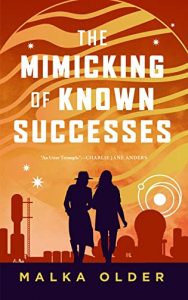
The Mimicking of Known Successes presents a cozy Holmesian murder mystery and sapphic romance, set on Jupiter, by Malka Older, author of the critically-acclaimed Centenal Cycle.
On a remote, gas-wreathed outpost of a human colony on Jupiter, a man goes missing. The enigmatic Investigator Mossa follows his trail to Valdegeld, home to the colony’s erudite university—and Mossa’s former girlfriend, a scholar of Earth’s pre-collapse ecosystems.
Pleiti has dedicated her research and her career to aiding the larger effort towards a possible return to Earth. When Mossa unexpectedly arrives and requests Pleiti’s assistance in her latest investigation, the two of them embark on a twisting path in which the future of life on Earth is at stake—and, perhaps, their futures, together.

My Review:

The Mimicking of Known Successes throws steampunk, mystery, climate fiction and planetary colonization into a blender with a soupcon of dark academia, a scintilla of romance and just a pinch of Sherlock Holmes pastiche to create a delightful story that leans hard on its central mystery and the push-pull relationship of its puzzle-solving protagonists.

It’s also a wonderful antidote to the recent spate of darkly corrupt academia. Or at least provides a much needed light at the end of some recent deeply dark tunnels in that genre. (I’m looking at Babel and both The Atlas Six and yesterday’s book, The Atlas Paradox.)

That light is in the characters, Investigator Mossa and her once and likely future lover, Scholar Pleiti. Neither of whom can resist a mystery. Or, as before and now again, each other.

The mystery begins, not with a dead body as such stories usually do, but with a missing one. It’s assumed that Scholar Bolien Trewl jumped, or was pushed off the platform at the last station on the end of the line around the gas giant moon these refugees from Earth have settled upon.

There is literally nothing else to do at that station except wait for the next train back inward, visit the four buildings on the platform, or drop off into the gas-wreathed planet below. The missing scholar isn’t still around, he didn’t board the next inbound train, so that leaves suicide or murder by plummet.

But that conclusion doesn’t make sense to Inspector Mossa. The pieces don’t add up. But those same pieces definitely lead her into temptation. The missing man was a Scholar at Valdegeld University, as is Mossa’s former flame Pleiti. Who might be of assistance in this investigation. Or the coincidence may just be an excuse to find out if the flame still burns.

As it turns out, more than a bit of both. And the game is most definitely afoot.

Escape Rating A+: This was a re-read for me. I reviewed The Mimicking of Known Successes last year for Library Journal, but I loved it so much that I kept referring to it in other reviews that I couldn’t resist giving a much longer review here.

So here we are.

At first, it was the setting that grabbed me. Mossa’s trip to that very remote station gives the reader a terrific introduction into the way this world both works and doesn’t, along with a taste of the marvelously steampunk-y nature of the whole thing.

Trains, the trains are so delightfully retro, while the planetary location is anything but. It’s not exactly a surprise that in this future view of the solar system, Earth is a painful and pined for reminder that humanity totally screwed the pooch of their home planet. Humanity is in exile, and seems caught between those who have settled down to make the most of their new home and those who are working towards a return.

That the divide reflects the town vs. gown contention that marks many college towns is just an added fillip to the whole. It’s the University that is devoted to a return, even as they spawn committees and arguments and delays and endless studies focused on the optimal way to go about it.

A process that the victim seems to have been at the heart of. As is Pleiti.

While the setting is fascinating and new, the details of academia that resemble the reader’s present provide a grounding (so to speak) a point of reference and congruence, and a whole lot of dry wit, particularly from Pleiti’s insider perspective.

As the story is told from Pleiti’s first-person perspective, we’re inside her head as she observes just how much her own profession obfuscates the important things and sweats the small stuff all the damn time.

Which lets the reader understand why Pleiti has let herself be drawn into Mossa’s investigation. It’s not just the rekindling of an old flame, it’s the need to work on something that has concrete and immediate effects that can’t be reduced to a footnote.

Even though Mossa and Pleiti nearly are reduced, not so much to a footnote as to a smear of grease on a cracked launchpad as the conspiracy and the mystery reach their explosive conclusion.

I initially picked this one up for its SF mystery blend, a combination that is having a marvelous moment right now. (If you want more of this combo, I highly recommend Station Eternity by Mur Lafferty, The Spare Man by Mary Robinette Kowal and Drunk on All Your Strange New Words by Eddie Robson along with John Scalzi’s Lock In.)

What grabbed me and kept me sucked in, TWICE, was the introduction to this quirky colony and its Sherlock and Watson investigative duo as they pursued the mystery to its surprising end. What kept me smiling and even chuckling all along the way were Pleiti’s wry observations of the familiar world of academe wrapped inside an utterly fascinating but not nearly so familiar setting.

When I first read The Mimicking of Known Successes last fall, it seemed to be a standalone book and I was a bit sad about that because I loved the characters and their world and the way they work together in it. So I was really pleased to discover that Mossa and Pleiti will return in February, 2024 in The Imposition of Unnecessary Obstacles. I’m looking forward to finding out what that title will mean for their relationship and their necessary investigations.