A- #BookReview: The Heist of Hollow London by Eddie Robson

A- #BookReview: The Heist of Hollow London by Eddie RobsonThe Heist of Hollow London by Eddie Robson
Format: eARC
Source: supplied by publisher via Edelweiss
Formats available: hardcover, paperback, ebook, audiobook
Genres: post apocalyptic, science fiction, science fiction mystery
Pages: 288
Published by Tor Books on September 30, 2025
Purchasing Info: Author's WebsitePublisher's WebsiteAmazonBarnes & NobleKoboBookshop.orgBetter World Books
Goodreads

In games of betrayal everyone loses.

Arlo and Drienne are ‘mades’―clones of company executives, deemed important enough to be saved should their health fail. Mades work around the clock to pay off the debt incurred by their creation, though most are Reaped―killed and harvested for organs when their corporate counterparts are in medical need.

But when the impossible happens and the too-big-to-fail company that owns them collapses, Arlo and Drienne find themselves purchased by a scientist who has a job for them.

The reward: Debt paid off, freedom from servitude, and enough cash to last a lifetime.

The job: Infiltrate a highly secure corporate reclamation facility in the heart of dead London and steal a data drive.

They’re going to need a team.

My Review:

This is a caper story. It says so right there on the label, doesn’t it? And it does not disappoint – even though this isn’t quite the caper that the reader thinks it will be. It’s not even the caper that the crew participating in it think it will be. Which, of course, is part of the caper itself, because they are the ones being conned and defrauded along with pretty much everyone else.

We first meet Arlo and Drienne while they are sneaking into someplace they shouldn’t be – because it’s sponsored by a megacorp that is a bitter rival of the megacorp that owns them.

Which is where we start to see just how effed up the world has become in this not-too-distant future post-climate-apocalypse story. Arlo and Drienne are clones. They aren’t merely second-class citizens, although they certainly are that. They are slaves, owned by the megacorp that created them to serve as disposable, low-wage workers until they are needed as spare parts for the VIPs who provided their genetic material.

Unless they can manage to earn enough credits to pay off the ‘debt’ they owe to their megacorp, Oakseed, to pay off the costs of their creation and training. Which happens so rarely that it might as well be a fairy tale.

Megacorps like Oakseed are, at least theoretically, too big to fail. But reality doesn’t give a damn about theoretical models, and that’s exactly what happens here. Oakseed fails – and it fails big. Global collapse-size big, creating a tsunami of chaos that spreads to every single Oakseed installation and figuratively drowns every single one of Oakseed’s assets in its wake.

Including all those clones, who become part of Oakseed’s assets, just waiting for their ‘contracts’ to be sold. Or exploited, along with all that chaos.

Someone wants to make one last really big score out of Oakseed’s catastrophic fall. All they need is a crew to do the deed and a patsy to take the fall. Which is where Arlo, Drienne and a select group of their fellow clones come in.

They ARE disposable. There’s no need for them to know the real purpose that they are being disposed of for. Which doesn’t stop them from figuring it all out – and turning the tables on the whole scheme – after all.

Escape Rating A-: I picked this up because I adored the author’s earlier SF mystery, Drunk on All Your Strange New Words, and was hoping for something in a similar vein – or at least similarly good. I got more of the second than the first, even though Heist is also an SF mystery. It’s just not the same kind of mystery. Words was a locked-room mystery, while Heist is pretty much anything but.

The Heist of Hollow London is about a heist. A caper. A big job that needs just the right crew to get it done. The form of the story, of the con and the score and the planning to get it done, has a lot of familiar parts to it. We’ve seen plenty of stories like this, and if you like those sort of stories you’ll like this one too, even if the SF setting isn’t quite your jam.

But it’s the SF setting of this story that sets it apart from the usual run of caper stories, and that’s what dragged me in and kept me glued to my seat for a bit over three hours. Because that setting has one hell of a set of layers to unpack.

The first layer is the cloning. As it turns out, it’s a bit of the last layer too. But the application here is old and new at once, as the megacorps go to great lengths to convince everyone, especially the clones, that they are not slaves. Even though they most definitely are.

Then there’s the reason for the cloning, and the reason why it’s not exactly working, from a scientific/medical/mercantile standpoint. Which leads back into another layer of the story – that this takes place in a world that is very much post-apocalyptic of the climate kind. It’s a bit like the world of Down in the Sea of Angels, only much closer to the ‘Collapse’ that world is recovering from. Or it’s the post-apocalypse of The Annual Migration of Clouds and The Knight and the Butcherbird, where the world is barely surviving the ravaging of ecological disaster.

Which is where one reaches the next layer, which is a humans are gonna human kind of story, in that the way that the megacorps control their corporate fiefdoms may be short term profitable but is not long term sustainable, and when that rug gets pulled it takes a whole lot out with it.

And all of that circles back to the caper itself. Someone needs to steal a macguffin from one of Oakseed’s installations before that installation gets shut down in the collapse of the company. They put together the crew that includes Arlo and Drienne by first, buying out their contracts and second, promising them freedom when the job is completed. Or, alternatively, selling their contracts to jobs they are guaranteed not to survive if they won’t play along.

Of course they’re being conned. Anything too good to be true usually is. While it’s equally true that you can’t cheat an honest person, Arlo, Drienne and their fellow clones know they can’t win, can’t break even, and are not in a position where they can even legally get out of this game. But they can cheat the people who are cheating them. If they can figure out the true goal of this wild scheme and turn it around before it’s too late.

That they are able to turn things around on everyone who intends to use them and throw them away made the heel turns of the plot, and the plot around the plot, and their own plot, all that much more satisfying – even if or especially because parts of that turn turn out to be bittersweet.

A- #BookReview: Extremity by Nicholas Binge

A- #BookReview: Extremity by Nicholas BingeExtremity by Nicholas Binge
Format: eARC
Source: supplied by publisher via Edelweiss
Formats available: hardcover, ebook, audiobook
Genres: horror, science fiction, science fiction horror, science fiction mystery
Pages: 176
Published by Tordotcom on September 16, 2025
Purchasing Info: Author's WebsitePublisher's WebsiteAmazonBarnes & NobleKoboBookshop.orgBetter World Books
Goodreads

*A time-traveling, end-of-the-world police procedural, Extremity is True Detective if written by Philip K. Dick.*
When once-renowned police detective Julia Torgrimsen is brought out of forced retirement to investigate the murder of Bruno Donaldson, a billionaire she worked with whilst undercover, she doesn't expect to find two bodies. Both are Bruno--identical down to the fingerprints--and both have been shot.
As the investigation sucks her back into the macabre world of London's rich elite, she finds herself on the hunt for a mysterious assassin who has been taking out the wealthy one by one. But when she finally catches up with her quarry, she unveils an entire world of secrets: impossible documents about future stock market crashes, photographs of dead clones, and a clandestine time-travelling conspiracy so insidious it might just mean the extinction of the entire human race.
If Julia is to have any chance of preventing this terrible future, she'll have to revisit her own past, the terrible choices she made undercover, and the brutal act that destroyed her once legendary career.

My Review:

It begins as a straight-up police procedural. It just doesn’t end there. Or, quite possibly, at all.

At first, things seem fairly ordinary, for select values of ordinary. A man is dead, shot in the middle of his office. It does go pear-shaped from there, but in ways that are also, well, sort of ordinary. Or at least ordinary if the dead man is one of the richest men in the world.

Meaning that the place is lousy with lawyers even before the cops arrive, all hell-bent (possibly literally) on keeping the dead man’s secrets. But still, that IS what most likely happens in these cases.

Even when the dead man resembles a combination of this world’s richest and most eccentric tech mogul AND one of many such rich people who had more than a nodding acquaintance with the world’s richest and most influential sex trafficker.

Which just means he had more secrets than the average megabillionaire – possibly – and more than enough money and influence to cover all of his misdeeds up. After all, he’s done that before, as Detective Chief Inspector John Grossman of New Scotland Yard and his retired former partner, Julia Torgrimsen can certainly attest.

No one, except possibly his lawyers and minions, is all that sorry that Bruno Donaldson is dead, but there are a lot of detectives stumped over how it was done, and a lot of lawyers putting up roadblocks to make sure that no one finds out.

Because there’s a second dead body – and it’s a second Bruno Davidson. But this body isn’t exactly a clone. It’s not exactly not, either. On the outside, it looks exactly like the first Bruno (and OMG yes we are going to talk about Bruno), but on the inside it’s just meat and muscle. No organs. Which is where this story heads straight out of the everyday – even the everyday for über-rich and influential people – and trips right over into science fiction.

Everybody has always known that Bruno was messing with a whole lot of things that he should have ended up imprisoned for – if people like him ever got held accountable for their dirty deeds in the first place. But someone is determined that Bruno and his little cabal of the rich and unaccountable are going to pay with their lives for the evil that they have – and will – commit.

Because everyone else already will.

Escape Rating A-: This was a very quick and interesting read. I expected quick as its under 200 pages, and I was hoping for interesting, which I definitely got. What I unexpectedly got was a book that reminded me a LOT of Adam Oyebanji’s Esperance – only better because Extremity stuck the dismount.

Both are stories that start out as seemingly ordinary police procedurals but then veer right off the cliff of ordinary into SF by way of crimes that were totally impossible to commit for motives that are, let’s say, difficult to believe – at best. Then they sail right off into time and/or space travel or a bit of both and we’ve landed right in the kind of situation that belongs in either the Terminator franchise or Adrian Tchaikovsky’s One Day All This Will Be Yours. (That is a hint. There are timey-wimey bits here and unlike the ones in the Tchaikovsky book they are NOT pretty.)

Places I wasn’t expecting to go at all – let alone to have carried out with the perfect twist at the end. Which I’m not going to spoil.

The idea at the heart of this story, however, is the same thing that underpins both the Terminator franchise and the Tchaikovsky book. It’s the problem of time travel and the butterfly flapping its wings. Because going back in time, or for that matter forward in time, is bound to change things. Even if you think you’ve done nothing, there’s still the observer effect to consider. That you’ve SEEN things and the things have seen you and that either your knowledge, or theirs, or the fact that you existed in that space-time for whatever amount of time will have a long term effect for good or bad.

And that’s with the best of intentions. The kind of person that Bruno Donaldson was, and the kind of people that he hung around with, pretty much never had the best of intentions in the first place. Generally the opposite.

So the science fiction of this story is about dealing with the consequences of their actions. Or, to be more accurate, reckoning with those consequences. But the way that the story gets told is through the characters, which takes us right back to those police procedural tropes of Julia, the lone wolf going out on a limb for either justice or vengeance; Grossman, the administrator who wishes he were still back on the streets investigating crimes and nabbing perps, and Cochrane, the naive newbie apprentice who is in this mess up to his eyebrows and sinking fast, making everything worse at the speed of light.

We stick with the story for those characters, and hope they manage to clean up those messes before it’s too late, all too aware that it’s probably already too late. Only because it is. Or it’s messing with all of our heads on the way out the door. Or both. Most likely both.

And I turned out to be a whole lot more there for it than I expected. Because it got to its horrifying implications through a side door. If that kind of SF turns horrifying works for you, Extremity is definitely, even extremely definitely, worth a try.

#BookReview: The Potency of Ungovernable Impulses by Malka Older

#BookReview: The Potency of Ungovernable Impulses by Malka OlderThe Potency of Ungovernable Impulses (The Investigations of Mossa and Pleiti, #3) by Malka Ann Older
Format: eARC
Source: supplied by publisher via Edelweiss
Formats available: hardcover, ebook, audiobook
Genres: climate fiction, gaslamp, mystery, science fiction, science fiction mystery, space opera, steampunk
Series: Investigations of Mossa & Pleiti #3
Pages: 246
Published by Tor Books on June 10, 2025
Purchasing Info: Author's WebsitePublisher's WebsiteAmazonBarnes & NobleKoboBookshop.orgBetter World Books
Goodreads

The Hugo and Nebula nominated science fiction detective series continues with The Potency of Ungovernable Impulses, featuring a new mystery concerning alarming incidents of targeted, escalating academic sabotage.
When a former classmate begs Pleiti for help on behalf of her cousin―who’s up for a prestigious academic position at a rival Jovian university but has been accused of plagiarism on the eve of her defense―Pleiti agrees to travel alongside her and investigate the matter.
Even if she has to do it without Mossa, her partner in more ways than one. Even if she’s still reeling from Mossa’s sudden isolation and bewildering rejection.
Yet what appears to be a case of an attempted reputational smearing devolves into something decidedly more dangerous―and possibly deadly.

My Review:

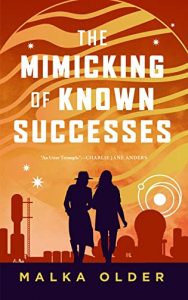
The first two Investigations of Mossa & Pleiti, The Mimicking of Known Successes and The Imposition of Unnecessary Obstacles, both began with missing persons cases rather than the corpse that kicks off most mysteries.

This third entry ALSO begins with a missing person, but not in the same way – at all. In the earlier books, the missing persons WERE the mystery, where this time the missing person is the person who usually investigates the mystery. Not that it’s not mysteries all the way down from the human-settled platforms that circle Giant (AKA Jupiter) to the roiling surface of that gas giant of a planet.

But Mossa is the person who is missing, sorta/kinda, and Pleiti is definitely the person who is missing her. (Not that THAT hasn’t happened before in their relationship!)

Mossa is lost, not physically but emotionally, deep in a depression that is so endemic to the human colony on Giant that it has a name and a pathology of its very own. Pleiti, on the other hand, is just a bit lost, leaving her partner behind in order to take a long trip around the transport rings to Stortellen, the university that sees itself as the rival of Pleiti’s own institution, Valdegeld.

Because a friend is being threatened, and she needs Mossa and Pleiti to investigate. If all she’s going to get is Pleiti, that’s going to have to do.

And it does – even if it doesn’t do at all for Pleiti herself until it’s nearly too late.

Escape Rating B: Part of what made the first two books in this series work so well, and made them so much fun to get into, was the way that Investigator Mossa and Scholar Pleiti balance each other out, both in personality and skill set. Not that they aren’t both capable in their own fields, but rather that the mystery usually involves tackling a puzzle that straddles both specialties and they need each other to reach the solution.

Neither of them can see the forest for the trees, as that saying goes, but they can each see the forest for the other’s trees, and when needed, the other way around.

This time around, Pleiti leaves Mossa behind to help out a friend – at Mossa’s seemingly indifferent behest – then feels guilt-ridden because she didn’t recognize her lover’s depression. But she’s stuck, and stuck in, and has to make the best of the situation no matter how deeply she feels like an imposter.

It should work, because the case is very strongly rooted in Pleiti’s personal bailiwick. It’s a story about academic reputations, the fragility thereof, and the ease and rapidity with which an unfounded rumor can derail an entire career. It’s steeped in the maliciously incestuous incivility of the worst of academe, and it’s an environment that Pleiti, as a scholar herself, knows all too well.

But without Mossa, Pleiti flails and angsts a LOT. Not that the situation doesn’t warrant both, and not that she doesn’t wish for Mossa’s ability to obtain an actual, legal, warrant when needed, but mostly she needs Mossa’s pragmatism and laser-focus to balance her out.

I have to say that, as much as I wanted to slip back into Mossa and Pleiti’s world, and as much as I enjoy them as characters and find their setting fascinating, this entry in the series didn’t work for me as well as the first two.

There were a few reasons for that. One is the obvious as stated above, they are better together than they are separately. With Pleiti as the first-person narrator, combined with her tendency to angst-spiral, it sometimes got a bit hard to take.

And that’s on top of the deep dive into the darker corners of bad behavior in academe, of which there was a lot and I have to say that the motives for the reputation bashing were a bit opaque and off-the-wall at the same time. I did figure out whodunnit, but their reasons for doing it mostly get chalked up to ‘ungovernable impulses’.

Also, because of the way this story was deep into the academic life, AND because English or whatever common language has evolved over the decades if not centuries on Jupiter, that language used has gone out and mugged a whole lot of other languages for words, to the point where I kept dropping out of the story to get a translation for a word that I was almost but not quite sure of in context. My immersion in the story got broken OFTEN, and I don’t believe this was the case in the previous books, but without Mossa it seemed that Pleiti got deep into the jargon and cliches and colloquialism of her own profession to the exclusion of those not a part of it. Which is exactly what kind of insider-speak is intended to do, but it frequently lost this member of the intended audience.

Your reading mileage may vary.

I still like Mossa and Pleiti, especially when they’re together, so I’m still following this series. Based on the ending of this book, this sapphic, gaslamp, SF mystery is planning to go full Sherlock Holmes in the next book, with Investigator Mossa striking out on her own as Giant’s first PRIVATE investigator and presumably, hopefully, Pleiti as her Watson-esq chronicler.

I’m looking forward to finding out!

#BookReview: Esperance by Adam Oyebanji

#BookReview: Esperance by Adam OyebanjiEsperance by Adam Oyebanji
Format: eARC
Source: supplied by publisher via NetGalley
Formats available: hardcover, paperback, ebook, audiobook
Genres: mystery, science fiction, science fiction mystery
Pages: 432
Published by DAW on May 20, 2025
Purchasing Info: Author's WebsitePublisher's WebsiteAmazonBarnes & NobleKoboBookshop.orgBetter World Books
Goodreads

The history-bending speculative fiction from Adam Oyebanji, award-winning author of BRAKING DAY.
An impossible death: Detective Ethan Krol has been called to the scene of a baffling murder: a man and his son, who appear to have been drowned in sea-water. But the nearest ocean is a thousand miles away.
An improbable story: Hollie Rogers doesn’t want to ask too many questions of her new friend, Abi Eniola. Abi claims to be an ordinary woman from Nigeria, but her high-tech gadgets and extraordinary physical abilities suggest she’s not telling the whole truth.
An incredible quest: As Ethan’s investigation begins to point towards Abi, Hollie’s fears mount. For Abi is very much not who she seems. And it won’t be long before Ethan and Hollie find themselves playing a part in a story that spans cultures, continents… and centuries.
An extraordinary speculative thriller about the scars left by the Atlantic slave-trade, by a master of the genre.

My Review:

Lake Michigan is a freshwater lake. There are no bodies of saltwater closer than the Gulf of Mexico or the Atlantic Ocean, hundreds of miles away. Unless you’re counting the gigantic saltwater tank and the Shedd Aquarium, which Chicago Police Detective Ethan Krol is forced to think about in this puzzle of a case.

The double homicide that he’s been called to utterly defies explanation. But as the lead investigator, he’s going to be required to both explain it and solve it, regardless.

A man and his baby son have been murdered, at home in their luxury apartment. Along with a barracuda. The two humans died by drowning – in seawater, while presumably the barracuda died from lack of the same. The man’s wife, the mother of the little boy, was in a profound coma in a nearby room. There are no marks or wounds on either of the bodies, but the man has plaster dust under his fingernails.

It’s a mystery – and it’s only the first of many.

When Krol reaches out to his fellow cops in the U.S. and even Interpol looking for any similar cases ANYWHERE he feels like he’s ‘casting his bread upon the waters’ or perhaps leaping and hoping the net will appear. Both turn out to be apt metaphors.

In either case, he’s successful – at least in discovering that there are other cops with similar cases who have been left just as puzzled as he is. A case in Nigeria a few years ago involving the dead man’s brother. A similar case in Rhode Island the next day. Meanwhile, a black woman of Amazonian proportions arrives in Bristol, England out of absolutely nowhere, with a mission to find the descendants of the captain of one very, very old shipwreck for reasons that she keeps very much to herself even as she eludes the police on what seems like a criminal rampage.

As information trickles and then pours in, it becomes obvious that all these events are linked – but to what? Something that combines Sherlock Holmes’ aphorism that “When you have eliminated the impossible, whatever remains, however improbable, must be the truth” with Occam Razor’s “simplest explanation is usually the best one,” (for really wild and improbable definitions of ‘simple’) and plugs the whole thing straight into Clarke’s Law that “Any sufficiently advanced technology is indistinguishable from magic.”

Escape Rating B+: This is one of those ‘mystery wrapped in an enigma’ stories that’s very much a part of the rising wave of SF mystery, and it does an excellent job of being both by starting the story from both sides of that SF + mystery equation.

It’s not like murder in Chicago is a new thing – not even among, let’s call it the upper, upper middle class. Which puts the frame directly around the wife, because the odds are that if a spouse is murdered, the other spouse had something to do with it.

Krol knows how to do his job, figures out that the frame doesn’t fit, and keeps on with dogged police work. (I do love me a good, solid, police procedural, and this is certainly that even as the procedures lead Krol straight into SFnal territory.)

At first, it’s the SFnal side of the story that is more than a bit, well, ‘out there’. So to speak. When Abidemi Eniola appears out of nowhere outside Bristol, she’s clearly a fish out of water. She’s dressed like an extra from a gangster movie, and talks like one as well. All her words are in English but they are combined in ways that don’t make sense. Or don’t make sense anymore, like she learned the language somewhere very isolated or very much behind the times.

(She talks like an extra from the Star Trek: Original Series episode “A Piece of the Action”.)

Abi needs a guide to the world in which she has found herself, and finds that guide – as well as a surprisingly loyal friend, in Hollie Rogers. Hollie helps her navigate while never knowing what she is leading – and being led – towards.

As Krol follows the trail by discovering the victims after the fact, Abi follows the same trail by researching who those victims will be. Of course they meet in the middle.

Which is where the truth comes out. A truth that is a huge spoiler, but also a truth that asks some equally huge questions about justice vs. vengeance, acknowledgement vs. reparations, and especially about what is owed and who should pay it.

I found the winding, twisted paths of this story’s mystery utterly fascinating, even as the SFnal aspects recalled Rivers Solomon’s historical fantasy, The Deep. And I adored the historical research that led to the ultimately very SFnal conclusion.

Howsomever I have to admit that the bittersweet parting at the end threw me off just a bit. OTOH, its conclusion is utterly right for the story and ties a perfect bow around the friendship between Abi and Hollie. But the way it reaches that perfect conclusion doesn’t quite make logical sense – unless, as has been true for their entire relationship, there’s something that Abi isn’t telling Hollie because she’s afraid that the truth will be too hard to bear.

#BookReview: A Study in Black Brew by Marie Howalt

#BookReview: A Study in Black Brew by Marie HowaltA Study in Black Brew by Marie Howalt
Format: eARC
Source: author
Formats available: paperback, ebook
Genres: science fiction, science fiction mystery, Sherlock Holmes
Pages: 153
Published by Spaceboy Books on May 22, 2025
Purchasing Info: Author's WebsitePublisher's WebsiteAmazonBarnes & NobleBookshop.orgBetter World Books
Goodreads

“They say life is a string of chances held together with grit and guided by passion, and who am I to disagree?”
Kellieth ReinAraneinth was headed for a career as a field chemist on a newly settled planet when their dreams and ambitions were crushed by coincidences and chronic illness.
They return broke to the wendek homeworld, Ganmak, where everyone’s basic needs are covered, but import luxuries like Kellieth’s favorite human-made beverage, black brew, is costly.
While piecing together a new life and recovering from their ordeals, Kellieth ends up sharing lodgings with the attractive, enigmatic, and infuriating Raithan WeinZalneinth.
When a human is found dead next to an alarming message on the wall in an empty house, Kellieth gets caught up in a gruesome mystery involving Raithan and the local peace corps.
Who is the human? How did he die? What is Raithan hiding? And when will Kellieth have the time to catch their breath?

My Review:

Kellieth ReinAraneinth is caught between multiple rocks and abundant hard places, as when the story begins they can barely catch their breath. Literally. They may not be human but their breathing and sense of smell are both compromised by on-the-job chemical exposure resulting in a condition that may not quite BE chronic asthma, but is close enough as to make no difference.

But it does, both in the sense that Kellieth’s health is compromised, and in the sense that they have lost one of their senses. Wendeks like Kellieth rely on their sense of smell every bit as humans rely on sight to gather clues to their environment as well as the ‘people’ they interact with. Except for Kellieth. Even their sense of taste is muted, which is where that ‘black brew’ comes in.

Because, of course, it’s coffee. Or at least as near to coffee as this far-flung, multi-species galaxy can manage for any humans who have settled on the wendek homeworld, Ganmak. Coffee has a strong and distinctive taste AND aroma. So strong, in fact, that even with compromised senses, Kellieth can sense that black brew nearly as well as they used to be able to sense their whole world.

Kellieth has returned to the homeworld to get their health back – if they can. They were part of an expedition to begin settlement of a newly available planet – a job that requires considerably more activity and exertion than Kellieth is currently capable of. At least without passing out.

They have enough to live on if they are frugal, but nothing extra for luxuries, while yet not really capable of going back to work even in the relatively safe laboratory setting that would be the usual jobsite for their work as a chemist.

Which is where their next-door neighbor, Raithan WeinZalneinth, comes in. First by helping them move in and preventing them from passing out on the front step as they did so. But also later, by providing Keillieth with someone to share occasional meals with – and most especially as a focus for their curiosity. Scientific and otherwise.

Raithan reveals his secrets first by hints and clues and, frankly, by showing off more than a bit. But eventually by taking Kellieth with him to view a dead body. This is far from the usual method of telling a friend what you do for a living, but Raithan enjoys little more than he does a dramatic reveal. Or, seemingly, drama of any kind.

That Raithan is an investigator for the Federal Wendek Security Agency, and he is VERY good at his job. Which both explains his propensity for telling people all about themselves upon first meeting, and his secretiveness. Raithan is the investigator who gets called in when the regular ‘peace corps’ (read as police) are stumped.

Raithan needs an assistant. Kellieth needs a job that they can perform with compromised health, AND they have the kind of curious, scientific, logically ordered mind that can do the job he needs and do it well. If they can get past Raithan’s initial, and rather dramatic, test of their abilities, that is.

All Raithan has to do is convince her to come along for what will turn out to be a rather dangerous ride. And make sure that Keillieth survives it – no matter what risks he has to take for himself.

Escape Rating B: The title might seem familiar, like it’s ringing a distant bell that you can’t quite place. Or that it sounds like something you recognize but isn’t quite it.

It might come into focus if you change the ‘Black Brew’ to Scarlet. Or Pink. Or Sherlock. A Study in Scarlet marked the first appearance of Sherlock Holmes and Dr. John Watson. Countless pastiche writers have been unable to resist the impulse to begin their own Holmesian or Holmes-like series with similar titles, from A Study in Honor by Claire O’Dell to A Study in Sable by Mercedes Lackey to A Study in Scarlet Women by Sherry Thomas and even A Study in Sherlock, the first in a series of collections of stories inspired by the Holmes canon. TV adaptations of the ‘Great Detective’ are not immune to this tendency as the first episode of the TV series Sherlock in 2010 was “A Study in Pink”.

In other words, A Study in Black Brew is an homage to that iconic detective duo, and I’m such a sucker for Holmes and Holmes-like stories that I couldn’t resist this book at all – and didn’t even try. If you like SF mystery – and I do – it may also remind you of another SFnal detective duo, Inspector Mossa and Scholar Pleiti. If you haven’t read their first outing, The Mimicking of Known Successes, it is an excellent readalike for A Study in Black Brew. And if you’ve already read that, I think you’ll like this and vice versa.

Keillieth and Raithan are not slavish copies of their more famous counterparts, rather the story takes the originals as a stepping off point – and occasionally the opportunity for a bit of an in-joke – to tell a fascinating murder mystery story that owes as much to its futurist time and place as it does to its progenitors.

The murders that these detectives have to solve are as twisty as any their originals might have tackled, but Raithan manages to be both more dramatically inclined and less forthcoming about his deductions than Holmes ever was. However, his tendency to use people for his own – albeit investigative – ends without fully informing them of the danger to themselves – is spot on.

As a reader, as much as I loved the story – and I did, and as much as I got caught up in the investigation – and ditto, I didn’t feel fully grounded in their world or in the fact that these characters were other than human. Also their future seemed a bit too similar to our present. I know we don’t know what we don’t know yet, but the worldbuilding feels like it could use more depth. Howsomever, I didn’t learn until after finishing this book that it is not JUST a Holmes-a-like story but is also a spinoff from the author’s Colibri Investigations series of SF mysteries. Which, OF COURSE, now I need to dive into, beginning with The Stellar Snow Job, as soon as I can manage it.

All of that being said, I still had an absolutely grand time with Kellieth and Raithan, and I’d love to see them in another investigation so that I can learn more about them, the future they live in, and the world they call home.

A- #BookReview: Murder by Memory by Olivia Waite

A- #BookReview: Murder by Memory by Olivia WaiteMurder by Memory (Dorothy Gentleman, #1) by Olivia Waite
Format: eARC
Source: supplied by publisher via Edelweiss
Formats available: hardcover, ebook, audiobook
Genres: mystery, science fiction, science fiction mystery
Series: Dorothy Gentleman #1
Pages: 112
Published by Tordotcom on March 18, 2025
Purchasing Info: Author's WebsitePublisher's WebsiteAmazonBarnes & NobleKoboBookshop.orgBetter World Books
Goodreads

A Memory Called Empire meets Miss Marple in this cozy, spaceborne mystery, helmed by a no-nonsense formidable auntie of a detective.
Welcome to the HMS Fairweather, Her Majesty’s most luxurious interstellar passenger liner! Room and board are included, new bodies are graciously provided upon request, and should you desire a rest between lifetimes, your mind shall be most carefully preserved in glass in the Library, shielded from every danger.
Near the topmost deck of an interstellar generation ship, Dorothy Gentleman wakes up in a body that isn’t hers—just as someone else is found murdered. As one of the ship’s detectives, Dorothy usually delights in unraveling the schemes on board the Fairweather, but when she finds that someone is not only killing bodies but purposefully deleting minds from the Library, she realizes something even more sinister is afoot.
Dorothy suspects her misfortune is partly the fault of her feckless nephew Ruthie who, despite his brilliance as a programmer, leaves chaos in his cheerful wake. Or perhaps the sultry yarn store proprietor—and ex-girlfriend of the body Dorothy is currently inhabiting—knows more than she’s letting on. Whatever it is, Dorothy intends to solve this case. Because someone has done the impossible and found a way to make murder on the Fairweather a very permanent state indeed. A mastermind may be at work—and if so, they’ve had three hundred years to perfect their schemes…

My Review:

Some versions of the opening line for the blurb are way, way off. A Memory Called Empire meets Miss Marple is so far off as to be misleading. (The Becky Chambers version of the blurb is somewhat better.) I’m going to do my damndest to correct that misdirection as Murder By Memory is just a terrific cozy mystery that just so happens to be set on a spaceship.

Although that’s misleading too. The HMS Fairweather is more like a space-liner. Or, really, like that cruise line that almost-but-didn’t-quite manage to launch, the one where people were intended to move in and live on the cruise ship as it traveled around the world.

The HMS Fairweather is a lot like that Life at Sea concept, except that it really did launch and its intended journey is for considerably longer than three years. It seems like it’s been traveling for more than three centuries when this story takes place – with no end in sight.

It isn’t a generation ship and it doesn’t seem to have a destination. It’s an endless journey – and an endless life. The passengers do age and eventually die – well, at least their bodies do. Their consciousness gets uploaded and downloaded from one body to another – and life goes on.

The ship is a world unto itself, a surprisingly large and fascinating one. But humans are gonna human, even in the vastness of space, and that’s where Detective Dorothy Gentleman comes in.

Literally, as her sleeping consciousness gets dropped into someone else’s body, in the middle of the ship’s night, while all the passengers and crew – except for Dorothy and this one intrepid and/or intriguing individual who is for some reason out and about while everyone else is tucked away safe and sound in their quarters.

Except, of course, for the other person who is not where they should be, the woman whose sudden death triggered Dorothy’s own return from the sleep between lifetimes. Leaving Dorothy with a job to do and a problem to solve while wondering exactly how unethical it is to borrow someone else’s body after they’ve just used it to commit murder.

Escape Rating A-: This is one of those stories where my one and only complaint is that I really, really, REALLY wish it had been longer. Because what we got was a whole lot of cozy, murderous fun and Dorothy Gentleman is a marvelous take on the lone detective chasing clues and unraveling puzzles in the middle of the long, dark night.

While I wouldn’t have gone within a parsec of the blurb’s description of Marple meets Teixcalaan, I absolutely would describe it as a combination of two books, the SF mystery plot of Mary Robinette Kowal’s The Spare Man combined with the secrets within secrets of life aboard a spacefaring cruise ship of Floating Hotel by Grace Curtis. Not that The Spare Man isn’t also set on a space cruise, but that ship doesn’t have the same vibe that living aboard the ship has in Floating Hotel and Murder by Memory.

So much of A Memory Called Empire is wrapped up in the high-stakes, deeply corruptive, politics of Teixcalaan and its imperial history and ambitions that it just doesn’t feel like any kind of match for Murder by Memory, which is, in spite of the murder, much lighter and frothier. (If the Chambers comparison is to her Wayfarers series and The Long Way to a Small, Angry Planet, well, that’s somewhere in the virtually towering TBR pile and I haven’t gotten there yet.)

Dorothy Gentleman is good at her job – and it’s fun to watch her work. That she is working from within the body of her primary suspect adds just the right touch of grounding in the SFnal setting to make the whole thing just that much better AND more convoluted at the same time.

Because the solution to this mystery is a grand case of following the money. It’s just that the money that Dorothy is following has been both stolen and hidden in ways that are only possible in SF even though the motive is one of the oldest and most human – greed. While the final piece of evidence is found in the most science fictional way possible.

Dorothy herself starts out as just a touch noir – as she has been unlucky in love and seems determined to conduct her investigation the same way she intends to conduct her life – alone. That she is surprised by both the support of her new and remaining family AND that love might just have found her again made the story end on a high and hopeful note.

I’m looking forward to reading more of Dorothy’s adventures aboard the Fairweather. The setting is already delightful, and more time will just add more delicious layers. Dorothy herself is a fascinating character, someone who has lived a long life and turned her nosy nature to good use. That we’re inside her head for this story, hearing her true – and often wry and witty – thoughts as she works her way through the mystery made the whole thing just that much better and absolutely worth a read.

A- #BookReview: The Way Up is Death by Dan Hanks

A- #BookReview: The Way Up is Death by Dan HanksThe Way Up is Death by Dan Hanks
Format: eARC
Source: supplied by publisher via Edelweiss
Formats available: paperback, ebook, audiobook
Genres: horror, science fiction, science fiction mystery
Pages: 400
Published by Angry Robot on January 14, 2025
Purchasing Info: Author's WebsitePublisher's WebsiteAmazonBarnes & NobleKoboBookshop.orgBetter World Books
Goodreads

When a mysterious tower appears in the skies over England, thirteen strangers are pulled from their lives to stand before it as a countdown begins. Above the doorway is one word: ASCEND.
As a grieving teacher, a reclusive artist, and a narcissistic celebrity children’s author lead the others in trying to understand why they’ve been chosen and what the tower is, it soon becomes clear the only way out of this for everyone… is up.
And so begins a race to the top, through sinking ships, haunted houses and other waking nightmares, as the group fights to hold onto its humanity, while the twisted horror of why they’re here grows ever more apparent – and death stalks their every move.

My Review:

When a mysterious tower appears over the English countryside, huge and dark and literally floating in the clouds, it seems pretty ominous to just about everyone. And that’s definitely EVERYONE, as the thing is filmed and photographed from every angle, 24/7, as it’s a fantastic – and possibly also fantastical – news story.

But the human attention span is short, so when the tower just floats there portentously but doesn’t actually DO anything, people stop watching. Even the pontificating stops. Which is, of course, when it finally does DO something.

It kidnaps thirteen people, seemingly at random, from the nearby countryside – including one flight attendant whose flight just happens to be passing through the tower’s catchment zone – whatever that might be.

What the tower’s criteria for choosing are – if they exist at all – is unknown. The assortment of humans it chooses seems entirely random. Worthiness of any sort was clearly not a deciding factor.

There is, however, one anomaly among the group. It’s made up of twelve adults – and one child on the cusp of adolescence. And that, as it turns out, means everything.

Escape Rating A-: It’s easy, as the characters initially face off against the tower, to see this story as a huge exercise in LARPing (that’s Live Action Role Playing) that’s a feature of many a science fiction convention. As the tower’s initial ‘level’ is based on a popular video game, it wasn’t difficult to fall down a rabbit hole of thinking that this would have some resemblance to Ready Player One – but that’s just the beginning.

The participants start out believing – or perhaps that’s hoping – that the whole thing is a ‘Reality TV’ show like Survivor, possibly combined with a bit of Lost. Except for one thing. Before they all enter the tower, the first member of the group dies. And unlike any of the things they collectively think this might be, his death is graphically ‘permadeath’. There’s no coming back from the messy pile of blood and viscera he was chopped into.

The further they go into the tower, the more horrifying the situation gets. That first level is drawn from the video game that young Rakie played over and over until she beat it. But it’s not because this is meant to BE any kind of video game. It’s because the memory was drawn from her head.

The remaining adults on this journey have MUCH scarier things gibbering in the dark corners of their minds. As they rise through the tower, each in turn sees the things born out of their worst traumas come dramatically to life – and to the death of one of their number.

For each level they rise, one person has to die.

What makes this story work aren’t the horrors, although most of them are plenty horrible. What makes it work are the relationships that develop among this random assortment of random humanity. They do not become better people on the journey, they become more of who really are.

For the grieving teacher, Alden, he discovers he wants to live even as he realizes that it’s not going to happen – and that it’s alright if it’s in a good cause. The reclusive artist finds her voice and her inner warrior after decades of pushing those both down, while the narcissist cuts down anyone who stands in his way of whatever grand prize he believes is at the top of the tower until his own inner demons finally catch up to him. Not everyone has their moment to shine and not everyone deserves a shining moment, but it all blends into a very human whole.

Even as they fall by the wayside, one by one.

In the end, the story turns out to be bigger than any of the characters initially imagined, and the ‘prize’ the survivor received at the end was absolutely worth the cost of the frightening, fantastic and compulsively readable journey.

A- #BookReview: Out of the Drowning Deep by A.C. Wise

A- #BookReview: Out of the Drowning Deep by A.C. WiseOut of the Drowning Deep by A.C. Wise
Format: ebook
Source: supplied by publisher via NetGalley
Formats available: hardcover, ebook
Genres: fantasy mystery, horror, mystery, science fiction mystery
Pages: 176
Published by Titan Books on September 3, 2024
Purchasing Info: Author's WebsitePublisher's WebsiteAmazonBarnes & NobleKoboBookshop.orgBetter World Books
Goodreads

In the distant future, when mortals mingle with the gods in deep space, an out-of-date automaton, a recovering addict, and an angel race to solve the Pope’s murder in an abandoned corner of the galaxy.
Scribe IV is an obsolete automaton, peacefully whiling away his years on the Bastion, a secluded monastery in an abandoned corner of the galaxy. But when the visiting Pope is found murdered, Scribe IV knows he has very little time before the terrifying Sisters of the Drowned Deep rise up to punish the Bastion’s residents for their crime.
Quin, a recovering drug addict turned private investigator, picks up a scrambled signal from the Bastion and agrees to take the case. Traumatized by a bizarre experience in his childhood, Quin repeatedly feeds his memories to his lover, the angel Murmuration. But fragmented glimpses of an otherworldly horror he calls the crawling dark continue to haunt his dreams.
Meanwhile in Heaven, an angel named Angel hears Scribe IV’s prayer. Intrigued by the idea of solving a crime with mortals, xe descends to offer xer divine assistance (whether those mortals want it or not). With the Drowned Sisters closing in around the Bastion, Scribe IV, Quin, and Angel race to find out who really murdered the Pope, and why. Quin’s missing memories may hold the key to the case—but is remembering worth the price?
Haunting, dreamy and beautifully written, Out of the Drowning Deep is perfect for fans of Becky Chambers, Martha Wells, and This Is How You Lose the Time War.

My Review:

I’m not quite sure what I was expecting with this one – but I’m certainly that I wasn’t expecting the ginormous size of the book blender that would be needed to encompass the many, many, many bookish influences that I caught glimpses of along its merely – I say again – MERELY 176 pages of mysterious, fantastical, science fictional surprises, delights and horrors.

Definitely the horrors. This is one of those cases where judging the book at least a bit by its cover is utterly justified. Because Out of the Drowning Deep absolutely does go to some truly creepy places – and that cover doesn’t just merely reflect that fact but stares it down with myriad, haunting and haunted, eyes.

We start with a mystery. In this far-future universe, in an ancient monastery long decayed from its glory days, the visiting Pope has just been murdered.

Scribe IV, the AI-driven “automaton” in charge of “The Bastion” is already regretting his wish for a bit of mystery in his routine existence. The mystery that has just fallen at his feet has the potential to bring about the end of the home and sanctuary of every member of the Bastion’s remaining staff, including himself.

It might also mean the literal end of all of them AND as well as the place itself, as it seems that Scribe IV’s acknowledgement of the identity of the body has triggered an immediate response from the dreaded Drowned Sisters.

As if their name wasn’t ominous enough, the Sisters have the power to lock down the Bastion, take over the investigation of the Pope’s death, and act as judge, jury and executioner on the whole tragic and/or terrible mess.

The Sisters are not known for their mercy. They are however known for their headlong rush to punitive judgment and the swiftness of their actions tells Scribe that they have passed that judgment long before the murder took place – to the point where they might have been instrumental in it or were merely waiting in the depths to pounce on any conceivable opening to swoop down upon the Bastion and Drown the old temple with its population still inside.

Scribe has one hope – and yes, the automaton has taken on the possibility of hope, and even prayer, along with a host of other human characteristics over the years of his service transcribing prayers and serving as majordomo of the Bastion.

He managed to get an SOS out before the Sisters locked the Bastion down. Scribe called for any independent investigator to answer his call. And he was answered by not one but two investigators; a man with his own terrible experiences of gods, monsters and the creatures who exist between the two, and an angel who the Sisters may not believe in but whom they also cannot control.

Even if this whole sordid mess is part of their attempt to control someone even more powerful – the god they claim to serve.

Escape Rating A-: About that gigantic book blender I mentioned earlier… This was a book that persisted in making me think of other books although I still got completely wrapped up in the story that it was telling. Then again, I really do love the current run of SF and Fantasy mysteries and this is absolutely part of that wave – pardon the pun.

So the overarching vehicle for this is solving that mystery, the who and how and why of the dead Pope lying on the Bastion’s floor. (Whether the Pope in this far-flung future is a direct spiritual or organizational descendant of the current Pope isn’t detailed and doesn’t need to be.)

Which led directly to one of the books this one reminded me of, albeit in opposition, and that was Lavie Tidhar’s short story “The Old Dispensation” in the recent New Adventures in Space Opera collection. Because that story, which also dealt with terrible acts of a far-future religious organization, used entirely Jewish references for its religious iconography and the unadorned, unexplained use of ‘The Pope’ as a person of religious authority was a reminder that Christian-styled reference in both SF and Fantasy can pass without definition or explanation.

Scribe’s desire to investigate the mystery and find the truth instead of swallowing the uncomfortable lie that he knows the Sisters are about to proclaim struck sparks of the independent investigative journalist AI Scorn from Aimee Ogden’s Emergent Properties.

The truth of this universe relies on a bit of the premise that underscores American Gods, that man makes actual gods in his own image and can literally make himself into one under the right conditions. This particular chain of thought also looped in a bit of Max Gladstone’s Three Parts Dead.

But the two books that I felt most keenly related to Out of the Drowning Deep were, on the one hand, We Shall Sing a Song Into the Deep by Andrew Kelly Stewart and The Angel of the Crows by Katherine Addison.

Those are two books that probably shouldn’t have anything to do with one another – and yet they are blended together in Out of the Drowning Deep.

Like We Shall Sing a Song Into the Deep, Out of the Drowning Deep (and yes, the similarity of the titles does echo more than a bit) there’s that shifting foundation of the way that the isolated religious worshippers – the Sisters here and the Brothers there and I just picked up that bit of irony – have wrenched their original worship of their deity and their service to its commandments into an even darker message that they intend to inflict on their world at any cost and by any means necessary. Once they served their gods faithfully – now they intend their gods to serve them.

As dark as that part of the story is, and as often as Angels appear in fantasy and even SF as overbearing, overzealous, self-righteous destroyers, in Out of the Drowning Deep, while that’s the reputation the Angels certainly have, that’s not all that they are, and that’s absolutely not who the two Angels who become involved in this mystery, Murmuration and especially the investigating angel who befriends Scribe, the one who calls xemself just Angel, both feel more human and take on more human characteristics, both good and bad, than Scribe initially expects, much like in The Angel of the Crows.

Which leads the automaton Scribe IV, who has taken on more human attributes than he likes to admit to, to consider the possibility of a much different future, a future of his own choosing, than he ever imagined possible. With a friend he never expected at all.

There’s more here. In fact, there’s lots more here. For a novella, Out of the Drowning Deep went to a lot of fascinating and surprising places, and I was as delighted to go there with Scribe IV as I was creeped out by all those eyes.

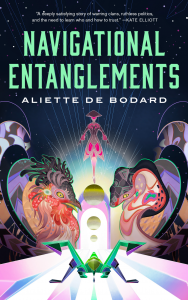
A- #BookReview: Navigational Entanglements by Aliette de Bodard

A- #BookReview: Navigational Entanglements by Aliette de BodardNavigational Entanglements by Aliette de Bodard
Format: eARC
Source: supplied by publisher via Edelweiss
Formats available: hardcover, ebook
Genres: science fiction, science fiction mystery, space opera
Pages: 176
Published by Tordotcom on July 30, 2024
Purchasing Info: Author's WebsitePublisher's WebsiteAmazonBarnes & NobleKoboBookshop.orgBetter World Books
Goodreads

Award-winning author Aliette de Bodard presents yet another innovative space opera that broadens the definition of the this time bringing xianxia-style martial arts to the stars.

Using the power of Shadows generated from their own bodies’ vitality, Navigators guide space ships safely across the a realm of unreality populated by unfathomable, dangerous creatures called Tanglers. In return for their service, the navigator clans get wealth and power―but they get the blame, too. So when a Tangler escapes the Hollows and goes missing, the empire calls on the jockeying clans to take responsibility and deal with the problem.

Việt Nhi is not good with people. Or politics. Which is rather unfortunate because, as a junior apprentice in the Rooster clan, when her elders send her on a joint-clan mission to locate the first escaped Tangler in living memory, she can’t exactly say no.

Hạc Cúc of the Snake clan usually likes people. It says so on her “information gathering”―right after “poisoning” and “stabbing.” So she’s pretty sure she’s got the measure of this they’re the screw-ups, the spares; there isn’t a single sharp tool in this shed.

But when their imperial envoy is found dead by clan poison, this crew of expendable apprentices will have to learn to work together―fast―before they end up cooling their heels in a jail cell while the invisible Tangler wreaks havoc on a civilian city and the reputation of all four clans.

My Review:

The ‘navigational entanglements’ of the title aren’t just a bit of clever phrasing – not that it isn’t a clever and evocative phrase! In the case of this novella, it’s also a literal description of the whole story – in more ways than one.

This SF mystery, shot through with political shenanigans and a tart but gooey center of sapphic romance, begins its entanglement with its solution for the faster-than-light travel conundrum with actual creatures called Tanglers who live in the realm of unreality that makes faster than light travel and the galaxy-spanning empires it makes possible, well, possible.

As is often the case in stories that use this method of FTL travel, navigating the Hollows requires highly skilled navigators who are born with special gifts. In this particular universe, the power of Shadows generated from their own bodies’ life force.

It could be considered magic, at least magic of the Clarke’s Law variety that “Any technology, sufficiently advanced, is indistinguishable from.’ However one thinks of it, it takes special training and special talent and is especially valuable. Particularly to the clans who have a near monopoly on intergalactic shipping because of their success in nurturing navigators.

A hegemony that is under threat when this story begins. Which is why this story begins. The exact nature of the threat, and the clans’ decision on how to meet that threat, is the exact thing that Hạc Cúc of the Snake clan is pretty sure she’s not supposed to figure out.

The clans, or at least her own clan, should have known better. Because if there is one thing that Hạc Cúc can’t resist, it’s a secret. Especially not the kind of secret that is intended to get her killed whether she figures it out or not.

Escape Rating A-: I grabbed this book because I’ve been picking my way through the author’s vast, sprawling, Xuya Universe series and figured that this would be similar without being an actual part of THAT tangled mess.

Two things at the top, Navigational Entanglements is NOT part of Xuya. I’m not saying there aren’t similarities in style and in the way that the culture and history work, but this is a standalone. So if you’re looking to sample the author’s work, this is a good place to start.

Howsomever, one of the characteristics of Xuya is that the publication order and the chronological order don’t have even a nodding acquaintance. Each story in the series is intended to be read without prior knowledge and starts a bit in medias res of the whole series. As in the reader is thrust into the middle of a story that they may or may not have read the background of, or the background may or may not yet exist, and is supposed to sink or swim with what they have in front of them.

Navigational Entanglements is written in that same manner, even though there aren’t any previous or succeeding stories – at least not yet. (If we get more stories in this universe this reader at least would be very happy because the politics are just so fascinatingly messy.)

In other words, this is a story that requires the reader to figure things out as they go. Not that these characters don’t turn out to be doing exactly that, but going with their flow means that the reader has to jump in feet first and that’s not every reader’s comfort zone.

Part of what makes the story work, however, is that this is very much an SF mystery from the top and at the top. It’s just unusual in that the team was purposely created to fail, because they all hate each other. It’s only that Hạc Cúc’s love of secrets allows her to stand outside of the group’s bickering, see it for what it is, and redirect their weaknesses and their enmity into a productive, if not always harmonious, team.

Which allows friendship, love and trust to all blossom – rather like a cactus flower complete with spikes! – and provides this novella with its surprising – especially to the protagonists – happy for now with the possibility (hopefully) of more political and investigative shenanigans to come.

A- #BookReview: The Citadel of Weeping Pearls by Aliette de Bodard

A- #BookReview: The Citadel of Weeping Pearls by Aliette de BodardThe Citadel of Weeping Pearls (Xuya Universe) by Aliette de Bodard
Format: ebook
Source: purchased from Amazon
Formats available: paperback, ebook
Genres: science fiction, science fiction mystery, space opera
Series: Universe of Xuya
Pages: 164
Published by Jabberwocky Literary Agency on September 12, 2015
Purchasing Info: Author's WebsitePublisher's WebsiteAmazonBarnes & NobleKoboBookshop.orgBetter World Books
Goodreads

The Citadel of Weeping Pearls was a great wonder; a perfect meld between cutting edge technology and esoteric sciences-its inhabitants capable of teleporting themselves anywhere, its weapons small and undetectable and deadly. Thirty years ago, threatened by an invading fleet from the Dai Viet Empire, the Citadel disappeared and was never seen again. But now the Dai Viet Empire itself is under siege, on the verge of a war against an enemy that turns their own mindships against them; and the Empress, who once gave the order to raze the Citadel, is in desperate needs of its weapons. Meanwhile, on a small isolated space station, an engineer obsessed with the past works on a machine that will send her thirty years back, to the height of the Citadel's power. But the Citadel's disappearance still extends chains of grief and regrets all the way into the fraught atmosphere of the Imperial Court; and this casual summoning of the past might have world-shattering consequences... A new book set in the award-winning, critically acclaimed Xuya universe.

My Review:

I wasn’t expecting to go down the “wibbly wobbly, timey wimey” rabbit hole again after yesterday’s book, but here we are all the same. Only further back and further forward, with MUCH bigger consequences, even though the motives for the time travel are every single bit as personal and emotional as they were in before.
I’ve been nibbling at the vast, sprawling Universe of Xuya ever since I read The Tea Master and the Detective and fell hard for the way that the author dips in and out of a vast history and galaxy-spanning empire that takes root in a version of Earth’s history that simply managed to go down a different leg of the trousers of time.

If China founded a colony on the west coast of North America in the 15th century and started growing both eastwards and southwards, shoring up the Aztec, Maya and Incan regimes in Central and South America, bringing the scourge of smallpox to the continent early enough that immunity has developed before the conquistadors and the pilgrims invaded, the world changes. A lot.

As with all alternate history SF, once the butterfly has flapped its wings in a different direction, the changes ripple out in all directions, resulting in the universe we find in this amazing saga. A universe where human expansion from Earth is based on Chinese and Viet traditions – because they became different types of world powers than they did – or did not – in our history. (The author goes into the history and how it changed in quite a bit of helpful and fascinating detail on her website. An explanation I’ve been staring at for several days that probably had more than a little bit to do with my picking this book up now instead of the other things I had planned.)

But human is as human does, which ties back to those “wibbly wobbly, timey wimey bits” and the all too human regrets of an Empress who faces the threat of war and wishes she had not exiled her brilliant, untraditional, defiant heir many years ago, a daughter who has carried on sailing the same sea of regrets and recriminations, and a young girl grown up without the mother who was lost in that same explosion of fear, love and war.

In this SFnal universe, however, lost does not necessarily mean dead, and advanced engineering makes entirely too many things possible – including some that it quite possibly should not. Like time travel, even if, as in yesterday’s book, it’s not possible to change the past – only to visit.

And perhaps, just a little bit more.

Escape Rating A-: The more times I dip into this series and to the author’s work in general, the more I realize that all her stories are SF mysteries to some extent, and that most of them were published ahead of the current trend for that fascinating blend.

In Citadel, the mystery begins when a famed scientist and engineer disappears just as she is getting results in her greatest and most speculative experiment. She was searching for the Empress’ heir, Bright Princess Ngoc Minh, who disappeared into deep time, or the space between the stars, or somewhere believed to be utterly mythical – and took her entire rebellious colony of ships and orbital stations, collectively known as the Citadel of Weeping Pearls, along with everyone aboard them with her wherever it is she went.

With war on the horizon, the Empress needs her daughter’s genius and the weapons and technologies it created. But the promising trail has winked out of existence along with the missing engineer, only to reappear in the hands of a pair of amateurs on a far distant orbital station.

A station that seems to be in the process of going to join the Citadel though a time portal – with someone trapped on the other side.

But nothing is quite as it seems, as the possibility of going back and bringing the Citadel forward forces everyone who has been touched by its disappearance to rethink what they did then, what they’ve felt in the absence of the shooting star that is/was Bright Princess Ngoc Minh, and what they might do with a second chance.

Whether that’s a chance for closure, a chance to say goodbye, the possibility of reconciliation or the question of whether a miracle will be enough to save an empire rests in the minds, and the hearts, of every compelling character in this glimpse into the workings of the Universe of Xuya.

I’ll certainly be back the next time I have a flail and bail week like this one. Either with On a Red Station, Drifting which looks like it might be a bit of a direct prequel to The Citadel of Weeping Pearls, or Of Wars, and Memories, and Starlight because it gathers together so many of the early stories in the series that were published in a scattered array over the years.