
#BookReview: Idolfire by Grace Curtis

#BookReview: Idolfire by Grace CurtisIdolfire by Grace Curtis
Format: eARC
Source: supplied by publisher via NetGalley
Formats available: hardcover, ebook, audiobook
Genres: epic fantasy, fantasy, fantasy romance, historical fantasy
Pages: 480
Published by DAW on March 11, 2025
Purchasing Info: Author's WebsitePublisher's WebsiteAmazonBarnes & NobleKoboBookshop.orgBetter World Books
Goodreads

An epic sapphic fantasy roadtrip inspired by the fall of Rome, from the Sunday Times bestselling author of Frontier and Floating Hotel
On one side of the world, Aleya Ana-Ulai is desperate for a chance. Her family have written her off as a mistake, but she's determined to prove every last one of them wrong.
On the other, Kirby of Wall's End is searching for redemption. An ancient curse tore her life apart, but to fix it, she'll have to leave everything behind.
Fate sets them both on the path to Nivela, a city once poised to conquer the world with the power of a thousand stolen gods. Now the gates are closed and the old magic slumbers. Dead — or waiting for a spark to light it anew…
A character-driven science-fantasy road trip book with sword fights and a slowburn romance, Idolfire delves into the vastness of history and the terrifying power of organized faith.

My Review:

In the world left behind centuries after the fall of a world-spanning empire, history has fallen into myth and legend on its far-flung fringes. Kirby of Wall’s End and Aleya Ana-Ulai might as well be from entirely separate worlds – because they are.

When the Empire of Nivela fell, or died, or imploded, or all of the above, the places that either resisted them or were conquered by them – or both – were left to struggle on without all the things and people the Empire stole at the height of their reach.

Including, in the case of Wall’s End, their god. And in the case of the Kingdom of Ash, one of their most important relics. Wall’s End NEEDS their god back, because their land is dying without the renewing power of Iona, the Goddess of Spring. And the people are dying with it, withering generation after generation.

Ash just wants their relic back, as they believe that no one should have the power of Idolfire, the power to consume the accumulated worship vested in a deity, except for their own royal house.

Then again, Wall’s End is the last remnant of a kingdom that Nivela thoroughly conquered, while Ash successfully resisted the might of the Nivelan Empire until that Empire fell. Of its own weight – or its own ‘Worldlord’s’ hubris.

Or both.

The story of Idolfire is a quest. It’s two quests. Kirby sets out for the ruins of fabled Nivela to get her village’s god back. Not because she’s a hero – but because she feels guilty that what was left of the god listened when she cursed her brother and not only killed him but blocked the water for the entire village.

Aleya, the reviled, disregarded, bastard princess of Ash, is sent by her Aunt the Queen on an actual, sanctioned quest to the ruins of Nivela to retrieve the other half of their sacred relic. Aleya knows she’s not expected to succeed, that she’s expected to either give up or die trying. But if she does succeed, she’ll be able to follow her Aunt as Queen, and make the reforms needed to save her city from dying from the weight of its own corruption and hubris – much like Nivela did.

The story is their journey, separately and together, over the whole of what was once the great Nivelan Empire. Along the way, they face death and danger and corruption and old gods and new kingdoms and desperate people and deranged leaders. They turn an enemy into a fast friend.

They find redemption for the sins they left behind. And they fall in love, even as they know that, as much as failure will doom them, success can only be bittersweet.

Escape Rating B: If you’re expecting something like the author’s previous work, Floating Hotel, you might want to check out some reviews (obv. Including this one) before continuing. Because Idolfire is not at all like Floating Hotel, and not just because that was SF and this is definitely fantasy.

Because I really did enjoy Idolfire, I’m trying to set expectations a bit better than either a quick reference to Floating Hotel or the bolded opening line of the book’s blurb. OTOH, that description, “Idolfire is an epic sapphic fantasy inspired by the fall of Rome from the author of the Frontier and Floating Hotel.” is 100 percent true.

But the emphasis isn’t quite in the same places in the blurb as they are in the book – leading back around to potentially disappointed expectations.

The emphasis in the story is on the epic fantasy parts of the description. It’s a quest story. Actually, it’s two quest stories combined with two heroines’ journeys that begin at literally opposite ends of the world as they know it. Those two heroines do eventually meet and there is a slowburn sapphic romance but the romance isn’t the driving force in the story.

Their separate quests drive the story, quests that begin as far apart as possible – as Kirby and Aleya themselves do – but have the same center point in more ways than one.

Which is where that reference to the fall of Rome comes in. The fall, the reasons for that fall, and what the world looks like at the fringes of what was once the empire so long after that fall that history has fallen into myth and legend.

The historical underpinnings of this story may remind readers of the way that Guy Gavriel Kay works history into fantasy. Because yes, Nivela is Rome – more or less – but it is also biblical Nineveh. Ash is Assyria and Wall’s End is post-Roman-occupation Britain. But their enemy-turned-companion Nylo is from someplace like the ancient Greek city-states, and these places did not all exist at the same time.

The romance between Kirby and Aleya is VERY slow burn. They do come to love each other, but it takes them a lot of time – and miles, definitely miles! – to get there. They are both aware that the BEST ending they can possibly get is that they each return to their opposite ends of the world. It’s realistic but it’s ultimately sad. The reader wants them to have an HEA and they both want it and KNOW they can’t have it.

As much as I loved their journey and enjoyed their long and winding tour of this quasi-ancient, slightly magical, somewhat historical world, theirs is not the only perspective on their quests. Someone is moving events behind the scenes, looking on from above – or underneath – or both, watching as history unfolds. And it has shades of the secret at the heart of the city of Kithamar in Daniel Abraham’s Age of Ash series. It’s something I’m not sure worked in either epic, but it’s left me thinking I’ll go back to Age of Ash and see.

Nevertheless, that extra perspective is one that kinda works and kinda doesn’t and your reading mileage may definitely vary. My enjoyment of and fascination with Aleya’s and Kirby’s world, their epic journey through it and their relationship within it was MORE than enough to carry me through this fascinating tale.

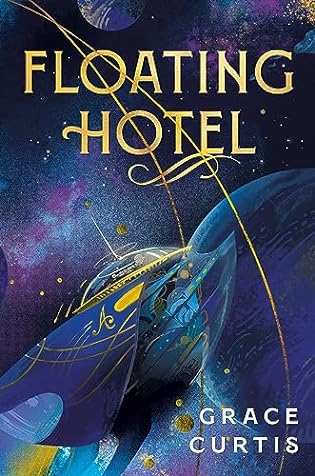
#BookReview: Floating Hotel by Grace Curtis

#BookReview: Floating Hotel by Grace CurtisFloating Hotel by Grace Curtis
Format: eARC
Source: supplied by publisher via NetGalley
Formats available: hardcover, ebook, audiobook
Genres: mystery, science fiction, science fiction mystery, space opera
Pages: 304
Published by DAW on March 19, 2024
Purchasing Info: Author's WebsitePublisher's WebsiteAmazonBarnes & NobleKoboBookshop.orgBetter World Books
Goodreads

This cozy debut science fiction novel tells a story of misfits, rebels, found family—and a mystery that spans the stars
Welcome to the Grand Abeona home of the finest food, the sweetest service, and the very best views the galaxy has to offer. All year round it moves from planet to planet, system to system, pampering guests across the furthest reaches of the milky way. The last word in sub-orbital luxury—and an absolute magnet for intrigue. Intrigues such Why are there love poems in the lobby inbox? How many Imperial spies are currently on board? What is the true purpose of the Problem Solver’s conference? And perhaps most pertinently— who is driving the ship?
Each guest has a secret, every member of staff a universe unto themselves. At the center of these interweaving lives and interlocking mysteries stands Carl, one time stowaway, longtime manager, devoted caretaker to the hotel. It’s the love of his life and the only place he’s ever called home. But as forces beyond Carl’s comprehension converge on the Abeona, he has to face one final when is it time to let go?

My Review:

The Grand Abeona, the ‘floating hotel’ of the title, isn’t quite as grand as it used to be. Both as a place and as a story, It also isn’t quite as cozy as the blurb leads the reader to believe. Which does, however, make it much more interesting as a story.

It’s more layered than cozy, rather like an onion. Complete with tears.

Traveling through Imperial-controlled space, the Grand Abeona serves the function that once upon a time the circus used to fill in small town America. It’s a place that blows into town – or above town, as the case might be – livens up an otherwise humdrum life for a few hours or days, and then leaves, taking its crew of roadies and roustabouts along with it.

Along with, occasionally, a local or two who can’t resist the bright lights or can’t bear or afford to stay where they’ve always been for another minute, now that they’ve seen a way out.

So, the story of Floating Hotel begins with young Carl, who doesn’t so much stow himself away as he does slouch around in plain sight hoping for a chance to work his way aboard the most beautiful place he’s ever seen and away from his home planet. A place that is literally eating itself from the inside out as its people mine its resources to their own and its destruction under the orders of the rapacious empire.

Because they have no choice. It’s mine now and die later, or stop now and die now. It’s happened all over the empire and it’s happening right now on Hoxxes. But not to Carl, because he’s found a way out.

Middle-aged Carl is now the manager of the Grand Abeona, and that later he staved off all those years ago by leaving with the floating hotel is now coming for him and everyone aboard the place he’s come to call home. The place that he has let consume him, one day and one task at a time.

So welcome aboard the last voyage of the Grand Abeona. Be sure to take your heart and all your belongings with you on your way out.

Escape Rating B: This isn’t nearly as cozy as I was expecting from both the blurb AND the opening Prologue. That introduction makes it seem like its going to be Carl’s story about rising through the ranks of the hotel and that it will follow him along the way.

It isn’t and it doesn’t. While Carl opens the story – and also closes it – we absolutely don’t follow his rise through the ranks. He’s already there when the real story begins. We also don’t follow Carl, although he’s clearly the center around which the hotel revolves – even if no one quite sees him that way.

Instead, the story skips around through the crew and the regular guests, focusing on one after another as the saga of the ship’s last voyage gets told. That kaleidoscope of perspectives keeps the reader from getting invested in any one of the characters, but does show all of the facets of the hotel as it is – and pokes its way around the edges of the many, many secrets that are being kept aboard her.

One ginormous, galaxy-spanning secret most of all.

On the one hand, we have the ship and its denizens, each telling their individual bit of the story. And on the other, we have the ship and its denizens, each revealing a bit of their own secrets, as well as a soupçon of the BIG secret, while painting an excruciatingly unflattering portrait of the Empire they have escaped by becoming part of the ship’s company.

Initially believing that this was going to be cozier, The Floating Hotel gave me vibes of several recent SF stories that featured, or began with, entertainment venues in the space lanes, even if they branched out later into either mystery or space opera. I’m particularly thinking of The Spare Man, You Sexy Thing, and Veronica Scott’s Star Cruise series.

In the end, the SF book I was most reminded of is Khan Wong’s awesome The Circus Infinite, although I have to say that The Floating Hotel isn’t quite as awesome because The Circus Infinite was just a WOW of a book from beginning to end. (Therefore, saying it’s not quite as awesome as such an absolutely fantastic book means it was still pretty damn good.)

But it’s in that correlation between the circus and the cruise ship that gives the two a bit of the same resonance, as both stories begin with a character who desperately needs the kind of escape that constant traveling among the stars can provide, and finds themselves in a world that is filled with more secrets than just their own. Secrets that they will have to go to extreme lengths to keep.

So if you liked any of the above mentioned books, or if you have fond memories of either the very old book Hotel by Arthur Hailey, or the slightly less old TV series based on it, The Floating Hotel will both tickle that memory AND tell a fascinating story about the lengths that can be taken in running away and the crimes that can be committed in forcing someone back to the place they’re supposed to belong.