“Knowledge Wins” WWI propaganda poster by the American Library Association
Burton E. Stevenson, librarian at Camp Sherman in Chillicothe, Ohio, during World War I:
“When I started this work, I had some very plausible theories about the kinds of books the men would want; but I soon discarded them. We have had requests here for every sort of book, from some books by Gene Stratton Porter to Boswell’s ‘Life of Johnson’ and Bergson’s ‘Creative Evolution.’ We have had requests for Ibsen’s plays; for books on sewage disposal; and so many requests for ‘A Message to Garcia’ that I had a supply mimeographed. In one building there were so many requests for books on religion and ethics that we set up a small reference collection. Broadly speaking, of course, most of the men read fiction ; exciting, red-blooded fiction-detective stories, adventure stories, and so on. But there is also a steady demand for Conrad, and Wells, and Hardy, and Meredith. Poetry is also in demand, and good books of travel go well. The only kind of books we don’t want is the salacious, risqué sort—for they have no place in our camp libraries. And we don’t care for unattractive, cheap editions, with yellow, muddy paper and flimsy binding. We want attractive books—nice, clean copies of good editions—and the more of these we get the better service we can give the men.
War Service Library bookplate, ca. 1917
This quote is found in a 1918 pamphlet, “War Service of the American Library Association”, by Theodore Koch of the Library of Congress. It describes a project by the American Library Association, in collaboration with the War Department and other organizations, to acquire and make books available to soldiers and sailors during WWI. Libraries were set up at many training camps in the U.S. and books were sent overseas for distribution to the front lines, military hospitals, and prisoners of war. (Regarding the trenches, one British officer, when writing back home to request some books, noted “Don’t suggest that I should read ‘War and Peace.’ If one makes ambitious plans like that, one certainly gets killed in the midst of them.”).
Koch subsequently expanded his observations in a book, Books in the War; the Romance of Library War Service. The book describes not only ALA’s War Service, but also the efforts of the French and British to distribute books, including books in Braille for the benefit of soldiers blinded during the war. ALA’s overseas efforts eventually led to the establishment of a headquarters library in Paris. That HQ ended up becoming itself one of the memorials to the war that is going strong to this day: The American Library in Paris, the largest English-language lending library on the European continent.
The pamphlet ends with the following poem, read by Mr. Nixon Waterman at the dedication of the ALA Library at Camp Johnston, Florida:
Arms and the Man
Men, with War’s challenge before you,
You who must win in the fight,
You who shall bring the glad morning
After War’s terrible night;
Here find the way and the wisdom
To match and to master the Hun,
Translating the book and its message
Into the speech of the gun.
Here find the counsel to stay you
Down through the riot and ruck,
Here find the zeal that shall lift you
Out of the mire and muck.
Here are the words of your seniors,
Your masterly skill to increase,
And type’s many tongues to direct you
On toward the daybreak of peace.
Perhaps not the best example of poetry, but it serves to express two of the purposes of the Library War Service: helping the soldiers fight better via technical materials and distraction during pauses in combat, but perhaps more importantly, laying groundwork in those who survived to see the peace to make the most of it.
I will close this post with another extract from the book:
“A handsome young blond giant who looked like a native American, one arm strapped to his side, was scrutinizing closely the papers in my bag. ‘What is that you have there?’ he asked, most politely. *Oh, nothing you would care for,’ said I; ‘only two old Greek newspapers.’ ‘Well, Greek is my language,’ said he, ‘and it’s a long time since I’ve seen a word of it. May I have them?’ And as he sank into the nearest chair and lost himself in the precious papers he murmured rapturously, ‘First Greek words I’ve seen in six months.'”
This little incident. Miss Freeman went on to say, brought home to her, as nothing else had, a realization of how many nationalities have gone into the making of America, and have poured out their blood, as stanch Americans, upon the fields of France.
May we never forget the sacrifices of those who came from all over the world to be Americans and sometimes lost their lives in service to our country.
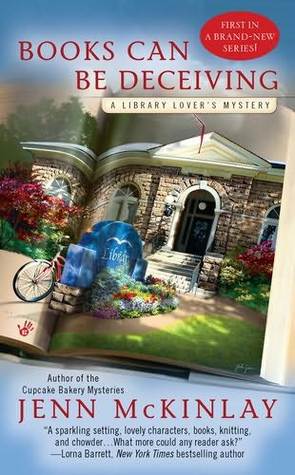
Lindsey is getting into her groove as the director of the Briar Creek Public Library when a New York editor visits town, creating quite a buzz. Lindsey's friend Beth wants to sell the editor her children's book, but Beth's boyfriend, a famous author, gets in the way. When they go to confront him, he's found murdered-and Beth is the prime suspect. Lindsey has to act fast before they throw the book at the wrong person.
My Review:
I discovered this series as a read-alike for the Cat in the Stacks series by Miranda James, and it certainly. Both feature real-seeming librarians in almost-real libraries in small towns that are just perfect. Although I did miss Diesel, the librarian’s very large cat from the Cat in the Stacks series.
But where the Cat in the Stacks series is set in Athena Mississippi, the Library Lovers mysteries hail from Briar Creek Connecticut. Let’s just that the autumns are obviously a lot blustrier in coastal Connecticut than in the landlocked parts of Mississippi.
Unlike Charlie Harris at the beginning of the Cat in the Stacks series, Library Director Lindsey Norris is the relatively new director of the small town Briar Creek Public Library. She is also female, single, unencumbered and in her mid-30s – very different from widowed, 50-something Charlie with his grown children – and Diesel.
Lindsey on the other hand, is still feeling her way professionally and personally. Briar Creek is her first posting as the library director, and it’s not a career turn she had planned on. She had been an archivist at one of the Yale University libraries when budget cuts forced her to look in other directions. She found the position in Briar Creek because her best friend from grad school is the children’s librarian there.
Being a new, first-time director has its challenges. But no one plans on having one of their staff, particularly a friend, accused of murder. It’s difficult to tell which is worse, that Beth had both the motive and the opportunity for murdering her ex, or that the local sheriff is so determined to take the easy way out and place the blame on the “woman scorned” that he isn’t even looking for any other suspects.
He’s not exactly the sharpest knife in the drawer, either, and his bull-headedness is clearly driving the detective from the state Bureau of Investigation bonkers.
But with the local sheriff doing his level best to make sure Beth is found guilty, and the local press more than willing to stir up trouble just for the ratings, it’s up to Lindsey to focus her research skills on the late and not very lamented, to see if there’s someone else who might have a motive to end his existence.
The problem is that Lindsey’s research skills, as formidable as they are, barely keep her one step ahead of the killer – a step that closes faster than she expected.
Escape Rating B: I came down with the flu, and was looking for comfort reading again. As this will be posted just before I run off to the American Library Association Midwinter Conference, yet another library mystery seemed like a good fit.
Lindsey Norris does seem like “one of us”, much as Charlie Harris does. And for the same reason – her creator is also a library worker. But where I’d love to sit down and have coffee with Charlie, Lindsey reminds me much more of the “road not taken”. I often thought about becoming a library director but when I was interested I wasn’t able to make the leap, and eventually I realized that it just wasn’t my calling in the profession.
Seeing what Lindsey deals with, even in a fictional and perfectly imperfect library reminds me that I was right.
This story is the introduction to the series, the characters and the town of Briar Creek, and it does put the reader firmly into the middle of the action. Lindsey, as a transplant from somewhere else, is still warming up to the little town, and vice-versa, which makes her a good point of view character for the reader.
As is often the case, the case itself, the murder at the heart of the mystery, is just a bit over the top, but the scenes of small town life and Lindsey fitting herself into it are well done. The reader can certainly see why she’s fallen in love with the place.
A lot of what happens in the Briar Creek Public Library is very true to library life, both the good and the bad. Every library, big and small, has patrons just like those in Briar Creek, the good, the bad, the loud, the demanding, the weird and the obstreperous.
The staff, while occasionally a bit too good to be true and sometimes a bit too bad or weird to be true, is also quite true-to-life. And unfortunately that includes the nasty character of Ms. Cole, the head of the circulation department and the disapprover of everything that Lindsey, Beth and anyone not the previous (and deceased) library director. That Ms. Cole can’t let go of her resentment of change and the advent of the 21st century is unfortunately all too plausible. I’ve worked both with and for people like her in my career (and supervised a few), and saying that it is never fun is a serious understatement.
But Lindsey is the new director of the library. That makes her Ms. Cole’s boss, whether either or them likes it or not. That Lindsey, with just about six months tenure under her belt, has not figured out what to do about Ms. Cole yet is not surprising. The woman is a fixture in the library and the community – even if a frequently resented one. The problem isn’t just that Ms. Cole challenges Lindsey’s authority at every turn, although that is a problem.
What I found questionable, to the point where it threw me out of the story, is that Lindsey isn’t even thinking about what she should do about Ms. Cole. While the reality is that the answer may be very little, she’s at the point in her job where she should be at least thinking about some changes. This disturbed me because Lindsey makes it clear at one point that she is aware that part of the joy of the job from Ms. Cole’s perspective is to torment and browbeat the library shelvers, who are usually teenagers in their very first job. While life isn’t fair, and bad things happen to good people, etc., etc., etc., for Lindsey to be aware of this and not even be thinking about what to do about this aspect of Ms. Cole’s performance of her duties is problematic.
And now I’ll get down off my soapbox.
But if you like cozy mystery series like Cat in the Stacks, or other small town mystery series that feature the mainstays of the town, Books Can Be Deceiving is a lot of fun. I have the other books in the series and I’m looking forward to returning to Briar Creek the next time I need a comfort read.
Reviewer’s Note: One of the reviews listed in Goodreads for this book was written by a dear and departed friend. I knew that if she liked it, I would too. I wish I could talk about it with her, because I’d love to hear the snark that she left out of her review!
The Books That Need More Attention Giveaway Hop started yesterday, so there’s plenty of time to enter. This seems to be hop season, as there is yet another hop scheduled for this week, and then there’s the Spooktacular Giveaway Hop starting in mid-October. This may not be Christmas yet, but it still seems to be the season to give away books and bookish prizes.
But speaking of giveaways, I don’t say this often because it feels just a bit crass, but Reading Reality is an Amazon Affiliate. Buying one of the books you find on my blog (or any other book, for that matter) by going to Amazon from one of my links nets me a few cents or a dollar per book. Those affiliate fees add up, and they are how I fund the giveaways. So I very, very much appreciate when I see that someone has bought a book through my links, both because it means that I reached that person with my review, and because it helps provide the giveaways that introduce new readers to Reading Reality. So thank you all very much.
And before we end the weekend, let’s take a look at what happened last week. It was a theme week for Banned Books Week, so all the books I reviewed were on topics related to Banned Books Week in some way. One book is currently under challenge, one talks about reading the world and what breaking out of our Western, anglophone reading habits might mean. And then the recent and controversial history of one of the world’s great libraries, as well as a book about our First Amendment rights and then a book about how those rights are being eroded by ubiquitous government and commercial surveillance. The books were fascinating and occasionally frightening. And compelling enough that I only made one change from my original plan – not because I’m not planning to read Terms of Service but because I needed to carry my book around the day I was supposed to read it, and I didn’t have an ebook.
Also, I admit, Patience and Fortitude was about half the length of Terms of Service, and it was starting to matter. These were all marvelous books, but not the kind of thing that keeps one up until 3 am because you want to see what happens next. I may do this again, for next Banned Books Week if no other time. If anyone has any thoughts on the concept or how it worked, please let me know in the comments.
And next week we’re back to our regularly scheduled genre fiction! I need a break from the serious.
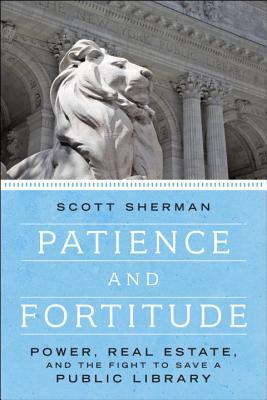
A riveting investigation of a beloved library caught in the crosshairs of real estate, power, and the people’s interests—by the reporter who broke the story In a series of cover stories for The Nation magazine, journalist Scott Sherman uncovered the ways in which Wall Street logic almost took down one of New York City’s most beloved and iconic institutions: the New York Public Library.
In the years preceding the 2008 financial crisis, the library’s leaders forged an audacious plan to sell off multiple branch libraries, mutilate a historic building, and send millions of books to a storage facility in New Jersey. Scholars, researchers, and readers would be out of luck, but real estate developers and New York’s Mayor Bloomberg would get what they wanted.
But when the story broke, the people fought back, as famous writers, professors, and citizens’ groups came together to defend a national treasure.
Rich with revealing interviews with key figures, Patience and Fortitude is at once a hugely readable history of the library’s secret plans, and a stirring account of a rare triumph against the forces of money and power.
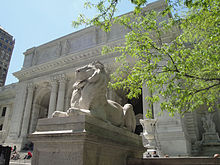
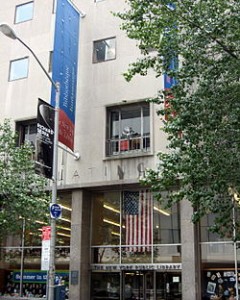
The iconic lions that welcome readers to the entrance of the New York Public Library’s Central Library are named “Patience” and “Fortitude”. This made me wonder about the names of the two equally iconic lions that guard the entrance to the Art Institute of Chicago. Those two don’t have official names, but their unofficial titles are “stands in an attitude of defiance” and “on the prowl”. The difference in names may describe the difference between New York and Chicago, right there.
At the entrance to the New York Public Library
But the patience and fortitude in this book about the New York Public Library and its most recent step into controversy may be better attributed to those who campaigned against what looks remarkably like a real-estate boondoggle, at least from the outside looking in.
There’s plenty of story here. It begins with the very origins of NYPL, and its rather strange and certainly unique financing. In spite of the name, NYPL was never a public library in the way that most of us think of one. It is not a department of the city of New York, and is not owned or managed by the city. Nor is it an independent taxing district as many libraries are in the Midwest (and probably elsewhere)
Instead, NYPL is a private non-profit entity that owns the buildings of the library, while the city provides funds for personnel and other services – funds which are then administered by the private non-profit. To add to the confusion, the research function of NYPL was never intended to be supported by taxpayer dollars. The intent was for the research library to be supported by donations.
So there are two effectively competing agencies housed uneasily under one administrative roof, while everyone hopes that someone else will pay the bills. A plan which never works, but does provide at least some of the genesis for the mess that NYPL found itself in from 2007 until 2014.
Entrance to Donnell Library Center
The plan was to sell both the Donnell Library and the Mid-Manhattan Library, and to gut the Central Library’s book stacks, then combine all the services into the single remaining building at Fifth Avenue and 42nd Street. While the Donnell Library building was sold, the great recession intervened before any more damage could be done.
As the text makes pretty clear, it’s not that there wasn’t a financial crisis that needed to be solved, it’s that in the end, no one except the consultants and their staunchest supporters believed that the solution being proposed would actually solve anything at all. Those in opposition were convinced, and it looks like correctly, that the plan would cause structural damage to the Central Library building, further erode services both to the public and to researchers, and would not actually generate the income necessary to sustain the library. It didn’t help their cause that the claims of damage and rot to the structure of those incredible book stacks seemed overblown, and that no less drastic solutions were even considered.
In the end, it all looked like a grand shell game being played with other people’s money. In this case, NYPL’s money. It also looked increasingly to outsiders that even though no one involved from the library’s side did anything illegal, or made any money under the table, that there was more than a whiff of sweetheart dealing in the way that the properties were going to be, or in the case of the Donnell Library actually were, disposed of.
And no one anywhere should ever believe any consultant on a major building project who claims that there can’t possibly be any cost overruns. There almost inevitably are cost overruns, and the less you expect them, the more ruinous they are.
Reality Rating B+: Before I discuss the gist of this story, I need to insert a caveat or three. I am a librarian, and while I never worked at NYPL, I did work at two of the other city libraries named in the text, Chicago and Seattle. I also served in a middle-management position, not just at CPL and SPL, but also at several middle-sized public libraries, which gave me the opportunity to observe library board meetings on a regular basis, and interact with the boards of trustees at some of those institutions. What I am saying is that I know something about how the sausage is made, and can see similarities to situations I worked in fairly clearly.
So reading this book felt a bit like insider baseball. Some of the people involved were nationally recognized it the profession. And the situations they got themselves into had the ring of familiarity.
The financial situation at NYPL was never very stable. As a librarian, it was considered a great place to have on your resume, but a lousy place to actually work because NYPL did not pay a living wage for the city of New York. Reading the introductory chapters of this book makes it pretty clear why the finances were so precarious.
One of the things that I found amazing was the way that the powers that be at NYPL during this era used their unique situation to suit themselves. They went to the city hat in hand to beg for money for this project, while at the same time frequently ignoring Freedom of Information Act Requests and even demands from the press or the State Legislature for information, and they did it with impunity as a “private non-profit”.
The main part of this saga begins in 2007. This was just before the great recession dropped the bottom out of the real estate market pretty much everywhere. It was also the point where the Google Books project to digitize the collections of great research libraries, including NYPL, was in full swing – and before it ran afoul of the copyright laws in court. Some pundits on the bleeding edge were predicting that libraries would either be all digital or completely obsolete in a relatively short time. Basing the building design on a premise that hadn’t yet been proven looks foolhardy in retrospect. Especially when combined with the notion that “everything will be digitized” when the volume of “everything” that existed prior to the ubiquity of computers is much too high a volume to be digitized within the lifetime of anyone now living.
There has also been a longstanding shift in the library profession to a “give ‘em what they want” mentality. The other side of that coin is when “they” stop wanting something, it’s time to throw it out to make way for something new that “they” will want. This works fairly well in most public libraries, and is an absolute necessity because real estate and shelf space are generally expensive and always finite. But in a research library like the NYPL Central, the intention is to keep a broad and deep collection because we don’t know what some researcher will want 5 or 10 or 50 years from now. But we know that if we don’t preserve it, it won’t exist for that researcher to find.
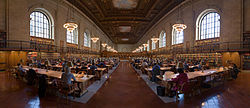
A panoramic view of the Rose Reading Room
And then there was the issue at NYPL that the steel book stacks are physically supporting the Rose Reading Room on the top floor. Take out the book stacks and the top floor becomes the bottom floor with a sudden and resounding crash. While there were designs to account for this, none of them seemed as sturdy, robust or even as beautiful and simply functional as the existing stacks.
Part of the plan was that the 3 million volumes housed in those stacks be relocated to off-site storage in New Jersey for better preservation. There was a frequently articulated promise that books would be made available within 24 hours. The problem with this part of the plan was that patrons already had plenty of experience with off-site storage, and 24 hours was known to be a laughable dream. Three or four days was considered an achievable dream, but a week was not unheard of.
As part of this phase of the plan, the powers that be conducted a stealth removal of the books in the stacks, sending them to off-site storage and to private warehouses. The stacks are now echoingly empty, even though the grand plan is dead, and some of the books are completely inaccessible. Others were lost in transition.
There have been any number of libraries and library directors who have found themselves in the midst of hurricanes of controversy over plans to vastly eliminate or move the collections of their libraries. One of the more infamous cases occurred at the San Francisco Public Library in the mid 1990s (see Nicholson Baker’s scathing book, Double Fold, for an example of just how acid the vitriol became). There are more recent stories from the Urbana Free Library in Illinois and the Berkeley Public Library in California. Every librarian knows that massively weeding or otherwise removing the collection is one of the fastest ways to generate negative publicity that libraries can fall into. But the librarians seem to have been left out of the decision-making loop in all of the planning for this great plan.
The NYPL Central Library, with its enduring and patient lions, is a living symbol of the city. It is also a storied place of history, where many scholars and writers did their research and composed some of their greatest work. It’s also a place that, in spite of its often shaky finances, fulfilled every library’s purpose of being the “People’s University” with its doors and its collections open to any researcher or reader who visited its hallowed halls. There were too many people, both famous and forgotten, who loved that building and the purpose it served.
The real estate moguls never had a chance. Just this once, the pen was mightier than the pocketbook. But it was still one hell of a fight.
First and foremost, I want to thank everyone who participated in my Blogo-Birthday celebration for their suggestions. I very much appreciate the kind words, and will take the suggestions seriously. I know Reading Reality needs a makeover, and I’m on a waiting list to get that done. (I actually CAN carry a tune in a bucket, but I can’t draw a bath. My graphic and artistic skills are seriously limited, so I need help!)
On the more directly bookish front, I was surprised when I looked at next week’s schedule and saw that all my books are blog tour books next week. When I was in school, even though I loved to read, I hated to read anything that was assigned. I guess that because I assigned these to myself, it doesn’t feel quite the same. And of course I only sign up for tours when I really think I’m going to like the book. It usually works out that way.
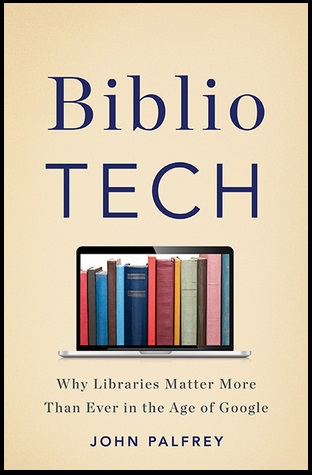
The good libraries in Phoenix today are more important than ever. More than just book repositories, libraries can become bulwarks against some of the most crucial challenges of our age: unequal access to education, jobs, and information.
In BiblioTech, educator and technology expert John Palfrey argues that anyone seeking to participate in the 21st century needs to understand how to find and use the vast stores of information available online. And libraries, which play a crucial role in making these skills and information available, are at risk. In order to survive our rapidly modernizing world and dwindling government funding, libraries must make the transition to a digital future as soon as possible—by digitizing print material and ensuring that born-digital material is publicly available online.
Not all of these changes will be easy for libraries to implement. But as Palfrey boldly argues, these modifications are vital if we hope to save libraries and, through them, the American democratic ideal.
My Review:
This week is National Library Week, so it seemed logical to review a book about libraries. Not just because I am a librarian, but because I believe that libraries are important to our future as a democratic society.
BiblioTechattempts to answer a question that most librarians and library workers face multiple times in any given month: whether libraries are still relevant in an age where any information an average person (or library user) might desire ostensibly can be found in the palm of one’s hand – in other words, accessible on the internet via any smartphone.
For those who believe that libraries’ primary purpose is to provide repositories for books, especially popular books, isn’t everything anyone might want to read available for instant download as an ebook?
In the face of those two questions, the author of BiblioTechprovides a plausible and mostly reasonable answer.
However, the subtitle of BiblioTechis “Why Libraries Matter More Than Ever in the Age of Google”. After having read the book, I got the sense that the question the author actually answers is “How Libraries Can Matter More Than Ever in the Age of Google”.
The words “should”, “ought” and “must” get used much too much to let this book stand as “why”. The prescription here is that if libraries make some significant and necessary changes, they are capable of mattering more in the Google Age.
We aren’t there yet.
While it seems that the intent is to reach a popular audience rather than an insider (inside libraries, that is) audience, I can’t help but wonder how much of a popular audience this book will manage to reach. I’ve read most of these prescriptions before – but then again, I feel as if I am a part of the choir that this book, intentionally or otherwise, preaches to.
So from the point of view of this librarian/reviewer, the book reads as more of a prescription rather than a description.
It is an interesting prescription all the same.
The author’s questions, and in fact most librarians’ questions, revolve around finding, creating or transforming into a mission that draws on libraries’ unique strengths instead of continuing to do what we have always done, because what we have always done is in many cases being served more ubiquitously, if not always better, by for-profit entities.
But there are things that libraries do that are not done elsewhere, or are not done as well elsewhere. Most people support their local libraries and value them highly, but that support is not translating to tax dollars or institutional budgets.
Libraries as places do provide a sense of community. They are clean, well-lighted and climate-controlled “third places” in our society where anyone can come to get in out of the sun, to find a less distracting place to read or study, and to get information assistance if one needs it.
Too many of the places that provide some of these functions are Starbucks, where you need to buy something to “rent” a table, and someone will help with your coffee but not your homework.
Also, Starbucks may provide “free” wifi, but doesn’t provide laptops for those who need a computer to apply for jobs and services, to make the leap onto that first rung of the ladder that can get a person onto the ladder of success, or simply to get help.
(The above is not to say anything terrible about Starbucks. Just that their mission is different from a library’s – and so it should be.)
There is a long-term preservation mission that libraries fulfill. The entire sum of human knowledge has not, and probably will never be, digitized. But digitization makes remote or unique resources available to a wider world. And if you believe that those who forget the past are doomed to repeat it, well, libraries and archives and museums are the places where that past is preserved and analyzed for future applications.
The irony, as the author makes quite clear, is that it is proving more expensive to preserve the current digital output of information for future researches than it ever was to preserve the paper records of the past. Paper is still readable 50 years later, but the computer files of 20 years ago may only be readable on a device that no longer exists except in museums.
Also, libraries provide information from all sides and in all formats, without an agenda other than making the information available and protecting the privacy of those who seek it. If Google controls the availability of information, keep in mind that their agenda is to make a profit. Things that are not profitable may be deemed of lesser importance and suppressed or simply made too difficult to find. (I am not saying this is necessarily happening now, only that it can. This is similar to the arguments about Amazon’s power over the book marketplace.)
One of the strongest chapters in the book is the chapter on copyright law and how it both affects and hinders library mission, especially in this current age where the much more restrictive law of licensing is having greater and greater control on what libraries are able to offer and the means by which they are able to offer it.
As much as I agree with the author about the need for libraries in the future, and the need for libraries to change in order to be a part of that future, I have some difficulty with the way that the author addresses how libraries should go about that change.
One of the premises is that in order to provide funding for research and development into the necessary changes, and to provide funding for capital equipment and especially for professional development (meaning training) for library staff, that libraries will need to convince their current user base to accept less and fewer services now in order to pay for this bright new future that the author envisions. I find this more than a bit too idealistic. In order to maintain funding now, libraries are generally in the position of having to maintain all their services at the current levels with shrinking budgets, just to keep those budgets from shrinking even further in the wake of dissatisfied patrons screaming at their funding bodies about what they consider poor service.
In these types of scenarios, everyone wants someone else’s ox to get gored, and not their own.
But while I think that the implementation of many of the author’s prescriptions will prove much more complicated in practice than is evident between the pages of a book, the need for libraries to change in order to continue to adapt, and to adapt faster, in the future is more than evident. These prescriptions for one such future deserve a wide readership and much further discussion.
Reality Rating B+: I agree with a lot of the message that the author proposes, but the book also reads as if the author is “preaching to the choir”, in other words, talking to believers. At the same time, as part of the choir being preached to, I have heard most of these arguments before. I found the chapter on copyright law and its effects and issues to be the most informative. It contained information that I was aware of, but found this author’s description to be both a good summary of the current state of affairs and to provide new information. I also think it is accessible for a layperson, and that is needed.
Reviewers note: In the text, the author refers to himself as a “feral librarian” because he became a library worker (in fact, director) without having ever received a library degree. As someone with decades in the field, I have never heard that terminology. Some research (i.e. Google) leads me to wonder if this is a term in currency in Boston or the New England area. I’ve not heard it in other regions. The Urban Dictionary says it applies in academic libraries, but the person supplying the definition is also from Boston.
***FTC Disclaimer: Most books reviewed on this site have been provided free of charge by the publisher, author or publicist. Some books we have purchased with our own money or borrowed from a public library and will be noted as such. Any links to places to purchase books are provided as a convenience, and do not serve as an endorsement by this blog. All reviews are the true and honest opinion of the blogger reviewing the book. The method of acquiring the book does not have a bearing on the content of the review.
You still have a few hours left to enter my 4th Annual Blogo-Birthday Celebration Giveaway. I’m giving away four(4!) $10 gift cards or books, so that’s four chances to win. But time is running out!
The big piece of bookish news this week has been the continuing fracas over the nominee slate for this year’s Hugo Awards. If you are looking for balanced coverage of the mess, take a look at either George R.R. Martin’s Not a Blog entries or File 770’s posts. I am planning to attend WorldCon this year in Spokane, which means that yes, I was eligible to nominate. I’m glad that I did this year, even though very few of my nominations made it to the final ballot. I am definitely planning to vote. I think I’ve figured out what I’m going to do, but there are lots of thoughts still running around my head. This has been a big topic of discussion around our house this week. While it certainly makes the evening walks go faster, it is also an exhausting piece of chaos, and there are not going to be any winners at the end, possibly including whoever takes home the actual Hugo rockets. If anyone does.
I thought seriously about writing a blog post on this mess, but I have decided not to. What I wrote for my own amusement was cathartic but probably not helpful to anyone except me.
Besides, I believe that Robert A. Heinlein, who seems to be the patron saint of the Puppies, said it best in The Notebooks of Lazarus Long:
If you are part of a society that votes, then do so. There may be no candidates and no measures you want to vote for…but there are certain to be ones you want to vote against. In case of doubt, vote against. By this rule you will rarely go wrong. If this is too blind for your taste, consult some well-meaning fool (there is always one around) and ask his advice. Then vote the other way. This enables you to be a good citizen (if such is your wish) without spending the enormous amount of time on it that truly intelligent exercise of franchise requires.
In the meantime, here is what’s happening on Reading Reality…
As you read this, I am at the American Library Association Midwinter Conference, which is being held in Chicago. While voluntarily going to Chicago in January may seem strange, it could be worse. Last year the conference was in Philadelphia. We may be cold in Chicago, but we’re not snowed in. Or out.
Actually out might not have been so bad. It is way warmer back home in Atlanta than it is in Chicago in January. Oh well, the June conference is in San Francisco. But then again, there’s that famous Mark Twain quote: “The coldest winter I ever saw was the summer I spent in San Francisco.”
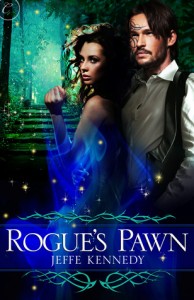
My featured guest for today is Jeffe Kennedy, the author of the marvelous fantasy romance series, Covenant of Thorns. The series concludes with today’s featured review book, Rogue’s Paradise, which answers so many of the questions that series fans have been waiting for.
In her guest post, Jeffe talks about one of the subjects near and dear to my heart, getting ebooks into libraries.
I love that Reading Reality focuses on ebooks and ebook integration into libraries. This is partly because libraries and librarians have always been such a huge part of my life as a reader. As a writer, too, which is less visible to me. But more and more, librarians come up to me at events and tell me how my ebooks are in their collections and I should know how often they’re checked out and how their patrons just love, love, love them! I’m glad they tell me, because otherwise I have no way of knowing that.
I also appreciate that Marlene is dedicated to bringing ebooks into libraries, especially genre books, because I strongly feel that, without Carina and their willingness to take a chance on my digital series, A Covenant of Thorns, then these books might never have seen the light of day. That’s the terrific thing about ebook publishers—they’ve allowed books that don’t neatly fit into genre categories to have a chance.
When I started Rogue’s Pawn,, I had no idea that I was writing a story that would “fall into the cracks between genres.” My tale of a modern woman, a professor of neuroscience who passes through a magical gate at Devils Tower and ends up in Faerie—exactly as in the tales of old—would maybe be an urban fantasy. Only with more romance. And sexier.
Okay, like many newbie writers, I had no idea what I was doing. I understood my story, but not how the marketplace worked.
Since I first started shopping that book—to praise for the writing and imagination, followed by rejection for marketability—the market has changed. Carina called it Fantasy Romance and now there’s lots more of those books out there. The Covenant of Thornstrilogy doesn’t sit squarely in Fantasy Romance, but it gets to be in the club still. More, the books have found readers and I’ve gotten to write others.
All because people embraced ebooks and the windows they open.
I couldn’t be more thrilled!
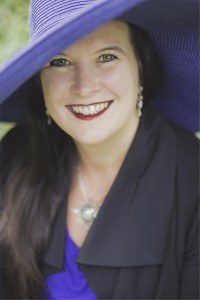
Jeffe Kennedy is an award-winning author with a writing career that spans decades. Her works include non-fiction, poetry, short fiction, and novels. She has been a Ucross Foundation Fellow, received the Wyoming Arts Council Fellowship for Poetry, and was awarded a Frank Nelson Doubleday Memorial Award. Her essays have appeared in many publications, including Redbook. Her most recent works include a number of fiction series: the fantasy romance novels of A Covenant of Thorns; the contemporary BDSM novellas of the Facets of Passion, and an erotic contemporary serial novel, Master of the Opera, which released beginning January 2, 2014. A fourth series, the fantasy trilogy The Twelve Kingdoms, hit the shelves starting in May 2014 and a fifth, the highly anticipated erotic romance trilogy, Falling Under, will release starting in July.

She lives in Santa Fe, New Mexico, with two Maine coon cats, plentiful free-range lizards and a very handsome Doctor of Oriental Medicine.
Jeffe can be found online at her website: JeffeKennedy.com, every Sunday at the popular Word Whores blog, on Facebook, and pretty much constantly on Twitter @jeffekennedy. She is represented by Foreword Literary.
Because I enjoyed the Covenant of Thorns series so much, I want to give some lucky reader the chance to enjoy it too. So, the prize is the winner’s choice of Rogue’s Pawn, Rogue’s Possession or Rogue’s Paradise. These are all ebook only, so anyone can win!
Today I’d like to extend a very warm welcome Mary Ann Rivers, who recently published her terrific first book, The Story Guy (reviewed here). Her guest post topic is particularly near and dear to my heart, so let’s get right to it, shall we?
Why I Love Libraries and Librarians by Mary Ann Rivers
Libraries are the very best effort of society. The very best. Humans are very good at falling in love and at making libraries and precious little else. Everything else we do, is basically the business of filling libraries—with stories, with information about the human project. The very tiniest towns have some kind of library, and big cities have libraries that are glorious expressions of architecture and media.
I had a difficult childhood, and libraries saved me. I could be just exactly who I was in a library, or I could be someone else entirely. Physically, libraries are beautiful and safe; inside the mind they’re dangerous and illicit. As a child, the combination of that, of being safe with a free mind, was completely irresistible. Is still irresistible. I go every week, sometimes every day—even though I borrow most of my library books as digital media on my ereader (I love digital borrowing—it means the library is open 24 hours a day).
Librarians dedicate their work to the service of the very best of what it is we do as humans. It’s difficult schooling, and so librarians are obviously gorgeously smart; but also librarians have to negotiate the whole world and their community at the same time. Digital engagement is huge, but what if you serve poor rural or urban patrons? How do ereaders get in your community’s hands? If you’re serving in a world class library, you have the challenge of trying to represent your patrons, AND all other librarians.
Librarians help us ask questions, not just find the answer. They look at their community and try to fill the holes in it. They read to our kids, sometimes when no one else does. They figure out how and why we read so that the most perfect book is right in front of us when we explore the stacks. Carrie asks Brian if he has a librarian fetish. His answer is the same as mine, “who doesn’t?”
About Mary Ann RiversMary Ann Rivers was an English and music major and went on to earn her MFA in creative writing, publishing poetry in journals and leading creative-writing workshops for at-risk youth. While training for her day job as a nurse practitioner, she rediscovered romance on the bedside tables of her favorite patients. Now she writes smart and emotional contemporary romance, imagining stories featuring the heroes and heroines just ahead of her in the coffee line. Mary Ann Rivers lives in the Midwest with her handsome professor husband and their imaginative school-aged son.