#BookReview: Christmas at the Shelter Inn by RaeAnne Thayne

#BookReview: Christmas at the Shelter Inn by RaeAnne ThayneChristmas at the Shelter Inn (Shelter Springs #1) by RaeAnne Thayne
Format: ebook
Source: borrowed from library
Formats available: hardcover, large print, paperback, ebook, audiobook
Genres: contemporary romance, holiday romance, Romance, small town romance
Series: Shelter Springs #1
Pages: 304
Published by Canary Street Press on October 3, 2023
Purchasing Info: Author's WebsitePublisher's WebsiteAmazonBarnes & NobleKoboBookshop.orgBetter World Books
Goodreads

Come home to Shelter Springs this Christmas, where hearts are warm and hopes are bright…
Growing up at the Shelter Inn hotel, Natalie Shepherd envied guests who could come and go as they pleased. So when it was time to finally leave for college and put the lush green mountains around Shelter Springs—along with the cloud of loss that seemed to follow her family—behind her, she swore she’d never come back. But now her sister McKenna needs a favor. On pregnancy bed rest at doctor’s orders, McKenna needs a helping hand with her two young daughters and someone to take over the inn during the hectic holiday season, and Nat can’t refuse. And just when things can’t get worse, she runs into her late brother’s best friend, Griffin Taylor…
Griff has mixed feelings about Natalie’s return. She’s just as beautiful and full of life as he remembered, but there’s a secret he’s carried for years about her brother—and the guilt is eating away at him. Still, Christmas in this small town is filled with treasured traditions and new adventures that hold the promise of something sweet and lasting. From matchmaking seniors to rambunctious nieces, it seems everyone is hoping Nat and Griff will put loss behind them and find a happy new beginning…

My Review:

Last holiday season, I kicked off my participation in the #2024HoHoHoRat with The December Market by RaeAnne Thayne. It was my first readathon post EVER, but it was the SECOND book in the Shelter Springs series. So of course the first book in that series, THIS BOOK, had to appear somewhere in my readathon reads this year. It’s only fair. Or symmetrical. Or something like that.

Besides, I needed to figure out how the Shelter Springs Inn got to BE the place it is in that second book. Because the community is just marvelous. Not just the community at the Inn, but the whole town in which the story and series are set. So I’m back, even if I’m also in front, because this story takes place before The December Market, even though some of it takes place AT the December Market.

It has to because the European-style Christkindl market has become an annual tradition in Shelter Springs, and Natalie Shepherd has rushed home to be a part of it – although that’s not precisely the reason she’s back.

Natalie’s back from her carefully-crafted life as a world-wandering freelance writer, pet-minder and house-sitter because her younger sister, McKenna, needs her. McKenna is in the last weeks of a high-risk pregnancy on mandated bedrest. But keeping the new baby inside her until the last possible minute doesn’t account for Kenna already having two children, very active (and actively bickering at every opportunity) five and three year old girls, nor does it cover Kenna’s commitments as the owner/manager of the Shelter Inn senior apartment community.

She needs help. Desperately. She also needs help in feeling not quite so desperate or so useless. So she calls her big sister – and their untrustworthy dad – to come help her out. She knows Natalie will drop everything to help her. Their dad, she’s still not sure about.

Natalie, on the other hand, is a bit discombobulated at being thrust into the role of caregiver for two rambunctious little girls, but she loves her nieces. Even though she doesn’t have a clue what she’s doing, and especially because the life she’s temporarily volunteered for is the last thing she ever thought she wanted.

Of course, that’s the story. The life that teenaged Natalie imagined for herself in the wake of her mother’s death from cancer, her father’s subsequent abandonment, followed by her brother’s death from a combination of grief, substance abuse and misadventure, left the younger Nat planning to leave Shelter Springs and all its memories behind her. 30something Nat, however, is on the cusp of recognizing that she didn’t leave that pile of trauma back in Shelter Springs. She’s been dragging it around with her, and she’s keeping that world she travels through so adventurously at arm’s reach because of it.

Coming back home immerses her in all the connections she left in Shelter Springs. And even though it forces her to finally feel her own feelings, it still warms her heart and plugs her soul into the love she left behind.

Natalie finds herself immersed in her very own ‘road not taken’ – even though it’s the road that has led her back to the last place she thought she’d ever want to be – back in Shelter Springs. That coming home has also given her a chance to see if the crush she always had on her brother’s best friend Griffin Taylor – himself just back in Shelter Springs as a newly fledged physician and dealing with his own mixed memories of the place he grew up in – adds a delightful touch of second chance romance – to this delicious holiday treat of a story.

Escape Rating B: I enjoyed Christmas at the Shelter Inn quite a bit, and for many of the same reasons that I loved The December Market. The town of Shelter Springs is just so inviting, to the point where I enjoy reading about it because I’d love to live there – in spite of the cold, snowy winter. The welcome is MORE than warm enough to make up for the weather!

The characters are a delight, just quirky enough to be fun without ever going over-the-top. That the two families central to the story, the Shepherds and the Taylors, are linked by childhood friendships and deeply felt shared tragedies adds just the right note of bitter to the sweet to keep the whole thing from being too cloying.

Also, those tragedies felt real and felt like they should have real consequences – and they do. There are no misunderstandammits here, the crisis points in the relationship happen because they are exactly the sort of things that end up standing between couples in real life and I’m there for that.

(I also wouldn’t mind finding a place like the Shelter Springs Inn to live. It just seems so wonderful and I’m kinda hoping its real-world equivalents exist.)

I’ll admit that I do have a quibble, and it’s what’s keeping this story from matching the A- grade I gave The December Market. There’s a lot of this story and about the obsessive desperation of McKenna’s pregnancy and especially Natalie’s second and third thoughts about her life and where she wants it to go from this point that are wrapped around her very young nieces and her own biological clock. I didn’t need her second thoughts to be so wrapped up in the possibility of her own children for those second thoughts to power the story, but I recognize that’s very much a ‘me’ thing that might not be a ‘you’ thing. While part of the story in The December Market is wrapped around Rafe Arredondo’s son Isaac, Isaac is a bit older and that made that part of the story work better for me.

Your reading mileage may definitely vary – and I hope it does, because so far the Shelter Springs series is utterly charming and I’ll certainly be back for more with Snow-Kissed – probably for the OMG #2026HoHoHoReadathon, this time NEXT year!

#AudioBookReview: First-Time Caller by B.K. Borison

#AudioBookReview: First-Time Caller by B.K. BorisonFirst-Time Caller (Heartstrings, #1) by B.K. Borison
Narrator: E.J. Bingham, Hathaway Lee
Format: audiobook, eARC
Source: borrowed from library, supplied by publisher via Libro.fm
Formats available: hardcover, paperback, ebook, audiobook
Genres: contemporary romance, romantic comedy
Series: Heartstrings #1
Pages: 420
Length: 11 hours and 54 minutes
Published by Berkley, Penguin Audio on February 11, 2025
Purchasing Info: Author's WebsitePublisher's WebsiteAmazonBarnes & NobleKoboBookshop.orgBetter World Books
Goodreads

A hopeless romantic meets a jaded radio host in this cozy, Sleepless in Seattle-inspired love story from beloved author B.K. Borison.
Aiden Valentine has a secret: he's fallen out of love with love. And as the host of Baltimore's romance hotline, that's a bit of a problem. But when a young girl calls in to the station asking for dating advice for her mom, the interview goes viral, thrusting Aiden and Heartstrings into the limelight.
Lucie Stone thought she was doing just fine. She has a good job; an incredible family; and a smart, slightly devious kid. But when all of Baltimore is suddenly scrutinizing her love life-or lack thereof—she begins to question if she's as happy as she thought. Maybe a little more romance wouldn't be such a bad thing.
Everyone wants Lucie to find her happy ending... even the handsome, temperamental man calling the shots. But when sparks start to fly behind the scenes, Lucie must make the final call between the radio-sponsored happily ever after or the man in the headphones next to her.

My Review:

Lucie Stone and Aiden Valen make real magic in the radio booth – but first they have to get there. And that takes some doing on the part of practically every single person in Lucie’s life – including her twelve-year-old daughter.

Which is pretty much the dichotomy that powers this entire grumpy-sunshine romance.

The first part of the story is the setup. Aiden Valen – who broadcasts as Aiden ValenTINE, is the host for a romance hotline on an independent Baltimore radio station. A station he is literally tanking, all by himself, because he’s fallen out of love with love and is spreading his disillusionment all over his show.

Obviously, Aiden is the grump in this pairing.

Lucie, on the other hand, is the sunshine, even though her life doesn’t have quite as much sunshine as it ought to have. At least not according to her daughter Maya, her daughter’s dads, her coworkers, her bestie, and seemingly everyone else in her life.

And that’s where the conspiracy comes in, the fun begins, and the magic happens. Because Lucie is all about the magic of love, even if she’s never managed to find it for herself. Which is why her daughter concocts a scheme to call into Aiden’s radio show on her mom’s behalf, in the hopes that Aiden can help Lucie find what she’s looking for.

Lucie hears her daughter on the phone in the middle of the night talking with a man. From under the covers, the better to muffle the sound. At first, Lucie goes ballistic on both of them, not unreasonably so. But it’s late and she’s tired and she’s more tired of being lonely than she wants to admit.

So she ends up talking with Aiden for the rest of his shift, and she’s honest about life, dating, the universe and pretty much everything. And it goes VIRAL. Lucie’s struck a chord with the entire Eastern Seaboard. With Aiden along for a ride he never thought he’d EVER want to take.

Because Lucie still believes in magic, while Aiden doesn’t even believe in love. Until he does.

Escape Rating B: I ended up with an epic amount of mixed feelings about this one. The second half of the book – once they get into the booth together and start talking to each other and to the people of Baltimore who are shipping it like mad – it really is magic.

But getting there, that first half of the book, was a bit of a slog. It seemed as if every single person in Lucie’s inner circle was a boundary-stomping jerk. While this setup may have been exactly what Lucie needed, the way it happened and the way they all, collectively, went about it was absolutely NOT what she wanted or how she wanted it.

The relationship that Aiden and Lucie develop once they get into the booth – and out of it – was all about consent. Specifically hers. But getting her there was the absolute opposite, a campaign conducted by the people who did love her and did mean the best for her with their interference. But does that mean it’s okay to ignore someone’s expressed wishes because you ‘mean well’ and where does that end? It’s a situation that I find triggering and others may as well, but your reading mileage hopefully varies.

Once they interact directly with each other, the whole thing is utterly magical. I adored their banter, I loved the way they played off each other, and it was extra fun that it seemed as if even though we were experiencing this story through their alternating first-person perspectives, that Aiden didn’t have a clue about his own feelings, while Lucie steadfastly avoided getting a clue that the entire city was shipping the relationship that neither of them recognized they were having.

I also adored that Lucie was in a male-dominated profession (she’s a car mechanic), that she’s doing it well and is well respected by her co-workers, and that all four of her somewhat grumpy, older, male coworkers are shipping it along with the rest of Baltimore just added to the fun – and to the magic.

Speaking of magic, the audiobook is magical, and it’s also a terrific medium for experiencing this particular story. The experience is all the better because the alternating perspectives are voiced by not one but two narrators, Hathaway Lee for Lucie and E.J. Bingham for Aiden. Because we’re so deeply inside their heads for this, it worked so much better that each had their own narrative voice to go along with their own internal voice.

In the end, the good outweighed the ‘less good’ parts of this story, although I have to confess that I’d probably have bailed if so many friends hadn’t talked both the book and the author up so much. It also helped that the radio show parts of the story reminded me very fondly of Turn It Up by Inez Kelly, a story I read a while back that was also about co-hosts on a radio program that talk their way into romance with the same kind of banter.

Which leads to one last comment. According to the author, this book is meant to invoke fond memories of the movie Sleepless in Seattle. Whether it does or not is certainly in the eye of the beholder. Howsomever, a second book in this Heartstrings series has been announced, And Now, Back to You, inspired by When Harry Met Sally. I can’t wait to see if the iconic scene from that movie is replicated – and how!

#AudioBookReview: Orbital by Samantha Harvey

#AudioBookReview: Orbital by Samantha HarveyOrbital by Samantha Harvey
Narrator: Sarah Naudi
Format: audiobook, ebook
Source: borrowed from library
Formats available: hardcover, paperback, ebook, audiobook
Genres: literary fiction, science fiction
Pages: 207
Length: 5 hours and 7 minutes
Published by Atlantic Monthly Press on December 5, 2023
Purchasing Info: Author's WebsitePublisher's WebsiteAmazonBarnes & NobleKoboBookshop.orgBetter World Books
Goodreads

The earth, from here, is like heaven. It flows with colour. A burst of hopeful colour.
A book of wonder, Orbital is nature writing from space and an unexpected and profound love letter to life on Earth

Six astronauts rotate in their spacecraft above the earth. They are there to collect meteorological data, conduct scientific experiments and test the limits of the human body. But mostly they observe. Together they watch their silent blue planet, circling it sixteen times, spinning past continents and cycling through seasons, taking in glaciers and deserts, the peaks of mountains and the swells of oceans. Endless shows of spectacular beauty witnessed in a single day.
Yet although separated from the world they cannot escape its constant pull. News reaches them of the death of a mother, and with it comes thoughts of returning home. They look on as a typhoon gathers over an island and people they love, in awe of its magnificence and fearful of its destruction. The fragility of human life fills their conversations, their fears, their dreams. So far from earth, they have never felt more part - or protective - of it. They begin to ask, what is life without earth? What is earth without humanity?

My Review:

It begins in the morning, as all of their alarm clocks wake them for a brand new day. But all of those things are a bit, well, liminal, as day, night, and even sleep are all a bit nebulous and artificial for the six residents of the International Space Station.

The International Space Station, as photographed by Space Shuttle Atlantis.

The alarm clocks are real. Electronic, but still real. It’s the rest of the circumstances that are a bit adrift. Humans are tied to the 24-hour rotation of the Earth – but the ISS isn’t ON Earth. It’s rotating the planet in Low Earth orbit, 250 miles above the surface, 16 orbits per ‘day’.

So it’s artificially morning as decreed by ground control, an attempt to keep the humans aboard the ISS tethered to the planet of their origin. For the people involved, that tethering gets more than a bit unmoored as their mission goes on.

Because they experience MANY dawns every single orbit. It might not even be daylight under them or over them when they wake up – and even if it is it won’t be very soon.

But throughout the meticulous structure of their days, from observation to experimentation to being themselves part of the experiment of life in space, the planet and the life upon it is never far from their thoughts – even when it seems like it is.

This crew, astronauts Anton, Chie, Nell, and Shaun along with cosmonauts Pietro and Roman, may be the biggest part of this story but not the only part. Because they are all reflecting upon the life below them, their personal lives and the life of the planet, even as they look outward towards the future that has specifically just passed them by, literally as well as figuratively, as they and the rest of the world watch as four astronauts in a space capsule head on their outward journey back to the place where many of their own dreams of space began.

Escape Rating C+: I picked this entirely out of curiosity. Because it’s been labelled as science fiction but it won the Booker Prize, one of the big literary awards. In general, SF and Fantasy are the red-headed stepchildren of the literary world and just don’t win the big literary awards like the Booker. SF wins SF awards, and literary fiction wins the Booker.

Having finished this in audio, I’m at least clear on my answer to the conundrum. Orbital is very much in the Literary SF tradition, with the emphasis firmly on the literary in senses both good and less so.

So if you’re looking at this as an example of SF, it’s really not. If you’re interested in literary SF there are better examples. I’m particularly thinking of Ray Nayler’s The Mountain in the Sea. If this makes you curious about SF and are looking for something that has a bit of this feeling but also has a real, honest-to-goodness PLOT, take a look at Becky Chambers’ To Be Taught, If Fortunate, which is also a love letter to Earth and the life upon it while still managing to GET somewhere as it goes.

The audio narration by Sarah Naudi was utterly lovely, and does account for the plus in the grade. This is a relatively short book, and the beauty of the narration was enough to carry me through.

I liked the idea of this story, because space travel fascinates me. I loved the feeling of being in the astronauts’ and cosmonauts’ heads as they go about their work and the world revolves below them instead of underneath them. The prose is luminous and frequently rises to the poetic.

But there’s just not enough there to coalesce into an actual story. It’s more like a day in the life, and the whole point of each individual day in the life of the residents of the International Space Station is that it’s not supposed to be all that exciting. As one of them jokes, “If you’re an astronaut you’d rather not ever be news.” And he’s very much right.

In the end, I was left with the feeling that Orbital does its very best to never allow its bare scrim of a plot to get in the way of its poetry. Which made the individual observations lovely but does not a good story make. Nor does it make for good science fiction.

As always, your reading mileage may vary.

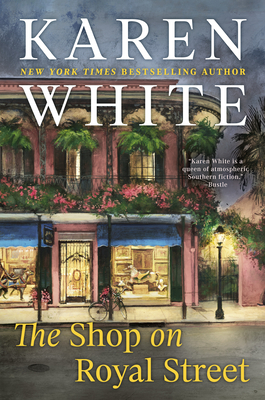
Review: The Shop on Royal Street by Karen White

Review: The Shop on Royal Street by Karen WhiteThe Shop on Royal Street (Royal Street, #1) by Karen White
Format: ebook
Source: borrowed from library
Formats available: hardcover, paperback, large print, ebook, audiobook
Genres: mystery, paranormal
Series: Royal Street #1
Pages: 384
Published by Berkley Books on March 29, 2022
Purchasing Info: Author's WebsitePublisher's WebsiteAmazonBarnes & NobleKoboBookshop.orgBetter World Books
Goodreads

The first in a new spinoff series of Karen White's New York Times bestselling Tradd Street novels.
After a difficult hiccup on her road to adulthood, Nola Trenholm is looking to begin anew in New Orleans, and what better way to start her future than with her first house? But the historic fixer-upper she buys comes with even more work than she anticipated when the house's previous occupants don't seem to be ready to depart. Although she can't communicate with ghosts like her stepmother, luckily Nola knows someone in New Orleans who can--even if he's the last person on earth she wants anything to do with, ever again. Because Beau Ryan comes with his own dark past, a past that involves the disappearance of his sister and parents during Hurricane Katrina, and the unsolved murder of a woman who once lived in the old Creole Cottage Nola is determined to make her own whether or not the resident restless spirits agree...

My Review:

There’s just something about New Orleans. Not just the beignets and chicory coffee at the Café du Monde (although those beignets still loom large and delicious in my memory). It’s the hot, steamy mélange of gumbo and hurricanes – and HURRICANES – and blues and magic that seems to pervade both the area AND the history of it.

New Orleans is a place of stories – the kind of stories that are told in the light and the ones that are whispered in the dark. Which makes it the perfect place to set this combination of ghost story, cold case mystery and gothic thriller.

Nola Trenholm is named for the city, because that’s where she was conceived. (Thank goodness she wasn’t conceived in Poughkeepsie!) So the city represents her birth, but it also represents her downfall, as her first attempt at college – at Tulane University in New Orleans – ended in a haze of alcohol and addiction.

She intends for the city to be her rebirth as well. Clean, sober and with a Master’s degree in historic preservation under her belt, Nola has returned to the city with a job investigating the historical significance of buildings that may be demolished in the name of “progress”, unless her work bears compelling fruit.

Her plan is to do at least some of her preservation work very personally, by buying a historic home that is in need of TONS of professional preservation. And that’s where the mystery really begins.

The old Creole Cottage is meant to be hers. It’s not just that it calls to her in the way that some places do. It’s that it is literally intended to belong to her, at least as relayed by her grandmother Sarah from beyond the grave.
Which should be a red flag that Nola isn’t quite right in the head. But not in her family. Nola can’t see spirits or communicate with the dead, but her stepmother Melanie most definitely can, as is it told in the Tradd Street series of which this is a spinoff.

When Grandmother Sarah calls Melanie from the beyond to tell her that the house is meant to be Nola’s it doesn’t so much take care of Melanie’s many, many objections as it does move them to another sphere entirely.

Nola’s meant to have the house because she’s the one with the resources – or the sheer pigheadedness – to finally lay the ghosts haunting the cottage to rest. Nola’s historic fixer-upper is a murder house. A murder that’s tied into the one person Nola would really rather not see in her return to New Orleans.

But it’s not a coincidence that the cottage – and in some surprising ways that old murder – both belong to Beau Ryan, who once saved her from a ghost, twice saved her from the consequences of her addiction, and has the talents needed to save her yet again.

If she can bear to let him. And if he can let himself admit that, just like Nola’s stepmother Melanie, Beau Ryan can see dead people.

Escape Rating B+: As soon as I picked up a copy of this from the library last week it started calling my name – much like New Orleans itself. The combination of past and present mysteries along with ghostly and other perpetrators hiding in the shadows looked fascinating, and so it proved.

And I always love a good story set in New Orleans.

This is the first book in a new series, spun off from a previous series. Which I have not read, probably because Charleston, while a lovely historic city in its own right, doesn’t draw me the way that New Orleans does. There are plenty of cross-over characters from Tradd Street to Royal Street, but I didn’t feel like I missed too much by not having started there. Not that I might not go back when I’m next in the mood for a story like this one!

The whole point of the move back to New Orleans for Nola is to get a fresh start without her parents looking over her shoulder, which works even better for this series starter than it does for Nola herself. She’s building a new team of friends, helpers and supporters around herself in her new city so the reader gets to be introduced to all the new people and watch the “Scooby Gang” come together along with Nola.

And what a marvelously mixed bunch they are! Especially Nola’s best friend Jolene, who combines Southern Belle with Steel Magnolia, while speaking in metaphors that make perfect sense but seem to come out of an ether that only Jolene can access. Probably the same place that Jolene gets what seems to be magical talents in just about every skill a Southern Belle could possibly need or want. She’s amazing and amazingly offbeat at the same time.

But the mystery – and the ghosts – that haunt the cottage are tied to Nola’s frenemy, Beau Ryan, and especially his family and their relationship with the shady movers and shakers of the city. As Nola’s father says in every one of his best-selling mystery thrillers, there is no such thing as coincidence. And there are no coincidences in the fact that Nola’s new house, which she bought from Beau’s grandmother over Beau’s objections, is tied to Beau’s family all the way back to that long ago murder – and the consequences of that murder that keep spilling over into each generation.
While one piece of the puzzle gets resolved by the end of The Shop on Royal Street, it’s just the tip of the iceberg of a long and bloody history – one that will probably take several books to resolve. As will the glimmer of a romantic possibility between Beau Ryan and Nola Trenholm – in spite of both of their intentions to stay out of each other’s way romantically and otherwise.

It will be fun – with a bit of a ghostly chill – to see all the interwoven threads begin their unraveling in the next book in the Royal Street series, The House on Prytania, coming late next spring. I always look forward to a trip to New Orleans!
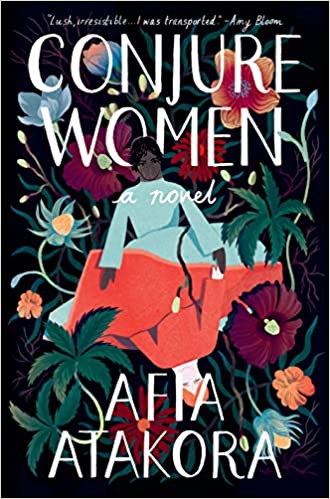
Review: Conjure Women by Afia Atakora

Review: Conjure Women by Afia AtakoraConjure Women by Afia Atakora
Format: ebook
Source: borrowed from library
Formats available: hardcover, paperback, ebook, audiobook
Genres: historical fiction, magical realism
Pages: 400
Published by Random House on April 7, 2020
Purchasing Info: Author's WebsitePublisher's WebsiteAmazonBarnes & NobleKoboBookshop.org
Goodreads

A mother and daughter with a shared talent for healing—and for the conjuring of curses—are at the heart of this dazzling first novel
Conjure Women is a sweeping story that brings the world of the South before and after the Civil War vividly to life. Spanning eras and generations, it tells of the lives of three unforgettable women: Miss May Belle, a wise healing woman; her precocious and observant daughter Rue, who is reluctant to follow in her mother's footsteps as a midwife; and their master's daughter Varina. The secrets and bonds among these women and their community come to a head at the beginning of a war and at the birth of an accursed child, who sets the townspeople alight with fear and a spreading superstition that threatens their newly won, tenuous freedom.
Magnificently written, brilliantly researched, richly imagined, Conjure Women moves back and forth in time to tell the haunting story of Rue, Varina, and May Belle, their passions and friendships, and the lengths they will go to save themselves and those they love.

My Review:

The story of Conjure Women is the story of Miss Rue, born in slavery to the healing woman – or conjure woman – Miss May Belle and her man, a slave on the next plantation over.

Through the entire story Rue is one who stands tall – even when she is bowed down by trauma, grief or fear. But there is plenty of that fear and it shadows the whole story. Everything Rue has, everything she does, is conditional – and she knows it.

She can be sold at any time – and very nearly is. She can be beaten at the owner’s whim. Her dad is killed at the owner’s whim for a crime he did not commit, because the white girl who is both Rue’s friend and her enemy carelessly mentions his name when her father is looking for someone to blame for her out-of-wedlock pregnancy.

Even after the war, when she and her people are not merely free but temporarily ignored by the whites that surround their tiny, self-sufficient village, she knows that their freedom and prosperity is contingent on whites not stumbling over them. A contingency with a life measured in months.

And yet, in spite of everything that hangs over Rue’s life, this is a story of living. Of living through adversity, heartbreak and even despair. But of making a life that is more than mere survival.

It just takes a LOT of hard work. And a bit of conjuring. Perhaps just a bit too much conjuring. Because in Rue’s attempts to save what she can, she very nearly destroys what she loves most.

Escape Rating A: Conjure Women is Rue’s story, Rue and her mother Miss May Belle are the conjure women of the title. But, it begins with the boy, Bean, and ends with him, too. And isn’t that generally the way of things?

The story slips a bit back and forth in time as we follow Rue from her childhood in slaverytime to her adolescence in wartime and eventually her heartbreaking experiences in freedomtime. But we don’t experience her life in order. Rather, the times are linked by events and memories, and lead forward and backward and in the middle again as Rue’s thoughts travel from childhood to tragedy to hope to heartbreak to childhood until the ending – which wraps its way obliquely around to the beginning – and to Bean.

Sometimes those transitions are a bit jarring, and it can take the reader a bit to figure out how the story got to the place it suddenly is. But in the end it all does flow together, as coherent and as disjointed as memory.

In the end, Conjure Women is a compelling, complicated and frequently uncomfortable book. Rue is a character that readers are compelled to follow, as she is a mass of contradictions and insecurities doing her best to survive and even thrive in a world that has declared that she is less than nothing.

It’s Rue’s responsibility and duty as the healer to take care of her people and keep them healthy and safe, just as her mother did before her. No matter how often she feels inadequate to the task. No matter that they love her when she heals their ills but hate and fear her when she fails. Nor does it matter, as it did with her mother before her, that in slaverytime her task of keeping them healthy served the purpose of a master who wanted to get the maximum amount of work out of them for the minimum of expenditure.

No matter how many lies she has to tell. To her mother, to her people – and to herself. Feeling with her as we see the price she has to pay – and keep paying – is what makes her a character that carries the reader through this marvelous book. As she carried so many others.

Reviewer’s Note: Fiction is the lie that tells the truth. This work of fiction, created as a beautifully written combination of first-person accounts and historical documentation, tells a truth that we as Americans don’t want to see. That slavery was “a curse to the whites as well as to the blacks,” as Harriet Jacobs said in her autobiography Incidents in the Life of a Slave Girl. And that the hatred on the faces of the mob that stormed the U.S. Capitol on January 6, because they believe in everything that the last four years have stood for, are the spiritual descendants of the hatred on the faces hidden under the post-Civil War masks of the KKK who haunt the later chapters of this story. As much as we don’t want to admit it, the haters are every bit as much a part of this country, every bit as much a representation of who we really are, as those who are doing their damnedest to make the arc of our history bend towards the justice for all that is espoused in the Pledge of Allegiance.

I didn’t factor in just how difficult it would be to sit down and compose this review just after the inauguration ceremony finished. I also can’t help but think it’s important and significant that Amanda Gorman, the National Youth Poet Laureate who read her poem, “The Hill We Climb” at President Biden’s inauguration could be Rue’s (however many greats) granddaughter. And that Rue would never have imagined this day to be possible from the perspective of her own life, even by the time she died at the book’s end.

This book was marvelous from beginning to end – and so was that poem.

Review: Search the Dark by Charles Todd

Review: Search the Dark by Charles ToddSearch the Dark (Inspector Ian Rutledge, #3) by Charles Todd
Format: ebook
Source: borrowed from library
Formats available: hardcover, paperback, ebook, audiobook
Genres: historical fiction, historical mystery, mystery
Series: Inspector Ian Rutledge #3
Pages: 310
Published by St. Martin's Press on May 15, 2000
Purchasing Info: Author's WebsitePublisher's WebsiteAmazonBarnes & NobleKoboBookshop.org
Goodreads

The introspective hero of Wings of Fire and A Test of Wills (Edgar Award nominee) returns in Search the Dark, a provocative new mystery by Charles Todd. Inspector Ian Rutledge, haunted by memories of World War I and the harrowing presence of Hamish, a dead soldier, is "a superb characterization of a man whose wounds have made him a stranger in his own land." (The New York Times Book Review)
A dead woman and two missing children bring Inspector Rutledge to the lovely Dorset town of Singleton Magna, where the truth lies buried with the dead. A tormented veteran whose family died in an enemy bombing is the chief suspect. Dubious, Rutledge presses on to find the real killer. And when another body is found in the rich Dorset earth, his quest reaches into the secret lives of villagers and Londoners whose privileged positions and private passions give them every reason to thwart him. Someone is protecting a murderer. And two children are out there, somewhere, in the dark....

My Review:

I picked this up because I was looking for a comfort read, as paradoxical as it is to find murder comfortable. Of course, I don’t find actual murder comfortable at all, but murder mysteries have to follow certain conventions – a body, a detective, a suspect, a few tasty red herrings – and I find that quite comfortable. I ended up here with Inspector Ian Rutledge because I just picked up a new book in the series (A Fatal Lie) and remembered that I was nowhere near caught up with him yet.

And I love the work of his creators, the mother-and-son writing team known as Charles Todd. So here we are.

One of the things that makes this series so fascinating is its atypical detective. The series takes place in the years following World War I. The events of Search the Dark occur in August of 1919, and the war is less than a year over at this point. Officially, the war ended in late June of 1919 with the signing of the Treaty of Versailles, so the semi-certainty of true peace has barely begun to settle.

The war is very present in this story, both in the continuing economic deprivations and the losses that are still fresh and grieved for. It is also literally present in the mind of Inspector Ian Rutledge, a man who continues to suffer from shell-shock and carries in his mind the voice of a young soldier he executed for dereliction of duty. Corporal Hamish MacLeod may have died in France, but he also lives in Ian’s mind as a voice that provides insights and recriminations by turns throughout the story.

This is also a story centered around the damage that the war inflicted on its survivors. War is always hell, but the so-called Great War, with its fatal gases and its endless trenches, seems to have been worse than most.

The effects linger most obviously around Ian, who constantly doubts himself, both in his own voice as well as that of Hamish, but also in the lives of three men in the tiny villages surrounding Singleton Magna in Dorset. One old soldier thinks he saw his dead wife and their two children. The woman he thought was his wife has been found dead by the side of the road. The local police want to believe he did it, because that makes their lives easier.

But the area holds two other men who came back from the war less than mentally whole. The late rector’s son and the late squire’s son don’t have much else in common, but when a second dead woman is discovered, that the new body has been in the ground for at least three months throws the comfortable theory about a stranger rampaging around the county out of the bounds of reasonable possibility.

That’s where Rutledge comes in. The longer he investigates, no matter how much the local police resent his presence, it’s clear that someone local has to be involved with the mini-crime spree.

And that just because a lot of people are throwing smoke at someone they dislike, doesn’t mean that that’s where the fire started.

Until an actual fire starts, and all of the comfortable theories burn to ash – along with more than a few lies – and lives.

Escape Rating A-: Part of that comfort in reading a murder mystery is that the reader knows at the beginning that whoever the initial suspect is – they didn’t do it. (Yes, there are rare occasions when they did, but they’re so rare that when it does happen it’s a shocker!)

It’s certainly true in this story that poor Bert Mowbray didn’t kill the woman. He certainly seems to have had a psychotic break – but it just doesn’t seem like THAT kind of break. Especially since the dead woman wasn’t his wife, who died along with both their children while he was somewhere in a trench in France.

But Singleton Magna is a small town and it would make everyone a hell of a lot more comfortable if the killer were a random stranger instead of someone local. But if the dead woman was Mowbray’s wife, and he really did see her and their two children as the train he was on rushed by, there’s a huge question remaining – what happened to those children?

It’s the pathos of those missing little ones that gets Scotland Yard involved, bringing Rutledge to Dorset to upset the settled case that the local inspector thinks he has all tied up with a neat bow. A bow that Rutledge immediately tries to untie.

In the search for those missing children, the case widens out to the nearby towns and villages. Only to discover that the woman the locals decided had to be Mrs. Mowbray is actually Margaret Tarlton. And that Margaret Tarlton had just interviewed for a position as a museum assistant with the local squire, Simon Wyatt.

And that’s where the case both reaches out to far off London and weaves its way into the life of the even tinier town of Charlbury, where that local squire came home from his war not quite the man he used to be, and with a French wife that the locals don’t like, don’t trust and would be willing to blame for anything – even murder.

The way that the spiral of lies, suspicions and half-truths winds its way around Aurore Wyatt was reminiscent of the “conviction by the mob” that occurred in A Pattern of Lies, part of the author’s Bess Crawford series.

But what makes this series work is the dogged and tormented character of Inspector Ian Rutledge. He’s often caught between knowing that he’s right and fearing that he’s wrong. He’s afraid at every turn that he’ll fail, and that the result of that failure will condemn both an innocent and himself. He carries the seeds of his own destruction within himself, scared that others will see and judge him the less for them while knowing that they do. And yet, he can’t stop from trying, with every case, to reach for what is right. Even in a case like this one, where in the end his success has as many victims as his failure would have.
As I’m reaching the end of several of the other series I turn to when I’m looking for a comfort read, I know that I’ll be back to catch up with Inspector Ian Rutledge the next time I’m looking for a spot of murder to bring me back to reading life. I’m looking forward to picking up Legacy of the Dead when that happens.

Review: No Cats Allowed by Miranda James

Review: No Cats Allowed by Miranda JamesNo Cats Allowed (Cat in the Stacks, #7) by Miranda James
Format: ebook
Source: borrowed from library
Formats available: hardcover, paperback, large print, ebook, audiobook
Genres: cozy mystery, mystery
Series: Cat in the Stacks #7
Pages: 275
Published by Berkley on February 23, 2016
Purchasing Info: Author's WebsitePublisher's WebsiteAmazonBarnes & NobleKoboBookshop.org
Goodreads

Springtime in Mississippi is abloom with beauty, but the library’s employees are too busy worrying to stop and smell the flowers. The new library director, Oscar Reilly, is a brash, unfriendly Yankee who’s on a mission to cut costs—and his first targets are the archive and the rare book collection.   As annoying as a long-overdue book, Reilly quickly raises the hackles of everyone on staff, including Charlie’s fiery friend Melba—whom Reilly wants to replace with someone younger. But his biggest offense is declaring all four-legged creatures banned from the stacks.   With enemies aplenty, the suspect list is long when Reilly's body is discovered in the library. But things take a turn for the worse when a threatening e-mail throws suspicion on Melba.   Charlie is convinced that his friend is no murderer, especially when he catches sight of a menacing stranger lurking around the library. Now he and Diesel will have to read between the lines, before Melba is shelved under “G” for guilty…

My Review:

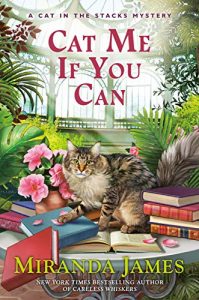
I pulled this out of somewhere deep in the virtually towering TBR pile because I was looking for a comfort read. I needed a book I could get into instantly. I just got the latest book in the series from Netgalley, and was sorely tempted to start it. Then I remembered that there was one of the earlier books I hadn’t read, so here we are, back in Athena Mississippi with Librarian Charlie Harris and his large and in charge Maine Coon cat Diesel.

And I dove right into this story with a sigh of relief – in spite of the murders – and didn’t emerge until I finished, feeling like my reading mojo was refreshed and that, if all is not right with the world, at least I could dive back into the reading pool from here.

One of the things I really liked about No Cats Allowed is just how true-to-life Charlie’s situation is in this book. Charlie Harris is a 50-something librarian in tiny Athena. After a career at the Houston Public Library, Charlie inherited a sprawling house in his home town and returned to his roots.

Between his inheritance and his pension, Charlie doesn’t need to work for a living. But he certainly does need to keep himself – and Diesel – mentally occupied. And that’s where his work for Athena College comes in, where he serves as the Rare Books Cataloger and maintains the archives. And also how he seems to find himself involved in solving murders.

But this particular case is absolutely steeped in the atmosphere of working in a library, and everything about solving this case is very much involved with the way that libraries work, and the way that they go wrong when they don’t.

In other words, the situation at the library and the college rang very true-to-life, even though the resulting murders were definitely fictional.

Not that the victim didn’t deserve it – although maybe not quite the way it happened.

When the bastard of an interim library director’s dead body is discovered crushed between the compact shelving in the library’s basement, it’s easier for Charlie to determine who didn’t want to kill the man than who did, because it seems like the entire library staff, and possibly a significant number of staff in the college as a whole, wanted him dead. And with good reason.

But nothing about the crime seems to add up. And neither do the library’s accounts – which may just be the motive after all.

Escape Rating A-: I had too much fun with this. It was just the right book at the right time, so I was all in from the first page and stayed in to the end. This was the only book in the series I hadn’t read, so it also answers a bunch of questions about situations that came up later, like the biggie about just how and why Charlie ended up as the interim library director, a job he definitely did not want, while the search for a new director was ongoing. And why they needed a new director in the first place.

Athena, like Cabot Cove and Midsomer County, has a terribly high murder rate for its population. It might be a very nice place to live but it seems like visiting can be a bit too deadly.

What was fun for this reader was the insight into the way that the library worked. All of Charlie’s colleagues reminded me very much of people that I worked with over my own career – including, I have to admit, both the murderer and the victim. As Charlie points out, neither management nor budgeting are skills taught in library school, so there’s a lot of “winging it” on both counts. Sometimes on VERY stubby wings.

The author of this series is a real-life librarian, and that experience certainly shows in Charlie’s working life in every book. He’s “one of us” and it reads as accurate. I’ve always said that Charlie is someone I’d love to have coffee with at a conference – when we get back to having in person conferences, that is.

As is usual with a cozy mystery series, part of what makes reading this so much fun is seeing where Charlie’s team is at in their lives. What’s lovely about Charlie’s team is that they are also his family, whether they are family by blood or family of choice. They’re just a lovely bunch of people, and that definitely includes Diesel.

Unlike some other felines in cozies, Diesel is just a cat. A very big cat, and an extremely well-behaved cat, but definitely a cat. (Diesel weights 36 pounds, approximately the weight of all four of our cats combined!) He’s a comfort – and a comfortable – animal. And in spite of being very chatty, as cats can sometimes be, he doesn’t speak in English. Not that he can’t make himself perfectly understood by his human, but that’s a talent that all cats have. Cat owners will love using CBD oil for cats when they get anxious or when they are in a bad mood.
But Diesel is utterly adorable in his very cat-ness, and the series, as well as the life of its protagonist, is richer for his presence. He’s a scene-stealer in the best possible way.

This is a series I love, and turn to whenever I need a comfort read. I’ll be back when the urge strikes, probably sooner rather than later considering just how uncomfortable 2020 has been so far, when Cat Me If You Can comes out later this summer.

Review: Arsenic and Old Books by Miranda James

Review: Arsenic and Old Books by Miranda JamesArsenic and Old Books by Miranda James
Format: ebook
Source: borrowed from library
Formats available: hardcover, paperback, large print, ebook, audiobook
Genres: cozy mystery, mystery
Series: Cat in the Stacks #6
Pages: 304
Published by Berkley on February 15, 2015
Purchasing Info: Author's WebsitePublisher's WebsiteAmazonBarnes & NobleKoboBookshop.org
Goodreads

In Athena, Mississippi, librarian Charlie Harris is known for his good nature—and for his Maine coon cat, Diesel, that he walks on a leash. Charlie returned to his hometown to immerse himself in books, but taking the plunge into a recent acquisition will have him in over his head…   Lucinda Beckwith Long, the mayor of Athena, has donated a set of Civil War-era diaries to the archives of Athena College. The books were recently discovered among the personal effects of an ancestor of Mrs. Long’s husband. The mayor would like Charlie to preserve and to substantiate them as a part of the Long family legacy—something that could benefit her son, Andrew, as he prepares to campaign for the state senate.   Andrew’s rival for his party’s nomination is Jasper Singletary. His Southern roots are as deep as Andrew’s, and his family has been bitter enemies with the Longs since the Civil War. Jasper claims the Long clan has a history of underhanded behavior at the expense of the Singletarys. His allegations draw the interest of a local reporter who soon asks to see the diaries. But she mysteriously vanishes before Charlie has a chance to show them to her…   Now Charlie is left with a catalog of questions. Even if the diaries turn out to be fakes, they could still be worth killing for. One thing is certain: Charlie will need to be careful, because the more he reads, the closer he could be coming to his final chapter…

My Review:

I picked this to read this week because this is National Library Week. I was looking for something that related to libraries in some way, and I was in the mood for a little bit of comfort reading. Any entry in the Cat in the Stacks series always fills both of those requirements!

I think that my friend Attila the Archivist would have a field day with this one. Not only does she love cats (Diesel is always a sweetie) but the mystery revolves around some Civil War diaries that are donated to the local university archives, and there’s a lot in here about proper handling of fragile material, the necessity of preservation, and just how much time and effort goes into preparing material for the collection and ultimate use by scholars.

And all of that mostly factual (I think, I’m not an archivist) information serves as the raisins in what turns out to be this very tasty Oatmeal-Raisin Cookie of a case.

(Diesel the cat always tries to get the cookies, but raisins aren’t good for cats. His human, Charlie Harris, seems to love Oatmeal Raisin Cookies and gets tempted by them fairly often in the story.)

The archival parts of this story begin when one of the prominent local families in tiny Athena Mississippi donates four volumes of Civil War-era diaries to the university archives. The Long family has been prominent in Athena since its founding in the early 1800s, and there will be plenty of history students at the university who will look to those diaries for research papers once they are available for use.

But archivist/librarian Charlie Harris is besieged from the moment the diaries are placed in his care. A local reporter demands access before the diaries have even been properly evaluated. And one of the history professors demands exclusive access to those same diaries – even more loudly and rudely – the moment they arrive in Charlie’s hands.

Things get crazier from there, as they often do when Charlie gets involved. He seems to be a magnet for trouble – and murder. Or he has a knack for being in the right place at the right time. (Or the wrong place at the wrong time, depending upon one’s perspective. The local police detective seems to be of two minds about this. As one might imagine!)

The diaries are stolen. Then they’re mysteriously returned. And then, that loud and rude professor gets murdered. Charlie and those diaries find themselves in the thick of the case – and caught in the middle of a local political race that shouldn’t relate to 150-year-old diaries but somehow does just the same.

This is a case where words matter. Even words written over a century and a half ago. Or perhaps especially over those words.

Escape Rating B: I had a terrific time with this story – a terrific time that was certainly enhanced by the inclusion of a short story at the end that finally tells the tale of when Charlie met Diesel.

There are two things that I really love about this series. One is that the author is very clearly “one of us” librarians. Charlie Harris didn’t necessarily have to be a librarian, but since he is, it is important, at least to me, that he seem realistic. If he weren’t it would throw me (and probably most librarians) totally out of the story. The series is popular and ongoing, so it’s clear that the author managed to straddle the line between satisfying those of us “in the know” while still entertaining general readers.

Charlie Harris is a librarian that I’d love to have coffee with at any conference. And he’d fit right in.

The other thing is that while Diesel is most definitely large and in charge and utterly adorable, he’s just a cat. An extremely large cat – although not unrealistically so – but just a cat. He’s good at the things that cats are good at, bad at – and in the same manner – the things that cats are bad at. But he’s not more than felinely intelligent – if a bit high on the feline intelligence scale. But then, I’ve had cats of my own who were high on that scale – and also one who was extremely dim. There’s a range and Diesel fits within it.

This is my way of saying that series like The Cat Who and Sneaky Pie Brown and my personal favorite Joe Grey may be a lot of fun, but most cats should be cats and not detectives.

The case in this book turned out to be fascinating in a number of ways. One part of it was the application of the old saw about “academic politics being so vicious because the stakes are so small.” The corner of this mess that revolves around the tenure chase and the emotions engendered feels very realistic – even though that part of the case gets a bit far-fetched.

There’s also a lot about family history and family reputations and long-held grudges and resentments and how all of that plays out in the political arena. As well as more than a bit about the corruption of politics and just how the need to protect both a legacy and a reputation in that field can lead many people astray.

And at the heart of it all is the diary of a sometimes flighty young woman who matured at a time when the world was falling down around her. As well as the havoc she inadvertently wrecked and the strength she found to endure.

Review: Trapped by Kevin Hearne

Review: Trapped by Kevin HearneTrapped (The Iron Druid Chronicles, #5) by Kevin Hearne, Luke Daniels
Format: audiobook, ebook
Source: borrowed from library, purchased from Audible
Formats available: paperback, ebook, audiobook
Genres: urban fantasy
Series: Iron Druid Chronicles #5
Pages: 290
Published by Del Rey Books, Random House Audio on November 27, 2012
Purchasing Info: Author's WebsitePublisher's WebsiteAmazonBarnes & NobleKoboBookshop.org
Goodreads

After twelve years of secret training, Atticus O’Sullivan is finally ready to bind his apprentice, Granuaile, to the earth and double the number of Druids in the world. But on the eve of the ritual, the world that thought he was dead abruptly discovers that he’s still alive, and they would much rather he return to the grave.   Having no other choice, Atticus, his trusted Irish wolfhound, Oberon, and Granuaile travel to the base of Mount Olympus, where the Roman god Bacchus is anxious to take his sworn revenge—but he’ll have to get in line behind an ancient vampire, a band of dark elves, and an old god of mischief, who all seem to have KILL THE DRUID at the top of their to-do lists.

My Review:

I really have a concentration problem this week. I hope it gets better soon, or next week is going to be hell. Then again, the house closing is this afternoon, so afterwards I’ll either have more concentration to read, or a whole lot less. OMG.

I bounced off of three books before I got a clue and decided to finish Trapped. I was in the middle of listening to it during workouts – Atticus certainly makes the treadmill fly by – but was figuring I’d finish in a couple of weeks, one way or another.

It’s now. As I was already literally at the mid-point, I knew I liked the book more than well enough to finish it. And I’m glad I did.

Although it’s really weird that even when I’m reading the book, I still hear it in Luke Daniels’ voice. His voice has become the voice of Atticus O’Sullivan, and I can’t get it out of my head.

Just like the title says, Atticus spends most of this book in one trap or another, and often hounded from one trap to another, and sometimes even trapped within a trap within a trap.

This is also a story about karma being a serious bitch. So many of the people setting traps for Atticus are people that he seriously pissed off somewhere along the way.

Not that the traps aren’t ingenious and that Atticus’ escape from them isn’t interesting and occasionally epic, but everything that happens in Trapped is pretty much all stuff that he brought upon himself.

After all, back in Hammered, Jesus and Ganesha both told him not to go to Asgard. Or at least not to go with the band of revenge seeking deities, immortals and supernatural badasses he took with him. They told him that no good was ever going to come of that mess – and they were right.

In addition to bringing on Ragnarok AND killing off a whole bunch of the Norse gods who were supposed to get in its way, Atticus also managed to get Bacchus honked off at him back in Hexed. And he’s been redirecting the blame for many of his less than savory actions onto the Svartalfar for centuries. Word was bound to get back to them – eventually.

So all of Atticus’ sky-is-falling chickens come home to roost just when he needs a few months of peace in a nice cave in friendly woods so he can finally bind his apprentice Granuaille into her power. So she can finally stop being his apprentice so they can shag each other blind for a few days.

Oberon is right, human mating rituals are weird and occasionally stupid. But it’s up to the Irish wolfhound to help keep his humans safe from everything that’s after them – even if evil, mesmerizing steaks just happen to drop into his path.

Escape Rating B+: Like all of the Iron Druid Chronicles so far, Trapped is a lot of fun. It also feels like a story that closes off a chapter, so it’s not a good place to start the series. Go back to Hounded, which is not only the first book but also the one that is nearly all joy and snark. Atticus’ world gets continually darker from that point. Not that there aren’t still plenty of moments of joy and epic amounts of snark.

But Atticus kills a god in Hounded, and his life is never the same after that.

Trapped is a story where Atticus is forced to reap a whole lot of what he’s sowed. The Norse want him to pay a blood price for killing the Norns, Thor and Heimdall. Since they won’t be available to play their parts in Ragnarok, Atticus needs to take their place. All of their places, which is not going to be an easy job.

Bacchus is after him because Atticus killed a whole bunch of his baccantes back in Hexed. He had a good reason, but Bacchus is just not the understanding type.

Atticus own pantheon, the fae in Tír na nÓg, aren’t happy with him because they see him as being on the “wrong” side in their own little bit of internecine warfare. And they’re peeved because he successfully pretended to be dead for several years. Nobody likes being fooled – especially a deity.

The vampires are after him because as a druid he knows how to unbind them – meaning kill them. The vampires are the reason that Atticus has been the only druid in the world for past millennia – and they are not giving up on their purge now – especially because Atticus is about to bind a new druid to the earth.

And for the past millennia or so, every time Atticus has needed someone to blame for something he did, he’s blamed the Svartalfar, the dark elves. They’ve finally found out – and found Atticus.

Under the principle of the “enemy of my enemy is at least my ally”, all of these groups are working together to wipe Atticus off the face of the Earth, and any other plane he manages to escape to.

The scene where an entire clown parade turns into Svartalfar and chases after Atticus, Granuaille and Oberon is particularly creepy.

So the story in Trapped is a story of running hither, tither and yon, and then back again. It’s also a story that feels like it’s one gigantic interruption. Every time they settle down to take care of Granuaille’s bindings, another faction is led to them and disrupts the work. Which makes this very much an “out of the frying pan into the fire” kind of story.

And it’s a fun one.

Fair warning, it ends on a cliffhanger of truly epic proportions! But that’s OK, because I’ve already got Hunted queued up and ready to go!
Review: The Magic of Recluce by L.E. Modesitt Jr.

Review: The Magic of Recluce by L.E. Modesitt Jr.The Magic of Recluce (The Saga of Recluce #1) by L.E. Modesitt Jr.

Format: ebook
Source: borrowed from library
Formats available: hardcover, paperback, ebook, audiobook
Genres: epic fantasy
Series: Saga of Recluce #1
Pages: 501
Published by Tor Books on May 15, 1992
Purchasing Info: Author's WebsitePublisher's WebsiteAmazonBarnes & NobleKoboBookshop.org
Goodreads

Young Lerris is dissatisfied with his life and trade, and yearns to find a place in the world better suited to his skills and temperament. But in Recluce a change in circumstances means taking one of two options: permanent exile from Recluce or the dangergeld, a complex, rule-laden wanderjahr in the lands beyond Recluce, with the aim of learning how the world works and what his place in it might be. Many do not survive. Lerris chooses dangergeld. When Lerris is sent into intensive training for his quest, it soon becomes clear that he has a natural talent for magic. And he will need magic in the lands beyond, where the power of the Chaos Wizards reigns unchecked. Though it goes against all of his instincts, Lerris must learn to use his powers in an orderly way before his wanderjahr, or fall prey to Chaos.

My Review:

“The burned hand teaches best. After that, advice about fire goes to the heart.”

The above quote is from The Lord of the Rings by J.R.R. Tolkien, but it could equally apply to the way that all of Lerris’ teachers operate in The Magic of Recluce. They all want him to think for himself and learn for himself, and not expect answers to be handed to him. At the same time, it is all too easy to sympathize with his position that they all already know, and why won’t they just tell him already!

And on my hidden third hand, it is clear that while their desire for him to learn things for himself is reasonable, they don’t exactly give him the building blocks from which to start. He’s 15, he’s exiled from the only home he’s ever known, and no one has bothered to really explain why.

All that he knows is that the endless striving for absolute ORDER bores him to exasperation. And that no one can be bothered to help him make sense of it all. There are always secrets within secrets, and cryptic answers within enigmas. He doesn’t even know that his own father is a High Master of Order until long after he has left the boring, orderly paradise that is Recluce.

But speaking of order, this is also a story about order vs. chaos, and the need to maintain the balance between the two. Lerris is actually kind of right in that pure order can be boring. Recluce is the bastion of order, and seems to be needed to balance the untrammeled chaos outside its borders.

However, while in this world it seems to be easier to create evil through chaos than through order, the fact is that both order and chaos, taken to their extremes, are bad. If that sounds familiar, it is also one of the premises of the Invisible Library series and of the Shadow War that was so much a part of Babylon 5. Unchecked chaos is ultimately destructive, but unchecked order leads to tyranny. Neither is particularly good for humans.

It’s up to Lerris, in his journey of training and discovery, to figure out where he belongs on that spectrum between order and chaos. The moral and ethical dilemmas that he faces illustrate the fine lines that separate the two, and show just how easy it is to fall down what turns out to be an extremely slippery slope – in either direction.

Escape Rating A+: The Magic of Recluce was the first book published in the author’s long-running Saga of Recluce. As such, it carries the weight of the initial worldbuilding that is needed for all of its prequels and sequels. However you may feel about reading series in publication order vs. the internal chronological order, this feels like the place to start.

And I fell right into it. I didn’t so much read this book as get absorbed by it. I started one night at dinner and finished the next afternoon. All 500-plus pages later. It’s a good story that keeps twisting and turning until the very end – and, I think, beyond.

Lerris’ story is both a coming-of-age story and a coming-into-power story. At the beginning, he doesn’t know who he is or what he is. He doesn’t even know there is a who or a what to be discovered – and that’s his journey. His internal doubts and fears, his constant questioning of what his purpose is, along with all of his very human frustrations, make him a fascinating character to follow.

What he does eventually realize, after fits and starts and mistakes and catastrophes, is just how equal, opposed and opposite chaos and order are – and how necessary the one is to the other. And that both sides are more than capable of deciding that the ends justify the means.

In the end, Lerris strikes his own path – by doing the best he can with what he has and what he knows – and often by ignoring what he doesn’t – occasionally with disastrous results. But in the end, he discovers or embodies that necessary balance even if it hurts. Because the person who is usually the most wounded is himself – every single time.

His journey is the making of him, and it’s the making of an utterly marvelous story as well as a terrific beginning to a fantastic series.

In celebration of the release of Outcasts of Order, the OMG 20th book in the series, The Magic of Recluce and the following two books in the series are being re-released with new covers this fall.  (The panorama view of the three covers is below, and it is gorgeous!) After falling in love with this series, I have a lot of catching up to do. And I can’t wait!