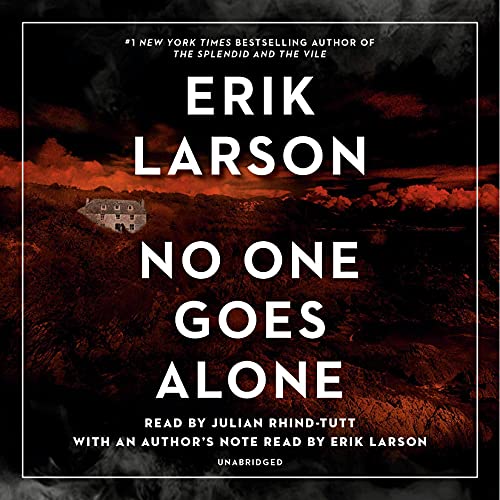
 No One Goes Alone
 by
Erik Larson Narrator: Julian Rhind-Tutt Format: audiobook Source: supplied by publisher via Libro.fm Formats available: audiobook
Genres: horror,
mystery,
paranormal,
suspense Length: 7 hours and 35 minutes
Published by Random House Audio Publishing Group on September 28, 2021
Purchasing Info: Author's Website,
Publisher's Website,
Amazon,
Barnes & Noble,
Kobo,
Bookshop.org,
Better World Books Goodreads From New York Times best-selling author Erik Larson comes his first venture into fiction, an otherworldly tale of intrigue and the impossible that marshals his trademark approach to nonfiction to create something new: a ghost story thoroughly grounded in history.
Pioneering psychologist William James leads an expedition to a remote isle in search of answers after a family inexplicably vanishes. Was the cause rooted in the physical world...or were there forces more paranormal and sinister at work? Available only on audio, because as Larson says, ghost stories are best told aloud.
A group of researchers sets sail for the Isle of Dorn in the North Atlantic in 1905 to explore the cause of several mysterious disappearances, most notably a family of four who vanished without a trace after a week-long holiday on the island. Led by Professor James, a prominent member of the Society for Psychical Research, they begin to explore the island’s sole cottage and surrounding landscape in search of a logical explanation.
The idyllic setting belies an undercurrent of danger and treachery, with raging storms and unnerving discoveries adding to the sense of menace. As increasingly unexplainable events unfold, the now-stranded investigators are unsure whether they can trust their own eyes, their instincts, one another - or even themselves.
Erik Larson has written a terrifying tale of suspense, underpinned with actual people and events. Created specifically to entertain audio listeners, this eerie blend of the ghostly and the real will keep listeners captivated till the blood-chilling end.
Featuring Erik Larson reading his Notes for a Narrator.
My Review:
This is a ghost story. Actually, it’s not, because there’s no ghost. No one has ever reported seeing an actual ghost on spooky, creepy, isolated Dorn Island. Oodles of disappearances and other strange phenomena have been recorded, but there has been a singular lack of actual ghosties in a place that even the Society for Psychical Research has flagged as being haunted.
Maybe it’s the humans who occasionally visit who bring the hauntings with them. After all, they certainly bring enough emotional baggage along to conceal any number of ghosts.
That learned society, however, isn’t interested in mere speculation – although they certainly have plenty of that documented in their archives. The Society is looking for proof, for scientific evidence obtained by scientific methods, that will either prove beyond most shadows of doubt that psychic phenomena – including ghosts – are real, or that they are unequivocally not.
A party of researchers, led by pioneering psychologist William James, embarked for the tiny Island of Dorn off the coast of England in 1905. The reader, or in this case listener, follows along in their wake through the eyes of Julian Frost, an up-and-coming engineer in the British Post Office for his expertise with the new wireless telegraphy pioneered by Guglielmo Marconi. The party and the Society entertain some hopes that the sensitive apparatus that pulls telegraph signals from thin air might also manage to record psychic emanations the same way.
As we listen to Frost reading his diary long after the events chronicled within have come to their eerie, deadly, fever dream of a conclusion, we’re right there with this eccentric and increasingly fractious group of confirmed skeptics, reluctant believers, and as it turns out, unwitting experimental subjects and eventual signers of the Official Secrets Act regarding the tale that Frost is telling us much, much later – even though he knows he shouldn’t be revealing anything at all.
Whether this story tells a truth still behind lock and key, or is merely the fevered imaginings of a young man thwarted in love by not one but two beautiful women while the rest of the company looks on and laughs at his frequent humiliation is a question that will haunt the reader long after Frost’s furtive account has come to its surprising end.
Escape Rating B: I need to get this part out of the way because it’s the thing that drove me utterly BANANAS while I was listening to this story. No One Goes Alone was an audio original when it was published three years ago, because the author believes that ghost stories are best when told rather than read. YMMV may vary on that.
Howsomever, it’s been three years. I confess that I fully expected that at some point in those intervening years a text would have been published. My expectation was in error. There is no text. Still. Hence the bananas.
When I began the story, I was sucked right in and couldn’t wait to find out not just whodunnit but how and why it was done. The dramatic tension began on a very low simmer but kept building bit by bit as the water got hotter – so to speak – and an entire, literal rain of frogs started to overheat.
BUUUUT, there’s no text. So I couldn’t just read it quickly – it’s not that long even in audio – and I absolutely could not thumb to the end to get my curiosity assuaged. I got VERY frustrated with the whole thing but I HAD to know. (Now that I do know, I know that if I had flipped to the end it wouldn’t have made sense – but even that would have been informative in its way.)
Which doesn’t mean that I had to enjoy every scrap of that journey towards that knowing.
The story of No One Goes Alone is a very slow-building story, both because of the ponderousness of the early 20th century manners of polite speech and because it’s a story mostly told rather than shown, possibly because of the nature of the way it is told, through the reading of a diary rather than as it is happening before the diary writer’s eyes.
Also, while the narrator did a good job mimicking those slow speech patterns and differentiating between the members of this mixed party, American and British, male and female, young and middle-aged, the narration itself was a bit ponderous. To the point where, even though I normally listen to audiobooks specifically FOR the voice acting, this was a rare audiobook that worked better at 1.1x speed.
At first, the story had a bit of the flavor of Agatha Christie’s And Then There Were None, even though the cast of characters didn’t have anything like the right mix of seething resentments and hatreds to make that plot work without an outside force.
When the penny finally dropped, I realized what this story reminded me of very much was the Ishmael Jones series by Simon R. Green – hence yesterday’s review. Obviously not in the tone of the characters, as Green’s snark would not have played well or fit AT ALL coming from Julian Frost’s pen, but rather in the way that the story worked and the way that the ending came out of a deep left field that subverts the haunted house genre, pulls in elements that are totally unexpected, and does its damndest to make the story part of something bigger, more horrific and considerably more complicated all the way around.
In the Ishmael Jones series, that sharp turn into the even weirder works because the premise of the entire series comes out of that weird – that Jones is an alien masquerading as human and therefore has some superhuman talents and outside of the box enemies.
In No One Goes Alone, this claustrophobic haunted house story is connected instead to a greater, but more amorphous and less defined evil in a way that I’m not sure worked – at least not for this reader – leaving the conclusion to the story plenty chilling but not nearly as cathartic or as much of a resolution as I expected.
Your reading mileage, of course, may vary.

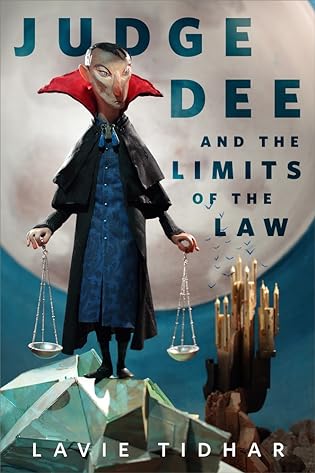 Judge Dee and the Limits of the Law (Judge Dee, #1) by Lavie Tidhar
  What makes the story fun – more than fun enough that I’ll be picking up the next story the next time I need something short to tide me over an overcommitted calendar – is the first person perspective of poor, put upon, Jonathan. He’s snarky, he’s both world-weary and vampire-weary, but he’s always aware of the side on which his bread is buttered – when he can get any, that is. So his commentary covers the Judge, the law he administers, his opinions and predilections, but also the companionship they provide each other.
 The House on Widows Hill (Ishmael Jones #9) by
  The House on Widows Hill is more of a twist on the typical English country house mystery than even Ishmael Jones and his partner Penny Belcourt usually have to contend with.
 Someone in the ‘Organization’ is considering buying the place – or that’s what Ishmael and Penny are told, anyway. That night is a ‘one-night-only’ invitation to not just Ishmael and Penny as representatives of the potential buyer, but also to a whole team of “ghost botherers” (as Ishmael calls them) who have been begging – for years it seems – to get inside the old haunt. Along with one intrepid reporter who represents the family that owns the creepy pile – and really would like to get shed of the place once and for all.
 Escape Rating A-: I normally save this series for around Halloween, but I’m in the midst of a reading quandary that I hoped this book would solve – or at least beat back for a couple of days. I’m in the middle of listening to Erik Larson’s
  The House on Widows Hill very much has the classic haunted house vibe going on – even though with Ishmael and Penny involved the reader begins the story aware that it just isn’t going to go to any of the places that haunted houses normally go. That Ishmael gets shaken out of some of his internal certainties and securities added a bit to the ongoing arc of the series while at the same time ramping up the tension of both this book and the books in the series yet to come.
 The Holy Terrors (A Holy Terrors mystery) by
  Escape Rating B-: I ended up with a LOT of mixed feelings about this one, some of which may have to do with having no love or even liking for so-called reality TV. (Although, honestly, if the author has any love for that genre it’s a particularly twisted version of it.)
 It niggled at me through the whole book as something familiar, but I was caught up just enough in the mystery at hand and the bell didn’t ring until AFTER I finished the book. Because that phrase, in popular parlance in British in the 1930s,
  The Night Island (The Lost Night Files, #2) by
  All of
  Escape Rating A-: The thing about the ‘Jayneverse’ is that everything connects up – EVENTUALLY. Howsomever, that doesn’t stop a reader from jumping in pretty much anywhere and getting sucked right in.
  Night Train to Murder (Ishmael Jones #8) by
  Because one of the things that this series does so very well, and with so much high-quality snark and occasional sheer bloody-mindedness, is that the worst monsters in this or any other universe are inevitably human. And that’s what keeps me coming back to this series, over and over and over again.
 Bad Blood (Goddess with a Blade, 7) by
  Getting back to Rowan, however, there’s an element of each book in the series where Rowan begins the story in the process of dealing with the fallout from the last clusterfuck she had to fix. And that’s certainly true in Bad Blood.
 Escape Rating A: I have a soft spot in my heart for the entire
 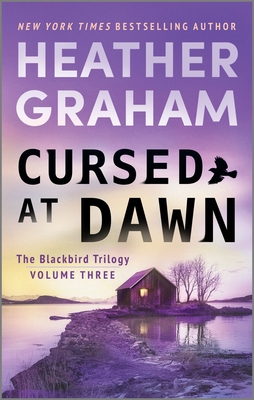 Cursed at Dawn: A Novel (The Blackbird Trilogy, 3) by
  When the series began in
  Escape Rating A-: I’ve enjoyed the entire
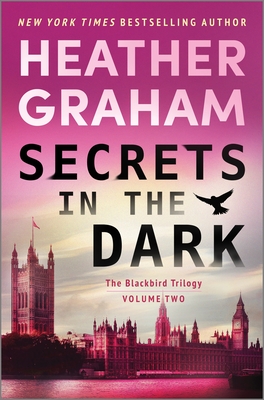 Secrets in the Dark: A Novel (The Blackbird Trilogy, 2) by
  In the first riveting book in the Blackbird trilogy,
  But the Ripper King of the
  The Only Purple House in Town by
  Iris Collins is at the end of her rope – and the knot she’s tied in that rope seems to be slipping through her fingers. And just at the point where all of her choices seem to range from bad to worse the universe throws her a lifeline. Ironic that, as the lifeline is the direct result of a death in her family. Her Great-Aunt Gertie has died and left her a charming but slightly dilapidated house in witch-friendly St. Claire, Illinois. All Iris has to do is get herself there, sign some papers, and she’ll have a rent-free place to live and a fresh start in a life that could seriously use one.
 Because there’s a wicked witch (even if she isn’t REALLY a witch) trying to run them out of town with an attack of flying monkeys (in the person of government bureaucracy and officialdom) who doesn’t want paranormal creatures in her perfectly normal little town.
 The story has a lot of the same cozy fantasy vibes – just with a paranormal twist – as Travis Baldree’s marvelous